Pahdo Labs: How does the UGC gaming platform led by a16z interpret "AI+Web3"?


Author: Luccy, BlockBeats
Editor: Jaleel, BlockBeats
"Oh, my first encounter with cryptocurrency was because I started playing Axie Infinity."
Many people, when talking about their experience entering the industry, will say that understanding the metaverse or cryptocurrency through GameFi seems to be a common approach. Without a doubt, in this field, Web3 games are one of the most exciting categories, and they are an important way for people to understand technology and its functions.
With the continuous development of GameFi, our understanding of the metaverse will also continue to improve, and GameFi is undoubtedly the window to the metaverse. Since the creation of the "metaverse" in the 1990s, there have been many discussions about the "metaverse", especially during the popular period, after Facebook was renamed Meta. The popular movie "Ready Player One" in 2018 also attracted many people's attention to the metaverse in the Web2 world.
In a project analysis report obtained by the encryption industry during the period of May to August 2022, it was pointed out that from the perspective of investment direction, funds in the market are more willing to invest in application layer projects mainly focused on games and NFTs during bear markets. In this bear market phase, a16z has once again turned its attention to the metaverse market and led the investment in Pahdo Labs, a metaverse platform development studio, on September 12th.
Related reading: "Unveiling the bear market investment preferences of the primary market: games, NFTs, and metaverse."
According to the official statement from Pahdo Labs, this is their Series A funding round with a total funding amount of $15 million. In addition to lead investor a16z, other participants include Pear VC, BoxGroup, Long Journey Ventures, Neo, and Global Founders Capital. The company also raised $2.5 million in seed funding from angel investors such as Kevin Hartz, Mark Pincus, and Cyan Banister. Currently, Pahdo Labs is preparing to launch a virtual world game called Halcyon Zero, which is built by players.
Why does Pahdo Labs want to do UGC?
One of the major features of Web3 is "immutable ownership", which is almost tailor-made for user-generated content (UGC) creators in the gaming industry. Jonathan Lai, a general partner at a16z, has said: "My personal assumption about Web3 is that in the long run, it will actually become a part of every game."
Due to the fact that the number of Web3 users is much smaller than that of Web2, projects should try their best to convert users into creators, increase user stickiness to the project, establish a consensus to hold onto NFTs or tokens without selling them. In Web2, players cannot determine that their user-generated content (UGC) belongs to them as a digital asset, nor can they automatically share profits based on contracts. Web3 transforms creators' UGC works into digital assets in Web3 games through NFTs, which have copyrights and can be shared. As long as the work is good, there is no fear of not making money, so Web3 projects should lean towards the UGC model.
Related reading: "Web3 Metaverse Outlook (Part 2) - Exploring the Current Status of User-Generated Content (UCG) Sector".
Pahdo Labs' plan is to create anime-style role-playing games and UGC platforms, which is one of the reasons why a16z chose Pahdo Labs.
a16z's $600 million gaming fund
As we all know, the famous venture capital firm a16z has a dedicated gaming fund of $600 million and a cryptocurrency fund of $4.5 billion. After a decade of preparation, a16z launched its first gaming fund, Games Fund One, in May of last year. Games Fund One firmly believes that games will play a key role in defining the way we socialize, entertain, and work in the next century, and believes that the gaming industry itself is worth $300 billion in the long run.
Games Fund One has three main investment themes. The first is game studios, where they believe the best games today are constantly updated online services, where players become an integral part of the game through multiplayer and UGC. These "games as a service" have become rich interactive social networks, and the friendships players build in the game are as meaningful as face-to-face friendships. As games become the primary way people spend their time, Games Fund One believes that some of the most innovative consumer companies will be built around player communities, so they invest in games x consumers.
The last one is infrastructure. As games evolve into virtual worlds and online services, the demand for tools and services to build excellent games is increasing rapidly. This infrastructure is not only important for the games themselves, but Games Fund One also believes that the upcoming metaverse will be built by game companies using game technology. From content creation to multiplayer game support, to virtual economy management and real-time operations, the gaming industry has solved many of the problems needed to create the metaverse.
Andrew Chen, the manager of Games Fund One, commented on the fund's 2022 fundraising deck, saying, "If I were writing this deck today and discussing why it's the right time to invest, I would definitely mention 'AIAIAIAI' and make AI a new investment theme."
According to a16z, software and tools built for gaming will become building blocks for the metaverse. Andrew claims that Games Fund One focused mainly on game studios, Web3, and infrastructure last year, and will continue to do so this year, but is now shifting its focus to the field of artificial intelligence. In addition, Games Fund One encountered more than 100 AI x Games companies in just the first quarter, and by 2023, 80% of the fund's investments in gaming will have a significant artificial intelligence component - reshaping core gameplay or creating tools.
Related reading: "Interpreting a16z: $600 million game fund raising Deck, what makes games attractive?"
Last November, Createra, a metaverse project led by a16z, positioned itself as a "UGC game platform with over 30 million game players/pixel content creators." Createra aims to build a community-managed "metropolis" where players can explore different types of game worlds or artworks created by creators, and creators can use the tools provided by Createra for creation and sell them on its marketplace.
Related reading: "Createra: Free Mint up to 1.75 ETH, new metaverse land led by a16z."
According to its official disclosure, Createra has accumulated nearly 15 million Z-generation users and 500,000 creators in Asia. Its development focus is mainly on the Z-generation, and in the project, Genesis land is the main core asset, which will determine the allocation of subsequent rewards and assets as well as exposure opportunities in Createra.
In March of this year, a16z led the investment in CCP Games to develop a new AAA game based on the EVE universe. Since 2018, 50 million EVE players have created over 276 billion items, and the EVE community has established a rich ecosystem of third-party tools and applications supported by APIs.
Using Godot to create UGC
Pahdo Labs founder Daniel Zou said in an interview with GamesBeat that his goal is to allow players to use AI tools and program generation to build their own virtual worlds, completely changing the anime RPG genre.
Pahdo Labs prioritizes player creativity, making user-created maps and game modes an integral part of the story and overall player experience. The developers hope to reduce barriers to creating visually stunning anime-style worlds through AI tools and procedural generation. Therefore, Halcyon Zero chose the Godot engine, which is simpler compared to UE and Unity, and games created with it can run as long as the files are compliant.
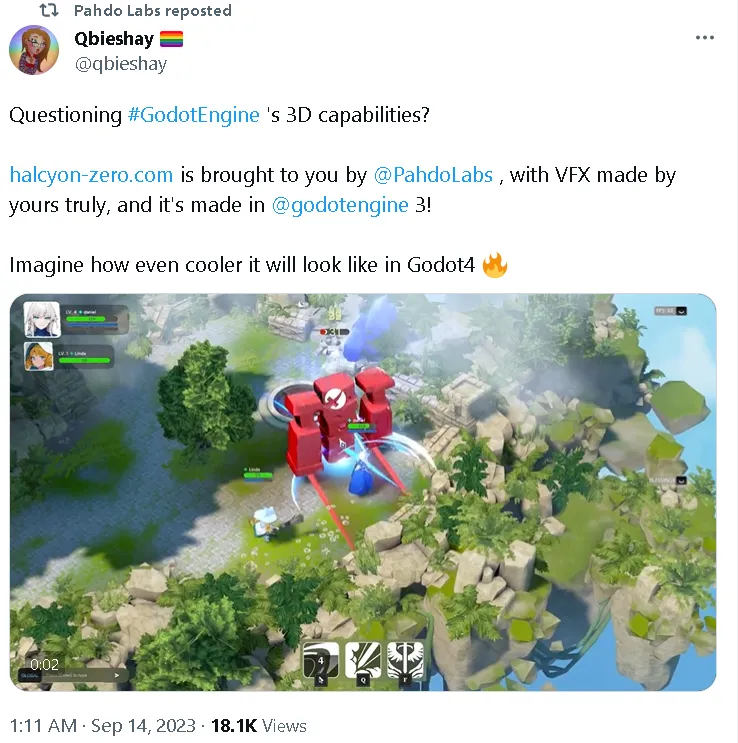
Godot is a multi-platform 2D and 3D free and open-source game engine developed by thousands of contributors from around the world. Users can download and use it for personal, non-profit, commercial, or any other purposes for free, and can also freely modify, distribute, redistribute, and remix it for non-commercial or commercial purposes. With Godot, users can develop various types of games on any platform without any usage restrictions.
Godot Engine provides a comprehensive set of common tools that allow users to focus on game development without having to reinvent the wheel. Games can be exported to multiple platforms with just one click, including major desktop platforms (Linux, macOS, Windows), mobile platforms (Android, iOS), as well as web-based platforms and consoles.
Godot has object-oriented design at its core, with a flexible scene system and node hierarchy, aiming to break away from strict programming paradigms and provide an intuitive way to build games. On one hand, like nested prefabs, users can aggregate scenes, for example, placing characters into levels and then dragging scenes as their children. These scenes can be weapons, characters, items, doors, levels, parts of levels, and can be inherited for use.
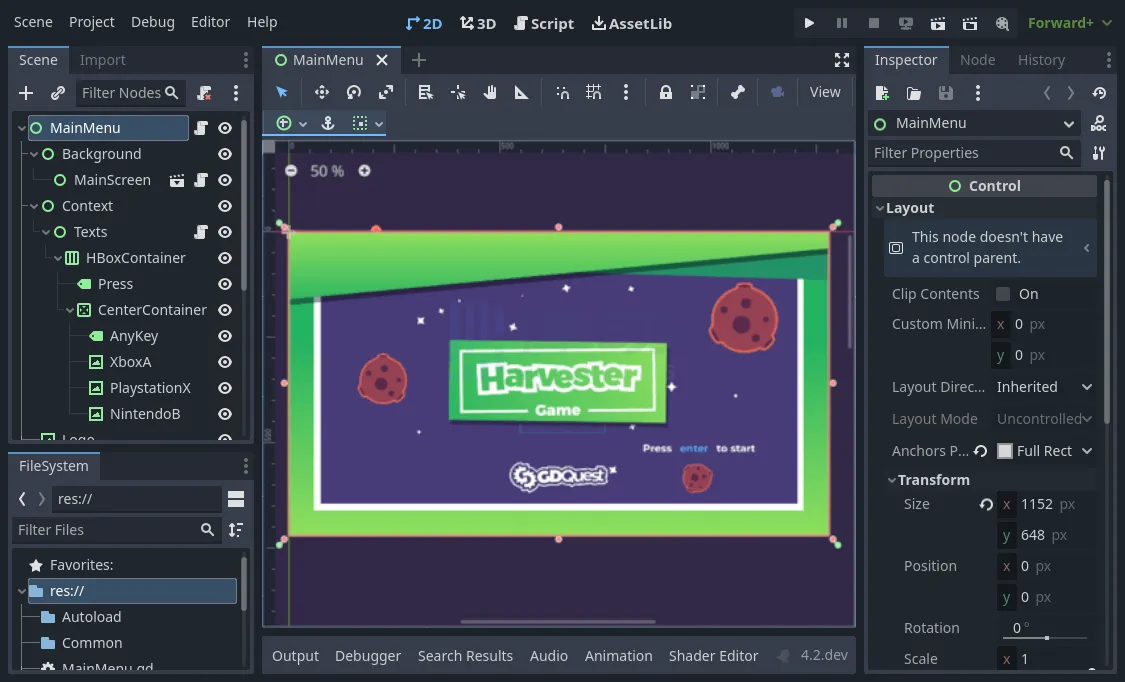
Godot Engine's scene design page, image source: Godot Engine documentation
On the other hand, Godot is different from other 3D engines in that it can inherit and extend these scenes. Users can create a magician and expand it into other characters. When modifying a character in the editor, the magician will also update, building the project to match the structure of the game design. Godot's nodes do not work like components in some other game engines, but provide many different types of nodes, most of which work independently of each other. Nodes are part of a tree and always inherit from the Node class of their parent.

Source of the image: Godot Engine Documentation
Godot has a dedicated script workspace, an animation editor, a tile map editor, a shader editor, a debugger, an analyzer, and the ability for hot reloading on local and remote devices, with the goal of providing a complete game development package and a continuous user experience. This is also part of the reason why Godot offers its own programming language, GDScript, and C#.
GDScript is designed to meet the needs of game developers and designers, and is tightly integrated into the engine and editor. It allows users to write code using an indentation-based syntax, but it can detect types and provide the quality of automatic completion of static languages. It also optimizes game code with built-in types such as vectors and colors. With GDExtension, users can write high-performance code using compiled languages such as C, C++, Rust, or Python without having to recompile the engine.
In terms of rendering, the 3D workspace has fewer tools than the 2D workspace, and users need external programs or add-ons to edit terrain, set animations for complex characters, etc. Godot also provides a complete API to use game code to extend the functionality of the editor.
Why is a16z optimistic about Pahdo Labs?
Jonathan Lai said that a16z has long been paying attention to anime topics and believes that the influence and impact of anime categories have exploded globally. In addition, Jonathan Lai's analysis pointed out that 69% of Generation Z and half of Netflix subscribers watch anime, and anime games generated approximately $17 billion in revenue in 2022, accounting for nearly 20% of total mobile gaming industry spending.
Pahdo Labs plans to democratize anime game creation starting with their first IP, Halcyon Zero. Jonathan Lai, General Partner at A16Z GAMES, said, "Pahdo's execution speed has left a deep impression on us, and we believe the team has the ability to provide an incredible next-generation anime RPG platform."
Pahdo Labs and its team
In 2021, a group of game developers interested in anime and action role-playing games met through the internet. They hit it off and some even quit their day jobs to move to New York and work tirelessly on developing multiplayer video games. Daniel Zou was one of them and he led this small team to establish Pahdo Labs in his apartment in Irvine, California.
Before becoming the CEO of Pahdo Labs, Daniel was dedicated to the growth team at Robinhood, helping Robinhood increase its user base from 4 million to 15 million. He also focused on cryptocurrency, recommendations, search engine optimization, international expansion, and product launches. Later, Daniel Zou went to the artificial intelligence company Anduril Industries as a software engineer. These two work experiences further deepened Daniel's interest and technology in various fields such as the metaverse and AI.
When establishing early communities, Pahdo Labs, like other game studios, attracted millions of views by showcasing the early independent game development process and the lives of these young game developers in their New York office on TikTok. As a result, the niche market for games continued to grow, attracting audiences in the early stages of game development.
Actually, Daniel's choice of the gaming industry was not accidental. His growth experience was full of various online role-playing games, such as "MapleStory", "Runescape" and "Mabinogi". The online virtual world provided Daniel with a sense of agency, friendship, and purpose. Therefore, Daniel spent all his time making his own games, which sparked his early interest in technology and computer science, and the early members of his team were also passionate players of Japanese-style role-playing games, fighting games, and independent adventure games.
In 2021, Pahdo Labs developed a 4-player action role-playing game inspired by their favorite action game.
"Creating a world where players have the power to create things of eternal value" - this is the vision of Pahdo Labs. For Daniel, eternal value means lifelong memories and a sense of pride that comes from creating and releasing creations into the world. That's why he founded Pahdo Labs, to ensure that the next generation can have similar rich and beneficial online social and creative experiences.
Afterwards, Pahdo Labs hired 21 full-time international employees in New York, Vancouver, Korea, Berlin, and other locations. This was a collaboration between Boston and Silicon Valley technical personnel and industry veterans from Riot Games, Capcom, and Electronic Arts. Over the past three years, Pahdo Labs has been both challenging and rewarding for the team, and team members have made a lofty commitment to continue bringing the vision to players.
Halcyon Zero
Halcyon Zero is an isometric anime-style fantasy role-playing game and online game creation platform built on the Godot engine. The game takes place in an ethereal fantasy world centered around a bustling town that serves as a social hub. In the town, players can band together to explore the chaotic wilderness, challenge anime-style bosses, and uncover the secrets behind the chaos.
Halcyon Zero will be designed as a free game, and the official stated that it will mainly monetize through cosmetic microtransactions. Blockbeats reminds that due to the unstable monetization path of current blockchain games, the development cycle of large-scale games is longer and more complex, and has higher risks. Moreover, Halcyon Zero is still in the game testing application stage, so it is recommended that users conduct sufficient research and understanding of its built-in economic model before participating in blockchain games.
Welcome to join the official BlockBeats community:
Telegram Subscription Group: https://t.me/theblockbeats
Telegram Discussion Group: https://t.me/BlockBeats_App
Official Twitter Account: https://twitter.com/BlockBeatsAsia

 Related Articles