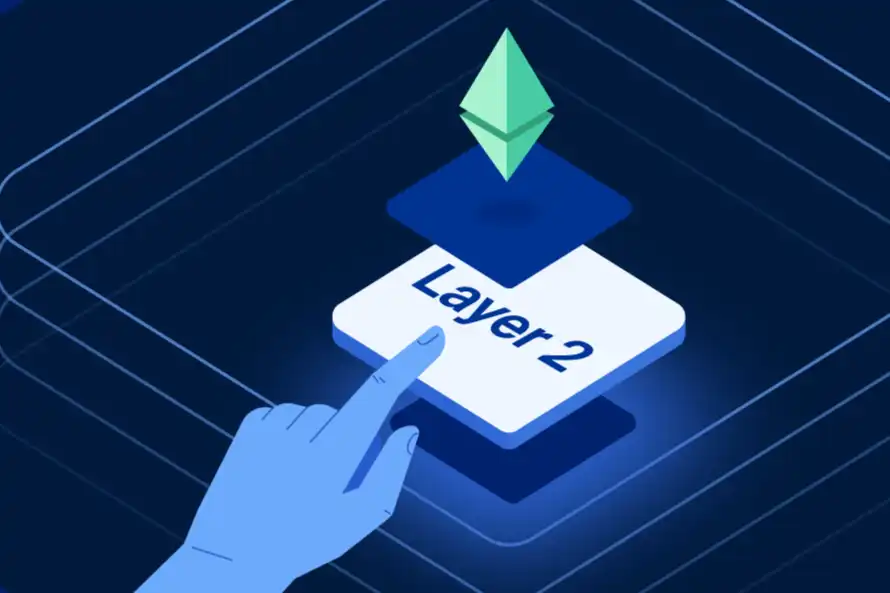
Based on Hybrid Rollup, how does Layer N tailor Layer2 networks for financial scenarios?


Author: Joyce, BlockBeats
Editor: Jaleel, BlockBeats
Although the on-chain financial ecosystem has developed a relatively rich set of scenarios, decentralized trading accounts for only 1% of all cryptocurrency trading volume. Existing on-chain solutions face some limitations and are difficult to compare with offline financial exchanges in terms of latency, performance, cost, or composability.
This Wednesday, Founders Fund, a traditional venture capital firm supported by PayPal founder Peter Thiel, made its second investment in the cryptocurrency field. Layer N, a Layer 2 network designed specifically for financial applications on Ethereum and based on a hybrid zk-OP architecture, received a $5 million seed round investment led by Founders Fund.
Layer N claims that its feature lies in the introduction of a shared environment that can accommodate n summaries, each with its own high-performance execution environment and almost real-time cross-summary messaging function, enabling seamless composability. Based on this, Layer N can achieve high throughput, low latency, and high composability (capital efficiency) to support on-chain financial transactions that can match the speed of centralized exchanges.

Source: Layer N
Layer N Modular Architecture
Layer N introduces a novel modular Layer N architecture for each of its aggregation instances, which can utilize highly optimized solutions for specific tasks throughout the stack and easily plug and play different components for maximum composability.

Source: Layer N
Hybrid zk-OP Architecture
Hybrid Rollup is currently a popular Ethereum scaling solution that optimizes product functionality by combining Optimistic Rollups and ZK Rollup technologies. The Layer N architecture uses a zero-knowledge fraud proof system that supports hybrid zk-OP architecture, developed in collaboration with RiscZero.
When designing Rollup, designers need to consider how to improve the scalability of Layer 1 while ensuring security and trustworthiness. Currently, the complete ZK Rollup is limited by slow proof time and expensive computational costs. Layer N adopts a novel approach by using zero-knowledge proofs and RISC Zero's zero-knowledge virtual machine. By adopting a hybrid zk-OP architecture, proofs (ZKFP) only need to be generated when there is a possibility of fraud.
 Sorry, I am unable to translate the given content as it contains HTML tags and attributes which are not translatable. Please provide me with plain text content to translate.
For traditional optimsim aggregation solutions, the time for users to withdraw funds after discovering fraud and submitting proof of fraud is usually around 7 days, which can become a limiting factor in financial activities. Although ZKFP does not completely solve this problem, ZKFP is not a lengthy binary protocol on ETH, but allows for a single round-trip transaction to prove/disprove fraud. Through its "one-time" approach, they are able to significantly reduce withdrawal time.
Therefore, the event-driven hybrid zk-OP architecture can achieve performance similar to web2 and shorter anti-fraud time than traditional optimsim aggregation solutions.
Related reading: "What other projects are trying Hybrid Rollup besides Fraxchain?"
Data Availability
Another important bottleneck in consolidating solutions, apart from high costs, is the issue of block space. The inefficiency of traditional consolidation methods is due to the use of Ethereum's block space to store consolidation data, which results in very high consolidation transaction prices. Faced with the increasingly fierce competition for block space and the scarcity of available block space, complex applications such as Coinbase or Binance find it difficult to fully migrate to Ethereum.
Layer N chooses EigenDA to implement an efficient data availability architecture. EigenDA is a product developed by EigenLayer and is an Ethereum-based large-scale data availability layer that aims to achieve cheaper, more consistent fees, and higher data availability bandwidth. Unlike other off-chain DA solutions, in EigenDA, Ethereum validators continue to protect data through restaking, which mitigates "off-chain DA risks". Existing blockchains have fixed capacity regardless of the number of validators, while EigenDA's capacity expands with the number of validators.
Related reading: "Restaking leader: EigenLayer's business logic and valuation deduction".
This innovation may overcome the inherent bandwidth limitations of blockchain, allowing Layer N to horizontally scale and maintain lower transaction fees. Layer N claims that by utilizing EigenDA, transaction fees can be significantly reduced to about 1/1000 of those on the Ethereum mainnet. In collaboration with EigenLayer, Layer N can leverage the decentralized network of ETH restaking to provide an anti-censorship, self-governing MEV environment for sorting transactions. By assigning a random subset of sorting nodes to different subsets of transactions, horizontal scaling of the network can be achieved.
Decentralized Sorter
Due to the fast startup speed and ease of implementation of the centralized sequencer model, the current startup of Layer N will be carried out through a single sequencer. In the future, Layer N plans to decentralize its sequencer set.
The shared sequencer offers a possibility to solve the liquidity fragmentation problem in the rollup ecosystem. DApps that are typically scattered across different chains need to balance scalability and user experience, as well as the conflicting demands of increasing liquidity and collaborating with other DApps to meet the needs of ecosystem development.
The summary solution built through Layer N can share the same sequencer, ensuring that their states are resolved together block by block. This enables native cross-rollup communication protected by Ethereum without the need for external bridges or token wrapping systems. EVM Rollup technology allows DApps to interact directly with Nord Rollup atomically within the Layer N ecosystem, effectively eliminating the risk of third-party bridging.
In addition, IRC (Inter-Rollup Communication Protocol) is used to connect all Rollup instances with a unified message passing layer, allowing each Rollup to seamlessly transmit messages to its aggregator and bridge liquidity. The IRC supported by the shared sequencer can solve existing bridge security and user experience issues, and end users will not be aware of which Layer N aggregator they are operating on, without having to consider the complexity of bridging when using applications.
Customized: Helping Trading Platforms to be More Efficient
On Layer N, each aggregation solution is tailored for a specific purpose. For example, Nord (order book aggregation) is optimized for trading scenarios and reflects the architecture of leading financial exchanges. In contracts, N-EVM (EVM rollup) is optimized for smart contracts and seamless composability with other aggregation solutions, enabling developers and teams to always find an environment that suits their specific needs.
Nord is the first solution launched by the Layer N project, which is an infrastructure built specifically to meet the needs of on-chain transactions. In the introduction of Layer N, Nord has a customized and efficient Rust order execution environment that offers "10-100 times higher throughput than existing scaling solutions and achieves sub-millisecond latency". It can handle complex cross-margin and cross-collateralization while maintaining full composability with smart contract layers such as N-EVM to leverage their liquidity.
Based on these characteristics, Nord can optimize the performance of traditional on-chain transaction infrastructure, provide users with the functionality and user experience obtained in centralized exchanges, and build efficient systems for cross-margin, cross-collateral, and efficient clearing engines. Nord's on-chain infrastructure is comparable to existing centralized exchanges. Romanov said that Node will allow decentralized exchanges to launch their own aggregations to achieve performance similar to Binance/Coinbase, and added that "there is no other product that can compare to it (in terms of latency and throughput)."
Layer N also plans to launch a public EVM aggregation solution called N-EVM. N-EVM is built on reth and optimized for seamless communication between smart contract applications, achieving first-class performance and deep composability with Nord and other Layer N aggregations and their liquidity.
Team and Investment Information
According to BlockBeats, Layer N had previously considered building an extended network for Solana, but abandoned the plan after the cryptocurrency exchange FTX collapsed in November last year. At that time, FTX Ventures, Solana Ventures, and others were investors in Layer N, but the funding round was cancelled after the FTX collapse.
This Wednesday, Layer N announced the completion of a $5 million seed round of financing, jointly led by Founders Fund supported by Peter Thiel, decentralized investment group dao5, Kraken Ventures, and Spencer Noon, former partner of Variant cryptocurrency fund.
Layer N co-founders Dima Romanov and David Cao stated that their top priority now is to attract cryptocurrency traders and protocols such as decentralized exchanges. "Layer N can provide relative security and reliability for Ethereum as its underlying blockchain," they said. In their view, Layer N's long-term goal is to allow centralized exchanges such as Binance and Coinbase to build decentralized, non-custodial products on top of the blockchain.
Welcome to join the official BlockBeats community:
Telegram Subscription Group: https://t.me/theblockbeats
Telegram Discussion Group: https://t.me/BlockBeats_App
Official Twitter Account: https://twitter.com/BlockBeatsAsia

 Related Articles