ABCDE: How Particle combines zkWaaS to build an intent-centric modular access layer?

Original author: Kris, Investment Director at ABCDE Capital

Particle Network is a Web3 infrastructure aimed at improving developer efficiency and accelerating the widespread adoption of Web3. Its wallet login and wallet middleware, currently the industry's leading wallet and login middleware, are provided to achieve this goal.
Since the product was launched in late October 2022, Particle Network has onboarded hundreds of clients, including Xter.io, Hooked Protocol, ApeX, 1inch, and CyberConnect. In April 2023, Particle Network released the MPC+AA wallet solution, which provides a cross-platform SDK and forms a product matrix of MPC+EOA and MPC+AA account abstract wallets.
Particle Network is about to release its V2 product, with the theme of Intent-Centric, Modular Web3 Access Layer. In V2, Particle will provide zkWaaS (Zero-Knowledge Proof Wallet-as-a-Service) services, which mainly include two aspects:
1. Add zkp to MPC-AA to achieve private login and transactions.
2. Launched the Intent Fusion Protocol. Built intent-centric products to enhance the user experience for c-end users.
One, Particle V2 Product Architecture:

What kind of experience can V2 bring to users:
The user logged in through the application layer product enabled by Particle Network's zkWaaS (enjoying the convenience of social login while not exposing any Web2 identity privacy). V2 can meet some complex user needs, such as users hoping to allocate some ETH to the best chain available on any L1/L2 yield product and automatically cash out and deposit funds into Lido when the yield reaches a certain amount, in order to obtain risk-free returns.
Particle Network v2's Intent Fusion Protocol will focus more on users' needs and expectations, rather than just providing a series of complex features and settings. This will be achieved with minimal cognitive and operational costs to realize users' true intentions.
二、解析 intent 的设计和用户体验:
Translation:
2. Design and User Experience of Intent Parsing:
To ensure that users can freely interact in the complex Web3 world, user experience is crucial. Unlike early blockchain technology, users no longer need to understand complex technical details. The key is to provide a simple guide for users to interact with decentralized systems. In Web3, a user-friendly experience needs to be based on intent-driven interactions, including the following keywords:
1. Result-oriented: Users only need to express the results they want, without worrying about the specific implementation method.
2. Conditional Authorization: Users authorize the distribution of assets and fees only after ensuring that the results have been achieved.
3. Competitive solver: In the intent-driven world, whether on-chain or off-chain, solver competition is to implement user intentions and obtain rewards. The more intense the competition, the higher the efficiency.
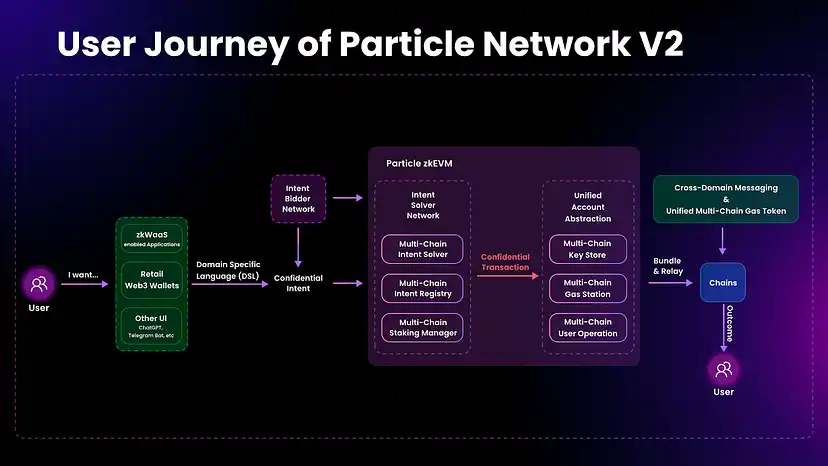
Three, the full process of user using Intent:
1. Users can send their own intent through ZKwaas, Retail Wallets, ChatGpt, Telegram Bot, etc.
2.intent uses natural language processing or template analysis to analyze the content of the intent and convert it into a standard recognizable DSL. It also provides a DApps Intent Framework for developers to easily build any user intent.
3. The confidential intent that has been encrypted and anonymized will be sent to the intent bidder network. The structured intent will be deconstructed through the intent bidder network to create optimized confidential intent objects in conjunction with on-chain and off-chain bidders.
4.Intent bidder network will send optimized intent solutions to Particle's ZKEVM. ZK EVM can solve two problems, one is the process of intent solver through the intent solver network, and the other is the process of transaction through AA account.
· Solver identifies user intent, classifies the intent, plans the optimal path to implement the intent. Once the path is determined, Solver constructs the necessary transactions to implement the user intent and forwards them to the account abstract wallet.
· The AA wallet is responsible for executing transactions and consists of bundler and paymaster. The bundler is responsible for receiving and planning transactions sent by the solver, while the paymaster manages the gas fees associated with these transactions. The bundler simulates the wallet's validateOp method on userop to determine whether to accept or reject off-chain. Then, they send the transaction to the entry point of the AA system to call the handleOp method. This process also includes bundling multiple user operations together to optimize gas fees and extract MEV. AA accounts built by Particle can achieve one-time signature and multi-chain operations for users.
· The entry point of the AA system verifies and processes on-chain operations. It ensures that userop meets the requirements and security checks before executing the required operation. Once the operation is successfully executed, the entry point will refund ETH from the wallet's deposit to the bundler. This refund mechanism compensates for the work done by the bundler and its prepayment.
5. Finally, the intent is broken down into transactions and sent to different chains through bundle and relay. The process involves cross chain messaging and unified multi-chain gas token.
6. The user signs a confidentiality intent object, and the intent solver network executes it to provide the user with the desired results.
From the perspective of end-user experience, users only need to interact with a button or express their intent through a user interface similar to ChatGPT. Then, the structured intent will be automatically deconstructed and executed by the intent bidder and intent solver, so that users feel like they are just clicking a button or sending a message.
Four, Some innovative designs of Particle in the entire intent process are worth noting:
1.Intent Expression and Authorization:
· The way users express intent: From the perspective of end-user experience, users only need to interact with buttons or express their intentions through user interfaces similar to ChatGPT.
· Users can express what type and level of intent.
4.Solver Network :
· How to check if the solver has completed the task? How do users and solvers settle accounts?
5. How to verify if the intent is completed?
6. How to ensure the privacy of intent?
· Through IntentVM, a unified Intent Mempool is implemented to pass structured confidential Intent objects to the resolving program for transaction establishment and execution.
Five, Particle's intent and differentiation from other companies, as well as advantages:
There are already many projects researching intent and adopting different solutions in the encryption industry. Solutions such as Cow Swap, 1inch Fusion, UniswapX, Anoma, and Flashbots' SUAVE have made some progress in this area, with slightly different deployment methods and focuses. A unified "General Intent Fusion Protocol" is still needed to simplify the operations of developers and users.
For more general intents, a relatively new architecture is needed, including a new intent language and a new VM. Particle is already the leader of AA Wallet, with a large customer base and B-side business, and the wallet is the closest step to the user. Particle has a unique advantage in intent. In addition, Particle's intent fusion layer will also adopt an open attitude, allowing other wallets and third-party dapps to access (share intent pool), and is expected to have a significant first-mover advantage in the intent market.
· Particle intent's modular stack:
We have noticed that the Web3 industry has undergone significant evolution in terms of content supply. The breakthrough lies in improving user interaction and transaction efficiency. Particle Network's intent-based Web3 modular access layer can accelerate Web3's transition from an engineer-friendly financial industry to a consumer-level industry.

Sixth, Privacy Transactions:
Privacy transactions are divided into two parts:
1. How does Particle ensure the privacy of user web2 identities?
2. How does Particle ensure the privacy of user on-chain addresses and transactions?
Web2 Identity Privacy:
Privacy transactions are an important milestone in breaking the circle of web3 wallets. If a user wants to buy a cup of coffee or receive wages on the chain, etc., if these transactions are public, it will greatly hinder the widespread use of web3 by users. Efficient implementation of privacy transactions will become a breakthrough for web3 to break the circle and gain more new users.
Particle v2 has added zkp on the basis of the original mpc aa, which realizes the privacy of user identity and allows users to hide their web2 identity during the login process. This ensures that the login identity cannot be associated with the wallet address, thus achieving private login.
In this regard, the industry has conducted extensive exploration in areas such as ZK DID, Holonym, Polygon ID, and Chainlink's CanDID. By combining ZK, MPC, and Oracle, it is possible to achieve the Web3 transformation of any Web2 credential in a sense. In this way, users only need to ensure the security of their Web3 credentials and generate corresponding ZK proofs when using them, which can be verified on-chain and off-chain.
However, the challenges faced by Particle's zkWaaS are not only the generation and management of credentials, but also balancing user experience.
Particle does not want users to sacrifice the frictionless Web2 experience, so it combines TEE to introduce fast mode, while also supporting familiar but non-credential-based login functions for users, such as email and phone.
In Particle's design, users create wallets in quick mode (note that even in quick mode, users do not sacrifice any privacy), and then the silently generated Web3 credentials will be persisted. Of course, users will not have any additional cognitive load during this process; zkWaaS will gradually help users manage their Web3 credentials during their operations.
In short, zkWaaS can ensure user login privacy, help users generate and manage Web3 credentials, and will not affect the user experience.
The developer experience is also straightforward. Compared to WaaS, the new design also takes on the management of user data, not just providing signature functionality.
This is the future responsibility of any Web3 wallet or wallet infrastructure, expanding from private key and MPC fragment management to broader user Web3 data management.

Web3 Privacy Address:
Particle adopts Vitalik's design for stealth address, which can be seen here. Each transfer generates a temporary private account address. However, if the temporary private account does not have gas, it will not be able to send funds. The AA account can solve this problem.
As a solution, Particle has designed intelligent stealth addresses. User interactions will be conducted through intelligent stealth accounts, cleverly solving gas station problems.

In short, zkWaaS solves the privacy issues for both off-chain and on-chain users through confidentiality authentication and confidential transactions. Additionally, it maintains complete user control and regulatory friendliness while achieving this goal. This lays a true foundation for the large-scale application of Web3.
This perfectly fits into the larger theme of promoting seamless integration of Web2 users without compromising privacy or security, thus achieving the dual tasks of user-friendliness and privacy protection. It indicates that building a secure and user-friendly Web3 infrastructure is entirely feasible, laying the foundation for wider public participation in decentralized networks.
Original Link
Welcome to join the official BlockBeats community:
Telegram Subscription Group: https://t.me/theblockbeats
Telegram Discussion Group: https://t.me/BlockBeats_App
Official Twitter Account: https://twitter.com/BlockBeatsAsia

 Related Articles