Vitalik Buterin's speech at Nanyang Technological University: "The Past and Present of Ethereum"

Original source: DeThings
Original translation: fanfan
Editor's note: This article is the keynote speech delivered by Ethereum co-founder Vitalik Buterin at Nanyang Technological University in Singapore on September 6. Unlike his speech at KBW (Korea Blockchain Week) on September 5, which focused on "Challenges and Solutions Facing Ethereum", Vitalik's speech this time was more macro, with the theme of "The Past and Present of Ethereum". He talked about the birth of Ethereum, from the vision to the implementation of "smart contracts", to the transformation of Ethereum's "consensus mechanism", these milestones destined to be recorded in the history of blockchain were told by him. Respected as "V God" by the Chinese blockchain world, he seems to always be dressed in T-shirts, shorts, and sneakers. The new crypto world has gone through several cycles, and countless people have risen and fallen, but this trail walker has never stopped.
Here is the full speech:
The Birth of Ethereum
Today I'm going to go over the history of Ethereum, starting with the beginnings in 2013 and 2014, and some of the changes that the project has gone through since then, and how the way we think about some problems is different from 5 or 10 years ago.
We released the Ethereum white paper in 2014, and it basically described our original vision for Ethereum. But the basic ideas behind some of these theories were not explained in detail in the white paper. Ethereum is a decentralized system, similar to Bitcoin. It is a blockchain, but unlike previous systems that tried to support only one application, Ethereum allows users to build their own applications. This means that users can write their own application code, then upload the code to the blockchain, and then the application can run on the blockchain.
At the beginning of the white paper, I mentioned some ideas that others had proposed, and one of the ideas that I started to think about was to issue your own asset on top of Bitcoin. Today, on Ethereum, we have ERC-20 tokens, but back then we had Colored Coins, which was an early attempt to issue your own assets on top of Bitcoin. Interestingly, recently a specific version of Colored Coins was introduced to the Bitcoin protocol, so there seems to be a renewed interest in Colored Coins, but Colored Coins was just one application. You could use it to represent ownership of physical objects, which was called smart property at the time. You could also have other types of assets, like domain names, and you could build a system on the blockchain for registering websites, registering usernames, tracking names of users and application reviews, and so on.
Smart Contracts
You can implement all of this in a distributed way on the blockchain. The concept of smart contracts is that you can have computer programs on the blockchain that can directly control digital assets. An asset does not have to be owned by an individual, it can be owned by a program. This concept of smart contracts can be used to implement many more complex applications. For example, you can have prediction markets, financial instruments, such as stablecoins and leverage, and so on. All of these different things can be defined by smart contracts. In addition, there is the concept of DAO, which is basically using smart contracts to implement the voting or governance logic of the entire organization on the blockchain. You don’t need to rely on the legal system to resolve disputes within the organization. You can vote directly at a very low cost.
So many of these concepts in terms of applications have been around to this day and are still evolving. We had Colored Coins before, and now we have ERC-20 tokens. We had smart property before, although there has not been much progress, but we have the on-chain domain name system (ENS), which many people are using, such as my blog has been uploaded and may be accessible through ENS. If you use an Ethereum-enabled browser like Brave, just type in eth.link and you'll get to the frontend of my blog.
These are the tools that can be used, and they involve smart contracts and DAOs. There are all kinds of DAOs around the world that are using all kinds of different logic. While they haven't really been adopted on a large scale outside of the ecosystem to date, they do exist and some have been operating for years. These are some of the applications that we're seeing right now. Obviously, there are other applications that are popping up, and some that surprise me. For example, NFTs (non-fungible tokens) are one example. But a lot of other things that exist today are basically very similar to what we thought about 10 years ago. The same is true for consensus research. Today, Ethereum has finally become a consensus chain. Consensus has greatly improved security and reduced Ethereum's energy consumption by more than 99.9%. Previously called "merging", before that, Ethereum's energy consumption was almost 40% of Singapore's, and now it's been reduced to almost zero. So the state transition is finally completed, but it's the result of almost 10 years of work in the ecosystem. The first five years of state proofs were essentially research, where we tried to understand the nature of state proofs, and the various options for different state spaces, and eventually converged to a specific version that actually worked.
The shift to “consensus mechanism”
In a 2015 blog post, we described a mechanism, called a “consensus mechanism,” that tried to encourage validators to send a series of messages expressing confidence in a particular block height to reach consensus more efficiently. Later, we discovered that our consensus mechanism had a lot of problems, it was overly complex, and was actually not as simple and effective as the Casper protocol that later evolved into it. But it was a step forward in our understanding of this space more deeply.
In fact, in 2018, I posted a series of tweets that reviewed the progress of Ethereum state research and how we started from initial exploration, gradually moved to state chains, and finally settled on the exact algorithm.
First it was research, and then the next four years were all about scalability. Scalability is critical to Ethereum because as of today, Ethereum can only process 10 to 20 transactions per second. In reality, it's probably between 10 and 50, depending on the complexity and size of the transaction. Now, this level of scalability is very limited, and to support mainstream finance, mainstream payments, and global systems, we need to process about 100,000 transactions per second. If you can only process 20 transactions per second, it will take 4 million seconds, about 13 years, for a million people in the world to execute a transaction on Ethereum. So improving scalability is very important.
Very early attempts to improve scalability were called "sharding," and what we're doing now is still a form of sharding, but many different things have been designed and modified into this mechanism since then. The basic idea is that traditional blockchains, like Bitcoin, require every computer in the network to process every transaction, so their scalability is limited.
We changed that design. Instead of every node processing every transaction, each node only processes a small portion of the transactions. It's like the way BitTorrent works, which works by breaking data into small chunks and allowing people to share, even though there's a lot of hot data, without requiring everyone to store the entire file. Because that would be too much data for people to handle. So the challenge is how do you do some form of history while still having a consensus system so that people can agree on the order in which things arrived so that financial systems and so on can be built on top of it. It's a technical challenge. This is one of our early concepts, sharding, where you basically split the transactions into different groups, each with its own node that processes transactions independently. It's a very complex idea. Since then, we've had to work really hard to reduce complexity. Basically, we had to work really hard to make things really simple, because we knew that what took 2 months or 2 weeks to write the spec would take 2 years to develop. If it took 6 weeks to write the spec, it would probably take 6 years to develop. We had to work really hard to reduce complexity, make a lot of sacrifices, and eventually we got close to where we are today.
Technical Progress and Challenges of Ethereum
One of the interesting things about the technical progress of Ethereum is that the things we're talking about today are very similar to the things we were talking about 6 years ago. This is a slide from an Ethereum conference, I think it was at that time, where I described some of the main problems with Ethereum, such as privacy, consensus, smart contract security, and scalability. If you ask me or anyone else what the biggest problems facing Ethereum are, you'll get basically the same answers: privacy, consensus, smart contract security, and scalability.
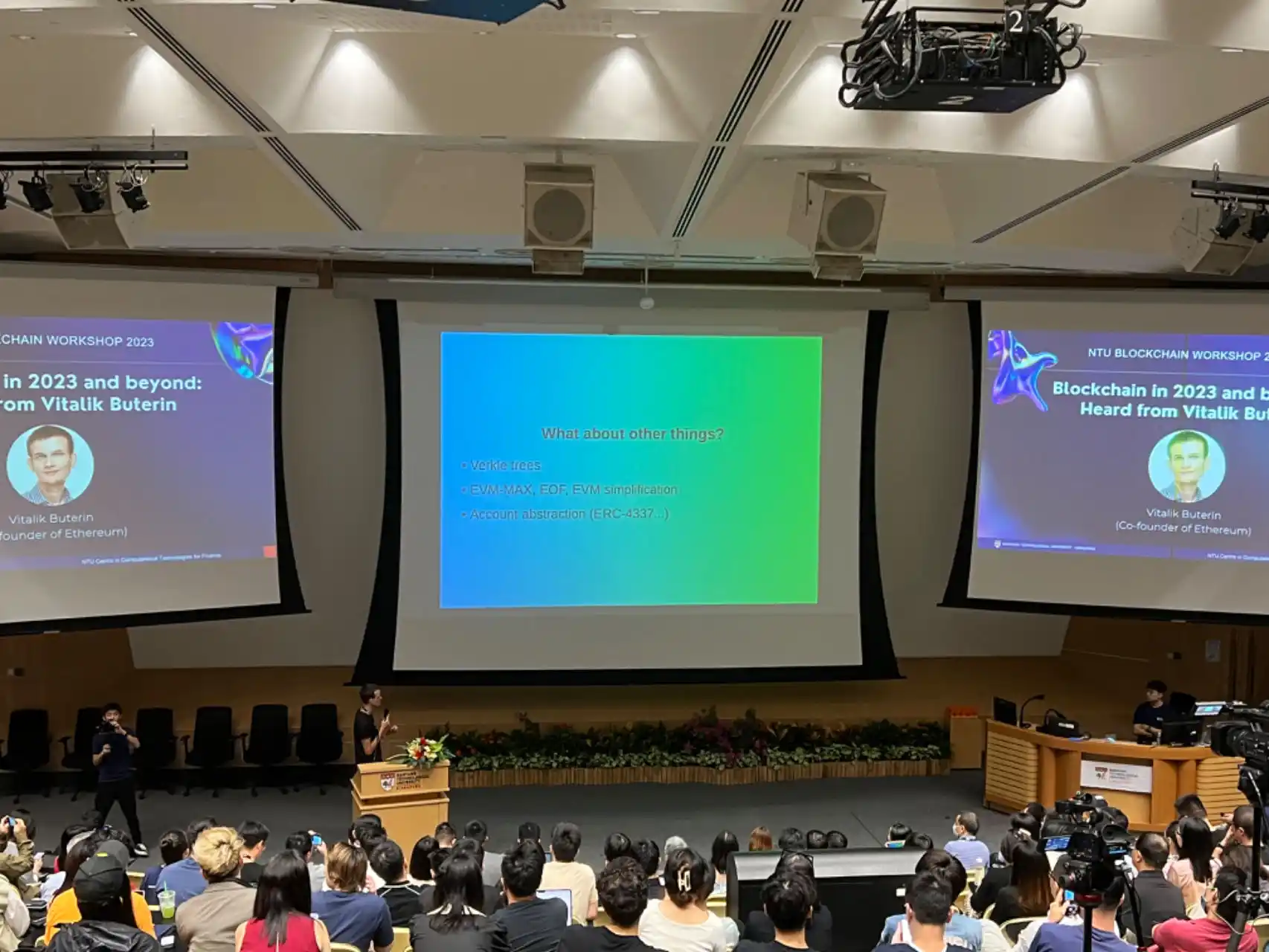
These challenges are the same today as they were 6 years ago, but at the same time, I think it's interesting to see some of the progress that's been made since 2017. For example, in 2017, privacy was just a technical challenge, and there was basically a new type of cryptography called zero-knowledge proofs, or zk-SNARKs. This allows you to create cryptographic proofs that prove certain mathematical properties, like data you have, without revealing anything else about that data. This was first used by Z.cash, a privacy-preserving cryptocurrency that launched in 2016, which used zk-SNARKs to achieve privacy. How did it do that? Basically, when you spend a coin in Z.cash, instead of pointing directly to the coin you spent, you need a proof that you're spending an unspent coin without revealing any other information about that coin. You prove the statements that need to be proved in order to have a monetary system that doesn't overinflate, but everything else remains private.
Back in 2017, the challenge was just to bring this technology to Ethereum and make zk-SNARKs work. These technologies are based on a complex mathematical theory called elliptic curve cryptography. With this technology, we basically add some overlays called "zero-knowledge statements", which are a code that enables you to use zk-SNARKs on the blockchain. So, using smart contracts, you can actually build an application with the same privacy-preserving logic on Ethereum. This was the situation in 2017. Now in 2023, the state of the art is very advanced, there are very advanced zk-SNARKs libraries, development environments, tools, protocols. We have a long list of very interesting technologies like StarK, ZK Rollup, Cairo, etc. In fact, the privacy aspect may become another bottleneck, mainly because of legal issues and issues related to whether the tokens produced by these systems are accepted by the wider financial system. For example, Tornado Cash has legal issues, which can be considered a privacy coin on top of Ethereum, because hackers used it.
So there's this concept called proof of innocence, where the goal of proof of innocence is for you to prove that your coins were sent through a privacy system, but they didn't come from one of the hackers. You prove that you're not one of the hackers without fully disclosing where the coins came from. There's actually a paper coming out soon on this idea. There's already several companies coming up with several different solutions. So there's a lot of work that needs to be done on the details to increase the likelihood that when users who use privacy systems deposit their coins into an exchange, the exchange will accept those coins without a lot of suspicion.
Also, there's work on verification and validation of zk-SNARKs to reduce the cost of verifying proofs. The goal is to make the cost of verifying proofs lower. Part of that is zk-Rollup, part of that is aggregation protocols. The difference between 2017 and 2023 is that in 2017 we were just trying to get the basic building blocks working, and in 2023, those building blocks are already working, but our focus is on optimizing those building blocks, as well as doing some of the more complex work to make it better integrated with the mainstream world. In terms of consensus security, in 2017, we were basically just done with the research part of the consensus mechanism development process and were just starting to develop. By 2023, Ethereum has completely switched to consensus mechanisms and has become a full consensus mechanism. But the challenges still include reducing the complexity of the protocol, improving the security of the protocol, solving the problem of centralization, making it easier for people to participate, and making a concept called PDS easier to participate in because there is no need to run complex algorithms to optimize returns.
In terms of smart contract security, solving smart contract security is probably the slowest of the four issues because in 2017, it was only a year after the DAO hack, which was a smart contract that controlled an investment fund of about $150 million. And it got hacked. The hacker actually tried to get away, but the Ethereum community eventually worked together to return the money to the original owners of the DAO.
That was the only time that this had happened to Ethereum, so in 2017, it was still fresh in everyone's memory. People were very concerned about this security, so everyone was working to improve the security of programming languages and make projects more secure. By 2023, a lot of this work has been successful. I think the frequency of hacks has decreased significantly. When hacks happen, it's usually because people are trying to build more complex projects, 20 times more complex than they were in 2016. If you're not building a project that's 20 times more complex than you were in 2016, it's generally pretty safe. There are a number of systems that have not been attacked in many years, which is a very impressive achievement. There have been a number of other security improvements as well.
In the months after the DAO incident, there was an incident called the "Shanghai DOS attack" where the attacker exploited a number of vulnerabilities in the Ethereum protocol itself, enabling them to send transactions that slowed down the entire blockchain. We spent a few months releasing updates basically every day. I know that hackers are finding new vulnerabilities every day, so we are constantly fighting and finding small problems. After 4 years of hard work, through a series of different changes and improvements, these security issues were finally fixed. EIP 2929 also brought a lot of improvements to the Defi codebase. The Gas optimizers have also done some amazing work. In short, a lot of security issues have actually been solved very quietly.
There was a major event called the "merge" when you switched from proof of work to proof of stake. Whereas in terms of security, there was no major event because the whole point was that there was no event. But sometimes it's important to remember that the event didn't happen, which is good news. So I think there have been real improvements in that regard, but there are still a lot of ongoing issues.
So back in 2017, sharding was just an idea. We were also talking a lot about state channels at the time, and there were adders, which were big legal solutions. And then around 2020, everyone moved to Rollups. Today, there are all kinds of Rollups, including ZK-Rollup, Optimistic Rollup, and so on. These Rollups are starting to get rid of the training wheels and become truly decentralized, and they're taking a major step in that direction. Polygon also took a big step this year. This year, we're continuing to work on decentralizing these systems, enhancing the security of the proof system, making the proof system faster so that a block that takes 5 hours to prove a block using CKDM may be reduced to 2 minutes in the future, and may even eventually be reduced to 12 seconds.
While we've made a lot of progress, and problems still exist, there's been tremendous progress on every problem. There's also a lot of other work going on, like Verkle trees. Five or six years ago, stateless clients were just an idea. Now, Verkle trees are a project with a team of hundreds of people, thousands of lines of code, thinking deeply about how to apply it to Ethereum. It's probably only one or two years away from being truly implemented. There's also EVM improvements, maximizing and simplifying the EVM. Account abstraction is a very important direction, and everyone who supports account abstraction has their own reasons. The reason I support account abstraction is that account abstraction is essentially a very flexible thing. The goal of account abstraction is to say that instead of having accounts controlled by keys, you can have accounts controlled by computer programs. If you have accounts controlled by computer programs, users can have different logic for how those transactions are approved. You can have not just one key, but three different keys, some of which are controlled by other people. You can do multi-factor authentication. You can store your keys in trusted hardware modules that exist on modern phones, or you can use hardware wallets, or even combine multiple hardware wallets together. You can use very complex methods like email accounts for authentication, and you can even use email accounts as a way to authenticate Ethereum addresses.
Back to reality and practical applications
Back to reality and real-world applications, one of the events I always mention is an experience I had when I traveled to Argentina around 2021, and I was impressed by how many people there were using Ethereum, they were really using crypto. I remember it was Christmas Day, and most places were closed, so I was just trying to find a coffee shop. The first coffee shop I found, the owner recognized me, and he told me that he had a crypto wallet, so I asked him if I could pay with Ethereum, and he said yes, so we paid with Ethereum. But there was a problem, he didn't use the Ethereum mainnet, he used Polygon. I appreciate the work that DeFi has done because it makes crypto more accessible to people who don't have a banking system, and without DeFi, they don't have other options, and I think it's good to provide these alternatives.
But at the same time, I think as an ecosystem, the goal is to gradually reduce more and more single points of failure in the future. I think even the Ethereum Foundation agrees with this. They're always becoming more and more decentralized. We're working on this, but the problem is that decentralized ways like this don't actually exist for people like that coffee shop owner. Even though it's technically possible to be more decentralized, the way that it's decentralized doesn't actually exist for these coin holders. So it's a very big challenge for these people on the chain to actually improve and make things better.
So basically I don't know if we can enable these coin holders to actually use the chain, benefit from it, enjoy the advantages of decentralization and global permissionlessness, and can we achieve a world where people can actually benefit from all the application areas that we've been thinking about since 2013. Can we turn these concepts into real beneficial applications that benefit people.
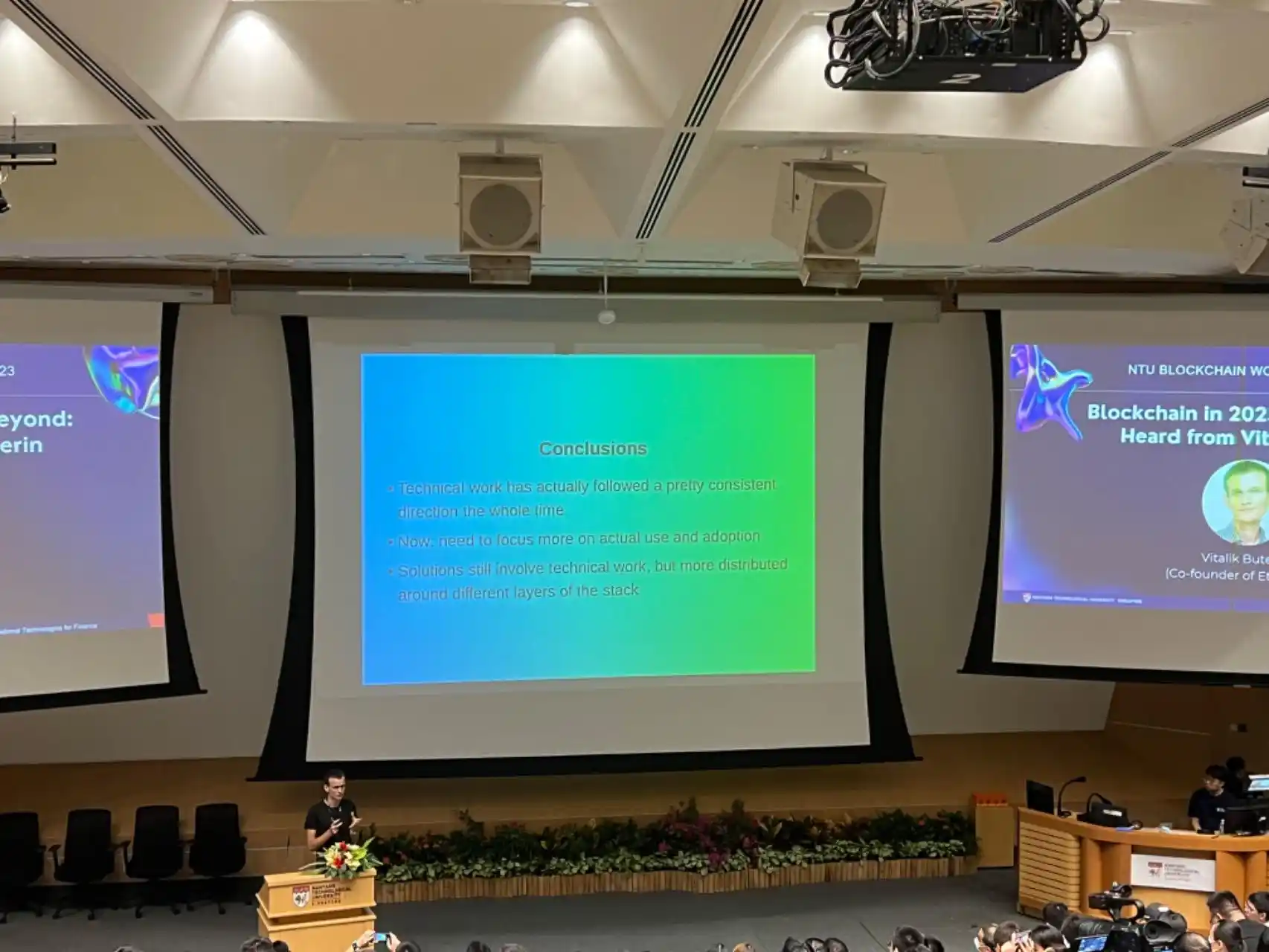
These technical efforts have been following a pretty consistent direction, which I think is interesting. The tools have changed, and 10 years ago we weren't even thinking about these issues, and now we are. But the rules are the same. But now I think there needs to be more focus on actual adoption and usage. The solutions involve technical work, but they are more decentralized and distributed at different levels. What that means is that the Ethereum Foundation and the Ethereum core development team and the client teams are no longer the only places where extremely important work is being done, but wallet companies are also the only places where extremely important work is being done, and application developers are also the only places where extremely important work is being done, and even building enterprise blockchains. This is something that people have been trying to do for years. But I think if you think of it as a layer 3 on top of Ethereum, then it’s actually possible to make it viable, to make it really deliver the benefits of decentralization for those who want to use it, and to make it actually viable.
These are some of the biggest changes we have seen in the past 10 years. It has been a long, slow journey from an initial concept to gradually solving various challenges in actual use. I hope that in the next 5 years, we will be able to solve most of these challenges.
Original link
Welcome to join the official BlockBeats community:
Telegram Subscription Group: https://t.me/theblockbeats
Telegram Discussion Group: https://t.me/BlockBeats_App
Official Twitter Account: https://twitter.com/BlockBeatsAsia