Will Lido's monopoly threaten Ethereum as the community continues to argue?
Translation: Kaori, BlockBeats
Last week, Ethereum LSD protocol projects such as RocketPool, StakeWise, and Stader Labs committed to limiting validator shares to below 22%, while market leader Lido Finance, which holds a share of up to 32%, did not make a statement on this matter. This has reignited discussions on whether Lido poses a risk to the Ethereum ecosystem.
Ethereum community member Ryan Berckmans (@ryanberckmans) believes that the risk of Lido's unlimited dominance is that Ethereum may be perceived as controllable or more centralized than other blockchains in the eyes of large companies and governments. If this is the case, Ethereum's development speed may be greatly affected, which will limit Ethereum's benefits to humanity and reduce the value of ETH.
Lido contributor sacha (@sachayve) published an article refuting many of Ryan's concerns, which are based on viewing Lido as a single entity. However, Lido is actually a coordination layer between multiple participants. It is not difficult to explain to institutions that Lido is not a single entity, especially given the greatly weakened governance power of LDO and the constraints imposed by stETH holders.
In response to Sacha's comments, Ryan published a second article to refute them. He believes that a monopolistic LSD protocol (with a 22%+ market share) will inevitably undermine the credibility and neutrality of Ethereum, regardless of how it is designed. However, the Lido team chose to ignore this point and refused to take the most direct approach (self-limitation) to restore Ethereum's neutrality. This is the main reason why the Ethereum community is increasingly distrustful of Lido.
BlockBeats has compiled the comments of the two individuals as follows.
Ryan: Lido's unlimited dominance is the only serious and persistent risk between Ethereum and global adoption.
In my opinion, the worst-case scenario for Lido's unlimited dominance is not a network outage, but the establishment of a reputation between enterprises and governments that Ethereum is "controlled" or "not as decentralized as other chains".
If this situation occurs, it may affect the magnitude of Ethereum's growth rate, which in turn affects Ethereum's interests and the small numbers of ETH's long-term valuation.
Ethereum is a chain with a very low tps, but it has the "so far" safest block space. This reputation is crucial for the future of the L1 and L2 ecosystems.
Our valuation forecast for ETH is based on the government anchoring its sovereign bond system on a low-data, high-cost chain on Ethereum, and then bridging it to many L2s and L3s. Compared to anchoring it on a higher TPS chain, the latter clearly has higher risks and poorer long-term property rights, while the former is clearly more advantageous.
Ethereum is moving towards becoming a global settlement layer, but this success depends on our reputation in the enterprise and government sectors. Given this path dependence, the threat of a single dominant player like Lido poses a risk to our reputation. This is different from the comparison with Google's search monopoly, as Google did not "threaten" the internet in the same way as Lido, which has diminished the impact of the internet.
Currently, Lido's unlimited dominance is the only known substantial risk that could potentially reduce the value of Ethereum to only 1.2 to 3 trillion dollars in 10 to 15 years, instead of 12 to 30 trillion dollars. That's why we cannot tolerate Lido's unlimited dominance - it is actually the only serious and persistent risk between Ethereum and global adoption.
Our mission is to create a fair competitive environment for all mankind. In order to achieve this goal, we are willing to bear social friction and use floating protocol fees to encourage Lido to strive for a 22% market share.
sacha: Why Ryan's concern about Lido's growth impact on Ethereum's reputation is wrong
Although Ryan acknowledges that "Lido's unlimited dominance is not the worst-case scenario for network disruption," his core argument about self-limitation is that if Lido's market share continues to grow, Ethereum may suffer reputational damage. In particular, he is concerned that this may affect Ethereum's growth, which in turn may limit its adoption ("benefits to humanity") and market value ("the number of zeros behind long-term ETH valuation").
In his view, the key difference between Ethereum and other higher tps chains is that Ethereum provides users with better and more secure long-term property rights.
Of course, the counterargument here is that if Lido does not follow the wishes of a few core developers, researchers, and influencers, threatening to restrict or fork Ethereum is the most reliable way to stifle any better and safer concept of property rights. As Ryan pointed out, this is one of Ethereum's strongest competitive advantages.
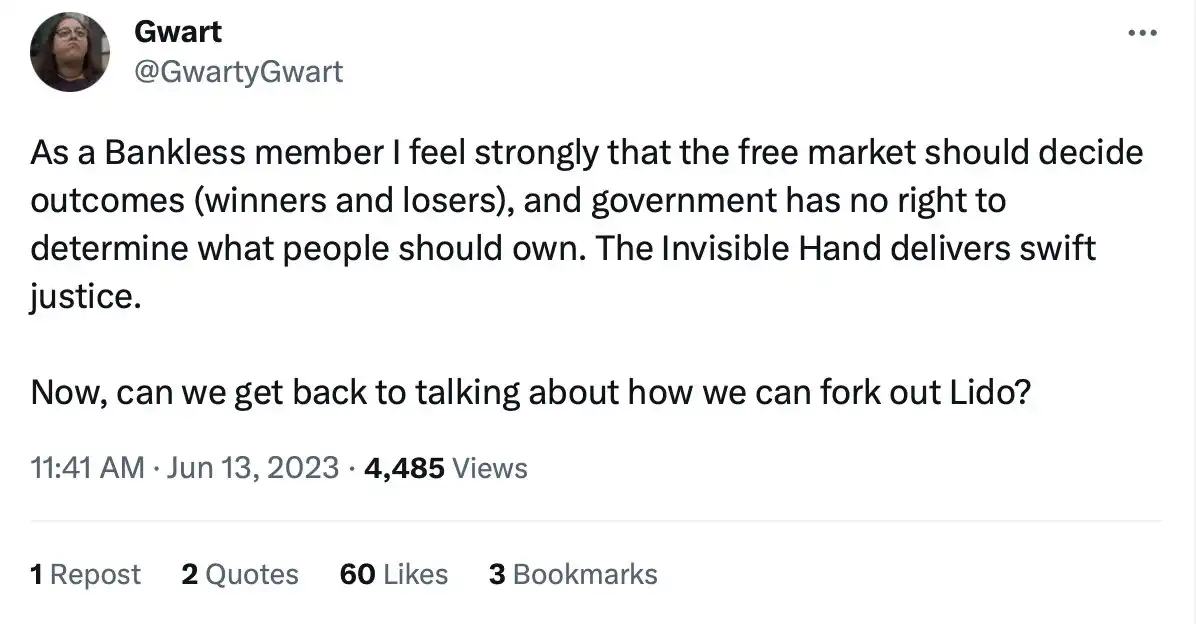
My personal opinion is that it would be extremely irresponsible for Lido to gain dominant market share before significantly improving its ability to resist tail risks and reducing the impact of these tail risks on the Ethereum protocol. Most, if not all, of the Lido contributors I have communicated with share this view.
In order to truly align with Ethereum, the Lido protocol needs to be as powerful and stable as Ethereum itself. That's why measures such as dual governance, carefully expanding the set of node operators, and allowing permissionless validation (through the Staking Router) are so important.
Despite this, Ryan's concerns about potential reputational damage are largely based on the premise of viewing Lido as a single entity. It is important to reiterate here that Lido is not a single entity, but rather a layer that coordinates between numerous stakers and node operators.

Explaining this issue to existing institutions is not an impossible challenge, especially in a world where LDO governance power is minimized (through gradual protocol ossification) and restricted by stETH holders (through veto power). In fact, I believe it is much easier than explaining to them why a few Ethereum applications that reach product-market fit are ultimately suppressed by the community, although these concerns are valid, they are still somewhat hypothetical (although the project has a roadmap to address these issues).
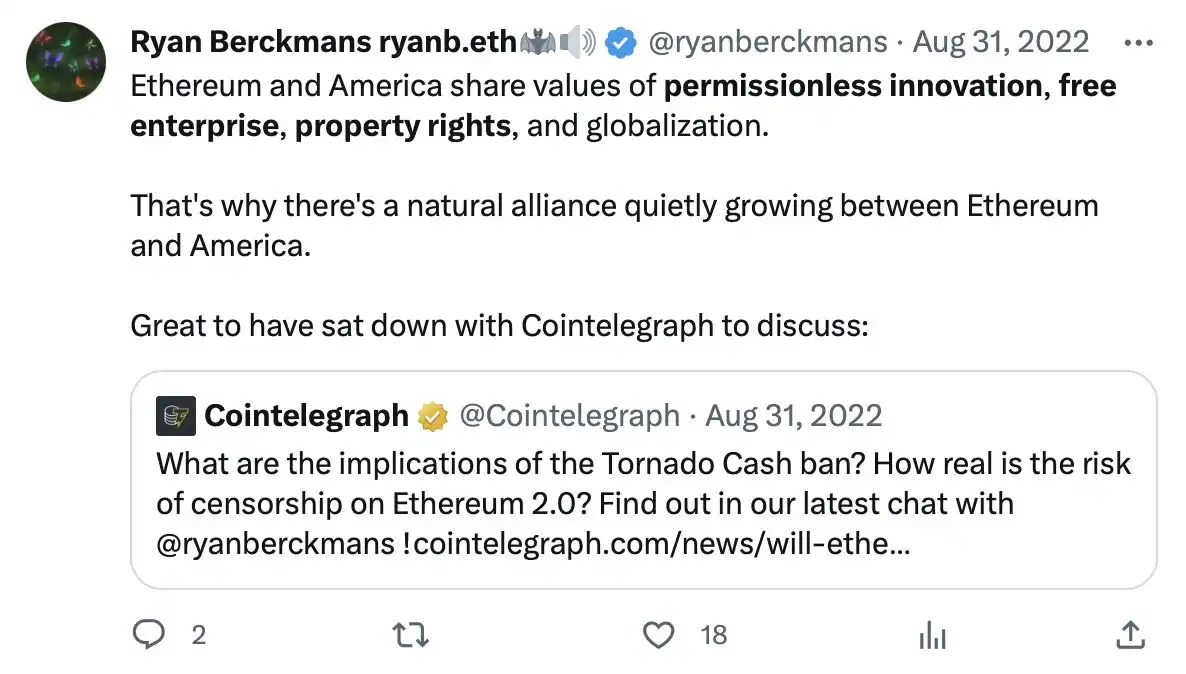
Regardless, in my opinion, such a result will undoubtedly raise significant doubts about Ethereum's ability as a home for free enterprise and permissionless innovation (values that Ryan and I hold dear).
Ryan: The reasons why the Ethereum community is increasingly distrustful of Lido
The core of his argument about self-limitation revolves around the potential reputation damage that Ethereum may suffer, which is caused by the continuous growth of Lido's market share.
The potential reputational damage is not just a surface issue, it will be a fair and reasonable response to the weakening of Ethereum's neutrality, compared to the proof-of-stake system of Ethereum that is not monopolized by LST.
If Lido does not comply with the wishes of a minority of core developers, researchers, and opinion leaders, and threatens to restrict or fork Lido, this will be the most precise way to stifle better and safer property rights concepts.
I completely 100% agree that "social reduction" of Lido (or similar institutions) will pre-emptively undermine our credibility and neutrality. I am not sure to what extent I might support social reduction of Lido under certain circumstances of governance. Perhaps I will never support it, or maybe I will support it when Lido approaches the critical 2/3 ownership threshold.
However, I support the community actively discussing EIPs aimed at reducing the threat of monopolistic LST or other large proof-of-stake entities.
If Lido were to gain dominant market share without demonstrating a significant ability to withstand long-term tail risks, it would be extremely irresponsible. The community's hostility towards Lido is encapsulated in this statement. Allow me to try to explain.
It is widely believed in the research community that monopolizing LST (accounting for more than 22% of the market share) will inevitably reduce the trust and neutrality of Ethereum, which is unrelated to the design of LST. The goal of Ethereum is to maximize trust and neutrality. Therefore,
(1) Lido is the only application that actively and successfully undermines Ethereum's largest trust neutrality goal.
(2) The leadership of Lido pretended that Lido did not undermine Ethereum by pretending that Lido could become neutral enough to avoid compromising Ethereum's trusted neutrality, but in reality Lido cannot achieve this.
The key driving factors for the decrease in trust in Lido by the Ethereum community are reasons (1) and (2).
Welcome to join the official BlockBeats community:
Telegram Subscription Group: https://t.me/theblockbeats
Telegram Discussion Group: https://t.me/BlockBeats_App
Official Twitter Account: https://twitter.com/BlockBeatsAsia