Fraxbonds and sfrxETH: Is the barbell strategy feasible for balancing high and low risk assets?
Written by: Samuel McCulloch
Translated by: Deep Tide TechFlow
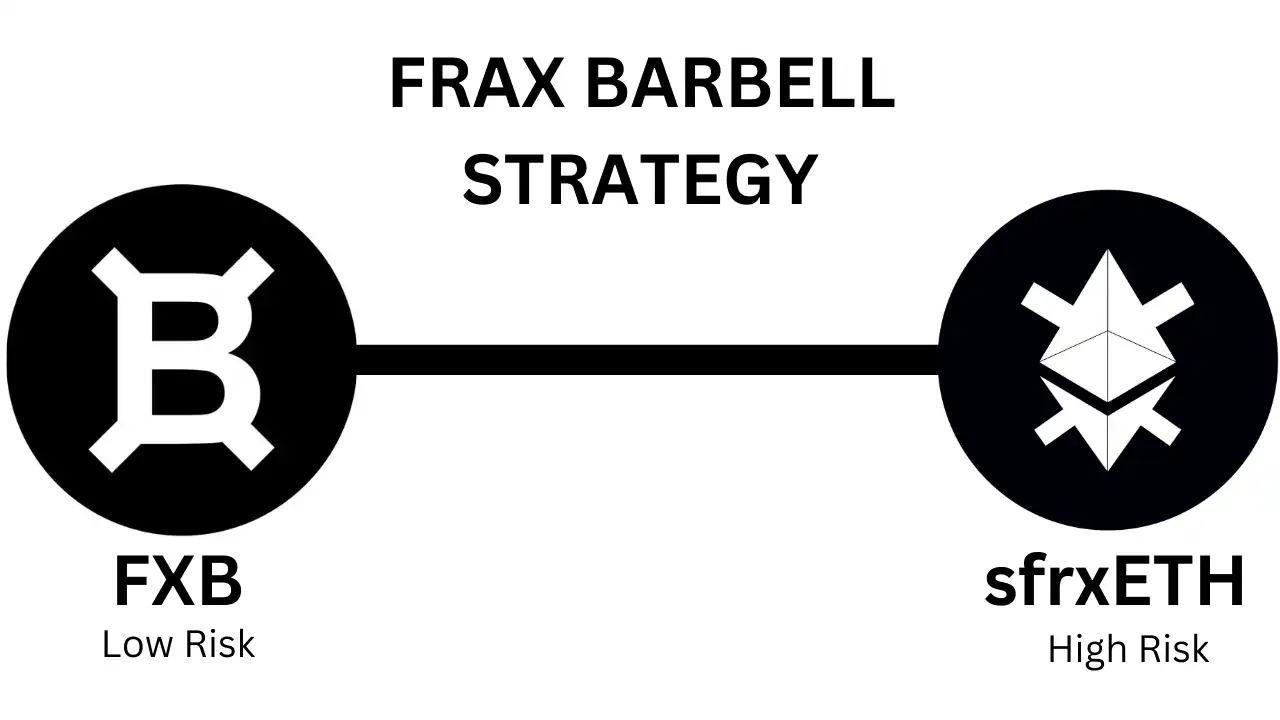
The barbell investment strategy is a method in which investors divide their investment portfolio into two extremes: low-risk, predictable assets such as government bonds, and high-risk, high-return assets such as speculative ETH. The method intentionally avoids medium-risk investments and aims to simultaneously leverage the security of low-risk assets and the potential significant returns of high-risk assets.
Asset allocation is not always 50/50; it is adjusted based on an individual's risk tolerance and financial goals. This strategy believes that the low-risk end provides stability, while the high-risk end provides growth opportunities, which can compensate for moderate returns on safer assets. As the market dynamics change, investors can rebalance their portfolios and shift returns from one end to the other.
Until now, there has been no effective way to fully execute this strategy on-chain if you want to. Although cryptocurrencies offer a lot of risky assets, there is no place for secure and reliable returns. Just like when investors were attracted by the 20% interest rate of Luna/Anchor, the price of UST collapsed and went to zero almost overnight.
There may also be risks in seeking returns in DeFi. All it takes is a motivated developer manipulating liquidity from within, or a North Korean hacker army looking for exploitable code, and the cash you worked hard to earn will disappear in an instant. Hackers stole over $3.8 billion in 2022, proving the risks of investing in cryptocurrency.
But even after all the hacker attacks, there are still many people who want to host all their assets on the chain and have no contact with centralized third-party services that they cannot control.
This post was inspired by a comment made by Naly during a conversation.
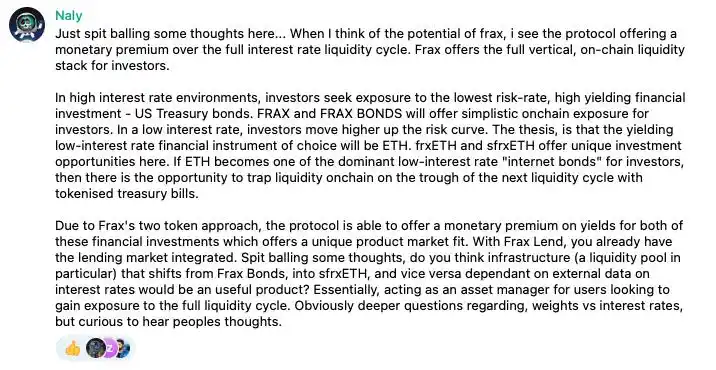
Naly pointed out that Frax is creating a "fully vertical, on-chain liquidity stack" for investors to seamlessly blend and match the returns and risks of sfrxETH and Fraxbonds (FXB) based on their risk preferences.
Naly wrote: "In high interest rate situations, investors typically prefer low-risk, high-yield investments, such as US Treasury bonds. FRAX and FRAX BONDS are seeking to provide similar on-chain risk exposure."
Fraxbonds will offer FRAX at a discounted price similar to off-chain short-term treasury yields. By selecting one of four annual maturity dates, FRAX holders can deposit their FRAX and ensure a fixed income during this period.
Okay, but why do investors buy bonds? In some cases, bonds are similar to cash and also pay interest, which is the yield.
With the rise of interest rates, new bonds offer higher fixed interest rates, making them attractive. In addition, during economic uncertainty, which is often associated with high interest rates, the low-risk nature of bonds, especially government-issued bonds, is attractive for capital preservation.
All risk assets are compared to bond yields. If you invest in real estate, which has a yield of 7%, and short-term bond yields are 5.5%, it may not be a good choice.
Fraxbonds will simulate the same type of exposure as real bonds, but entirely on-chain. When the market turns negative, FXB will become a safe haven for investors seeking safety and stable returns. FXB does not pay interest, but it represents FRAX purchased at a discounted price for future issuance.
On the contrary, in a low interest rate environment, Naly wrote: "Investors will increase their risk curve." As the yield decreases, the overall expected return of risk assets decreases, which drives up their asset prices.
Naly continued, "People believe that Ethereum (ETH) could become the preferred low-interest internet bond. ETH has both returns and upward potential. If you know that ETH will accumulate returns and that it may have huge upward volatility, then it makes sense to prepare for this event."
There is another possibility, which is to hedge the price difference of sfrxETH, that is, for every 1% increase or decrease, the rate of change in the value of the position, so that when interest rates rise, the impact of price fluctuations will be offset.
In this new paradigm, investors can find returns in low-risk FXB and high-risk sfrxETH. A true barbell structure strategy.
Naly also mentioned that by using AMM management based on external interest rate data, it is possible to manage the conversion between barbell strategies and act as an on-chain asset manager.
Balancer technology allows for weighted pools, but it also allows for liquidity pools with weights that change over time. There is also a model that allocates weights between two tokens based on external data sources. Therefore, for this example, you could have an 80/20 FXB/sfrxETH weighted pool in an environment where the US 10-year Treasury yield is greater than...%, and then switch to a 20/80 FXB/sfrxETH weighted pool when the Treasury yield is below...%.
Naly's idea presented here is revolutionary. Imagine a pool that automatically adjusts its strategy based on market conditions, providing both the safety of bonds and lucrative collateral returns. If executed properly, this could redefine how passive investments operate in DeFi, bringing the complexity of traditional finance into the decentralized world.
This AMM can also accept FXS gauge, further increasing the rewards for leveraged strategies. Therefore, in addition to earning yield from FXB and sfrxETH liquidity, rewards from CVX, AURA, and BAL gauges can also be added through integration with Balancer.
Naly has explored the Frax leveraged investment method through on-chain solutions, which is a remarkable proposal. Combining the security of bonds with the volatility of ETH, especially through automatically adjusted pools, is an ambitious task. It requires new oracles to input data, but theoretically it can be built.
This also writes a new chapter for the evolution of Frax, as a vertical support for the future of USD+ETH, where revenue is the lifeblood of its growth. In the next few months, we will see the release of Frax v3, FXB, and frxETH v2, and how this new system will connect all these parts together.
Original article link
Welcome to join the official BlockBeats community:
Telegram Subscription Group: https://t.me/theblockbeats
Telegram Discussion Group: https://t.me/BlockBeats_App
Official Twitter Account: https://twitter.com/BlockBeatsAsia