"Do you not remember me?" - the encrypted hell of scam text messages.
Original Title: "Don't You Remember Me?" The Crypto Hell on the Other Side of a Spam Text
Author: Zeke Faux
This article is excerpted from "Number Go Up: The Rise and Fall of Cryptocurrency," published by Currency, a division of Penguin Random House LLC's Crown Publishing. Copyright @ 2023 Zeke Faux.
On a night in August 2022, a friend and I received a mysterious WhatsApp message at a bar: "Hi David, it's Vicky Ho. Don't you remember me?"
It's strange that I'm not named David, nor do I know anyone named Vicky, but I've received many messages that seem to be sent to the wrong person. Usually, I ignore them, but for some reason, I clicked on this message, maybe because I had a spicy watermelon margarita.
After I texted her back telling her she had the wrong number, Vicky apologized and then awkwardly tried to continue the conversation - "Since I dialed the wrong number, can we still be friends? Haha," she wrote.

「Vicky」Source: Zeke Faux
I asked her where she was, and she sent me a selfie. The PS marks were heavy, making her look like an anime character. In the photo, she was a young and beautiful Asian woman with porcelain-smooth skin, a narrow chin, and big round eyes with long eyelashes.
Nice to meet you," I wrote. "My name is Zeke Faux and I live in Brooklyn.
"You have a cool name," she said. "I'm a 32-year-old divorced woman."
Later, I left the bar with my friends and didn't continue chatting with her. The next day, when I woke up, I found that Vicky had left me a series of messages.
"What are you doing?"
Good night"Have you slept?"
"What is your profession?"
"Where are my dear friends?"
"It seems like you're busy."
When I replied, Vicky was very excited. She said she also lives in New York and owns a chain of nail salons. Five years ago, she moved from Taiwan on the advice of her uncle, who is a wealthy person "very skilled in the financial field".
After a day had passed, Vicky revealed her love language: Bitcoin. She began sending me charts and claimed to have figured out how to predict market fluctuations and quickly earn 20% or more in returns. The screenshots she shared showed that she earned $18,600 from one trade, $4,320 from another, and $3,600 from a third trade that week.
But Vicky told me that I couldn't trade like her yet, and suggested that I read a few books about Bitcoin first. She has been chatting with me for several days without asking me to send money. She ignored my attempts to change the subject and remained very restrained.
Waking up, I saw Vicky say, "Darling, did you sleep well last night?" I tried to show her in a different way that I am a good potential customer. I told her I wanted to buy a car and sent a picture of the Tesla I've been dreaming of, worth $140,000.
"I saw the price was 142,200," wrote Vicky.
"Yes, they are expensive," I said.
"Money doesn't matter as long as you like it," she said.
Then she sent me a Bitcoin price chart and told me she would make new trades based on her data analysis. Finally, I joined in.
The next day, Vicky sent me a link to download an application called ZBXS. It looks very similar to a cryptocurrency trading app, with a banner at the top that reads "New secure and stable trading market".
Then Vicky gave me some instructions. They used another cryptocurrency trading app to purchase a cryptocurrency, and then transferred the cryptocurrency to the deposit address of ZBXS on the blockchain. This is a 42-character string consisting of letters and numbers.

Vicky, in「New York.」Source: Zeke Faux
For newcomers who have not been exposed to cryptocurrency, it may be a bit intimidating, but Vicky has randomly encountered a wrong target.
I have been investigating the cryptocurrency bubble for over a year, trying to figure out why the prices of Bitcoin and hundreds of altcoins are skyrocketing. The logic of the financial world seems to have collapsed, and almost no one knows what cryptocurrencies are for. Even the so-called experts cannot explain it, and it is still unclear why many cryptocurrencies have any value.
Companies that support this type of cryptocurrency are also called Tether, and they are almost in danger. Tether was conceived by a former child star of "Brave Little Boy" and is now run by an Italian former plastic surgeon who has never been interviewed and rarely appears in public.
The Attorney General of New York State has accused Tether of concealing its reserves, and it is currently unclear which countries are regulating it. However, Tether is at the center of the cryptocurrency world and sometimes sees over $100 billion in Tether transactions. Some people refer to Tether as the central bank of cryptocurrency. (A female spokesperson for Tether Holdings did not respond to this investigation. The company stated that it "works with global law enforcement almost every day" and freezes the wallets of criminals.) I have been investigating rumors of illegal use of Tether, such as a Russian money launderer promoting Tether to his clients in court documents. But the "pig-killing scheme" is the most concrete example I have found, and people around the world have lost huge amounts of money due to this scam. A Boston-based project financing lawyer with late-stage cancer was defrauded of $2.5 million. A single mother from St. Louis with three children was defrauded of $
With the help of translation, I started video chatting with the fugitive.

Featured in Bloomberg Businessweek, Aug. 21, 2023 .Illustration: Jiayi Li for Bloomberg Businessweek
A jobless Malaysian, Bilce Tan, told me that he saw an advertisement on the JobStreet website recruiting "telephone sales". When he arrived in Cambodia, he received a phone with fake accounts and was told he couldn't leave. He said his task was to ensure his target sent Tether.
"This is safer," Tan told me. "We are worried about being arrested for money laundering, but this cannot be detected."
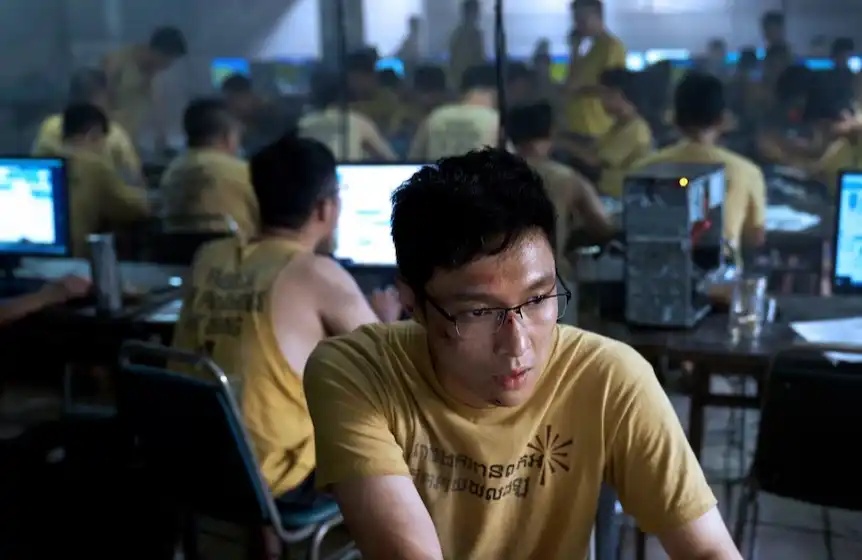
Some of the victims I interviewed were detained in a huge courtyard called Chinatown in the southwestern city of Sihanoukville, Cambodia. From the photos, it looks as big as the city center of a city, with dozens of tall, monotonous office buildings arranged around several courtyards, surrounded by high gates, cameras, and serpentine wire fences, with armed guards in black standing outside.
Such phenomena are so common that there are a large number of Tether transactions, and it is said that as many as 6,000 workers like "Vicky Ho" are detained in only Chinatown.
It's hard to imagine how slavery would exist without cryptocurrency. Cryptocurrency institutions claim that they are somehow helping the poor, but it seems that no one is bothering to study the darker consequences of the technology that allows anonymous and untraceable payments. Anyway, I can only learn so much about Chinatown from outside the screen, I have to see it with my own eyes.

Thuy hot-wired a guard‘s iPhone to escape a compound in Cambodia.Source: Zeke Faux
"I was very calm at the time and not afraid at all, because I felt that no matter what, I would die," Thuy told me. "If they found out that I stole the phone, either I would be beaten or killed. But if I managed to hide it, I would have a chance to survive."
I'm not sure how much I can trust him. He told me he had been in prison twice for assault and drug trafficking, and some of the personal life details he revealed to me cannot be verified. But he is still a valuable source of information. He provided me with photos he took inside Chinatown and the most detailed description of the escape location among the fugitives I interviewed.
I also met with the YouTuber, a Vietnamese man named Phong Bui, who confirmed many of Thuy's stories. Bui said he had rescued more than 50 people by paying ransom. He said the work was dangerous and he had been threatened by gangs, so he began arranging rescue operations through intermediaries. He warned me not to wander around. "Rent a taxi, take pictures in the car," he told me. "Don't get out."
When I was in Cambodia, I had planned to meet with two journalists from an independent news organization called "Voice of Democracy" who had helped expose issues of fraud and slavery. If they were in the United States, they would likely be able to win journalism awards. However, the situation is not the same in Cambodia.
Before the national elections planned for July 2023, long-time ruler Hun Sen has imprisoned opposition leaders on fabricated charges. The rampant issue of human trafficking in the country has become an international political issue. In February 2023, he ordered the closure of "Voice of Democracy". He claimed to be angry about comments regarding his son in an article, but many suspect it was because coverage of these areas had become an embarrassing issue.
"You always accuse me of abusing my power, so I will show you my power," Hun Sen angrily said in a speech, making strong remarks against this independent news organization. "Foreigners, I remind you not to interfere. This is Cambodia."
Three days later, I took a bus from Ho Chi Minh City, passing through cattle ranches and small houses with rusty tin roofs and neon-colored plaster mansions, heading to the capital of Cambodia, Phnom Penh.
At a casino parking lot, a sign on a small booth caught my attention. It advertised remittance services in Vietnamese and Chinese. On it, I saw a white "T" circled in green - the symbol of Tether. While this doesn't prove anything, I found it strange to see this symbol outside of a cryptocurrency conference in a place that has been referred to as a human trafficking center.
In Phnom Penh, I met up with former "Voice of Democracy" journalists: Mech Dara, who is now 35 years old and known for his fearless reporting and wearing flip-flops and jeans to official press conferences; and Danielle Keeton-Olsen, a 28-year-old American from Chicago who has been reporting in Cambodia since college.
Dara arrived at my hotel on a rickety old motorcycle. The purple body of the motorcycle was cracked and the rearview mirror was lost due to an accident. When I asked him and Danielle if they would continue reporting after the Prime Minister's decree, they told me they were not afraid. "If they want to find you, they will find you no matter what you do," Dara said.
Danielle took me to a Chinese community where there was a currency exchange shop with the Tether logo, similar to the one I saw near the border of Bavaria. Danielle and I were curious about what this meant. We went to a shop across from a shiny apartment building that was advertised as a luxury apartment in Chinese advertisements.
There are two fashionable black SUVs parked outside the store, with tinted windows: a Land Rover Range Rover and a Chinese-made Zotye car. On the LED sign above the 10-foot brass door of the store, there are continuously scrolling Chinese characters. Among them, we found a common abbreviation for Tether: USDT.
When we entered, a store clerk invited us to sit at a large marble table, with white leather chairs embroidered with the Bentley logo. I was the only customer in the office, which had polished marble floors. In a niche on the wall, I saw blue and white porcelain vases and a statue of a stag.
I told the shop assistant, a friendly young Cambodian wearing a football jersey, that I wanted to exchange Tether for US dollars. He told me that I could get cash immediately or deposit the money into a Chinese bank account and wait for his boss to return from lunch. He told me that Tether is very popular among Chinese merchants. "When they want to remit money overseas, it is very convenient to use USDT," he said. "USDT is anonymous and very secure."
When we were waiting, a Chinese man who looked drunk walked in wearing flip-flops and pajama pants. He walked behind the table, opened a black plastic package, and revealed a bundle of $100 bills the size of a lunch box tied with rubber bands - the clerk later told me it was a total of $50,000. He stuffed it under his arm and left.
The boss is another rude Chinese man who arrived quickly, wearing a white T-shirt over his fat belly. I was prepared with hundreds of USDT in an iPhone app. The boss sent me his wallet address, a string of random numbers and letters. I pasted it into my app and sent him 105 USDT, with 5 used to pay the fee. Then, he didn't even ask for identification or name, and handed me a brand new $100 bill. I have turned my cryptocurrency into cash without leaving any paper records. This is one of the four currency exchange shops in the community that promotes Tether.
Before heading to Chinatown, I decided to visit a scam base closer to Phnom Penh with Danielle and Dara. This place is affiliated with a casino complex located about 100 miles southwest of the capital in the Gulf of Thailand. It is located on a mountaintop called Bokor, in the middle of a national park. In 2022, a Taiwanese gangster nicknamed "Fatty" was arrested in Taiwan for trafficking dozens of people there.

The scam compound atop Bokor Mountain.Photographer: Danielle Keeton-Olsen
I visited a hiding place in the mountainous area of a human trafficking gang with some nervousness. But Danielle explained that the situation was not as dangerous as it sounded. Mount Pogo is a tourist attraction where visitors go to see the ruins of French colonial mansions and the scenery at the top of the mountain. People can take selfies 100 yards away from the base without knowing that someone is trapped inside.
As we approached Mount Bo, the mountaintop was shrouded in clouds and mist. At a large gate, guards asked us about our destination. Then, after driving on a winding mountain road for half an hour, we crossed rocks, passed palm trees and white-faced monkeys. We arrived at a huge hotel that looked severely weathered and stained, as if it had gone through a zombie apocalypse. Behind the hotel, there was a row of about 50 vacant townhouses with chrome fences winding up. The unused sidewalk slabs were overgrown with weeds. At the top of the mountain, there was a hundred-year-old Buddhist temple, where three monks in orange robes swept around a golden Buddha statue, listening to recorded scriptures. A dog sniffed around in the garbage.
This 500-room hotel, named "Thansur Sokha", is very quiet and spacious, with no one except a French couple who may not have read online reviews. Dozens of employees watched me enter, turning their heads like a family of owls. There is no one in the casino, spa, bar, restaurant, or children's playroom. I feel like I'm visiting the ghostly amusement park in Hayao Miyazaki's film "Spirited Away".
About 100 yards behind the hotel is a dilapidated office building complex. This is the so-called scam park. I decided to observe it up close. To highlight my stupid tourist costume for this occasion, I put on a waist bag and bought a cup of frozen strawberry ice cream in the lobby. A door separates the hotel-casino's public area from the base. As I approached the door, I deliberately licked the ice cream with a small spoon. A German shepherd jumped out, barking wildly and pulling heavily on the chain. A guard signaled that I could not pass. Through the windows of the building, I could see a row of bunk beds.
When I was warned by barking dogs, Dara talked to another guard who said that these buildings were rented to Chinese companies and the workers inside could not leave. I wanted to do something, but Danielle and Dara told me that reporting forced labor to the authorities was useless. Local authorities usually take money from traffickers. Cambodian officials will not help escapees and will detain them for violating immigration laws.
We packed our bags and got back into the car, slowly driving towards Sihanoukville, a total distance of 75 miles.
Since around 2017, Sihanoukville has experienced a boom in casino construction driven by Chinese investors. Gambling is illegal in mainland China, except for state-run lotteries, but the city is just a short flight away. Skyscrapers and apartment buildings have sprung up on either side of dirt roads. The city center is filled with domed buildings lit up by flashing neon lights. Tens of thousands of Chinese workers have flooded in. By 2019, the number of Chinese immigrants surpassed that of Cambodians. There are 93 licensed casinos and hundreds of illegal ones, with estimated total annual revenue of up to $5 billion. In the gaming halls and secret offices of the casinos, women dressed in evening gowns and headpieces showcase games like baccarat to Chinese gamblers through live broadcasts. Rolls-Royces and Red Flag luxury cars park outside the better casinos. "At the baccarat tables of Sands, the typical customer seems to be a young Chinese man in a T-shirt and shorts, rough-looking, smoking, holding stacks of $100 bills, betting as much as $1,500," according to a 2019 report in The New York Review of Books.
However, at the end of 2019, the Cambodian Prime Minister actually banned online gambling. Coupled with the subsequent travel restrictions due to the pandemic, the economy of Sihanoukville has been in trouble. About half of the casinos have closed, construction has stalled, and over 1,100 buildings remain unfinished. Most Chinese workers have left. The decline of the gambling boom has forced criminal gangs to transform. They have turned casinos into bases for online fraud operations.
News reports have linked the Tangrenjie property to Xu Aimin, a Chinese entrepreneur who developed the property. Xu is actually an international fugitive from a technical standpoint and is the subject of a "red notice" issued by Interpol, which should alert police worldwide to arrest him. In 2013, a Chinese court convicted him in absentia for operating an illegal gambling business with a turnover of over $1 billion and sentenced him to 10 years in prison.
When I asked Danielle and Dara if Xu was on the run, they dismissed it. The main street in Chinatown is named after him. And in Phnom Penh, a 53-story tower for his company, K.B.X. Investment Co, is being built next to the closed office of "Voice of Democracy" on the street. If completed, it will become one of the tallest buildings in the capital. (Inquiries about K.B.X. Investment have not been answered.)
When we arrived in Sihanoukville, I saw that the city was filled with hundreds of unfinished high-rise buildings made of concrete skeletons. In the gaps between the floors, staircases led to nowhere in the sky. The skyline looked strange, like a sculpture used to illustrate the size of a speculative bubble city.
Tangren Street is located outside the city center, near one of the beaches. It is a huge gray tower grid, just like the victims of human trafficking described, but many of the towers seem to be empty. The authorities announced the closure of the largest base in the area five months ago. After reports from Danielle, Dara, and other media, Chinatown has become a symbol of government-tolerated human trafficking.
The first batch of buildings in Chinatown are empty. When we arrived at the second batch, we saw more activity. This is a complex consisting of at least 20 dilapidated two-tone gray buildings, surrounded by a gold-plated hotel and a wide street lined with bouquet-shaped street lamps. Black-clad guards stand outside the black and gold gates, which have golden peaks on top. Each unit in the building has a spacious balcony. However, iron bars are welded on top, transforming the balconies into cages.
I saw Toyota Alphard vans with chrome plating and Land Rover off-road vehicles with colored glass windows passing through the guard station one after another, where they would check whether the passers-by had the appropriate passes. Several young women wearing tight party dresses rode motorcycles and were also allowed to pass. After the unwelcome attention passed, did the activities at this base resume?
Inside the gate, I could see the whole block: a barber shop, restaurants, and a store filled with stuffed animals in the windows. But when I asked if I could enter, I was denied entry. One guard said something to the other five guards and they all laughed.
I decided to go in. Danielle and Dara agreed that it would be less suspicious if I went in alone. A waiter showed me around. One highlight was a 20-foot-tall golden pineapple statue in the lobby. The place was as spacious as a hotel on Mount Bogo.
A spacious marble staircase leads from the lobby to an elegant restaurant upstairs, where a small selection of Chinese food is served buffet-style. The host appears surprised to see a tourist.
A huge restaurant can hold weddings, but only a few people dine there. Some of them are wiping Maybachs, and there is a Chinese man in a T-shirt watching TikTok videos loudly on his phone. He seems to be their boss, because he takes out a roll of banknotes from his pocket and distributes them one by one to them.
Everyone seems to be at ease, except for me. I took a bottle of Budweiser beer from the fridge in the room and tasted it carefully, trying not to look too nervous or interested in the surroundings. Next to me, could be the boss of a scam base, eating roast duck? Because most people are speaking Chinese, I can't catch any useful information.

Source: Zeke Faux
One of the female receptionists speaks English. I asked her why the hotel was so empty. She said the hotel had only recently opened to the public a few months ago. Prior to that, it was only open to people in the surrounding buildings. I asked her why these buildings had such tight security measures.
She said, "This is Chinatown, don't you know?"
I pretended to know nothing. She tried to explain in a way that was easy to understand that the workers were not allowed to leave. When I frowned, she tried to reassure me that the service I was enjoying was not provided by those "slaves".
She said again, "We are employees here and we have our own freedom."
I walked to the back of the restaurant, where the large windows provided a view of an inner courtyard. The sun had already set, and the lights in some of the gray office buildings indicated that they were once again inhabited. T-shirts and shorts hung on some of the balconies. Imagining what the people inside might be going through, I couldn't help but shiver and quickly returned outside.
Dara connected me and as we drove out of the area, I noticed a closed currency exchange point. Although its sign had been removed, the outline of four letters was still visible: USDT.
"Original article link"
Welcome to join the official BlockBeats community:
Telegram Subscription Group: https://t.me/theblockbeats
Telegram Discussion Group: https://t.me/BlockBeats_App
Official Twitter Account: https://twitter.com/BlockBeatsAsia

 Related Articles