Explaining Singapore's Stablecoin Regulatory Framework: Scope, Reserve Requirements, and Professional Qualifications.
Original Title: "Leading the Way: A Detailed Explanation of Singapore's Cryptocurrency Stablecoin Regulatory Framework"
Original Author: William
Original Source: Wu Shuo Real
With the development of financial technology and changes in global geopolitical relations, governments around the world have gradually realized the huge potential of stablecoins. Countries and regions such as the European Union, the United States, Singapore, and Hong Kong, China have successively launched consultations and legislative activities in order to seize the initiative in the future. On August 15th, the Monetary Authority of Singapore (MAS) announced the final version of the regulatory framework for stablecoins, becoming one of the first jurisdictions in the world to include stablecoins in its local regulatory system. In the near future, Hong Kong, China and the United States will also introduce stablecoin regulatory regulations. Therefore, Singapore's release of the regulatory framework has significant value and will to some extent become a template for reference by regulatory agencies around the world. Therefore, this article will analyze the Singapore stablecoin regulatory framework in detail and insight into the future development trend of global stablecoin regulation.
One, Key Points of Singapore's Stablecoin Regulatory Framework
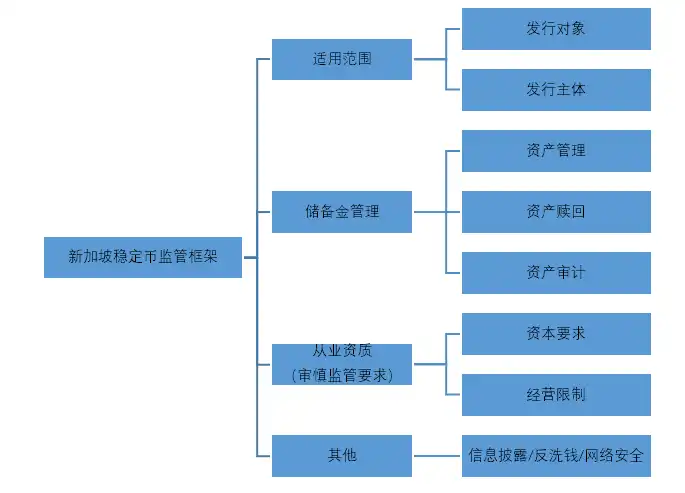
The earliest regulatory attempt by MAS on stablecoins can be traced back to the PS Act issued in December 2019. Subsequently, a consultation paper was released in December 2022 to solicit public opinions on the proposed stablecoin regulatory framework. The final stablecoin regulatory framework was completed on August 15th of this year. Therefore, Singapore's complete regulatory framework on stablecoins involves the content of the three regulatory documents mentioned above, rather than just one of them. According to the author's analysis, Singapore's stablecoin regulatory framework mainly includes the following parts: [Content in Chinese characters is not translated].
Figure 1 Key Points of Singapore's Stablecoin Regulatory Framework
1. Scope of Application
The regulatory framework for stablecoins introduced in Singapore this time has attracted market attention due to the openness of the stablecoin issuance target. MAS allows the issuance of single-currency stablecoins (SCS) anchored to a single currency [1], with the anchored currency being the Singapore dollar (SGD) + G10 currency [2]. Generally speaking, a country's currency is a symbol of its sovereignty, and other countries have no right to manage it. However, MAS allows stablecoins to be anchored to currencies of other countries, which is a major breakthrough. This shows that MAS has a certain degree of openness and innovation, fully considering the national conditions of G10 countries and communicating with them.
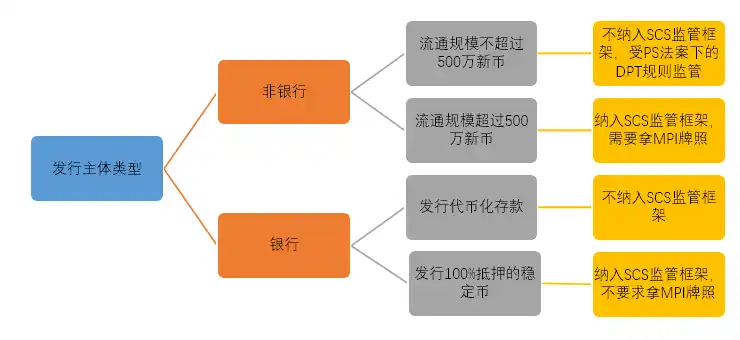
Secondly, in terms of the issuer, MAS has made significant adjustments. MAS divides stablecoin issuers into two categories: banks and non-banks. For non-bank issuers, MAS requires that only stablecoins with a circulation scale of more than 5 million SGD be included in the stablecoin regulatory framework, and they need to apply for the MPI license under the PS Act; otherwise, they do not belong to the scope of stablecoin regulation and only need to comply with the DPT regulations under the PS Act. For banks, MAS originally planned to include tokenized deposits in the stablecoin category, but the two differ greatly in asset nature (deposits are products under the bank reserve system, not 100% collateralized, and belong to bank liabilities), so they were eventually excluded. Therefore, banks must also issue stablecoins that are 100% asset-backed, but it should be noted that banks do not need to apply for the MPI license. MAS's explanation is that the Banking Act already requires banks to meet relevant standards.
Figure 2 Issuing Entity Scope Regulations
2. Reserve Management
In terms of reserve management, MAS has made detailed regulations, mainly in the following areas:
First of all, in terms of asset composition, MAS requires reserve funds to only be invested in cash, cash equivalents, and bonds with a remaining maturity of no more than three months. MAS also has detailed requirements for the qualifications of the asset issuer: either it is currency cash issued by the government/central bank, or it is rated by international institutions above AA-. It is worth noting that MAS has a restrictive interpretation of cash equivalents: mainly referring to bank deposits, checks, and promissory notes that can be quickly paid and cashed, but not including money market funds. Therefore, investments such as USDC, which invest 90% of their assets in money market funds, or even USDT, which invests in some commercial bills, do not meet MAS regulatory requirements.
Secondly, in terms of fund custody, MAS requires the issuer to establish a trust and open a segregated account to separate its own assets from reserve funds. MAS has also made clear requirements for the qualifications of fund custodians: they must be financial institutions with custody service licenses in Singapore, or overseas institutions with branches in Singapore and a credit rating of not less than A-. Therefore, stablecoin issuers who want to be included in the MAS regulatory framework in the future must partner with a financial institution that is local to Singapore or has branches in Singapore.
Finally, in daily management, MAS requires that the daily market value of reserves be 100% higher than the circulation scale of SCS, and that redemption be made at face value when redeemed, with a redemption period not exceeding 5 days, and monthly audit reports be published on the official website.
3. Professional Qualifications
The noteworthy aspect of this regulatory framework is that MAS has provided detailed regulations on the qualifications of stablecoin issuers as part of its prudent supervision. MAS has made three main provisions regarding the qualifications of issuers:
First is the Base Capital Requirement, which is similar to the Basel Accord's requirement for banks' own capital. MAS stipulates that the capital of stablecoin issuers must not be less than 1 million Singapore dollars or 50% of annual operating expenses (OPEX).
Next is the Solvency requirement, which requires that liquid assets exceed 50% of annual operating expenses or meet the scale of normal asset withdrawals, and this scale needs to be independently verified. It should be noted that MAS has clearly defined the categories of liquid assets, mainly including cash, cash equivalents, government bonds, large deposits, and money market funds.
Finally, there are business restrictions that require the issuer not to engage in lending, Staking, trading, and asset management, and not to hold any other entity's shares. However, MAS also explicitly states that stablecoin issuers can engage in stablecoin custody and stablecoin transfer to buyers. This actually restricts stablecoin issuers from engaging in mixed business operations. Furthermore, MAS explicitly states that stablecoin issuers cannot pay interest to users through activities such as lending, Staking, and asset management. However, other companies can provide similar services for stablecoins, including sister companies in which stablecoin issuers do not hold shares.
4. Other Regulatory Requirements
MAS has made regulations on information disclosure, qualifications and restrictions of stablecoin intermediaries, network security, and anti-money laundering, but there are no noteworthy points. Therefore, this article will not analyze them in detail. Interested readers can read the relevant documents on their own.
二、论新加坡稳定币监管框架的得失
Translation:
2. On the gains and losses of Singapore's stablecoin regulatory framework
The introduction of Singapore's stablecoin regulatory framework has a significant impact on the compliant development of the global stablecoin industry, as well as setting an example and leading other countries. Therefore, we will not elaborate on this further. Here, we mainly focus on several areas that MAS can continue to improve in the future.
This stablecoin regulatory framework of MAS has shelved or blurred several important issues, which may pose risks in the near future.
Firstly, there is the issue of the type of reserve currency. MAS originally planned that the valuation currency of the reserve currency must be consistent with the anchor currency, that is, if a new SGD stablecoin is issued, its reserve assets must be SGD assets rather than USD assets. However, this would bring a serious problem: users are very concerned about whether stablecoins can be exchanged for mainstream currencies such as USD. If the new SGD stablecoin can only be exchanged for SGD, then the stablecoin will not have a competitive advantage and the issuance volume will be very small. Secondly, the types and depth of investable assets for some anchor currencies are very limited, which will be a major challenge for reserve management. MAS should also be aware of these issues, but has not explicitly allowed reserve currencies to be invested in different currency assets, but only reiterated that the issuer needs to control risks and meet the 100% reserve requirement.
Next is the issue of cross-jurisdictional regulation. MAS has proposed two solutions to address this issue. The first is for issuers to submit an annual proof document demonstrating that stablecoin issuance in other regions also meets the same standards. The second is to establish partnerships with different jurisdictions. However, both of these solutions have proven to be unfeasible due to practical factors. As a result, MAS can only settle for requiring stablecoin issuers to not issue across jurisdictions in the initial stages. However, some stablecoins have already become global stablecoins and are issued on different public chains in different regions. If issuers comply with the above requirements, they may lose their market competitiveness.
The regulatory issue of systemically important stablecoins. MAS provided a descriptive explanation of what constitutes a systemically important stablecoin in its consultation paper last year and hoped to regulate them based on financial market infrastructure standards. However, due to practical considerations, MAS has chosen to shelve the controversy for now and observe the situation.
Setting aside the regulatory content itself, an important issue that the market is also concerned about is: what are the gains and losses of issuing compliant and stable coins in Singapore?
On the one hand, the advantage of compliant stablecoins lies in their compliance. For example, due to their compliance and security, compliant stablecoins give users greater confidence. Furthermore, MAS requires compliant stablecoins to be labeled as "MAS-Regulated Stablecoin" to distinguish them from other stablecoins, which is beneficial for the promotion of stablecoins. Additionally, because they are compliant, they are more recognized by traditional financial institutions and face fewer obstacles when depositing or withdrawing funds from banks.
On the other hand, we should also pay attention to the cost issue of compliant stablecoins. Firstly, MAS has clearly defined the issuance qualifications, with clear regulations on own capital, solvency, and business scope, while existing stablecoin issuers are not subject to such restrictions; secondly, there is a market fairness issue, as MAS stipulates that banks issuing stablecoins do not need to hold an MPI license, but non-bank issuers need to apply for an MPI license. Currently, the application period for MPI is about 1-2 years, and there are also many audit requirements for enterprise qualifications. Since the implementation of the PS Act in 2019, the number of enterprises obtaining MPI licenses is not many. Therefore, if you want to issue compliant stablecoins in Singapore, you need to invest a lot of time, manpower, and material resources.
Overall, under the current MAS stablecoin regulatory framework, banks or large companies with strong capabilities are more likely to issue "MAS-Regulated Stablecoins"; for non-bank small and medium-sized enterprises, the current policies are not favorable.
[1] Note: MAS does not allow the issuance of stablecoins pegged to a basket of currencies, nor does it allow stablecoins pegged to digital assets or algorithmically issued stablecoins.
[2] Note: G10 currencies include the Australian dollar, Canadian dollar, British pound, euro, Japanese yen, New Zealand dollar, Norwegian krone, Swedish krona, Swiss franc, and US dollar.
Original article link
Welcome to join the official BlockBeats community:
Telegram Subscription Group: https://t.me/theblockbeats
Telegram Discussion Group: https://t.me/BlockBeats_App
Official Twitter Account: https://twitter.com/BlockBeatsAsia

 Related Articles