Mint Ventures: The only correct solution for RWA in the short and medium term, a talk on Web3 treasury bond business

Original title: 《 The only correct answer to RWA in the short and medium term: a talk on Web3 Treasury bond business 》
Original source: Mint Ventures
Original author: Colin Lee
In the previous article, we mentioned that in the short and medium term, the most likely sub-category of RWA to achieve an explosion in scale and user level is Treasury bond RWA. According to data from rwa.xyz, the current Treasury bond RWA (excluding US bonds in MakerDAO) project has nearly $700 million in tokenized Treasury bond assets, which has increased by about 240% from the beginning of the year. In addition, the Treasury RWA in MakerDAO has also grown rapidly to the level of billions of dollars. The overall growth rate of Treasury RWA is relatively fast.
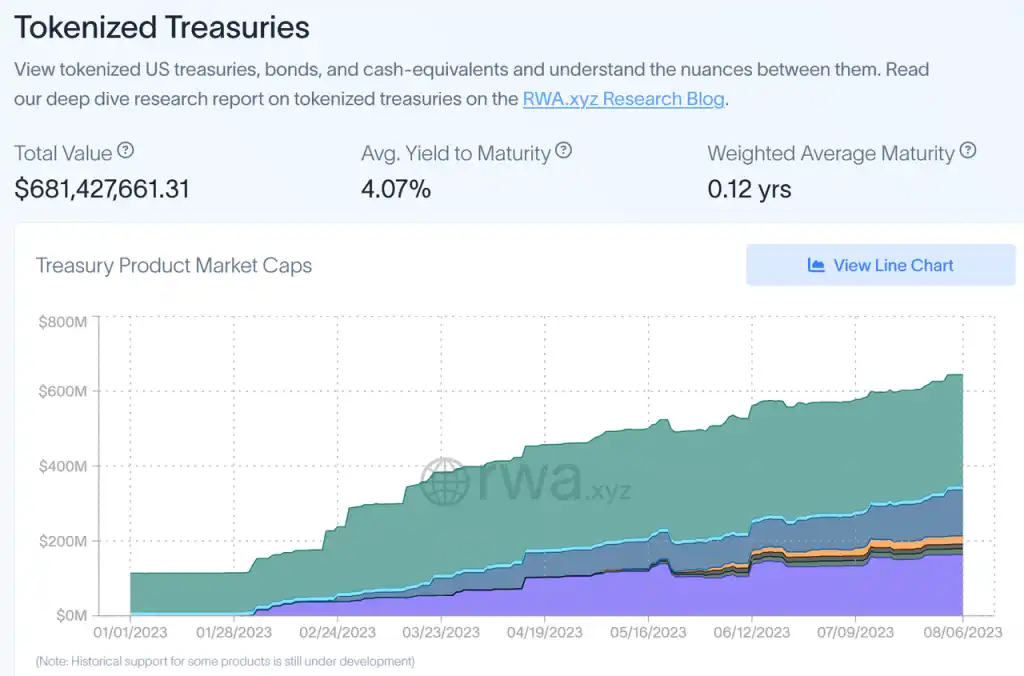
Source: https://app.rwa.xyz/treasuries
Based on the above industry background, let's analyze the mainstream Treasury RWA in the market.
The significance of Treasury RWA
In the previous "How to define the native benchmark interest rate in the crypto world? 》 and Outlook of the "Native Bond Market" in the Crypto World", we discussed the native benchmark interest rate and possible bond market in the crypto world. We can roughly assume that the PoS yield of the public chain is the risk-free interest rate of the public chain, and a bond market may gradually develop around the interest rate.
However, even if a crypto-native bond market similar to the current traditional bond market size does not develop rapidly on the chain in the future, the emergence of the "on-chain risk-free rate" LSD is still of great significance to investors: investors who use public chain tokens (such as ETH) as the bookkeeping standard can obtain low-risk returns in the currency standard even in a bear market. From this perspective, some investment strategies in the traditional market can be more smoothly migrated to the crypto-native industry: such as the stock-bond balance strategy.
Treasury bond RWA is the same as LSD. Once the risk-free interest rate of the traditional financial market can be introduced into the on-chain world, U-standard investors can enable traditional allocation strategies. This has several benefits:
(1) U-standard investors still have a relatively safe and stable place to earn interest after the market goes bearish. Taking the stablecoin market as an example, after the market began to gradually go bearish in mid-2021, the overall stablecoin market has dropped from US$188 billion to less than US$130 billion today. The reduction in the size of stablecoins is also affecting the overall liquidity of the market; (2) Equity-bond hybrid financial products are easier to launch and accepted by the market. Hybrid financial products are also familiar to most investors in the traditional market. This will also promote innovation in the DeFi asset management field. 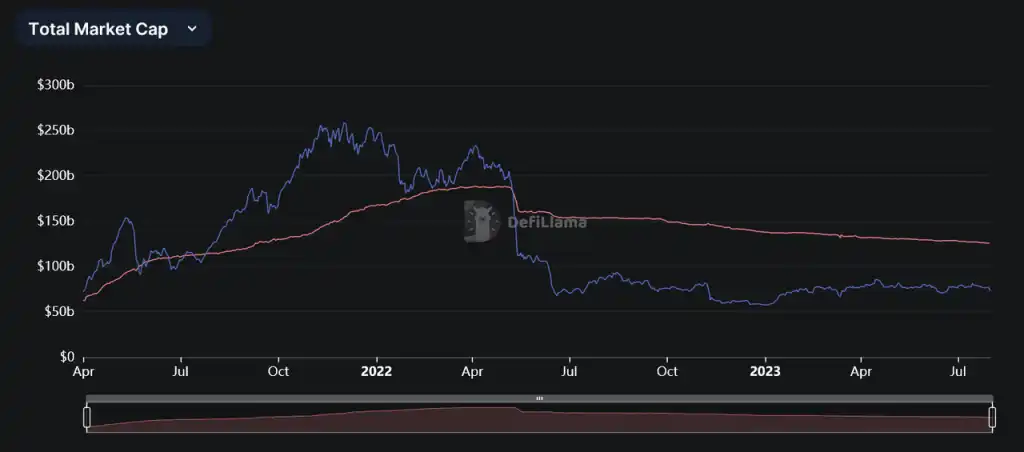 Source: https://defillama.com/stablecoins The most typical example is MakerDAO. After the bear market and the sharp increase in US bond yields, MakerDAO included US bonds in its investment scope. After entering 2023, MakerDAO's profitability has improved significantly.
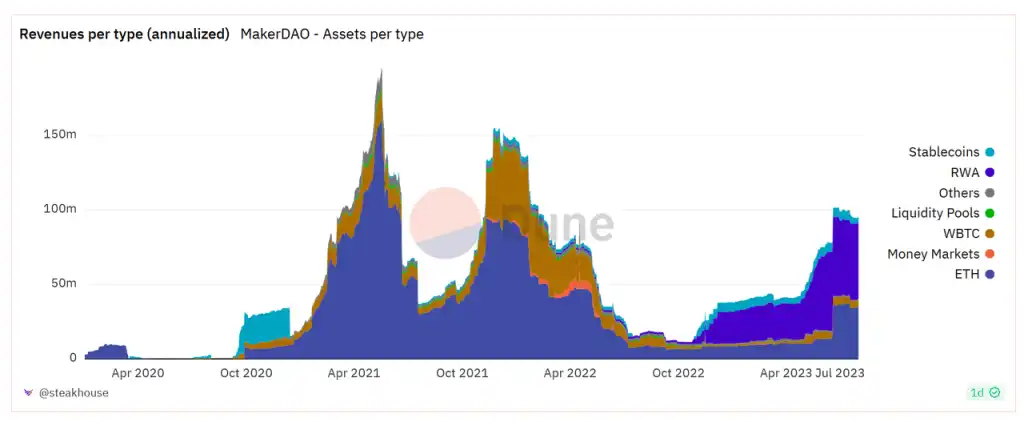
Source: https://dune.com/SebVentures/maker—accounting_1
Therefore, there is reason to believe that other DeFi projects, after seeing MakerDAO's "demonstration", will also hope to improve project profitability through more diversified strategies such as RWA. Especially in a bear market, RWA can provide a stable and sufficient source of income for the stable operation of the project.
Business model of Treasury RWA
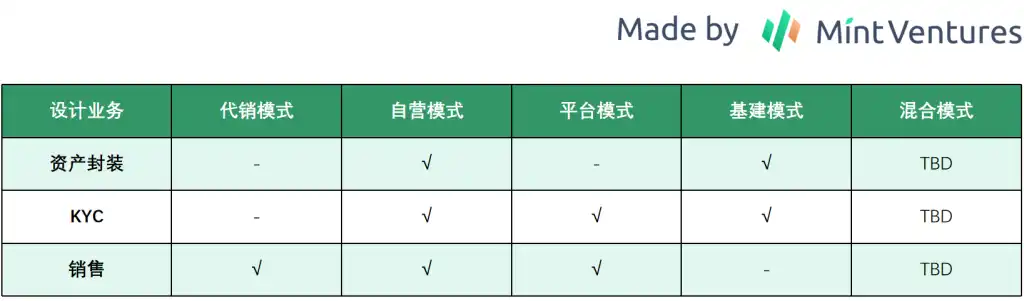
Currently, there are five main business models for Treasury RWA, namely: agency model, platform model, infrastructure model, self-operated model and hybrid model.
Agency modelNeither directly participates in the packaging of underlying assets nor provides user KYC services. It mainly acquires customers through crypto-native methods, focusing on business marketing, capital acquisition, and the expansion of ecology and application scenarios. Representative projects include TProtocol, etc. This type of project is no different from the daily infrastructure such as Aave and Compound. It often obtains liquidity by establishing a capital pool, then pooling users' funds together, and then a single borrower lends funds to purchase underlying assets such as US bonds.
Platform modelThat is, the project party only provides a series of service solutions such as chaining, sales, KYC, etc., but does not personally package assets. Representative projects include Desmo Labs, etc. This type of project generally provides three types of services: (1) asset/equity tokenization services; (2) on-chain verifiable information services; (3) user KYC services, etc. In theory, this type of project can help encapsulate any type of asset/equity from the traditional market, not limited to treasury bonds RWA, and is closer to the model of Internet platforms in business. To stand out in this track, you need to consider the ease of use of the project's own one-stop solution and the project's customer acquisition capabilities.
Infrastructure model, that is, providing RWA on-chain, asset purchase, asset management and other services, but not directly contacting C-end/B-end users who purchase treasury bonds. Representative projects include Centrifuge, Monetalis Group, etc.
Self-operated model, that is, the project party finds the corresponding assets by itself, establishes a business structure with external partners, isolates the risks of assets, and tokenizes assets/equity. At present, there are many projects of this type, such as MakerDAO, Franklin OnChain U.S. Government Money Fund, Frax Finance, etc. This type of model is more complex than the first two models in terms of off-chain business, and requires investment in legal affairs, the establishment of corporate business structure, and the selection of assets and partners. However, an important advantage of this type of project also comes from this: the underlying assets are relatively controllable, and the project party has the ability to actively manage risks.
Hybrid model, can be a combination of the above 4 models. This type of project can provide corresponding services such as chaining and KYC, and will also find assets by itself and directly provide users with corresponding investment opportunities. The representative of this type of project is Fortunafi. For example, Fortunafi provides four types of services: (1) Access Capital, which provides financing parties with access to funds; (2) Earn Yield, which is already packaged assets that users can invest directly after completing KYC; (3) Protocol Services, which provides governance, treasury management and other services to other protocols; (4) Whitelabeled products, which provides RWA full-process chain services. Of course, the RWA services of this type of project are not limited to government bonds, but can also provide chain packaging services for other assets.
Of course, in addition to the above 5 models, there are also purer trading infrastructures such as DEX that serve RWA, such as DigiFT, etc. However, this type of project does not participate in the screening, chaining, and sales of underlying assets, so I will not go into details here.
Asset side: underlying assets and asset side architecture
Underlying assets
Currently, there are the following types in the market:
(1) U.S. Treasury bond ETF. Projects that use this type of underlying asset include Backed Finance, Swarm, MakerDAO, and ARKS Labs. The advantage of this type of solution is simplicity: the management of the underlying assets is handed over to the ETF issuer and manager, including liquidity and bond rollover issues, which do not need to be managed by the project owner of this type of project. U.S. Treasury ETFs have not yet encountered major risk issues, so for this type of project owner, there is no need to worry about operational risks in asset management and other aspects. It only needs to include the largest and most liquid assets on the market.
(2) U.S. Treasury bonds. Projects that use this type of underlying assets include OpenEden, TrueFi, Matrixdock, etc. This type of project often chooses shorter-term U.S. Treasury bonds, which are no different from cash in terms of liquidity. However, since the project directly seeks a cooperative client, this type of project itself needs to bear the risks related to asset management, so it is very important to choose a suitable partner.
(3) A combination of three types of assets: U.S. Treasury bonds, U.S. government agency bonds, and cash/repurchase agreements. Projects that use this type of underlying assets include Franklin OnChain U.S. Government Money Fund, Superstate Trust, TProtocol, Arca Labs, Maple Finance, etc. Similarly, this type of project will entrust the management of the underlying assets to professional managers. The renewal and liquidity of the underlying assets will be directly related to the project party. On the operational level, if the project party does not select a high-quality manager, problems may arise.
Fee Structure
The three underlying assets discussed above have different fee structures. Without considering the gas fee caused by on-chain transactions, the main fee structure is as follows:
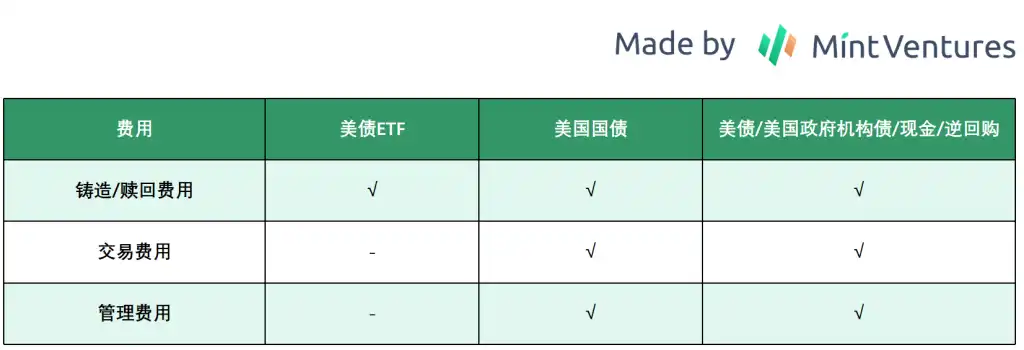
Since the management of US Treasury ETFs is handed over to ETF managers, the main fee issues come from the minting and redemption links, and the fee rates for this link are often around 0.05%-0.5%; the latter two involve the management of underlying assets, so new management and transaction fees are added. The cost of management fees is about 0.3%-0.5%, and the transaction fees are bank transfer fees and other aspects, and the fee rate is also around 0.2%.
Asset Business Architecture
The differences in underlying assets will also affect the entire business logic architecture. There are several types in the current market:
(1) Trust structure: Projects currently adopting this solution include MakerDAO, etc.
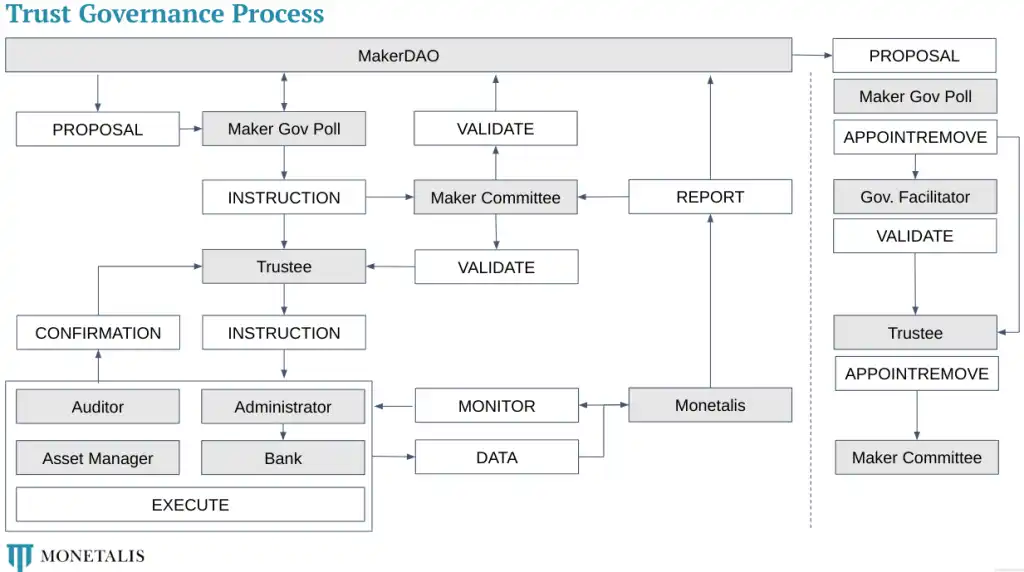
Source:https://forum.makerdao.com/t/mip65-clydesdale-governance-framework-setup/16565
The trust operation mechanism is that the sponsor transfers the assets to the SPV to establish a trust relationship, the sponsor obtains the trust income rights, and then the sponsor transfers the trust benefit rights to ordinary investors. Taking MakerDAO's U.S. Treasury bond RWA architecture as an example, it includes multiple roles such as managers and auditors, but part of the off-chain business architecture is built by Monetalis Group. The corresponding asset purchases, regular reports, and on-chain are all completed by Monetalis Group. In this architecture, MakerDAO uses governance to influence details such as scale and underlying asset purchases.
(2) Limited Partnership SPV Business Architecture: Currently, projects such as Maple Finance and Matrixdock have adopted this type of business architecture. Project partners will participate in the process of finding assets and acquiring liquidity.
SPV, or "Special Purpose Vehicle" - a vehicle for special purposes. The main function of SPV is to raise funds from investors in the process of asset securitization/asset purchase. The original design purpose was to achieve bankruptcy risk isolation. Strictly speaking, the first trust structure mentioned above can also be regarded as an SPV structure. The current SPV development has become more and more mature. In addition to bankruptcy risk isolation, there are several advantages:
· Simplify the financial management process and get rid of the problem that the financial process involves too many departments and the business flow is unclear in the traditional corporate business structure;
· Convenient penetration management. Generally speaking, a single SPV corresponds to a single project/asset, which may avoid management problems. For example, in a commercial bank, it is difficult for investors to understand the status of the underlying assets in a penetrating manner, because the bank will not disclose too many details, and this type of information may only be disclosed at the management accounting level used within the bank. For personal housing loans, the characteristics of this type of loan will not be disclosed in the financial statements and annual reports disclosed to the outside, let alone the information specific to a single debtor. However, if individual housing loans are packaged in an SPV, more detailed information about the loan will be disclosed, such as the term, interest rate, collateral, and loan amount, and sometimes even specific information about a single loan. In this way, the information that the SPV can provide is much richer;
· Reduce taxes and fees. For some underlying assets, the tax and fee standards of the SPV are lower.
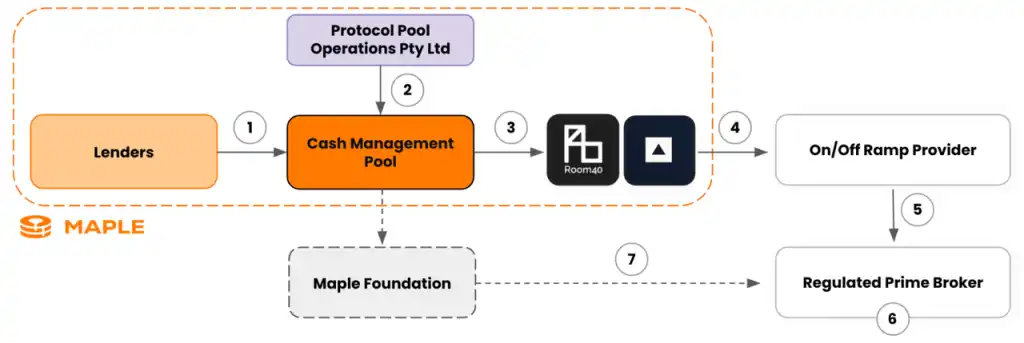
Source: https://downloads.eth.maple.finance/docs/legal/abe08ded-5d07-42cf-b435-a0d8d8156ca5/Cash_Mngt_T&C.pdf
There are two layers of structure in this business architecture:
The first layer, users and SPV: what users directly get is actually the debt of SPV. The premise for the user’s income to be guaranteed is the SPV Able to perform on time;
The second layer, SPV and commercial banks: SPV will participate in the treasury bond market and will also participate in reverse repurchase and other operations in the inter-bank market. In this process, if the reverse repurchase between banks defaults, it may be more risky than directly holding US Treasury bonds.
In addition, in this architecture, users will face an extra layer of risk: that is, SPV itself may have some risks.
ARKS Labs has expanded the above business architecture: nesting a small SPV in a large business architecture, which can achieve scalability of business scale and facilitate operation when adding new underlying assets in the future. This is very similar to the MakerDAO architecture mentioned in RWA Ramblings: Underlying Assets, Business Structure and Development Path.
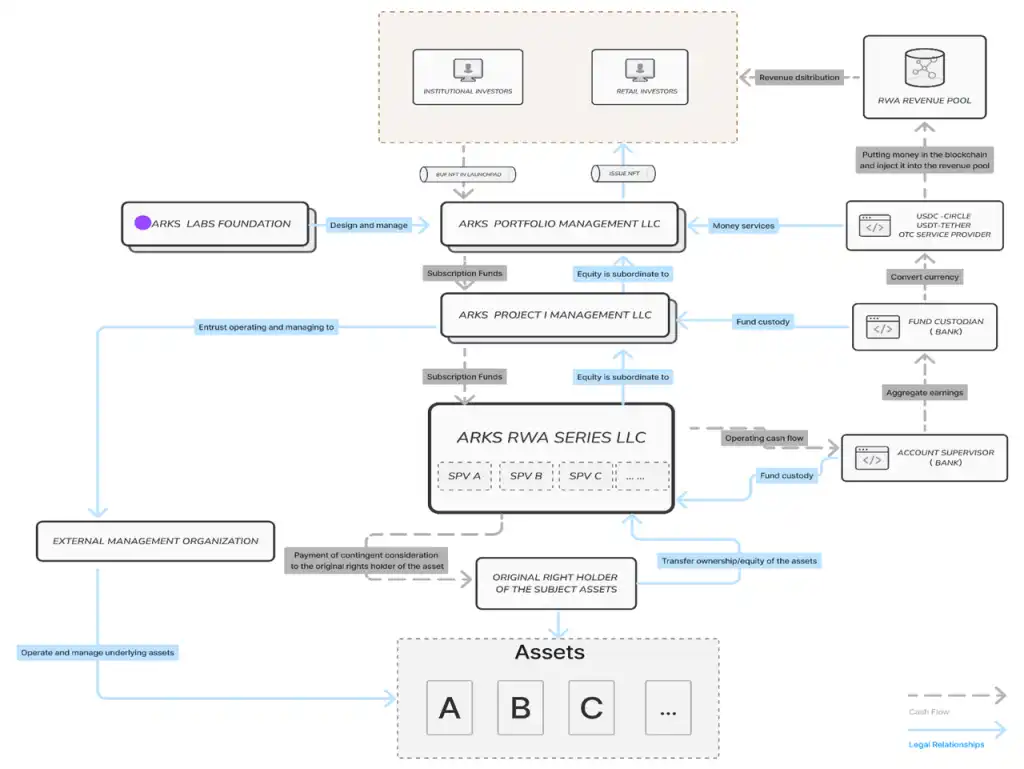
Source: ARKS Labs
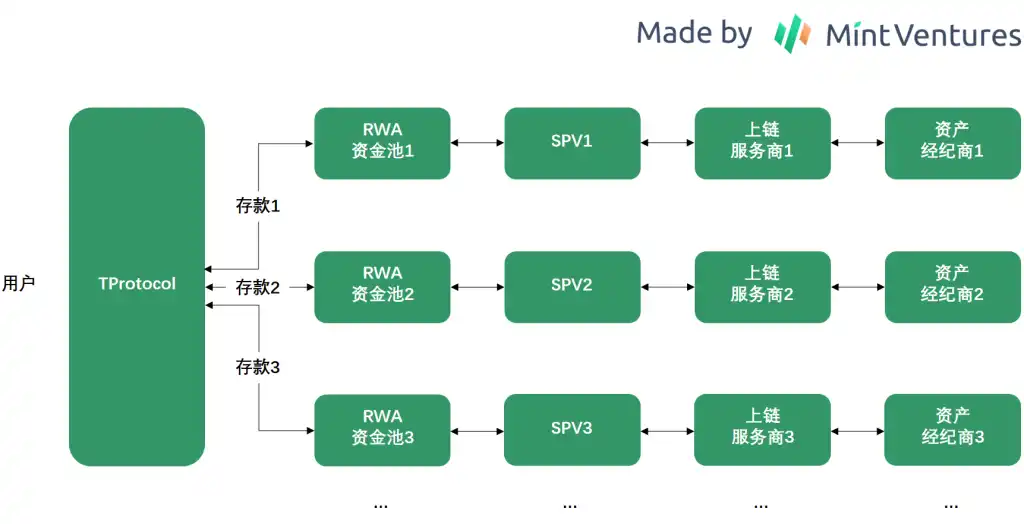
(3) Lending platform + SPV architecture: Currently, TProtocol adopts this type of business architecture. Compared with the second SPV business architecture mentioned above, the difference is that in the second SPV business architecture, one of the parties involved in the SPV is the project party, and the project party will participate in the asset search and packaging process. In TProtocol, the SPV is not related to TProtocol, but the initiator of the RWA asset.
Taking the following figure as an example, the initiator of the SPV can be different institutions, and the subsequent on-chain service providers and asset brokers can also be different. TProtocol's business organization is more flexible, but this is not without cost: as more and more partners are added, the subsequent control of the SPV, including the inspection and management capabilities of the service providers, may also be reduced to a certain extent.
(4) Fund shares on-chain: Similar to the strategy of traditional fund purchases, it is necessary to know the detailed information of the purchaser and the one-to-one correspondence with the address. Currently, Franklin OnChain U.S. Government Money Fund adopts such a business structure. This type of project is more like what was often called "chain reform" in the past, that is, the project party will put the assets and purchaser information off-chain on the chain, and the future transfer information will also be recorded in a bookkeeping manner and recorded again on the blockchain.
Although the RWA track is in its early stages, the requirements for the business architecture in terms of users and capital scale are not high, but as the value of treasury bond RWA is gradually recognized by investors, the "scalability" of the architecture becomes very important. Whether new assets can be packaged in a timely manner and more off-chain service providers can be connected may be the key to success in the rapid development stage of the track.
User side: KYC and other requirements
Due to the differences in underlying assets and business architecture, the project parties' requirements for the user side are also different. At present, there are three main differences:
(1) Minimum investment threshold: Projects led by MakerDAO, ARKS Labs, and TProtocol do not set a minimum investment amount limit for users, but projects such as Maple Finance, TrueFi, Arca Labs, and Backed Finance have set clear minimum investment amount limits. "No minimum investment amount limit" is more in line with the habits of current DeFi users. Some projects with a minimum investment amount of more than 100,000 US dollars are mainly aimed at users with higher net worth.
(2) KYC requirements: According to the difficulty of KYC, it can be divided into 3 categories: no KYC projects, such as Flux Finance, ARKS Labs and TProtocol; lightweight KYC, such as Desmo Labs, only need to upload passport information; heavy KYC, such as OpenEden, Ondo Finance, Maple Finance, Matrixdock, etc., need to submit KYC information comparable to that of the traditional financial industry. The higher KYC threshold not only means a threshold in the traditional financial industry, but it is even more unacceptable for DeFi users at this stage.
(3) Other requirements: Some projects also limit their investors to certain regions, such as only serving non-US users, or only serving non-US, non-Singapore, and non-Hong Kong users. This type of restriction is generally implemented by limiting IP addresses.
Some projects’ requirements for users, such as KYC and regional restrictions, are often verified by third-party KYC service providers, and the project party does not directly participate in the KYC review process.
Profit distribution strategy and composability
Profit distribution strategy
There are currently two main profit distribution strategies in the market:
The first strategy is the most common, which is to distribute directly through the debt relationship. Regardless of whether the user holds SPV debt or obtains treasury bond ETFs, treasury bonds, etc. through other structures, the final user can get most of the income generated by treasury bonds. Excluding the income earned by minting and destruction, as well as the income earned by intermediaries, users can probably get a net income of about 4 percentage points.
This income distribution method is very similar to LSD: most of the pledge income is returned to the user, and only a part of the handling fee is deducted.
The second strategy currently only appears in the MakerDAO project, that is, through the deposit interest rate. Since the user's funds do not directly correspond to the underlying assets, MakerDAO uses a model similar to the interest rate spread of commercial banks: on the asset side, the assets are invested in assets such as RWA that currently have relatively high returns; on the liability side, the income obtained by users is adjusted through DSR. So far, DSR has been adjusted four times, namely: (1) from 1% to 3.49%; (2) from 3.49% to 3.19%; (3) from 3.19% to 8%; (4) from 8% to 5%.
This strategy gives the project team greater flexibility, but the disadvantages may also be obvious: users lack a clearer analysis framework for future yields. Originally, it was a treasury bond RWA, and users directly understood that they had obtained a yield level close to the treasury bond yield. However, through monetary policy, such as the recent MakerDAO giving excess returns to deposit users, it caused a surge to 8%. If the number of deposit users increases to a sufficient number, the yield will drop to around the U.S. Treasury yield. This fluctuation is not friendly to investors who hope for a stable yield level.
For the yield of treasury bond RWA, clear and clear "predictability" is very important, so the first yield distribution strategy may be better than the second strategy. However, once the project adopting the second strategy clearly anchors the yield of government bonds, there will be no difference between the two from the perspective of yield.
Composability
Due to the KYC requirements, the composability of government bond RWA tokens has also diverged:
Some projects with strict KYC qualifications, such as Ondo Finance, Matrixdock, Franklin OnChain U.S. Government Money Fund, etc., have whitelist restrictions on addresses, so even if there are corresponding token trading pools on the chain, it is impossible to allow users to trade freely without access. For this type of project, unless the scale of the underlying assets can be large enough, it is difficult to get the support of many DeFi projects and obtain richer composability.
There is no difficulty in composability for projects that do not require KYC. The only factors that limit the composability of such projects are the business resources, BD capabilities, and scale of the projects themselves.
Summary
By combing through the above Treasury RWA projects, we can vaguely see the business model that may win for such projects in the short and medium term:
Underlying assets:Using Treasury bond ETFs may be a relatively tricky way to leave liquidity management and other issues to the giants in the traditional financial field. If the purchase is of US debt or mixed assets directly, the project party’s ability to select partners will be tested;
Business architecture: There is already a relatively mature model that can be applied, preferably with strong scalability to facilitate faster expansion and the inclusion of new asset categories in the future;
User side: In the short and medium term, projects that do not require KYC and have no capital threshold requirements have a wider user base. In the future, if the regulators require KYC, lightweight KYC projects may become a more mainstream solution;
Income distribution:In order to make the expectations of the yield of treasury bond RWA investors more stable and assured, the best solution is to keep the yield provided to users by the project consistent with the yield of treasury bonds;
Composability:Before the regulators restrict the access permission of RWA assets on the chain, expanding the use scenarios of user treasury bond RWA tokens as much as possible is an important factor for each project to obtain a larger business volume in the medium and long term.
In the medium and long term competition, some lightweight KYC projects may have greater opportunities due to the increasingly in-depth involvement of regulators.
Original link
Welcome to join the official BlockBeats community:
Telegram Subscription Group: https://t.me/theblockbeats
Telegram Discussion Group: https://t.me/BlockBeats_App
Official Twitter Account: https://twitter.com/BlockBeatsAsia