Competitor of DYDX, cryptocurrency derivatives platform MEKE's first round of public testing will end on August 10th.
Source: MEKE
(This content contains only HTML tags and punctuation marks, which will be returned as is.)
Since the launch of Bitcoin perpetual contracts in 2016, the growth of perpetual contract market in the entire cryptocurrency field has become unstoppable. By 2023, the market potential of perpetual contracts will gradually expand, completely crushing the cryptocurrency spot market.
From the launch of the first cryptocurrency perpetual contract trading platform to today, the development of perpetual contract trading platforms has undergone a qualitative change. Initially, perpetual trading platforms could only be built using centralized technology due to technical limitations. However, with the rise of DeFi and the improvement of blockchain performance, decentralized perpetual contracts have become a new direction.
In July 2023, MEKE, a chain-based derivatives trading platform developed by a US technology team, emerged. MEKE's main functions are deployed on the blockchain and can be used for perpetual contract trading of various mainstream cryptocurrencies such as BTC and ETH. In addition, MEKE will also involve perpetual contract trading of various physical assets such as gold, foreign exchange, and US bonds in the future.
MEKE has been loved by global cryptocurrency traders since its launch. Since the launch of perpetual contracts, some decentralized perpetual trading platforms have also appeared on the market, but most of them have discouraged users due to their cumbersome operation steps and laggy experience. However, MEKE has done quite well in this regard. MEKE not only realizes the characteristics of on-chain trading, tamper-proof trading, public transparency, and traceability, but also has a smooth experience similar to centralized user contracts.
In the entire decentralized perpetual contract trading market, dydx and GMX can be considered as the undisputed leading projects in the industry. However, MEKE is not inferior to them in terms of technology and user experience.
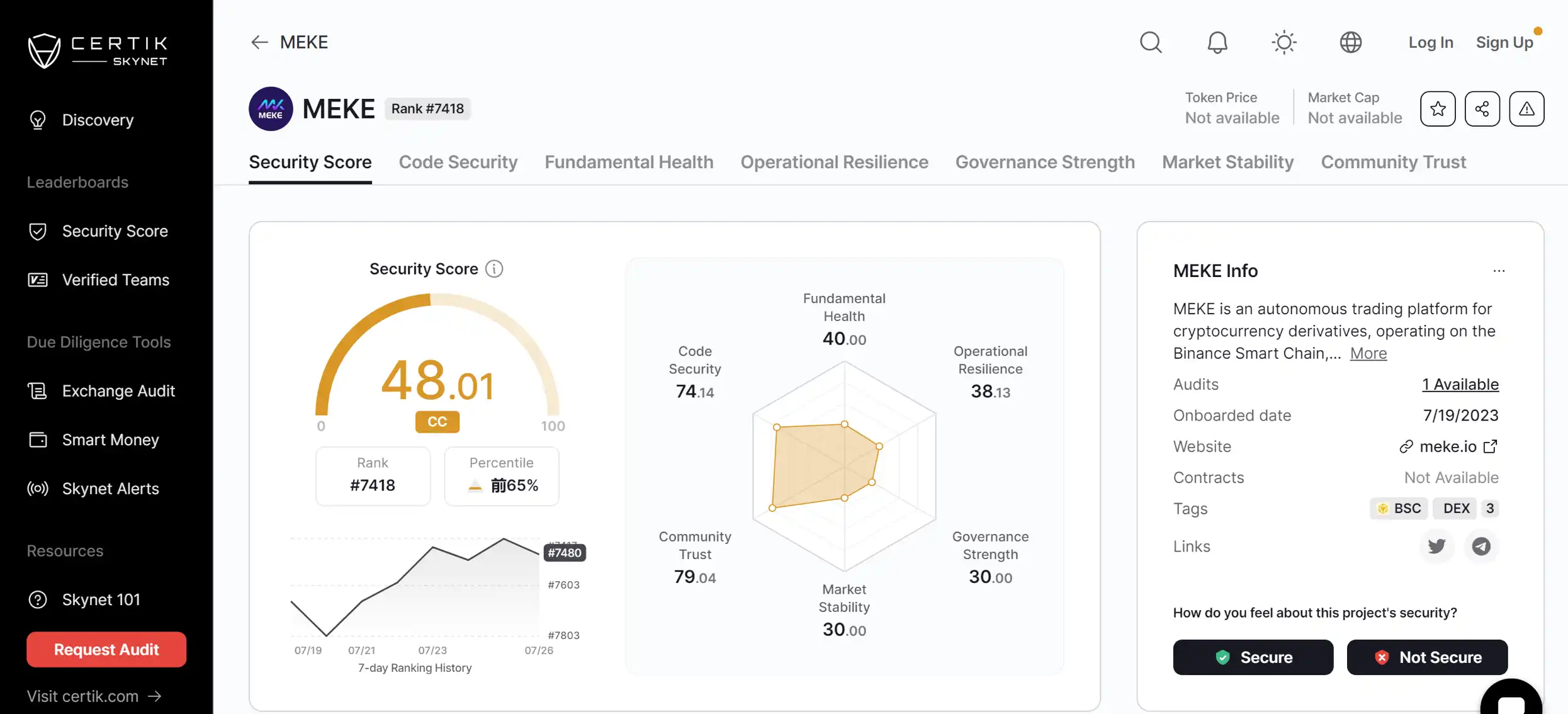
Using dYdX as an example, MEKE is deployed on the Layer2 opBNB launched by Binance, the world's largest trading platform, which is comparable to dYdX deployed on Starkware. The opBNB network has performance that is not inferior to all current L2 solutions, with a block time of 1 second, gas fees as low as $0.005, and a transaction processing capacity of over 4000 TPS. In terms of user experience, MEKE has already launched its first round of public testing on July 31st, and the testing experience is just as good as dYdX. Currently, dYdX has chosen to launch its own trading chain through Cosmos Stack, and perhaps MEKE and dYdX will be fierce competitors in the future.
Compared to GMX, MEKE differs in that it uses a classic order book model, making trading data more clear and visible, more in line with the trading habits and experience of the majority of traders, and more conducive to market makers. On the other hand, MEKE uses a weighted average price of oracle prices and real-time transaction prices on the platform as the implementation guidance price of assets, which is more stable and can largely avoid oracle attacks. GMX uses liquidity pool trading and uses only oracle prices for pricing.
Compared to spot contracts, perpetual contracts have the allure of leveraging to make big gains. Compared to traditional fixed-term contracts, perpetual contracts offer the flexibility of trading at any time, making them more suitable for the ever-changing cryptocurrency market. Therefore, perpetual contracts have been favored by many cryptocurrency traders. Until now, perpetual contracts have become the main source of income for many centralized trading platforms such as Binance and OKEX.
According to data from Binance's investigation, the cryptocurrency derivatives market currently accounts for 74.2% of the total trading volume. The monthly trading volume of cryptocurrency derivatives has tripled in the past three years, reaching $1.9 trillion. With the booming development of the cryptocurrency derivatives market, it is expected that the market revenue will increase to $231.2 billion by 2030. In recent years, with the increasing regulatory pressure and people's desire for transparent trading, decentralized perpetual contract trading has become the trend of the entire industry. It can be imagined that in the future, a leading product in the on-chain cryptocurrency derivatives market will emerge, just like Binance and Coinbase today. MEKE may be one of them.
Aside from MEKE's strong technological advantages and vast market potential, the MEKE token model is also noteworthy. The total supply of MEKE tokens is 60 billion, distributed as follows:
· 10% of which will be used to distribute to early investment advisors and technical advisors, and a large portion of the 10% will be airdropped to early users who participate in the MEKE public beta test.
· 50% is used to incentivize market makers and users. Users can earn MEKE by trading and providing liquidity to the trading platform through mining. The mining period lasts for at least ten years.
· 10% is owned by the project party and is used for market maintenance and various promotional activities.
The remaining 10% will be kept as an insurance fund. In the event of a major incident, the community will vote on how to handle the fund.
The use cases of MEKE token include:
1. DAO governance of the platform.
2. Hold MEKE to enjoy reduced transaction fees.
3. The platform will repurchase MEKE periodically.
4. Mortgage MEKE and share MEKE platform handling fees.
5. In the future, MEKE will open its public chain, and MEKE can be directly used for gas fees on the public chain.
As can be seen from above, more than 90% of the MEKE tokens will be gradually released over a period of ten years, with less than 10% being airdropped to early users who participated in the MEKE beta test. The first phase of the MEKE beta test started on July 31st and will end on August 10th, with only about one day left until the end. Currently, the MEKE beta test is progressing very well, with a large number of users joining the test every day, and the total number of users participating in the test has exceeded 20,000.
For users participating in the MEKE public beta, MEKE will airdrop platform tokens based on the amount of USDT traded by the user and their contribution to platform traffic. There are three phases in the public beta, and the earlier the participation, the more cost-effective the airdrop will be. The airdrop will gradually decrease in later phases. If there are any remaining MEKE tokens planned for airdrop after the public beta period, they will be directly destroyed.
It is worth mentioning that the underlying L2 opBNB deployed by MEKE has not yet issued tokens, and the opBNB mainnet will also be launched at the end of August. This means that participating in the MEKE public beta not only can get MEKE airdrops, but also may have the opportunity to get opBNB airdrops. The first phase of the MEKE public beta is about to end. For more details, please long press to copy and click to enter the MEKE community.
Official website: https://meke.io
Telegram: https://t.me/MEKE_Global
Discord: https://discord.gg/meke
Twitter: https://twitter.com/MEKE_PROTOCOL

Welcome to join the official BlockBeats community:
Telegram Subscription Group: https://t.me/theblockbeats
Telegram Discussion Group: https://t.me/BlockBeats_App
Official Twitter Account: https://twitter.com/BlockBeatsAsia