Interview with Linea: "Web3 giant" with a core competitive value of 7 billion USD.



Interview: Jack, BlockBeats
Translation: DaiTJ, Jaleel, BlockBeats
Editor: Jack, BlockBeats
After nearly 5 years of research and development, Linea team announced the launch of the mainnet Alpha during the Paris ETHCC conference in July, which has attracted widespread attention from the community. As of August 4th, according to Dune data, the mainnet has attracted more than 100 ecological projects in just one week, crossing over 20,000 ETH, with more than 170,000 transactions and over 127,000 interaction addresses, making Linea one of the largest and fastest-growing projects in terms of transaction volume on Goerli.

Since the beginning of this year, the ZK track has entered a stage of arms race, and this competition has entered a white-hot stage in recent months. zkSync and Starknet are following the OP camp and competing to release their own L3 plans. Also at the beginning of the year, Linea emerged in the already crowded ZK track and gradually attracted more users and attention with its dark horse momentum.
In March of this year, "Web3 Big Factory" ConsenSys launched a public test network and renamed it Linea. This test network, which will go live in the fourth quarter of 2022, has processed more than 350,000 on-chain transactions in three months. In an official blog post, the team wrote: "Linea represents the next stage of evolution for ConsenSys zkEVM, providing power for the new generation of Ethereum dApps."
This blockchain scaling solution, built by MetaMask's parent company, aims to combine powerful zero-knowledge proofs with the active EVM ecosystem to help developers build or migrate existing dApps in the simplest way possible. As a Type2 zkEVM equivalent to EVM, Linea offers new possibilities for solving the compatibility issues between ZK Rollup and EVM. In addition, ConsenSys also hopes to fully leverage its ecosystem advantages by natively integrating Linea with the company's MetaMask wallet and developer toolkit Truffle.
Declan joined the ConsenSys team as the Linea product manager in 2021. His core responsibility is to consider the features that the Linea core development team should promote, and to understand the importance behind these features, as well as the challenges that customers and partners may encounter when using our network. However, in an interview, Declan stated that from a broader perspective, his long-term goal is to gradually make his role "redundant".
"This may sound arrogant, but I believe that true success for Linea is when people pay more attention to our Web3 infrastructure and team, rather than just the applications themselves. This mindset is not unfamiliar in the Web2 world. For example, people usually don't care about which cloud server Facebook runs on, they care about the Facebook application itself. So that's what we need to do in terms of infrastructure."
Recently, BlockBeats interviewed Declan Fox, delving deep into topics such as the Linea mainnet Alpha, the ConsenSys ecosystem, the current and future state of the zkEVM track, as well as account abstraction and multi-provers.
About Mainnet Alpha
At the ETHCC conference in July, Linea announced the launch of its mainnet Alpha. With the expected airdrop and a series of task activities, the TVL on the Linea network exceeded $30 million in less than a month, and more than 100 DeFi-based application projects emerged rapidly within the ecosystem. However, there have been numerous feedback regarding "cross-chain difficulties" and "slow interaction" during the process. What explanation will the Linea team provide for this?
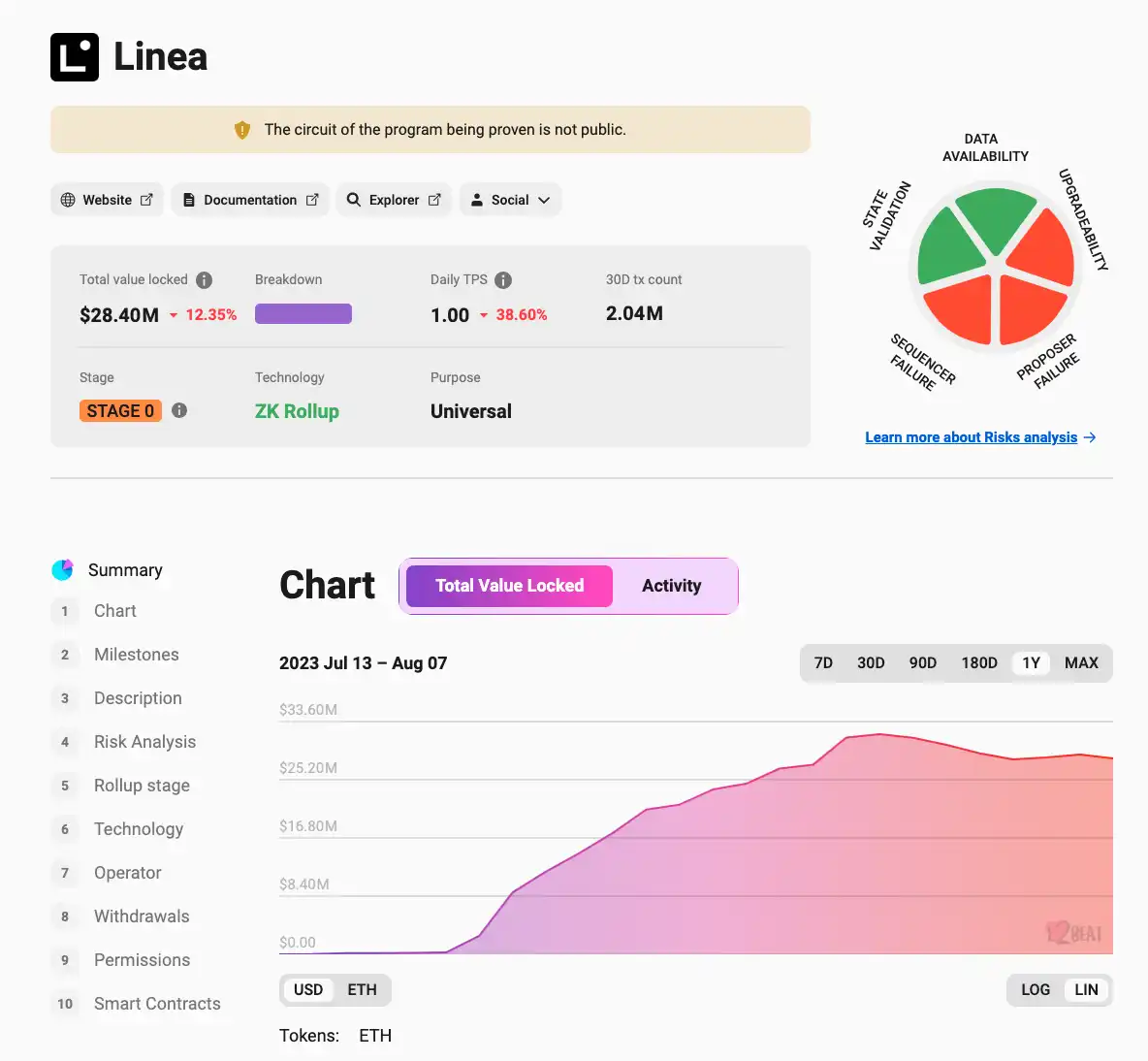
According to L2BEATS data, the TVL of Linea mainnet has grown beyond 30 million US dollars in about two weeks, and is currently stable at around 28 million US dollars.
BlockBeats: First of all, congratulations to you. The TVL of Linea mainnet has exceeded 30 million US dollars in such a short period of time. In your opinion, what is the main reason for this?
Declan Fox: I think there are two main reasons why we can achieve such success. First, as you said, we have accumulated great momentum from the testnet. Linea testnet launched a 9-week "Linea Journey", where users can experience different themed dApps every week, such as DeFi Week, NFT Week, Cross-chain Week, etc. This event was very successful, and we saw about 50 million transactions and attracted many interesting protocols to join, such as the Account Abstraction Protocol, which attracted over 1 million user operations on the testnet.
After the testnet event, we quickly launched the mainnet and carried the momentum forward. Additionally, during the mainnet launch, we conducted one of the largest on-chain NFT airdrops, distributing 352,000 NFTs to participants of the testnet event as a reward for helping test the network and promote the mainnet launch. We also opened up a public and free NFT minting event to a wider audience.
I believe the second reason is that people see the potential of Linea and have high expectations for its future. As a zkEVM public chain, Linea allows developers to seamlessly migrate existing dApps or develop new ones. At the same time, Linea is also integrated with other products from ConsenSys and will be automatically integrated into MetaMask upon mainnet launch.
This not only makes it easier to attract users, but also means that developers' users can easily access dApps on the Linea mainnet. I believe people see the value of this integration, so they are joining the Linea ecosystem despite it being in its early stages. We also intentionally marked it as an Alpha version, clearly indicating that this is a major milestone. There are now over 30 million TBR on Linea, not including the token bridge we are about to launch, which will enable cross-chain stablecoins and other ERC20 tokens.
Linea has many anticipated features coming soon, and many dApps are waiting for these features to go live. Overall, Linea has made a great start.
BlockBeats: You just mentioned many DeFi and NFT applications based on Linea. With the launch of the mainnet Alpha, what kind of applications do you most hope to see on Linea?
Declan Fox: DeFi is definitely a key focus area for Linea. In the world of cryptocurrency and Web3, DeFi has already taken on an important role, and Linea has brought even more possibilities to DeFi.
First of all, Linea is not only a universal smart contract platform that supports the combination and construction of different DeFi protocols, but also provides lower gas fees and higher throughput, which Ethereum does not have. This brings a better user experience for DeFi users.
Meanwhile, as a ZK rollup, Linea inherits the security of Ethereum and does not need to make dangerous trade-offs like sidechains. As a ZK rollup, Linea can achieve L2 transaction certainty in just a few minutes, which is crucial for DeFi and can provide certainty guarantees for high-value transactions in minutes instead of weeks as in the past.
Additionally, considering the cross-chain bridging with other systems such as Ethereum, Linea's fast determinism can greatly improve the efficiency of cross-chain fund utilization. This is similar to countries that have lifted capital controls, which can attract external funds more easily.
In summary, as a zkEVM rollup, Linea brings unique advantages to DeFi, ensuring both security and providing efficient and low-cost user experience. This will be the key to the flourishing development of DeFi on Linea.
Blockbeats: Next, I would like to ask about the issue of delayed withdrawal time. Previously, Linea announced that for security reasons, at least an 8-hour withdrawal delay would be artificially set. Can you explain the reason behind this move?
Declan Fox: An 8-hour withdrawal delay can be seen as a temporary security measure or a "training round". As I mentioned, the Linea mainnet is currently in the alpha stage and we have just deployed the system. We need to ensure that users' assets are protected while the system is still relatively early.
The purpose of setting an 8-hour withdrawal delay is to allow enough time to pause operations or intervene if there are any issues with rollup or if we need to investigate to protect user assets. As mentioned in our risk disclosure document, a security committee can be activated if necessary to take action and intervene. We do not want to do this, but it is a security measure.
Currently, the withdrawal delay is 8 hours. As we gain a deeper understanding of the system and the mainnet runs for longer periods without issues, we will gradually remove this restriction. I believe that zkSync currently has a withdrawal delay of 21 hours or even longer. However, all of these systems have an initial "training round" and I believe that over time, these restrictions will continue to decrease.
BlockBeats: However, during the interaction with Linea Network, complaints about network latency can indeed be heard. What is the reason for this?
Declan Fox: There are two types of delays. The determinism on Layer 2 is softer, while Layer 1 is the final determinism confirmed by Ethereum itself. Currently, the delay on Layer 1 is mainly caused by the 8-hour withdrawal delay we set, but this will gradually decrease over time.
Currently, the delay block time of Linea itself is 12 seconds, with a quota of 30 million gas. In the next few months, we will gradually shorten the block time and reduce the delay. Technically, there is no bottleneck, we just want to gradually introduce the system in stages. The next stage will shorten the block time by about 60%, making it a block time of 4 seconds, with a quota of 15 million gas. After that, we will further shorten the block time and increase the quota.
Reducing latency and increasing throughput is indeed not easy, but we are in a favorable position because we have the Basu team to provide us with technical support. The Basu team is currently executing blocks on Ethereum Layer 1 and will also become a sorting node for Linea in the future.
This is an experienced team whose client software has been tested in practice and can be seamlessly applied on Linea. This will be a key differentiating factor in ensuring that we can achieve both fast block production and accommodate a large volume of transactions. In short, this is not limited by technological bottlenecks, but rather the result of a phased and gradual rollout of the system.
About Linea and ConsenSys
It must be admitted that many people pay attention to Linea because of its powerful backer - "Web3 giant" ConsenSys. This OG crypto company, founded in 2014, now has business throughout the entire crypto industry. As one of the largest and most fundamental entities in the field of blockchain technology, ConsenSys has top computer scientists, protocol engineers, software developers, and enterprise delivery experts. In 2018, ConsenSys was called by The New Yorker as "the most famous and widespread developer and promoter of decentralized applications in the Ethereum community".
Among the many products it has created, MetaMask is undoubtedly the most influential. Now, this Web3 wallet with a large user base will bring a natural advantage in user numbers to Linea. As of now, Linea has raised $726 million in multiple rounds of financing, with a valuation of approximately $7 billion. As a strong player of ConsenSys, Linea will undoubtedly carve out a space for ConsenSys in the most market space expansion track. Of course, this also raises concerns and reflections about the decentralization spirit of Web3 and the centralized development of large teams.
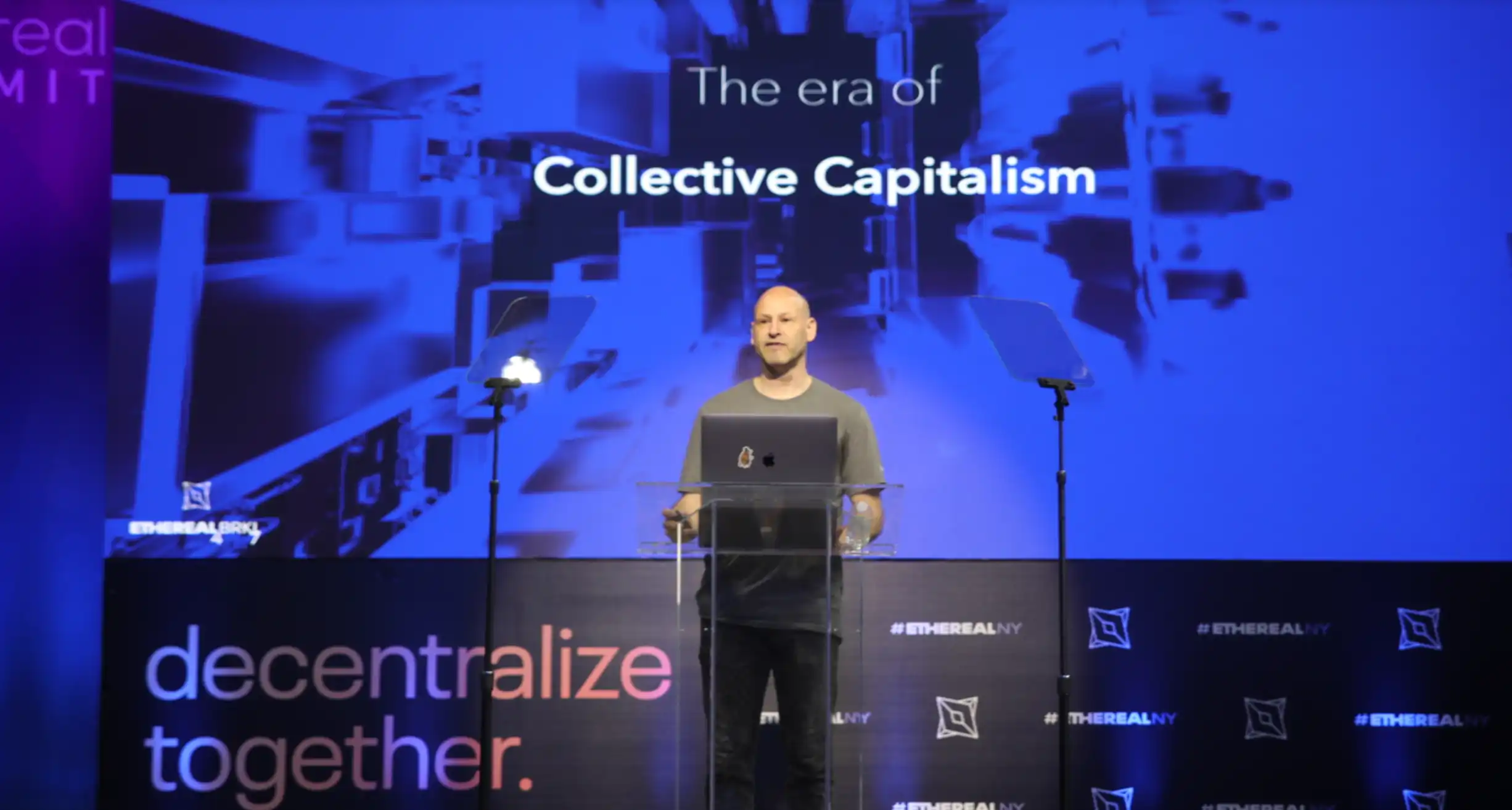
ConsenSys founder and CEO Joe Lubin gave a speech titled "The Age of Collective Capitalism" at the 2019 Ethereum New York Conference.
BlockBeats: In your opinion, what role does Linea play in the ConsenSys ecosystem?
ConsenSys has also incubated many public products, such as Baesu (one of Ethereum's leading execution clients), Teku (one of ConsenSys' important execution clients for Ethereum 2.0 merger), Web3Signer (a tool for securely signing private keys or transactions), etc. Linea is a key infrastructure to expand Ethereum's transaction capabilities. We recognized this need several years ago and also need to maintain the network effect of EVM during the expansion process.
Therefore, Linea can be said to perfect ConsenSys' technology stack, in order to have an impact and provide support for the entire process from users initiating transactions through MetaMask to reaching the RPC layer, and actually executing transactions on a scalable, general-purpose platform, which is the EVM-compatible Linea. It can be said that Linea seamlessly integrates into the solution portfolio provided by ConsenSys, helping to drive the development of the entire ecosystem.
BlockBeats: However, this has also raised concerns among some people who believe that ConsenSys is becoming a centralizing force in the Web3 and crypto world. Most people use MetaMask as their wallet, as well as the RPC provided by ConsenSys, and soon more people will be using the Linea network. I want to know how the Linea team views this perspective?
Declan Fox: I believe we should see that all these products are planned to develop towards decentralization and permissionless innovation.
Looking at it one by one, first of all, Linea has already released a decentralized and trust-minimized roadmap when the mainnet was launched, clarifying that Linea's operations and governance will gradually become decentralized and reduce dependence on ConsenSys. MetaMask users can also choose different RPC nodes and use non-Linea networks. The team is developing MetaMask Snaps, which allows any developer to extend MetaMask without permission.
Linea also supports the use of any wallet. As we can see, ConsenSys has promoted the development of the entire Web3 ecosystem by providing these key infrastructure products. However, the core principles of these products still adhere to decentralization and user freedom of choice. Users can choose to exit at any time according to their own needs.
BlockBeats: Let's talk about account abstraction on Linea. As an L2 network with native integration with MetaMask, can Linea better assist in innovating account abstraction for MetaMask?
Declan Fox: Yes, our philosophy is innovation without permission. So even for Linea today, there are other wallets that support Linea. Similarly, MetaMask will continue to support all other networks except Linea. We are working hard to find ways to improve the user experience together, but there needs to be a delicate balance between maintaining permissionless innovation and creating an environment that can solve user problems and drive space forward.
It is not practical to implement account abstraction at the protocol layer in the short term. Although it is on the Ethereum roadmap, we will not see the implementation of EIP-4337 tomorrow. Currently, we have implemented EIP-4337 and smart contract accounts at the application layer, but it is still costly and more suitable for use on Layer 2. As a Layer 2 zkEVM public chain, Linea is fully compatible with the Ethereum mainnet.
Therefore, various standards promoted by the Ethereum community, such as 4337, can be easily implemented on Linea. This allows us to leverage the rapidly growing community of account abstraction from day one of the Linea ecosystem. Additionally, we will also seek to support new endpoints to simplify management and protect the RPC and serialization layers from denial-of-service attacks. All of these stem from the larger Ethereum community consensus. As Linea is a fully compatible zkEVM, we are fortunate to be able to easily join and continue the network effects of Ethereum.
About zkEVM and RaaS
When discussing Linea, the topic of zkEVM cannot be avoided. As the most competitive field in the encryption industry, the zkEVM field brings together the most capable and intelligent developers in the industry. In addition to the different types of technical implementations of ZK L2, "RaaS" has recently become a "disaster area" for these geniuses. After the OP camp launched OP Stack and Orbit, zkSync and Starknet followed suit and released ZK Stack and Appchain. As one of the powerful representatives of zkEVM, will Linea also take similar actions in this field?
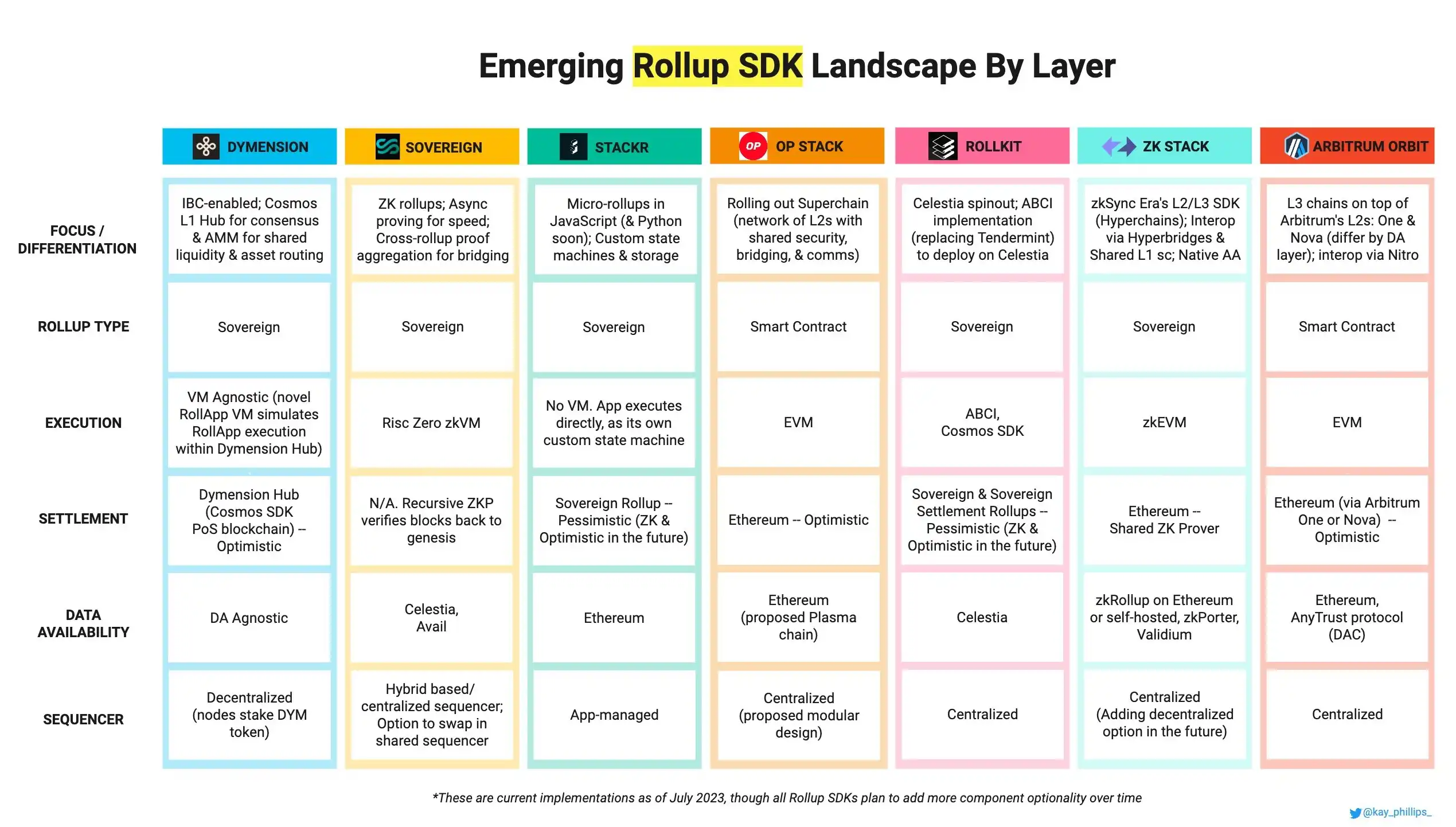
Rollup SDK Map curated by Kayla Phillips, Partner at Truffle Ventures
BlockBeats: Next, I want to talk about the general topic of zkEVM. Why did Linea choose to do Type2 zkEVM? What is Linea's biggest advantage compared to Polygon zkEVM and Scroll?
Declan Fox: Our decision to build Type2 zkEVM can be traced back to 4 years ago, which was January 2019. At that time, our R&D team Consensus R&D (which also helped implement the merge and engine API) was researching scaling solutions. In 2019, much of the discussion centered around optimistic rollups, while zero-knowledge technology was still in its infancy and the EVM was not easily simulated as a circuit.
So many people are unwilling to take the zero-knowledge proof route and instead build their own zkEVM. These virtual machines have their own programming languages, while EVM has the largest developer, tool, and dApps ecosystem in Web3. Considering the huge EVM ecosystem, we don't want to start from scratch, but maintain the network effect of EVM. So at the time, we believed that zero-knowledge proof was the best scaling solution for the future, while also maintaining the network effect of EVM. So we set out to achieve this goal, and after 4 years, we finally achieved a zkEVM that is both high-performance and compatible with EVM.
As a Type2, it means that we are largely equivalent to EVM. We use the same Solidity compiler and RPC interface as Ethereum, which is very developer-friendly. They don't need to learn new languages or tools, and existing dApps can seamlessly connect. This is also beneficial for decentralization, as users can choose to exit at any time without the risk of vendor lock-in. We follow Ethereum's standards and remain consistent with any project that implements EVM, which is also beneficial for decentralization.
There are other projects that are building similar projects to Type2 zkEVM. I believe the main differences between Linea and other projects are in two aspects: technical implementation and ecological integration.
In terms of technology, we can bring higher performance. Specifically, the speed and verification cost of the Prover in zero-knowledge proof are crucial to user experience and transaction fees. We have been building our own Prover since January 2019, and after four years of investment in research and development, it can be said to be the best in the industry. We directly arithmetize EVM operations instead of adding intermediate translation steps. This allows us to optimize at a lower level, which other systems cannot do.
Regarding ecological integration, Linea has deeply integrated with other products under ConsenSys. For example, the native integration with MetaMask is just the beginning, but it has already demonstrated the possibility of providing a complete user experience from wallet to RPC to execution layer. In addition, Infura provides support for infrastructure construction, which can improve the stability and security of Linea. Finally, the Basu team provides us with execution clients and sorting nodes. This collaboration can create a more comprehensive and coherent user experience, which is unmatched by other platforms.
Related reading: "Interview with Polygon zkEVM: One Token is Enough for MATIC".
BlockBeats: In addition to different types of ZK Rollups, another popular concept recently is "RaaS" (Rollup as a Service). As a strong competitor in the zkEVM field, does Linea have any plans in this direction?
Declan Fox: This is indeed an interesting topic. Overall, we are discussing the surge of Appchains or chains tailored to specific use cases, which is not a new concept. I believe that with the emergence of rollups, launching a new chain has become much simpler and more meaningful compared to the past monolithic Appchains.
Some people want to do this because they need a more flexible execution environment, or they want to have their own isolated block space and have complete control over the throughput and demand of the application. I don't think there will be only one shared execution environment to handle all transactions in the future, similar to the development of computing, from running multiple applications on a single server at the beginning to the trend of one application corresponding to one server later.
Of course, the shared execution environment still has its value, and we can continue to advance its development and see what use cases can be built. The shared execution environment can achieve synchronous composition, which is difficult to replicate in the fragmented multi-chain world. Linea has promised to open source its code, so Linea's technology stack can be instantiated. If the trend of fragmentation continues to intensify, there will be more demand for different instantiations of the Linea virtual machine, and fast proof generation will be crucial to verify the state with other chains and ensure a smooth user experience.
Linea happens to have a very fast Prover, so if this trend continues, Linea's technology stack and virtual machine will be very attractive to teams who want to build their own execution environment and eventually aggregate to the Ethereum mainnet. Many teams have already realized this in preliminary discussions, but we have not received any formal news yet.
About Multi Prover and the Future
At the Linea team, there is also a focus on a concept called Multi Prover. What does this concept refer to? What can Multi Prover bring to zkEVM and the cryptography industry? Why does the team consider it so important?
BlockBeats: What are Linea's current thoughts on the "multi-prover" concept that they have been promoting?
Declan Fox: Yes, this is the content mentioned in our decentralized and trust-minimized roadmap released during the launch of the Alpha mainnet. The basic idea is that Layer 2 transactions or batch transactions can be proven by multiple zero-knowledge proofs simultaneously. As long as the majority of them are verified on Layer 1, security can be ensured. This is more reliable than rollups with a single prover, without the risk of a single point of failure. As Ethereum continues to evolve, the standards need to be re-audited and updated, and the multi-prover model can help overcome various limitations.
As a zkEVM that closely replicates the EVM specification, Linea is in an excellent position to unlock multi-prover mode. I believe that once this is achieved, it will attract new risk-averse enterprises, liquidity, and users to enter Layer 2. This gives them better assurance that even if a prover has a vulnerability, the system can still remain secure. This is similar to the variety of execution clients available on the Ethereum mainnet, providing diversity. We hope to replicate the same level of security on Layer 2.
BlockBeats: Does the team currently have a mature design plan?
Multi-prover also allows us to innovate more in the Prover aspect, as there is a fallback guarantee. In short, multi-prover brings many interesting possibilities, which is also our long-term goal in the roadmap. We will maintain an open attitude towards specific technical solutions, but not fix them too early. Our goal is to achieve similar security and diversity as the Ethereum mainnet in Layer 2. Multi-prover not only improves stability, but also gives us greater innovation space in proof generation, which is very exciting. It will take time to implement multi-prover, but it is definitely our long-term goal and vision.
Declan Fox: From the user's perspective, the multi-prover mode is roughly similar to today's form. However, it can give developers and users higher confidence in the maturity of the system by increasing diversity and resilience to errors. This is similar to the Ethereum mainnet having various execution clients and consensus clients. If one client has an error, as long as there is enough diversity in the overall implementation, Ethereum can still ensure security. We are applying these design principles of Ethereum to Linea and Layer 2.
BlockBeats: Overall, what do you think is the most important task for the team going forward?
Declan Fox: Our main focus is still on the growth of user adoption, and to achieve this, we plan to approach it from several aspects.
Firstly, continue to reduce transaction costs. The cost of Linea is already much lower than that of Ethereum, but there is still room for further reduction in the short term. We can use aggregated proofs, zero-knowledge proofs, or validity proofs to complete second-layer transactions on Ethereum. In fact, we can aggregate many proofs together and recursively prove them, so that the fixed proof verification cost can be shared among larger transaction sets, reducing gas fees.
Data compression can also help reduce the cost of call data from Linea to Ethereum. We also hope to implement EIP-4844, which will reduce the cost of publishing call data to Ethereum. This Ethereum protocol change will be implemented later this year, and we will pass on the cost savings to our users.
Next is to improve the onboarding experience for new users. By simplifying the process of wallet opening and first-time use of DApps through account abstraction and other means, we aim to attract a new wave of users. We have already implemented the application of EIP-4337 for account abstraction on Linea, and on the Linea mainnet, we are also working with partners such as Pimnico to explore the possibility of opening wallets without the need for passwords.
Additionally, we need to enhance security. We will encourage our ecosystem partners and security-focused protocols to provide insights and information to users about malicious smart contracts, in an effort to help users avoid scams in a non-permissioned manner. Currently, there are many fraudulent activities on various chains, which hinders widespread adoption by users. We will strive to improve security in a decentralized manner while maintaining openness.
Welcome to join the official BlockBeats community:
Telegram Subscription Group: https://t.me/theblockbeats
Telegram Discussion Group: https://t.me/BlockBeats_App
Official Twitter Account: https://twitter.com/BlockBeatsAsia
 Related Articles