HopeLend: A key narrative in the trend towards full-stack DeFi, as told by Hope.money.
Whether it is RWA narrative or not, the veteran DeFi has once again become the focus of the market after 3 years. With Compound and MakerDAO as the leaders, the DeFi OGs have not only made the old DeFi follow the market with amazing gains, but also new DeFi projects are eager to try. HopeLend is one of them.
According to the planned roadmap, Hope.money, a stablecoin asset platform, has launched protocols and features such as HopeSwap, staking, and DAO in April. Recently, as one of the important foundational protocols in the entire ecosystem, HopeLend successfully completed its public beta test last week and is about to go live on the mainnet.
HopeLend is a decentralized non-custodial liquidity protocol where users can participate as depositors, borrowers, or liquidators. Depending on the state of the fund pool, HopeLend can provide instant loans without the need for individual matching between borrowers. Depositors provide liquidity to the market and earn passive income from it. At the same time, borrowers can borrow by over-collateralizing. Liquidators help prevent potential losses by quickly and efficiently liquidating under-collateralized positions and ensuring the supply of funds for other users.
HopeLend's Operating Mechanism
Regarding the operational mechanism, the HopeLend protocol provides convenience to liquidity providers through tokenization strategy. When funds are deposited, depositors will receive a corresponding amount of derivative tokens, namely HopeLend (referred to as hTokens), which are one-to-one corresponding to the underlying assets. Depositors can redeem their assets deposited in the fund pool at any time using the debt tool hToken. As a certificate of deposit, hToken can be sent to other addresses, and holding hToken is equivalent to owning both the ownership and the right to income of the deposited assets.
At the same time, the deposited assets can be used as collateral and new assets can be borrowed based on the Loan-to-Value (LTV) ratio. However, not all deposits can be used in all cases. Due to risk considerations, certain rules may restrict the use of deposits.
In order to prevent the risk of a single currency pool, the HopeLend protocol has established a risk committee, which sets a limit on the amount of deposits allowed for a specific pool based on the market performance and liquidity risk of a specific token. This limit can be adjusted by community vote as a tunable parameter. If the current token pool reaches the set deposit limit, users will not be able to continue depositing tokens. If the supply limit of the reserve is lower than the liquidity of the current reserve, no more liquidity can be provided to the reserve, but existing depositors will not be affected.
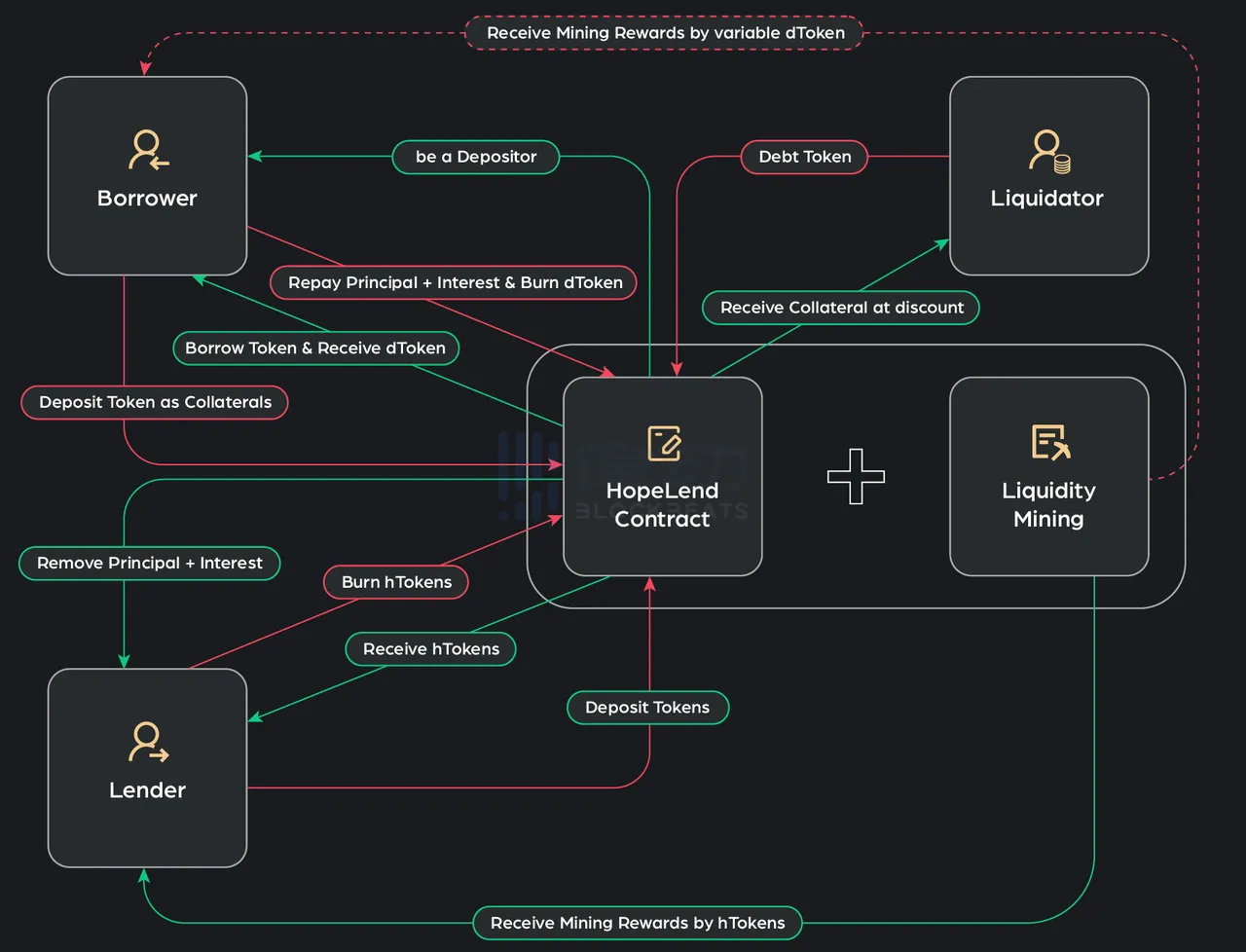
When users borrow assets in the agreement, they need to provide corresponding collateral assets. The specific amount of collateral assets is determined by their market performance and liquidity risk, and has an independent loan-to-value ratio (LTV) and liquidation threshold. At the same time, the amount of assets borrowed by users is calculated based on the loan-to-value ratio (LTV).
The number of borrowable assets has an upper limit to prevent the risk of protocol bankruptcy caused by various factors. This is an optional parameter that depends on the liquidity of on-chain assets and the total amount of borrowing assets in the liquidity pool. When the borrowing limit of a specific asset is reached, users will not be able to borrow assets from that asset pool. When users borrow funds from the HopeLend protocol, they will receive debt tokens, which are minted and destroyed during borrowing and repayment. The value of debt tokens is pegged to the underlying assets or collateral that support the debt.
How is the Lightning Loan function implemented?
Lightning loan refers to a financial service that completes loan and repayment operations in a very short period of time. In the DeFi field, lightning loans provide a way for financial transactions to be conducted without collateral, making it a powerful tool in the DeFi world. Lightning loans were initially proposed by the Marble protocol and have been widely adopted by protocols such as Aave, dYdX, and Uniswap. The first lightning loan transaction occurred on the Aave protocol. As an excellent latecomer, HopeLend will also support lightning loan functionality.
The execution process of Flash Loan is as follows: the user applies for a certain amount of assets, and the HopeLend protocol takes a snapshot of the asset balance. After some verification, the Pool (funding pool) applies to transfer the assets to the smart contract, so that the user can apply for a loan. The Flash Loan Receiver receives the assets from the Flash Loan. It can perform various operations such as arbitrage and liquidation. If the flashLoanSimple() function is executed, the receiver must repay the loan (including fees) to the funding pool after completing the operation. The funding pool will update the cache and interest rates, and transfer the user's loan amount and fees to the standby pool.
If the asset amount in the receiver's contract of the flash loan is less than the borrowed amount plus the fee when the flash loan ends, the data will be rolled back and the transaction will fail. If the flashLoan() function is executed and the mode parameter is not 0, the borrowed amount will become a debt after the operation is completed.
The process of debt conversion for Flash Loans is as follows: When applying for a Flash Loan, users can decide whether to convert the borrowed amount into regular debt through parameter settings. During this process, the system will conduct a check, and if it passes, it means that the user has converted the Flash Loan into regular debt. Users must set the interest rate mode in the interest rate model and can choose between floating or stable interest rates.
Loan Agreements and Stablecoins
As we all know, the economic model of Hope.money includes HOPE, stHOPE, LT, and veLT, among which the most important is the dual token mechanism of HOPE and LIGHT (LT).
LT is mainly used as a community governance token in the HOPE ecosystem, participating in the management and dividends of the protocol. Users can mint stHOPE by staking HOPE, and holding stHOPE can earn LT rewards. LT holders who want to participate in HOPE ecosystem governance need to stake LT to obtain veLT. The specific amount of veLT will depend on the amount of LT staked and the staking duration. When the HOPE ecosystem enters maturity, veLT holders will be able to participate in the formulation of rules for the use of excess reserve assets and enjoy the dividends brought by the protocol. This also means that LT will have bribery value, just like Curve's governance token CRV. At that time, the community may spontaneously organize to participate in the construction of the LT bribery ecosystem, creating a HOPE War similar to Curve War.
veLT is the tokenized representation of locked votes for LT when exercising governance rights. veLT holders can receive additional LT rewards. stHOPE is the tokenized representation of HOPE staking. Users can earn stHOPE by staking HOPE and earn LT rewards by holding stHOPE.
After the launch of HopeLend, LT and HOPE became stronger entities for receiving value. HopeLend has a built-in system to track rewards for accounts using the protocol. It tracks the entire history of their accrued rewards based on the participation of depositors and borrowers.
When an address holds any hTokens of Token, the variable debt Token, it will receive LT rewards. The allocation ratio of hTokens and dTokens in the lending pool to LT rewards (bound to Gauge) is related to the utilization rate of funds.
Whether stablecoins or lending protocols come first, there always seems to be some inevitable connection between the two. On the one hand, trading and lending platforms are the liquidity centers of various public chains, supporting the vast majority of the ecosystem's TVL. On the other hand, stablecoins account for a significant proportion of this liquidity and are the main pairing and lending assets of various protocols. With such significant revenue opportunities, it seems that lending protocols have inherent advantages.
It is not difficult to notice that several well-known lending protocols have issued their own stablecoins, and even combined their governance tokens with stablecoin mechanisms, such as Aave's GHO and Curve's crvUSD.
DeFi Protocol Full-Stacking: Taking GHO and crvUSD as Examples
Let's first take a look at how Aave combines its lending business with stablecoins. Almost all lending protocols in the initial stage prioritize attracting as much stablecoin liquidity as possible, as stablecoins undoubtedly have the highest demand for borrowing among all assets. As a leading lending protocol, Aave is no exception. Despite having extremely high total locked value (TVL) and liquidity, having its own stablecoin is much better than relying on whales like USDC. In addition, most of the income and value created by stablecoin lending flows to the Aave protocol itself.
Last July, the Aave team proposed the native stablecoin GHO. As a decentralized stablecoin based on the Ethereum mainnet, GHO is similar to DAI and is minted by protocol users or borrowers. Users provide various aToken interest-bearing assets as collateral on Aave at a specific collateralization ratio, and then mint GHO. Conversely, when users repay their loans or are liquidated, they need to destroy the minted GHO.
In order to accelerate the adoption of GHO in the market, Aave has introduced a mechanism called "promoters", which allows users to mint/burn GHO on other protocols or public chains. As a result, Aave itself will become the first "promoter" of GHO. At the same time, since GHO is minted directly by users through the protocol, all fees and interest generated by minting will not flow to LP whales, but will be fully collected by the AaveDAO treasury. As the number and frequency of GHO minting/burning increases, Aave will receive considerable income.
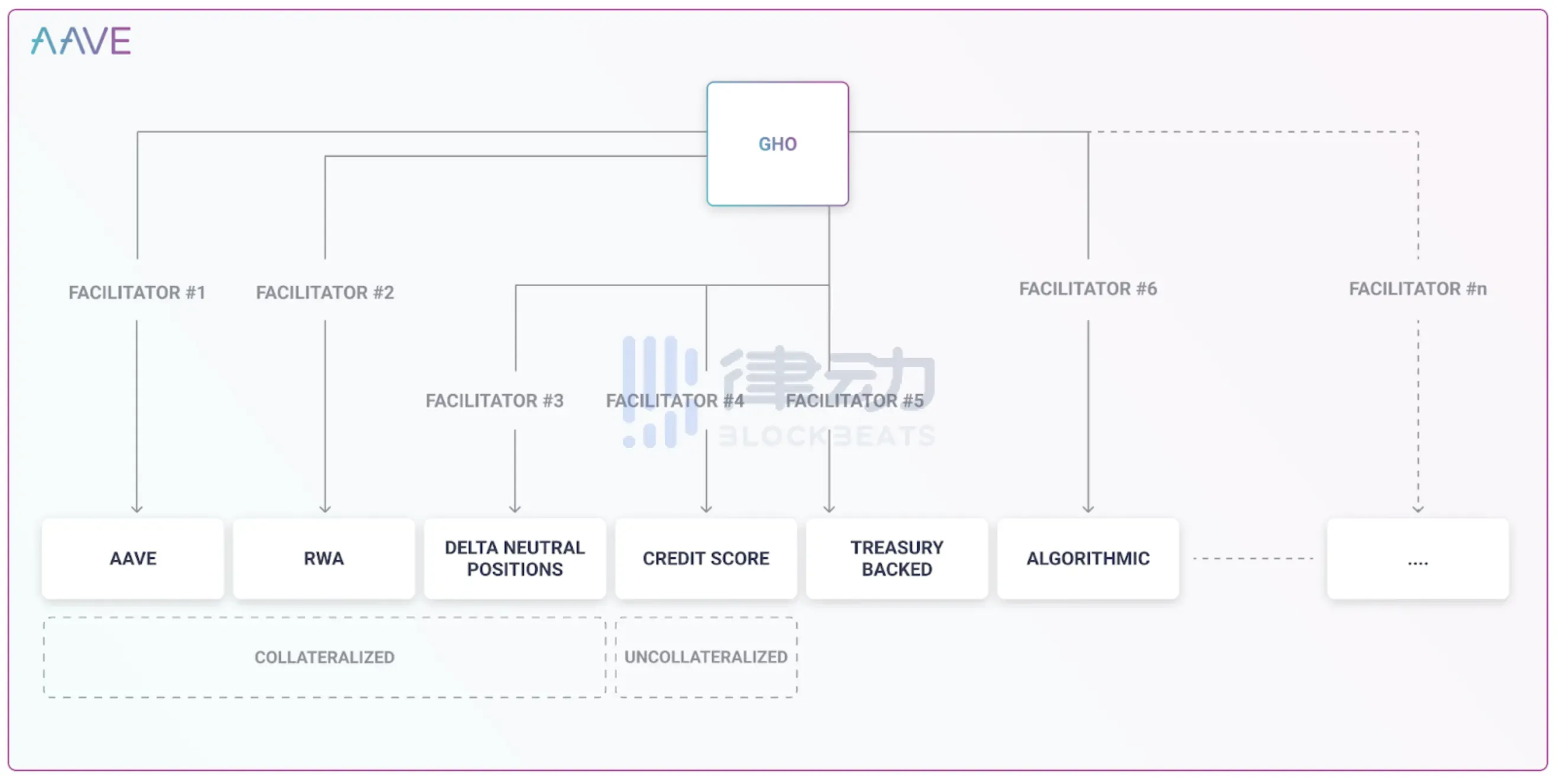
In addition, GHO also has a set of discount mechanisms. Users holding stkAAVE can mint GHO at a discount rate of 0% to 100%, in order to incentivize more AAVE to be staked in the protocol's safety module and further create market demand for AAVE. It is not difficult to see that embedding native stablecoins into lending protocols is a win-win situation for lending protocols like Aave.
As the leader in the stablecoin track, Curve is also unwilling to fall behind. Unlike GHO, the crvUSD collateral mechanism can have many different ways of playing.
First of all, Curve is an AMM designed specifically for stablecoins, and its existence is related to the survival of most small stablecoins. The 3Crv liquidity pool, consisting of USDT, USDC, and DAI, is one of the largest stablecoin pools in the cryptocurrency market. Emerging stablecoin projects can survive by linking their stablecoins to the 3Crv pool. Therefore, as long as the 3Crv pool is not replaced, crvUSD can be anchored through LP Token as collateral and connected to other stablecoins. In this way, Curve can earn coin minting fees while earning more income from its own 3Crv liquidity.
By holding more CRV, the protocol can gain higher voting power to incentivize more CRV to enter its liquidity pool. This not only attracts more liquidity to the protocol but also increases the market demand for CRV. Therefore, crvUSD can also be over-collateralized with CRV, transforming Curve incentives from CRV to crvUSD. First, using stablecoins for liquidity incentives is more attractive than tokens with greater price volatility. Second, to attract more liquidity, other DeFi protocols must hold more CRV to mint crvUSD, which not only reduces the issuance of CRV but also provides new growth momentum for the Curve flywheel.
Hope.money's Full-Stack Financial Concept
Return to Hope.money, how early HOPE was minted and burned by anchoring to BTC/ETH. During the growth phase, the price of HOPE will fluctuate with the price of the anchor. HOPE can be seen as an ETF of BTC and ETH, effectively avoiding the death spiral event of Terra. When the reserve reaches sufficient or even excess, HOPE will enter the mature stage and gradually anchor at $1, becoming a stablecoin. After maintaining ecological stability and excess reserves, assets participating in staking and minting HOPE will vote for expansion, and anti-censorship stable assets such as Curve 3Pool LP Token and DAI have the opportunity to become collateral.
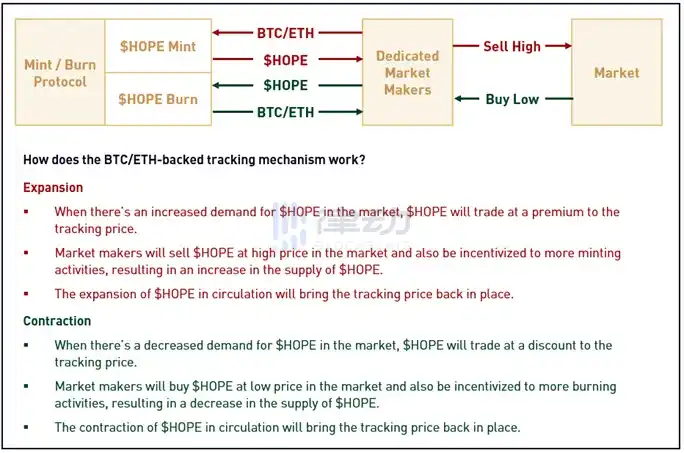
Although HopeLend may not seem to have much to do with stablecoin business, careful consideration reveals that stablecoins are always the most popular asset on all lending platforms. Hope.money supports borrowing and lending between any two tokens to capture the value flowing through the lending protocol.
In the early stages of project development, the first batch of users will be attracted through discounts and expectations, and these users will enjoy beta returns in BTC and ETH while growing with the project. When the project has accumulated enough momentum, HOPE begins to detach from BTC and ETH and generate alpha returns on its own. In the process of transitioning from beta to alpha, the governance token LT also captures the value brought by market demand.
As mentioned earlier, Hope.money hopes to build a full-stack ecosystem based on native distributed stability of encryption. Therefore, the launched HopeSwap and HopeLend are just a part of it. The HOPE ecosystem includes protocols such as HopeSwap, HopeLend, and HopeConnect, providing functions such as trading, lending, custody, clearing and settlement.
In the second phase of the Hope.money roadmap, a bridge will be established between DeFi and CeFi, with the launch of the HopeConnect protocol as an on-chain custody and clearing protocol. HopeCard will be the first application based on the HopeConnect protocol. In subsequent applications, HopeConnect will connect DeFi and centralized financial scenarios, allowing users to trade traditional financial RWAs such as derivatives, stock indices, fixed income instruments, commodities, and foreign exchange on centralized institutions including CEX, while maintaining anonymity and non-custodial features, and reducing the threshold for accessing traditional financial services.
In the third stage, which is the maturity stage of Hope.money, the HOPE ecosystem will become a full-stack ecosystem. This includes decentralized identity (DID), DeFi passport, zero-knowledge KYC, on-chain reputation system, and more, all of which will be integrated into the Hope.money ecosystem.
By reviewing Hope.money and deconstructing HopeLend, we can clearly see the shadows of many popular DeFi projects and the incorporation of traditional financial design ideas. This reminds us of the background of Hope.money's establishment. After the crisis in PayPal Finance, the former CEO Flex Yang, who had already left PayPal, chose to return and was responsible for the restructuring work between shareholders and creditors. He named this ongoing DeFi project Hope.money, delivered the product according to the official vision and roadmap, combined the advantages of DeFi and CeFi, and avoided events similar to those in PayPal Finance.
From stablecoin HOPE to HopeSwap, and now to HopeLend, Hope.money seems to be constantly optimizing its full-stack ecosystem and exploring new possibilities. As a newcomer in the industry, we are also very excited to see if Hope.money can achieve breakthroughs and surpass its competitors.
Welcome to join the official BlockBeats community:
Telegram Subscription Group: https://t.me/theblockbeats
Telegram Discussion Group: https://t.me/BlockBeats_App
Official Twitter Account: https://twitter.com/BlockBeatsAsia

 Related Articles