EIP-4844: Core of the Cancun upgrade.
Original Title: "EIP-4844: The Core of the Cancun Upgrade"
Source: Ebunker Chinese
One of the biggest obstacles to the widespread adoption of Ethereum is that users must pay high gas fees to conduct transactions or interactions. As on-chain activity increases, gas fees also increase significantly, thereby raising the barrier to entry for users.
In order to improve the performance of Ethereum L1+L2 and solve the problem of gas fees, the Ethereum Foundation proposed to use EIP-4844 to reduce gas fees and increase throughput as a mid-term transitional solution. This article will provide a detailed introduction to EIP-4844 and why it is crucial for the implementation of the Ethereum roadmap.

EIP-4844 Introduction
Ethereum EIP-4844 is the core content of the Cancun upgrade, which introduces a new transaction type (blob-carrying transaction) to reduce Ethereum transaction fees. Blob-carrying transactions are similar to regular Ethereum transactions, but with some additional data called blobs. Compared to the current calldata storage transaction data, which is immutable and memory-only, blobs have much larger storage capacity and are cheaper.
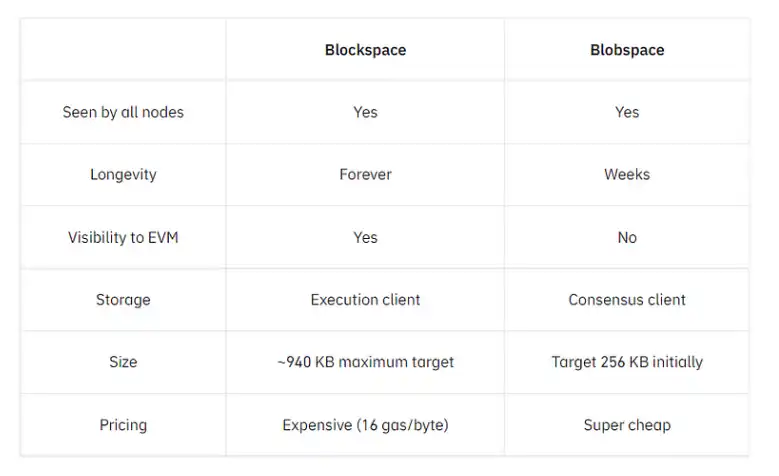
From the difference between blockspace and blobspace in the above figure, it can be seen that blobs are different from blocks visible to the Ethereum Virtual Machine (EVM). Blobs are only available for a short period of time and are not visible to the EVM. In addition, blobs are located on the Ethereum consensus layer, rather than on the computation-focused execution layer. Most importantly, blobspace is much cheaper than blockspace.
EIP-4844, also known as Proto-Danksharding, will implement the framework and logic of Danksharding with new transaction formats and validation rules.
EIP-4844 Development Timeline
Over the past 3 years, Ethereum has undergone a series of upgrades, transitioning from PoW to PoS consensus and making its blockchain more scalable.
Here is the timeline and overview of important updates for Ethereum:
On December 1st, 2020, the PoS-driven beacon chain went live, allowing Ethereum users to stake their ETH on a separate beacon chain for transaction verification.
In September 2022, Beacon Chain will merge with the Ethereum mainnet, combining the network's execution layer and consensus layer.
On April 13th, 2023, Shanghai Upgrade (EIP-4895) went live, opening up ETH staking and withdrawal functionality for Ethereum validators.
These upgrades are necessary for improving the scalability of Ethereum, but they do not directly improve the transaction speed or gas price of the blockchain. Future upgrades such as sharding and Danksharding will truly achieve scalability for Ethereum in practice.
What is Sharding?
Sharding refers to dividing the blockchain network into smaller units called "shard chains". Each shard chain can process transactions in parallel to maximize transaction throughput, reduce network congestion, and lower gas fees. In other words, sharding is a way to partition a database into smaller databases that manage specific data segments, thereby improving the efficiency and performance of these databases.
Due to the high difficulty of sharding technology, Ethereum has decided to adopt an intermediate solution, which is to first implement Proto-Danksharding and eventually transition to the more easily implementable Danksharding.
What is Danksharding?
Danksharding is a new sharding architecture that relies on large-capacity data called blobs to scale the Ethereum blockchain. The second-layer protocol centered around rollup uses additional blob data space to alleviate network congestion and reduce transaction fees.
Currently, the TPS of the Ethereum base layer is about 15, and the TPS of its second layer rollup is about 100. Based on rough estimates, Danksharding is expected to increase the TPS of Ethereum (considering L1+L2 as a whole) to 100,000.
Another innovation of Danksharding is the merging of fee markets, where only one proposer selects transactions for all shards instead of each shard having its own proposer. To ensure the smooth operation of this merged fee market and alleviate the problem of maximum extractable value (MEV), a method called proposer and builder separation will also be implemented (proposers refer to Ethereum protocol validators who choose which transactions to include in the next block).
However, implementing full Danksharding on Ethereum is not an overnight process, but requires several upgrades to be gradually implemented, such as EIP-4844 (Proto-Danksharding).
What is Proto-Danksharding?
Proto-Danksharding is named after two Ethereum researchers, Proto Lambda and Dankrad Feist. It will increase Ethereum's TPS to approximately 1000 and is a simpler step needed before fully implementing Danksharding. Most importantly, it will introduce a new transaction type that accepts blob data, which is an important component for making full Danksharding possible.
Vitalik Buterin believes that Proto-Danksharding executes most of the logic and framework of Danksharding, but still does not implement any actual sharding. In other words, Proto-Danksharding is a prototype of Danksharding, which provides a framework for implementing other sharding upgrades in the future.
EIP-4844 How to reduce gas fees?
The main purpose of EIP-4844 (Proto-Danksharding) is to reduce Ethereum gas fees by using blobs to carry transactions. Blob data is cheaper and cannot be accessed by the Ethereum Virtual Machine (EVM), only the promise to the blob can be viewed. Additionally, the data bandwidth in Proto-Danksharding is fixed at 1 MB per slot.
Due to the fact that simply making CallData cheaper may lead to a mismatch in average or worst-case scenarios, Ethereum developers are attempting to reduce gas fees by creating a new type of blob to carry transactions (focused on transactions from L2 Rollup).
The average block size of Ethereum is about 90 KB, but theoretically, the maximum block size is about 1.8 MB. This means that Ethereum blocks can accommodate more transactions during periods of high network activity, but require very high gas fees. If calldata becomes 10 times cheaper, transaction volume will increase by 10 times, and in extreme cases, block size will increase by 10 times (18 MB). Obviously, Ethereum cannot accommodate such large blocks in its network.
Solution
ProtoDanksharding solves the gas pricing crisis through a multi-dimensional EIP-1559 fee market.
Before ProtoDanksharding was proposed, EIP-4488 attempted to solve the issue of high gas fees.
EIP-4488 has two rules: the gas cost of calldata is reduced from 16 gas units per byte to 3 gas units per byte; the limit of 1 MB per block plus 300 bytes per transaction allows for a maximum size of approximately 1.4 MB.
The upper limit of block size is the simplest way to ensure that the average block load surge will not lead to extreme load surges. In addition, the maximum block size in the most extreme case (1.4MB) is always lower than the current maximum block capacity (1.8 MB).
Since the solution for gas issues has already been proposed in EIP-4488, why did the Ethereum community choose EIP-4844 to reduce gas fees in the end? This is because although EIP-4488 minimizes the current changes to maintain stability, more changes will be needed in the future. In contrast, the purpose of Proto-Danksharding is to make more framework changes to help the Ethereum network upgrade to danksharding in the future.
Proto-Danksharding has created a separate transaction type that stores data from L2 Rollup in a large blob, and the number of blobs that exist per block is limited, which greatly reduces L2 fees. The blobs are stored on the consensus layer rather than the execution layer, so the Ethereum Virtual Machine (EVM) cannot access them.
Even after Proto-Danksharding, sharding remains a complex task, but the complexity will be limited to the consensus layer. Therefore, execution layer client teams and rollup developers do not need to do any additional work to transition from Proto-Danksharding to full sharding.
EIP-4844 separates blob data from calldata, making it easier to store blob data within shorter time periods.
EIP-4844 Data Storage Options
Each slot (12 seconds) of approximately 1 MB Proto-Danksharding will generate 2.5 TB of data per year. The consensus layer can address the data storage challenge through the historical retention period (EIP-4444) and eventually implement logic to automatically delete blob data after a certain period of time.
EIP-4844 之前和之后都有哪些升级?
Before and after EIP-4844, what upgrades are there?
Ethereum developers proposed several upgrades before EIP-4844 to reduce gas fees. For example, EIP-3651 reduced the gas fees that prevent block builders from interacting with Ethereum block building software Coinbase, EIP-3855 reduced gas fees for developers through Push0, and EIP-3860 reduced gas fees for specific use cases.
EIP-4844 is a step towards full sharding, which will expand the Ethereum network and reduce gas fees. Developers are planning to introduce "Verge" after EIP-4844, which will introduce Verkle trees to achieve scalability.
EIP-4844 Impact
The main goal of EIP-4844 is to reduce the L2 gas fees of Ethereum by 10-100 times by using a new type of blob to carry transactions, making the transition to fully sharded easier, as all future upgrades will only be done at the consensus layer.
At the architectural level, EIP-4844 introduces the use of blobs to carry transactions, marking the first time Ethereum has built a separate data layer for L2, laying the foundation for fully implementing Danksharding in the future.
At the economic model level, EIP-4844 will introduce a new fee market for blobs, which will also be the first step for Ethereum to move towards a multi-dimensional market.
From the perspective of user experience, the most intuitive perception for users is the significant reduction in L2 costs. This important improvement at the underlying level will provide a crucial foundation for the explosion of L2 and its application layer.
Summary
EIP-4844 is a major upgrade that makes the Ethereum network more scalable and reduces the updates required for future full sharding. Proto-Danksharding increases the space of blob data groups, which will allow for more data processing, thereby reducing network congestion and lowering gas fees.
As a highly complex protocol upgrade, EIP-4844 is an important part of the Ethereum roadmap and is also related to other system upgrades, such as the separation of proposers and builders and the EIP-1559 blob fee adjustment.
除了引入 blob 携带交易外,EIP-4844 还将实施执行层逻辑,验证规则,多维 gas 费市场以及将来完全分片所需的其他系统变化。
Translation:In addition to introducing blob-carrying transactions, EIP-4844 will also implement execution layer logic, validation rules, multi-dimensional gas fee markets, and other system changes required for future full sharding.
It is worth noting that although EIP-4844 will implement most of the complete Danksharding logic, it will not implement any actual sharding. In addition to bringing Ethereum closer to the cost and throughput levels required for large-scale adoption, EIP-4844 can also improve scalability and save costs.
Although EIP-4844 does not currently have an exact release date, it is expected to be implemented later this year. After the implementation of EIP-4844, users will see significant improvements in Ethereum, especially L2, with faster transactions and lower fees. The successful implementation of EIP-4844 will also make Ethereum more competitive in the cryptocurrency industry.
Original article link
Welcome to join the official BlockBeats community:
Telegram Subscription Group: https://t.me/theblockbeats
Telegram Discussion Group: https://t.me/BlockBeats_App
Official Twitter Account: https://twitter.com/BlockBeatsAsia