Performance report of Solana network in July 2023.
Original Title: "Network Performance Report: July 2023"
Original Author: Solana Foundation
Overview
The performance of the Solana network has improved in the first half of 2023, as measured by normal operating time, the ratio of non-voting transactions to voting transactions, block generation time, and average and maximum transactions per second.
Since the last network performance report in October 2022, the Solana network has undergone significant improvements, including:
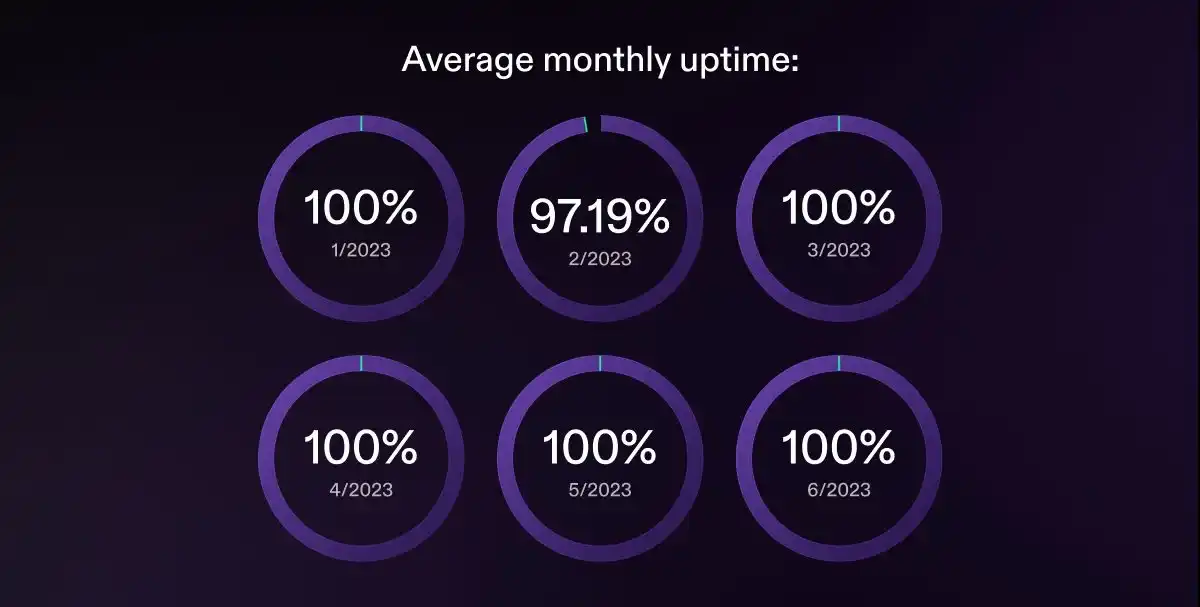
· The v1.14 version has been successfully released to the mainnet. This is the implementation of the improvement software upgrade process proposed after an interruption on February 25th. Since February 25th, the Solana network has achieved 100% normal operation.
· Network upgrades have been implemented to better handle high traffic and demand, including the introduction of QUIC TPU, equity-weighted QoS, and localized cost markets. Since these network upgrades, the network has performed well during high-pressure periods, such as the MadLads NFT minting period.
· Introducing state compression, a new method of directly storing data on the chain that can reduce costs by several orders of magnitude. Now, the cost of minting 100 million NFTs on the Solana network is as low as 50 SOL.
The Solana network continues to be run by a powerful group of independent validators from around the world. It is one of the most decentralized proof-of-stake blockchains globally and also one of the most developed. Below, we have listed some statistical data used by the Solana Foundation to measure the decentralization and vitality of the Solana network (as of July 11, 2023):
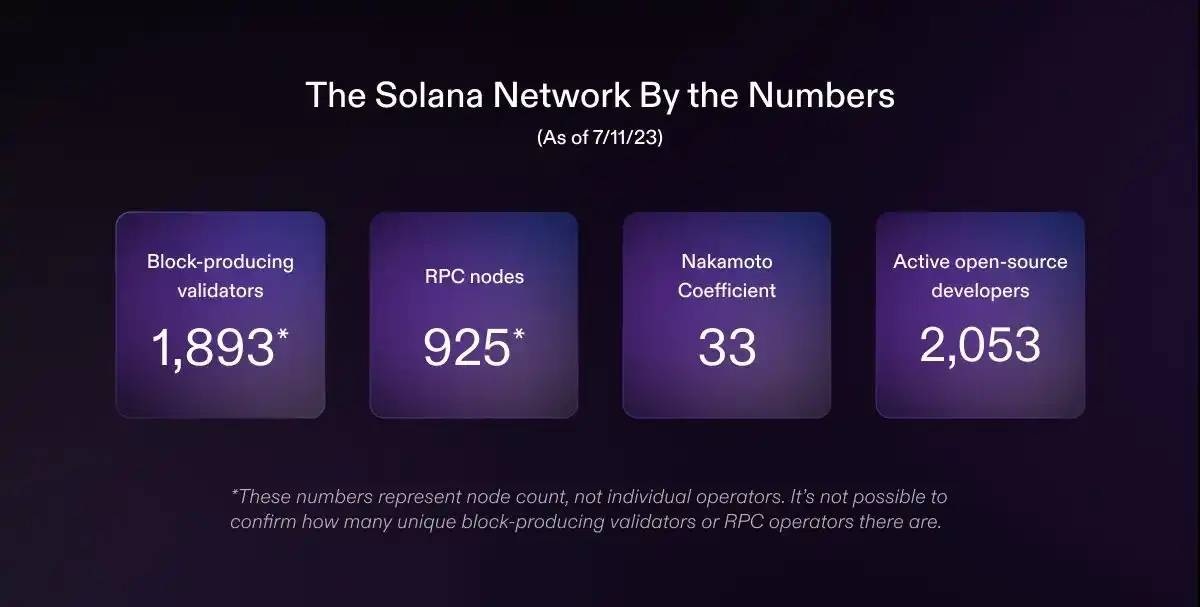
Note: These numbers represent the number of nodes, not individual operators. We cannot confirm how many unique validators or RPC operators are generating blocks.
Network Performance Overview
In order for billions of users to use and enjoy the advantages of the Solana network, users need to have sufficient confidence in the overall reliability of the network: the ability to continuously access the network, the accuracy of the network and related information, transaction speed, as well as the security of funds and information.
Below are some indicators tracked by the foundation to observe how the network achieves its goals. Although various indicators can help showcase the network's performance, in order to be concise and allow users to easily track these indicators and their progress over time, we focus on four key indicators and have created a Dune dashboard containing these indicators, as well as other indicators that allow you to dig deeper into the data or conduct your own analysis.
Normal operating time
A sustainable and reliable network is the foundation for building trust and continuous growth.
One of the most important indicators for measuring reliability is network uptime.
Below, we have recorded the normal operation time of the network for each month in the past six months, which is measured as a percentage of the operating time in a month.
Ratio of Voting Transactions to Non-Voting Transactions
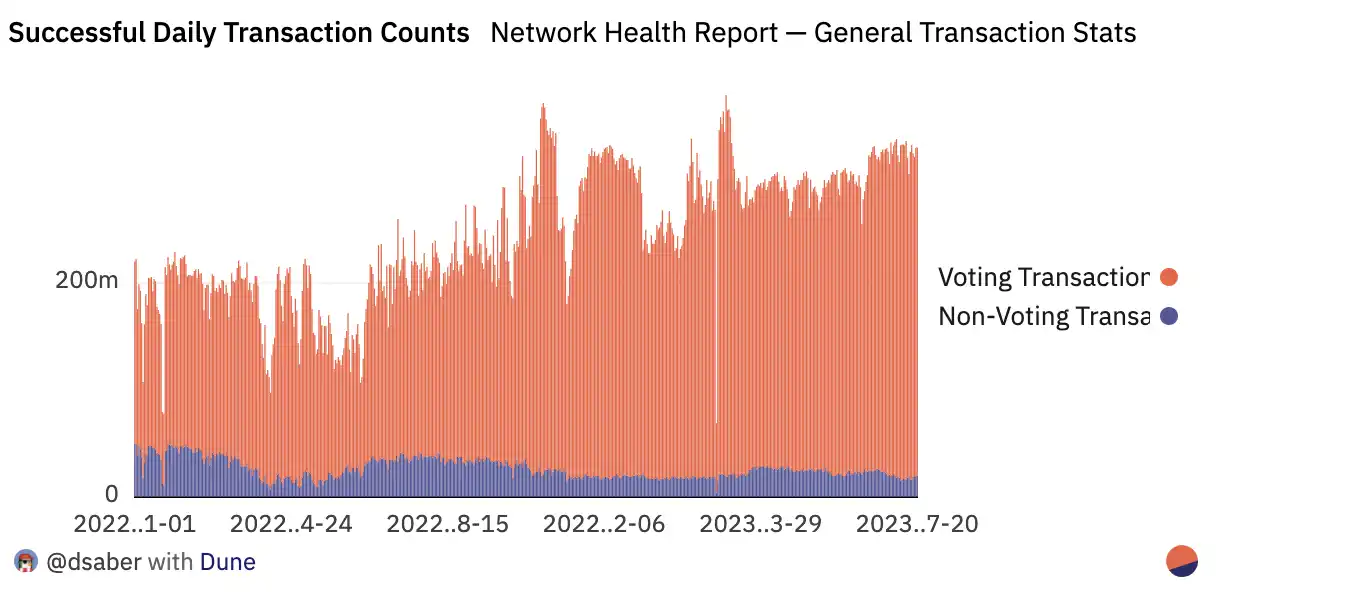
The operation of the voting transaction pair network is necessary because they create the decentralized consensus on which the blockchain relies. When validators vote to confirm one or more proposed information blocks, a voting transaction occurs. Non-voting transactions are triggered by user behavior on the blockchain. For example, non-voting transactions may represent the minting of an NFT or the transfer of tokens from one wallet to another. Consensus on the network requires a certain number of voting transactions, but over time, we expect to see a decrease in the proportion of voting to non-voting transactions as network efficiency improves.
Here is the ratio of voting and non-voting transactions in the past six months.
Block time (the time required to generate a block)
The block time measures the speed of individual transactions, as it measures the speed at which the network adds more "blocks" to the blockchain. In this chart, we see the average time it takes to produce a block, the consistency of this metric, and how it changes over time.
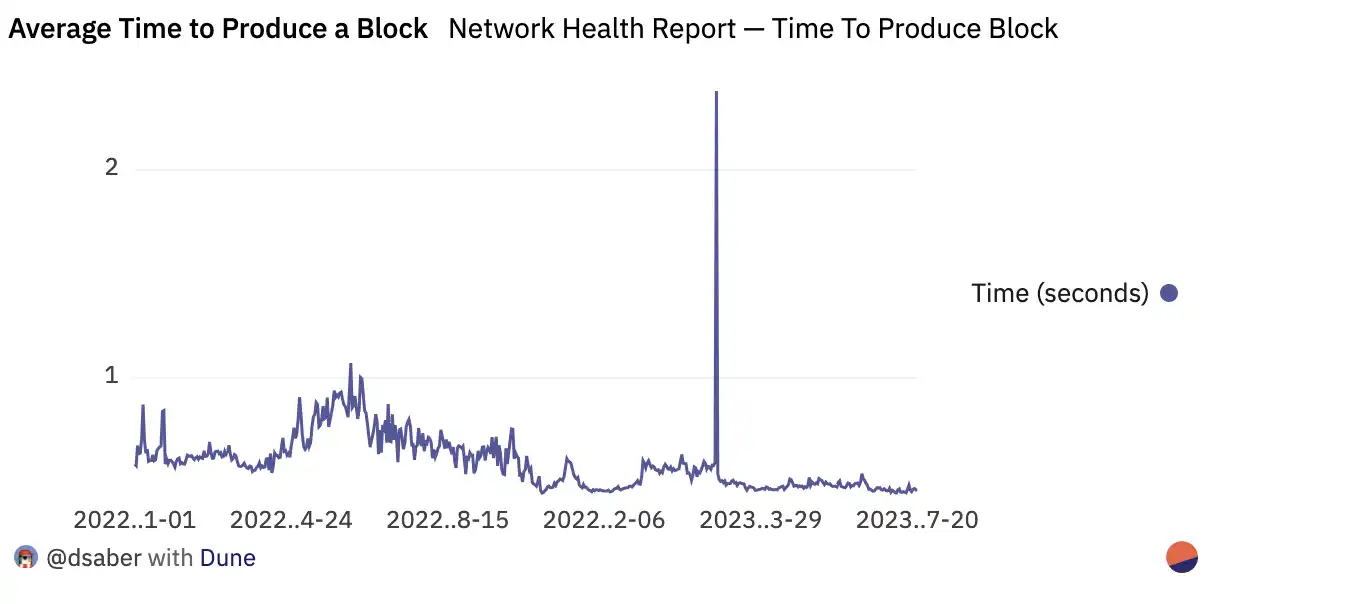
The peak at the end of February is related to the network outage event on February 25th.
Average and maximum transactions per second
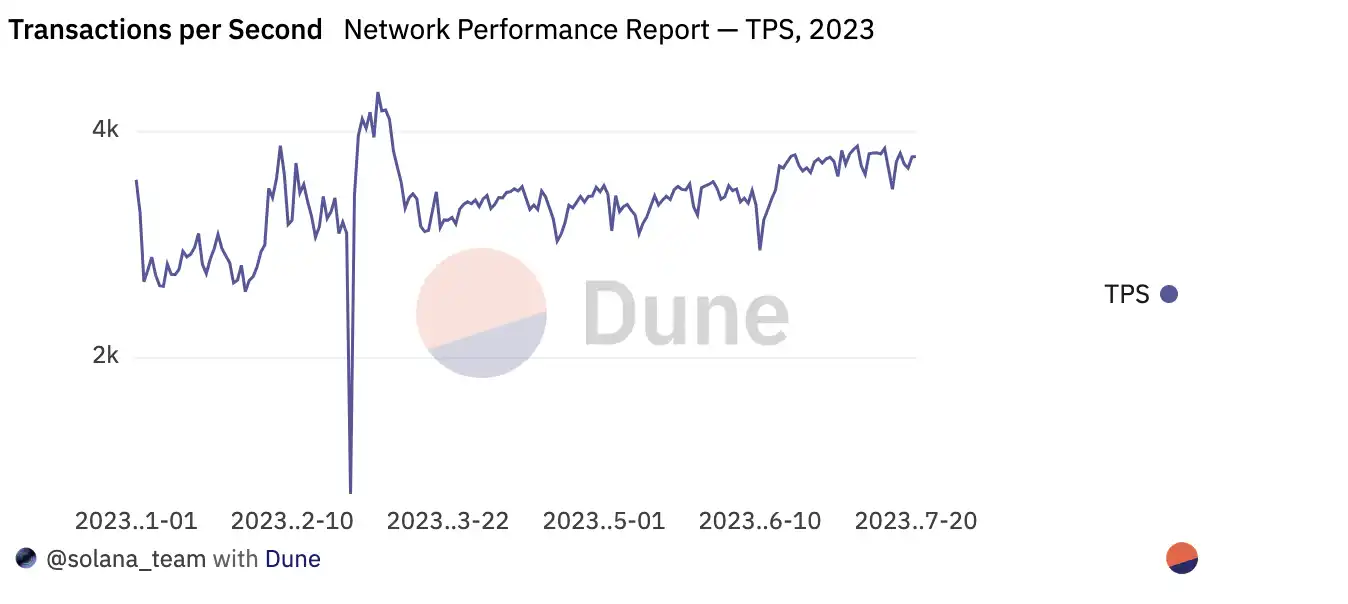
The overall transactions per second is the most accurate reflection of the network's current throughput and demonstrates its potential and growth over time. The benchmark throughput is 65,000 transactions per second based on simple transactions such as fund transfers. The actual transactions per second will vary due to the diversity of complex transactions on the network and the demand at any given time. For example, purchasing NFTs is much more complex than transferring tokens between wallets.
Please note that the actual number of transactions per second on the network does not reflect the network capacity, but rather reflects the demand for transaction throughput. In almost all cases, the operation of the mainnet-beta is below its capacity.
The following is a snapshot of real-time network performance. It is divided by date into the average transactions per second and the maximum transactions per second for a given day. Since December 2022, the average transactions per second have remained relatively stable with some fluctuations related to high network demand. Since January 2022, the maximum transactions per second have steadily increased, with significant growth in the second half of 2022 related to new network upgrades.

Highlights of the Network Since October 2022 Report
In order to better cope with high traffic and demand, network upgrades have been carried out: in 2022, the Solana network experienced several slowdowns or interruptions during periods of high activity, such as large-scale NFT minting. In response, core developers have launched network upgrades, including QUIC, stake-weighted QoS, and localized fee markets. Since these upgrades were introduced, the network has performed exceptionally well under high pressure, such as during the MadLads NFT minting period. Developers are also continuing to test and develop other network upgrades and plans, including increasing the maximum transaction size (currently limited to 1232 bytes) and simplifying voting logic, which reduces the total amount of data that needs to be transmitted and stored.
· QUIC TPU: QUIC is a network protocol designed by Google for fast asynchronous communication, but with session and flow control. QUIC can be used to limit the traffic of any participant, allowing the network to focus on truly effective transactions. QUIC has been added to the port that receives user transactions.
· Equity-weighted QoS: Equity-weighted is used to efficiently allocate leader network bandwidth. Instead of accepting transactions on a first-come, first-served basis indiscriminately, it provides permission to transmit information, so nodes with 0.5% equity will have the right to transmit at least 0.5% of the data packets to the leader. This can improve the resilience of the network by preventing spam or malicious participants. Equity-weighted QoS has been added to the QUIC TPU port.
· Localized Fee Market: The fee market provides users with a way to add additional fees to their transactions to indicate their urgency relative to other transactions. Priority fees are calculated based on the expected amount of computational resources needed for the transaction. For example, a simple token transfer has a lower total priority fee than an NFT minting with the same urgency. This process allows users to express urgency and prioritize transactions, making the market more efficient.
Improved upgrade process: In response to the February 25th interruption event (more on that below), Solana Labs CEO Anatoly Yakovenko published a blog post suggesting new processes for software releases to increase resilience during network expansion and new upgrades. These include involving more external developers and auditors in the release process, testing and discovering vulnerabilities, improving server restart processes, prioritizing network stability, and forming a adversarial team. Several of these suggestions have already been implemented, including:
· Conduct a comprehensive upgrade process on the test network: In order to simulate the upgrade process, the test network will first be downgraded to the previous software version, and then simulate the software upgrade process that will be launched on the main network. Prior to this, the test network was a relatively simple version of the main network when the main network was upgraded.
· Optimized tools for manual restart: For example, there is already an initial design that can automate some more mechanized steps (SIMD0046).
· Adversarial testing has been conducted on both private clusters and testnets: these tests are currently being conducted in a bespoke manner as core engineers are building a more formal testing plan. In related news, Solana Labs' validator reference client now has an adversarial port, and core lab engineers are adding the ability to configure scenarios for adversarial testing.
Version 1.14.17 smoothly released: Version 1.14 was officially adopted by the authorities on May 22nd, with over 66.6% of network nodes upgraded to version 1.14 at that time. This is the first important network upgrade since the interruption on February 25th and the above-mentioned upgrade progress improvement. As of May 30th, version 1.14 of the Solana validator client has been accepted by 97.4% of network nodes on the Solana network.
Compressed NFT and State Compression: After multiple stages of development, adoption, and launch, compressed NFT is now running on the Solana mainnet-beta. Compressed NFT is 2400-24000 times cheaper than uncompressed NFT. Minting 100 million NFTs on Solana now only costs 50 SOL. This new NFT technology structure, called "state compression," unlocks a range of new use cases and expands the potential impact of the Solana blockchain by allowing NFT minting for purposes such as sending messages or enhancing customer loyalty programs. State compression was developed for NFTs but can be used for other applications. Simply put, state compression involves storing some data on the blockchain that is typically stored locally on each machine.
Smooth Helium Migration: In April 2023, the Helium network successfully completed its migration to the Solana network. The entire process was relatively smooth for Helium network participants and did not cause significant disruption to the Solana network. Helium's migration utilized state compression to mint NFTs more efficiently and affordably. For more details, please see here.
Firedancer's Additional Progress: Firedancer, a Solana validation client developed by Jump Crypto, is adding and testing more components.
· QUIC Implementation Demonstration: Firedancer recently conducted a high-performance QUIC implementation demonstration, which should bring more efficient data transactions.
· Reed-Solomon error correction code release: Turbine is a mechanism in validators that is responsible for distributing "shreds" (fragments of a block) to other validators in the cluster. Reed-Solomon is an error correction code scheme that can accurately encode data before shreds are transmitted to other validators.
Tinydancer: Tinydancer, the first lightweight client on Solana, developed during the Grizzlython Hackathon by the Solana Foundation. A lightweight client is a software client that can run locally on simple devices such as laptops, connect to full nodes in the network, verify the state of the ledger, and check for invalid state transitions.
Real-time Emission Monitoring: In April 2023, Solana became the first major smart contract blockchain whose carbon footprint can be measured in real-time. TryCarbonara, an independent startup, launched a website to track the network's impact.
Network Challenges Since October 2022
Since the last network performance report in October 2022, there has been one interruption on the Solana network. During this incident, users' funds were not lost.
Here is our review of the response measures we took for this interruption and its reasons.
Interruption in February 2023: On February 25th, Mainnet Beta began experiencing longer block confirmation times. After investigation, the cause was traced to several services running custom block forwarding software on the network, which inadvertently transmitted data several orders of magnitude larger than normal blocks. The network's deduplication logic was unable to handle this situation, putting pressure on the Turbine protocol and greatly reducing network performance. After diagnosing this issue, core engineers created enhancements to the deduplication logic, which have now been implemented in Solana Labs validators clients v1.13.7 and v1.14.17. This will also be mitigated through the long-term design of the Solana protocol, which will replace all UDP-based network protocols with QUIC, which will be better in enforcing Turbine constraints. Please read the full outage report here.
Several proposed network upgrades have been implemented or are being rolled out to address the cause of this outage, particularly the implementation of QUIC, fee markets, and Quality of Service (QoS) weighted by stake.
即将采取的措施
translates to
Measures to be taken soon
Solana's core developers have been working on developing many new network upgrades to strengthen the network in the face of large-scale user growth and adoption.
These Solana improvement files, also known as SIMDs, are proposed design files on how to make changes to the network. These changes require coordination among multiple core development teams. Recently accepted SIMD-33: Timely Vote Credits is awarded based on the number of voting slots and gives more rewards for low-latency voting. This aims to reduce block finalization time and prevent intentional voting delays.
There are some network upgrades included in the latest release, but these features are not yet activated. Turbine's improvement is a feature of version 1.14, which can greatly improve network latency. There is a new Deactivate Delinquent Stake command that allows anyone to revoke nodes that have not fulfilled their obligations for five or more periods on the network, reducing skip rates and improving performance. (Note: Un-delegated staking accounts remain under the control of the original staker and can be re-delegated to active validators or withdrawn).
Users can continue to monitor the performance of the Solana network and use reports like this to help the community track its development over time.
Original Link
Welcome to join the official BlockBeats community:
Telegram Subscription Group: https://t.me/theblockbeats
Telegram Discussion Group: https://t.me/BlockBeats_App
Official Twitter Account: https://twitter.com/BlockBeatsAsia

 Related Articles