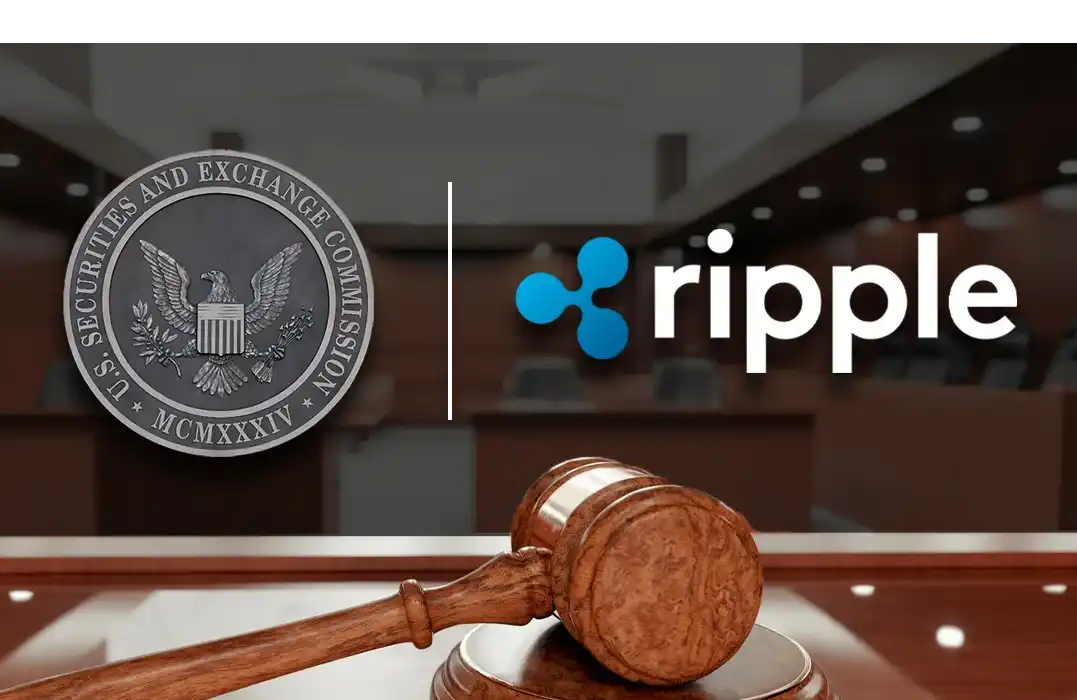
The Ripple case, which has been running for three years, is being closely watched to see if the court's ruling will have epoch-making significance.

Yesterday night, Ripple Labs finally reached a verdict in its three-year-long lawsuit with the US Securities and Exchange Commission (SEC). Ripple won in the US District Court for the Southern District of New York, and Judge Analisa Torres made a ruling in favor of Ripple Labs, stating that XRP is not a security.
After Ripple won the judgment that XRP is not a security, the overall sentiment of the entire cryptocurrency community seems to be jubilant.
As a result of this news, XRP's significant upward trend has shown a short-term breakthrough of $0.9, up more than 92.89%. As of writing, it is currently priced at $0.5432. Bitcoin and Ethereum also experienced a brief uptick, with Bitcoin breaking through $31,800 to reach a new high for the year, and Ethereum breaking through $2,000. Cryptocurrencies such as SOL, ADA, and MATIC, which were previously listed as securities by the SEC, also saw significant short-term gains.
Ripple CEO Brad Garlinghouse emphasized that the most important part of the ruling is that XRP is a digital token, not a "contract, transaction, or plan" that reflects the investment contract required by Howey, and now this is a legal issue that is not subject to judgment. "We said in December 2020 that we are on the right side of the law and will also be on the right side of history. Thanks to everyone who helped us make this decision today-this decision is for all cryptocurrency innovation in the United States. There will be more in the future," Brad Garlinghouse said on Twitter.

Epic Battle in the Cryptocurrency Industry
The history of Ripple can be traced back to 2004, when developer Ryan Fugger created the project "RipplePay". The core idea was to establish a peer-to-peer payment network that could replace the traditional banking system, which sounds very similar to Bitcoin.
And the reason why Ripple has attracted community attention is because in April 2013, Ripple received $1.5 million in funding from institutions such as Google Ventures, a16z, IDG Capital Partners, Lightspeed Venture Partners, Bitcoin Opportunity Fund, and Vast Ventures.
Aside from endorsements from institutions such as Google Ventures and Lightspeed Venture Partners, there seems to be a Japanese consortium behind Ripple. In September 2016, the Japanese consortium SBI Group acquired a 10.5% stake in Ripple for $55 million, and the two parties also established SBI Ripple Asia in 2017, with SBI Group holding a 60% stake.
On January 4, 2018, the XRP price reached a historical high of $3.31, with a year-on-year increase of over 500 times. Its total market value is equivalent to Google, Apple, and Alibaba. Larsen's net worth also reached $59 billion, surpassing Zuckerberg to become the world's fifth richest person. Of course, he has also been criticized as the "wealthiest person who contributes the least to the real world".
Meanwhile, the Ripple vs. SEC lawsuit has been ongoing for three years, dating back to 2020.
Open the litigation tug-of-war: Is XRP really a security?
On December 22, 2020, the SEC officially filed a lawsuit against cryptocurrency company Ripple Inc. According to the official website of the US Securities and Exchange Commission (SEC), Ripple and its CEO Brad Garlinghouse and co-founder Chris Larsen are the targets of the charges.
The defendant is accused of raising more than $1.3 billion through continuous, unregistered digital asset securities offerings since 2013, such as labor and market-making services. In addition to organizing and promoting XRP sales to fund company operations, Chris Larsen and Brad Garlinghouse also conducted unregistered personal sales of XRP, totaling approximately $600 million. This violates the registration requirements of the Securities Act and seeks injunctive relief and civil penalties.
After the news of SEC's formal lawsuit came out, the price of Ripple's token XRP plummeted. Within 48 hours, XRP fell from 0.58 USDT to 0.34 USDT, with a cumulative maximum decline of 42%.
Ripple CEO Brad Garlinghouse, who has been accused, bluntly stated: "From a legal and factual perspective, the SEC is wrong." The Ripple team does not seem to have signaled a settlement: "There is no doubt that we are ready to fight and win - this battle has just begun."
This lawsuit revolves around whether Ripple's digital asset XRP, which was launched in 2012, should be registered with the SEC. Registration involves disclosing a company's business model, risks, and financial condition to the SEC and the public. The SEC reviews the disclosure of information and provides feedback to investors to improve disclosure.
Subsequently, the two sides began a legal battle, with the focus of the dispute still on whether "XRP is a security".
不和解,诉讼进入白热化阶段
No understanding, litigation enters a white-hot stage
"Here's a little secret about the US court system: even 10% of cases cannot be tried. Judges always pressure lawyers to settle because the fact is, if more cases had to be tried, the system would collapse. There simply aren't enough resources. This is true for both civil and criminal cases." Wrote famous lawyer Jeremy Hogan on Twitter.

Jeremy Hogan said that in the United States, less than 10% of civil and criminal cases ultimately go to trial. This is because the US legal system is unable to handle a higher volume of cases due to resource pressures, and only a small portion of cases ultimately go to trial. He added that judges who are aware of this fact often pressure lawyers on both sides of the case to reach a settlement.
Therefore, many people speculate that ultimately the SEC may try to reach a settlement with Ripple, but unexpectedly both the SEC and Ripple have taken a strong stance.
On February 15, 2021, in a letter jointly submitted to Federal Judge Analisa Torres of the Southern District of New York, both the SEC and Ripple, as well as the two founders, stated that the possibility of a settlement regarding Ripple's alleged securities violations before the pretrial conference is unlikely.

The lawyers of the parties involved have already negotiated and all believe that there is currently no prospect of resolving the issue. The letter states that the previous settlement discussions were conducted under the leadership of the Trump administration and against the background of a former department head who has since left the SEC. However, the situation has now changed.
When the SEC officially filed a lawsuit against Ripple in late December 2020, Ripple CEO Brad Garlinghouse called the action an attack on the entire cryptocurrency industry. He also stated that he and Ripple Chairman Chris Larsen could choose to settle. However, considering his beliefs, he refused to do so to prove his point and pave the way for the rest of the cryptocurrency industry.
"Chris Larsen and I can choose to resolve this separately. We can do this, and all of this will be in the past. It didn't happen, that's the confidence Chris Larsen and I have, that we're right. We will aggressively fight and prove our case. Through this case, we will establish clear rules of the road for the industry here in the United States," said Brad Garlinghouse.
Gensler's attitude is so tough not only to compete for regulatory power in the encryption industry, but also to express dissatisfaction with the endless and dazzling operation modes of cryptocurrencies. Because under the dazzling, it is easier to breed gray areas. According to foreign media reports, Gary Gensler, chairman of the US Securities and Exchange Commission, recently testified in Congress, criticizing the compliance of cryptocurrencies and expressing concerns about stablecoin regulation. He said, "I have been working in finance for 40 years and have never seen an area that is so inconsistent with securities laws." He also confirmed that if cryptocurrency tokens are considered securities, any exchange that trades such tokens needs to register as a national securities exchange and be regulated by the SEC. Gensler's attitude towards regulation is extremely tough, and he insists on maintaining the existing regulatory guidelines without making major changes.
This dispute will set the tone for US regulatory rules and also affect the future direction of the cryptocurrency market. Therefore, the victory of one party will inevitably compress the rights space of the other party, leading to a stalemate between the two sides.
Previously, a lawyer involved in the lawsuit believed that the SEC's own experts admitted that the prices of two major cryptocurrencies, Bitcoin and Ethereum, could explain up to 90% of the XRP price changes since mid-2018. At the same time, the SEC also believes that Ripple Labs' high percentage of XRP holdings means that XRP is centralized and is a security. These two statements and positions are contradictory.
盖棺定论?
translates to
Final Conclusion?
in English.
The Chief Legal Officer of Coinbase, Paul Grewal, believes that according to the ruling on page 15: "XRP, as a digital token, is not itself an investment contract that satisfies Howey's 'contract, transaction[, or] scheme' test." and on page 25: "Ripple's programmatic sales of XRP on digital asset exchanges do not constitute offers or sales of investment contracts." Therefore, XRP meets the listing requirements.
"We have read Judge Torres' thoughtful decision and carefully reviewed our analysis. It is time to relist XRP." said Paul Grewal on social media.

According to a tweet by Fox News reporter, the SEC has responded to the court's ruling that XRP is not a security.
We are satisfied with the court's ruling, which found that Ripple provided and sold XRP tokens in some cases as investment contracts that violated securities laws. The court agreed with the U.S. Securities and Exchange Commission's (SEC) view that the Howey test determines the securities analysis of cryptocurrency transactions, and rejected Ripple's self-made test for what constitutes an investment contract, emphasizing that Howey and subsequent cases have ruled that various tangible and intangible assets can be the subject of investment contracts. In addition, the court rejected Ripple's fair notice argument, stating that the Howey test is clear and claiming ignorance cannot be a defense against violating securities laws. We will continue to review the court's decision.

During the long three-year litigation process, the price fluctuations of XRP have become a clear reflection of the community's sentiment towards the lawsuit. Earlier, there were reports predicting that Ripple might win in its lawsuit with the US Securities and Exchange Commission (SEC). As soon as this news came out, the XRP token rose by more than 20% in just 24 hours. Recently, the soaring price of XRP has also benefited from the active support of several well-known YouTubers and community influencers. They firmly believe that Ripple will win the lawsuit, which has led to a significant increase in the price of XRP. Moreover, on the early morning when the lawsuit ruling was released, XRP's increase was astonishingly over 92.89%.
The entire Ripple vs. SEC lawsuit is a true reflection of the current state of the cryptocurrency market in the United States. The emerging cryptocurrency market still faces a lot of uncertainty in terms of regulations and oversight. Due to the lack of clarity in the scope and responsibilities of regulation, cryptocurrency companies also find it difficult to have stable expectations for regulation. The cryptocurrency market urgently needs a clear regulatory system to reduce potential market chaos.
This lawsuit's outcome may become a turning point for the reform of cryptocurrency regulation, with epoch-making significance.
Welcome to join the official BlockBeats community:
Telegram Subscription Group: https://t.me/theblockbeats
Telegram Discussion Group: https://t.me/BlockBeats_App
Official Twitter Account: https://twitter.com/BlockBeatsAsia

 Related Articles