OPNX bond trading is criticized as 'false trading', can Su Zhu's desire to open an exchange to repay the debt be realized?
Original Title: "OPNX Bond Trading as a Gimmick, Questioned as 'False Trading', Can Su Zhu's Wish to Start an Exchange to Pay off Debts Come True?"
Original Source: Xiyòu, ChainCatcher
Recently, OPNX (Open Exchange), a cryptocurrency debt trading platform founded by Su Zhu and others from Three Arrows Capital, has received a lot of attention from the cryptocurrency community due to the increase in trading volume and the skyrocketing price of its platform token, OX.
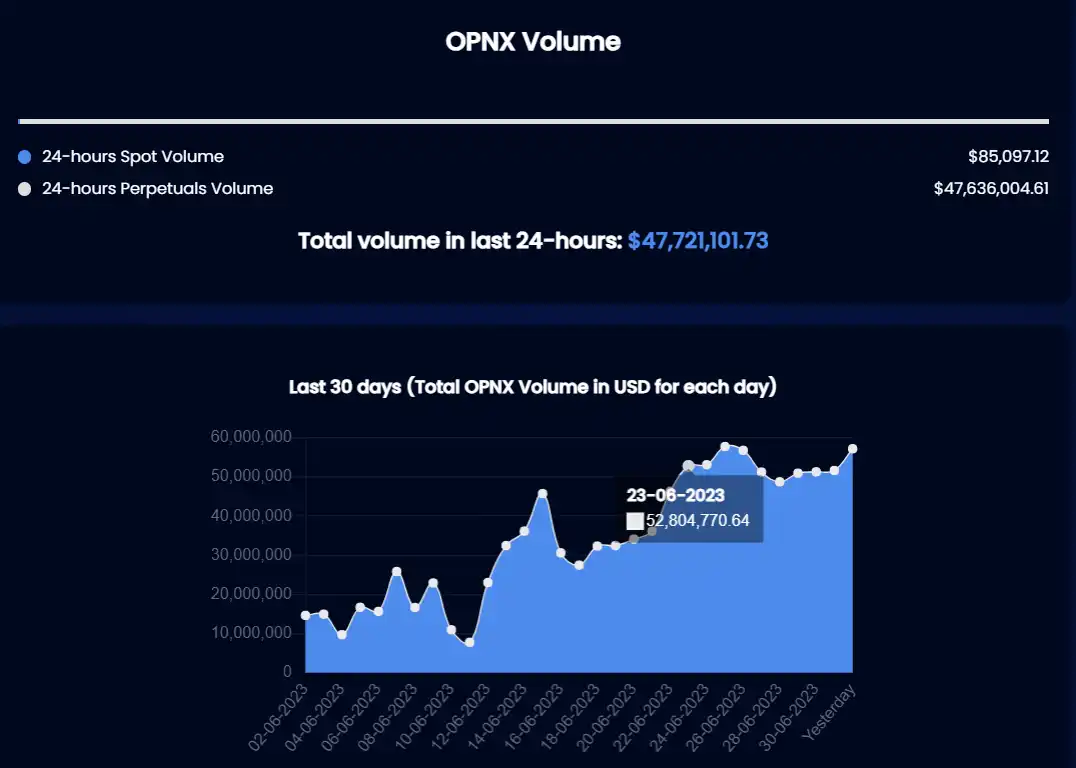
On June 26th, OPNX tweeted that its daily trading volume had exceeded 50 million US dollars, with an average daily trading volume of 41 million US dollars. Since the launch of its platform token OX on June 1st, the price has risen from 0.011 US dollars to a high of 0.044 US dollars, with a maximum increase of 300%. The current price has fallen to 0.036 US dollars, with a total market value of approximately 119 million US dollars, ranking 233rd among cryptocurrencies.
From the trading data on the OPNX platform, the trading volume of this newly established cryptocurrency trading platform, which has only been online for 3 months, is already comparable to that of well-established platforms such as Crypto.com (with a 24-hour trading volume of 79.63 million USD) and Bitfinex (with a 24-hour trading volume of 68 million USD).
It seems that all of these represent the direction in which OPNX is developing according to the founder's preset plan, but due to the unique nature of the founding team, users have always been skeptical of the platform.
On June 22nd, a community user raised concerns about inconsistent volume and price fluctuations or "false trading" in the BTC asset trading pair of OPNX, which sparked widespread discussion in the cryptocurrency community. Additionally, OPNX, which was initially positioned as a cryptocurrency debt trading platform, has since turned its debt tokens into a gimmick product, with its actual business being contract trading.
The combination of "founder of dishonesty + failed platform" always lingers around OPNX, difficult to shake off.
OPNX's trading volume of tens of millions is suspected of "false trading", but the price on the first day of listing is less than two dollars
Since June, OPNX has released a series of positive news. On June 26th, OPNX tweeted that the daily trading volume had exceeded 50 million US dollars, with an average daily trading volume of 41 million US dollars, and so on. On June 25th, it announced the launch of the first Launchpad project, Raiser (RZR), an unsecured credit market. All OX pledgers will share 10% of the RZR supply allocation. On June 24th, OPNX announced the launch of the credit currency oUSD, which can be exchanged with USDT at a 1:1 ratio. On June 1st, it announced the launch of a new governance token, OX, and a governance platform, The Herd. OX allows users to trade for free by pledging, and supports the conversion of OX with FLEX, and so on.
Since the launch of the OPNX platform, its trading volume has been highly regarded by users. According to FLEX Statistics data, since June 23, the 24-hour trading volume of the OPNX platform has exceeded 50 million US dollars, with a peak of 57 million US dollars, and the current 24-hour trading volume is 47.72 million US dollars.
However, the authenticity of the trading data on the OPNX platform has been questioned. On June 22nd, cryptocurrency trader @Loris raised concerns on Twitter, stating that after analyzing the BTC perpetual contract daily trading volume data on OPNX and comparing it with top trading platforms, it is possible that OPNX may have "false trading".
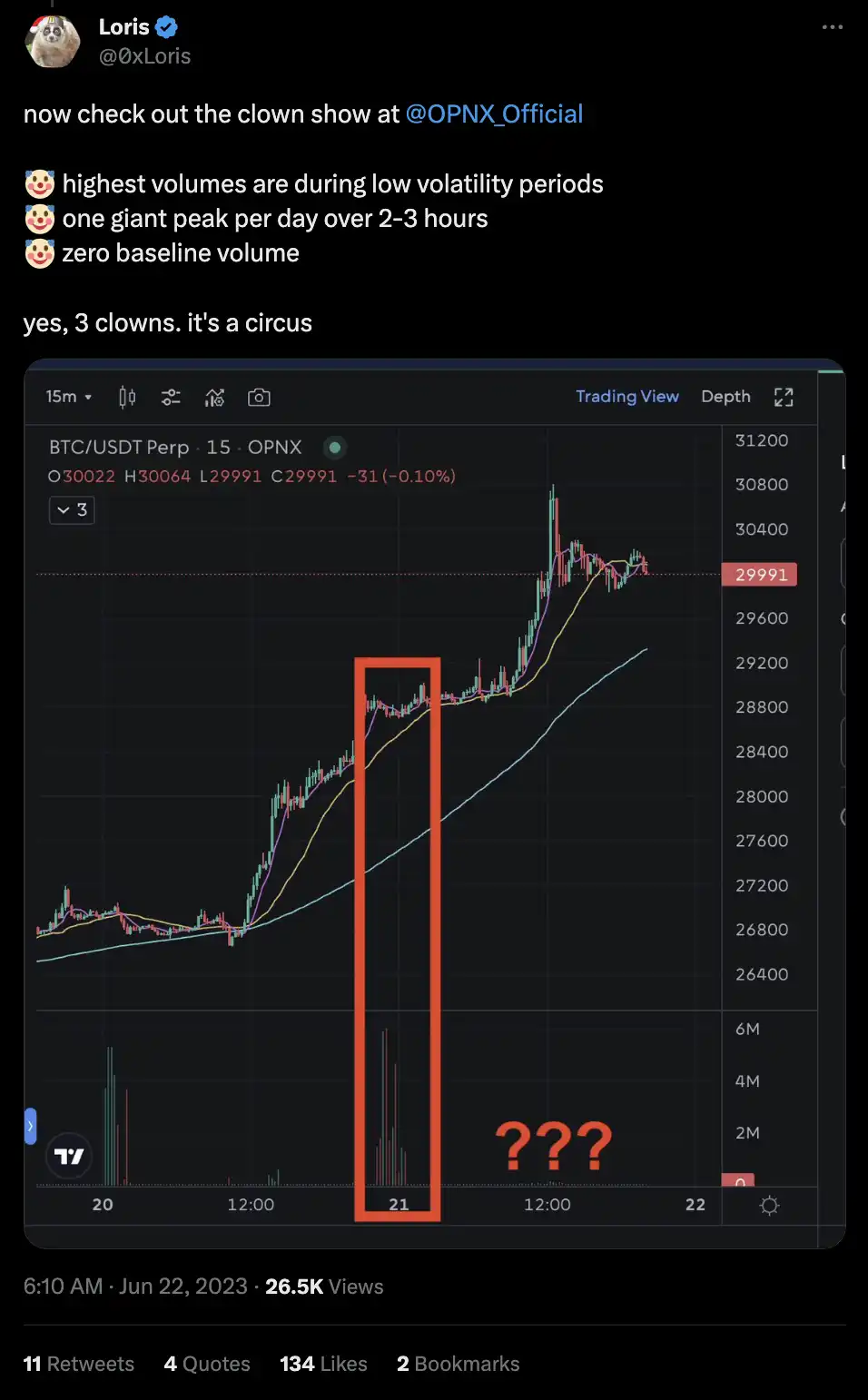
Loris pointed out that the normal volume and price data displayed on the head trading platform have consistent fluctuations (such as higher trading volume should be accompanied by significant price fluctuations) and stable baseline. However, the volume and price data of OPNX show that the price fluctuations corresponding to the amplification range of trading volume are very small, while the price fluctuations are large when the trading volume shrinks.
In addition, the trading volume of OPNX has an independent and clear pattern relative to price fluctuations, which indicates the existence of "false trading" in OPNX.
Later, another cryptocurrency user commented that the false trading volume of OPNX was so obvious.
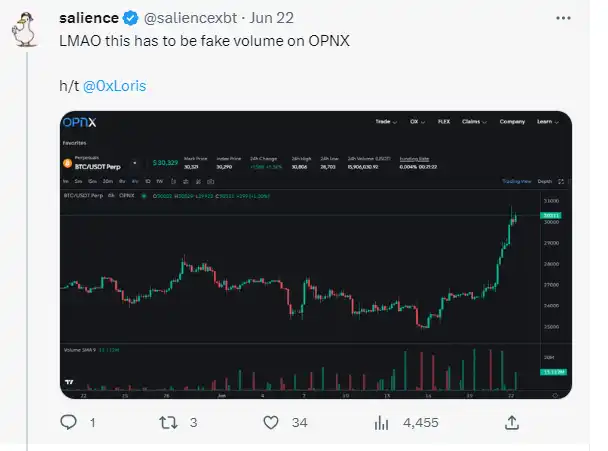
According to the BTC contract price trend chart data on the OPNX official website, it is consistent with Loris's statement. Since entering June, trading volume has regularly (usually at 8:00, 12:00, 4:00, etc.) soared, and the peaks in the trading volume bars are mostly in a similar range. During the period of low price volatility, the trading volume is huge, and during the period of violent price fluctuations, the trading volume is extremely low. The BTC price chart data and trend of the OKX platform during the same period also conform to the law of supply and demand.
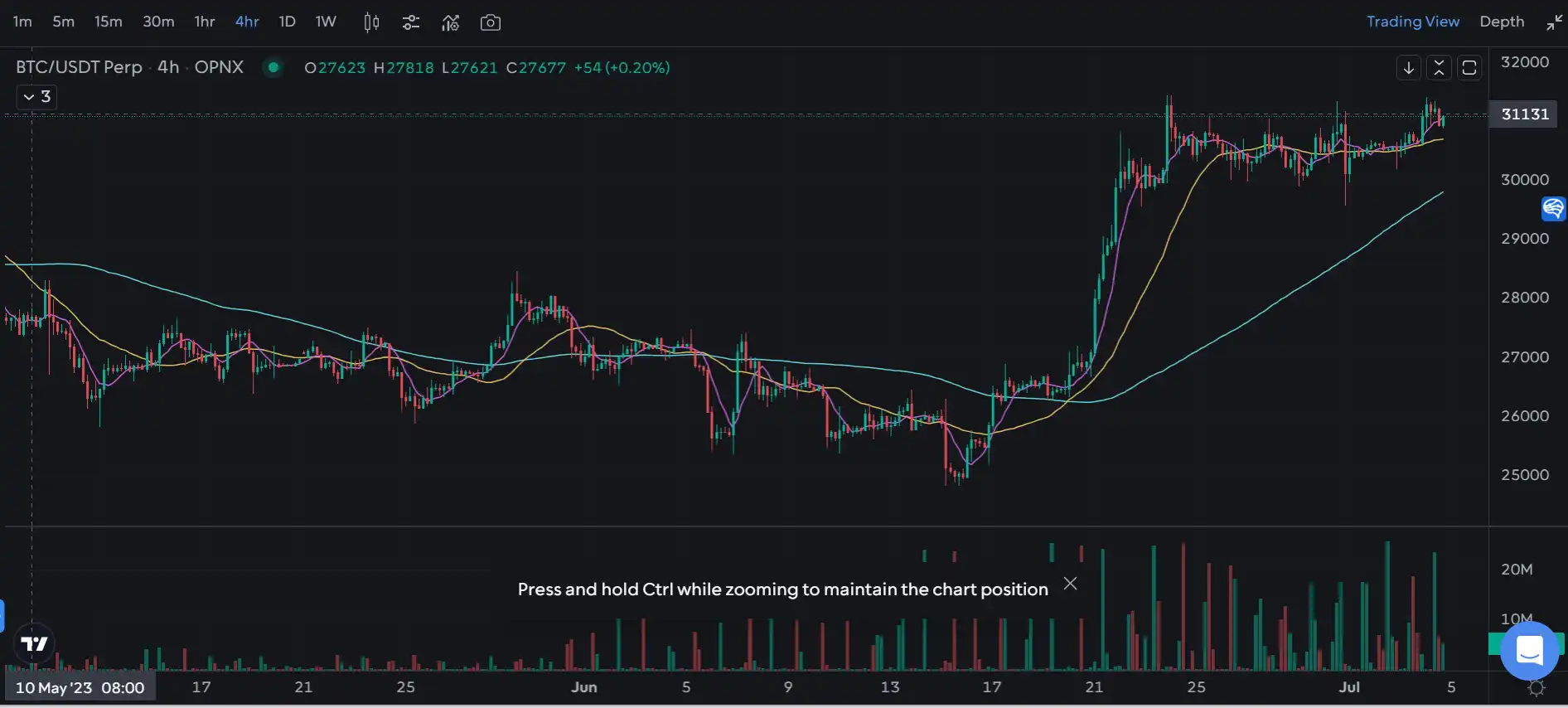
OPNX platform's BTC/USDT contract icon
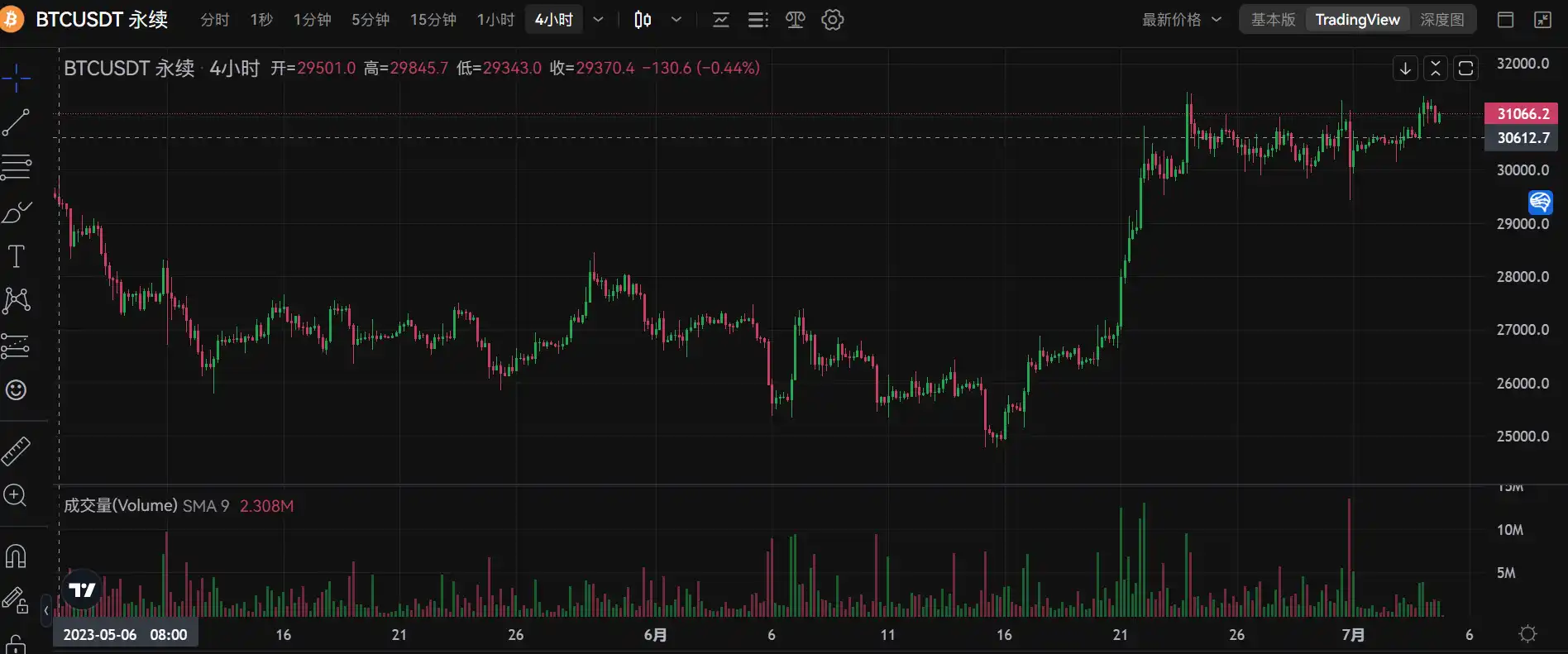
OKX platform's BTC/USDT contract chart
OPNX's response to this is that these trading volumes are attributed to its introduction of a market maker program. However, OPNX's market maker incentive plan was announced as early as April 8th. But currently, @Loris' tweet has been deleted.
The reason why trading volume is so concerned is that OPNX was found to have less than $2 in trading volume on the day of its launch on April 4th. According to CoinDesk, only two transactions were executed on OPNX within 24 hours of its launch, with a total value of $1.26. Later, OPNX officials clarified that CoinDesk's $1.26 transaction data only came from contracts and did not include spot transactions. In fact, the total trading volume that day was $13.64.
Within just 3 months, the daily trading volume of OPNX increased from around $10 to $50 million. The official explanation for this data change is attributed to a combination of factors, such as market maker plans, platform token OX, and new projects on Launchpad. However, this cannot dispel doubts in the minds of users.
OPNX debt trading becomes a gimmick, contracts become the main force
除交易量数据的真伪外,OPNX's initial focus on debt trading has also become a gimmick product, with the trading volume of claim-based assets (also known as debt-based tokens) almost zero for several days.
Currently, more than 99% of the trading volume on the OPNX platform is contributed by perpetual contracts. For example, on July 3rd, the 24-hour trading volume on the OPNX platform was $68.12 million, of which contract trading volume was $67.99 million, and spot trading volume was only $137,000. Debt-based tokens are included in the spot trading volume and can be ignored.
This seems to go against the original positioning. At the establishment of the platform, OPNX was a platform with a focus on debt trading and planned to support claim trading for multiple bankrupt companies, including Celsius, FTX, Genesis, BlockFi, Voyager, Three Arrows Capital, etc.
The first debt token to go online was rvUSD (Recovery Value USD Tokens), which was issued by CoinFLEX and represents Roger Ver's personal debt of $84 million to CoinFLEX. After CoinFLEX was acquired by OPNX, CoinFLEX users' KYC information and account balances can be seamlessly migrated to OPNX as its first batch of customers, and the debt token rvUSD is also listed on OPNX.
However, since the launch of OPNX in April, the price of rvUSD has been falling all the way, dropping from a high of $0.62 to the current $0.15, with zero trading volume for multiple days and almost no liquidity.
rvUSD trend chart
On June 1st, Celsius launched its debt token CELSIUS, which supports Celsius debt holders to tokenize their debt and release the liquidity of their trapped funds. However, as of July 4th, there has been no trading activity on the CELSIUS/USDT trading pair, with zero trading volume and a flat token price. The order book only shows 8 sell orders.
Debt token CELSIUS trend chart
From this perspective, OPNX did not develop into a preset debt trading platform. Nowadays, its business has shifted towards traditional cryptocurrency exchanges, with contracts becoming the mainstay of the platform.
Actually, there have been traces to follow. On April 4th, OPNX, a platform known for debt claim trading, officially launched its first feature, which supports cryptocurrency spot and derivative trading services, rather than debt token trading. This has also been described by community users as "using the guise of supporting encrypted claim trading, while the real business is a contract casino." This also indicates that OPNX's business focus is on encrypted asset trading, rather than debt trading, as the types of assets and user groups for claim trading are limited.
In addition, on April 18th, the Dubai Virtual Asset Regulatory Authority issued a written condemnation to the founders and CEO of OPNX, stating that they were operating and promoting their digital asset trading platform without the necessary local licenses. This exposes compliance issues with OPNX.
Can the plan to open an exchange and repay debts be realized amidst the lingering shadow of failure?
OPNX has attracted attention from users due to a short-term increase in trading volume and a short-term surge in the platform's token OX. However, the shadow of the founder's dishonesty and CoinFLEX's suspension of user withdrawals has not been lifted.
On June 27th, the liquidators of Three Arrows Capital were still trying to recover $1.3 billion from its founders, Su Zhu and Kyle Davies. According to a previous report by business management company Teneo, Three Arrows Capital currently owes approximately $3.5 billion in debt to 27 companies. Meanwhile, trading platform CoinFLEX has suspended all user withdrawals due to funding issues, forcing its creditors and investors to become shareholders of the company.
"The combination of a founder with a bad reputation and a failed platform really makes it difficult for users to fully trust OPNX, which faced a lot of opposition in its early days. When Su Zhu first announced the launch of a cryptocurrency debt trading platform on Twitter, one user in the crypto community commented below, 'You should focus on talking to your lawyer instead of launching new scams.' In addition, Evgeny Gaevoy, CEO of market maker Wintermute, said he would not invest in this new exchange founded by the founder of Three Arrows Capital. Nic Carter, a partner at cryptocurrency venture firm Castle Island Ventures, later said that it makes sense for disgraced scammers to work with other disgraced scammers to trade the debt of a collapsed fraudulent exchange. This actually sounds quite reasonable."
In April of this year, after OPNX went live, it announced its main investors on Twitter, including AppWorks, Susquehanna (SIG), DRW, MIAX Group, China Merchant Bank International (CMBI), Token Bay Capital, Nascent, Tuwaiq Limited, and others. It also stated that these institutions not only provided funding, but also offered many opinions and assistance in areas such as its vision, token economics, legal framework, and decision to relocate to Hong Kong.
However, the investor list released by OPNX was quickly refuted by DRW, Nascent, MIAX, Susquehanna (SIG), and others who denied investing in OPNX. Among them, Nascent, DRW, and other institutions stated that they did not participate in OPNX's financing, but only invested in FLEX tokens at the beginning of 2021.
Later, OPNX personnel stated that Su Zhu and Kyle Davies are no longer involved in the daily affairs of OPNX. However, their Twitter profiles still display @OPNX and they continue to share data and progress related to the OPNX platform on a daily basis. Just yesterday, Kyle Davies also stated in a Twitter Space that the two founders of Three Arrows Capital will donate the "future profits" of the OPNX platform to creditors who suffered losses due to the fund's bankruptcy last year.
This is consistent with the speculation that "OPNX is an important plan for Su Zhu and others to open a trading platform to repay debts". Trading platforms have always been considered a good business in the cryptocurrency industry, with some people saying that if a trading platform has a daily trading volume of 500 BTC, it can generate a net income of half to one bitcoin per day. So, can the wish to repay debts through the OPNX platform be realized?
After doing some calculations based on OPNX's daily trading volume of $50 million, and current maker and taker fees of 0.02% and 0.07% respectively, OPNX earns $45,000 in daily transaction fees. Three Arrows Capital currently owes approximately $3.5 billion in debt, and at this rate, it would take approximately 77,777 days or 213 years to pay off the debt. However, if we factor in the potential increase in value of the platform's token OX, growth in trading volume, and future listing fees, the repayment speed may accelerate.
However, it is worth noting that the official OPNX Telegram group currently only has 2060 users, while the Chinese Telegram group has 2690 users (Su Zhu's Twitter name has also been changed to Chinese "朱溯"). The number of community users is in stark contrast to Su Zhu and Kyle Davies' 568,000 and 517,000 followers, respectively.
Original article link
Welcome to join the official BlockBeats community:
Telegram Subscription Group: https://t.me/theblockbeats
Telegram Discussion Group: https://t.me/BlockBeats_App
Official Twitter Account: https://twitter.com/BlockBeatsAsia