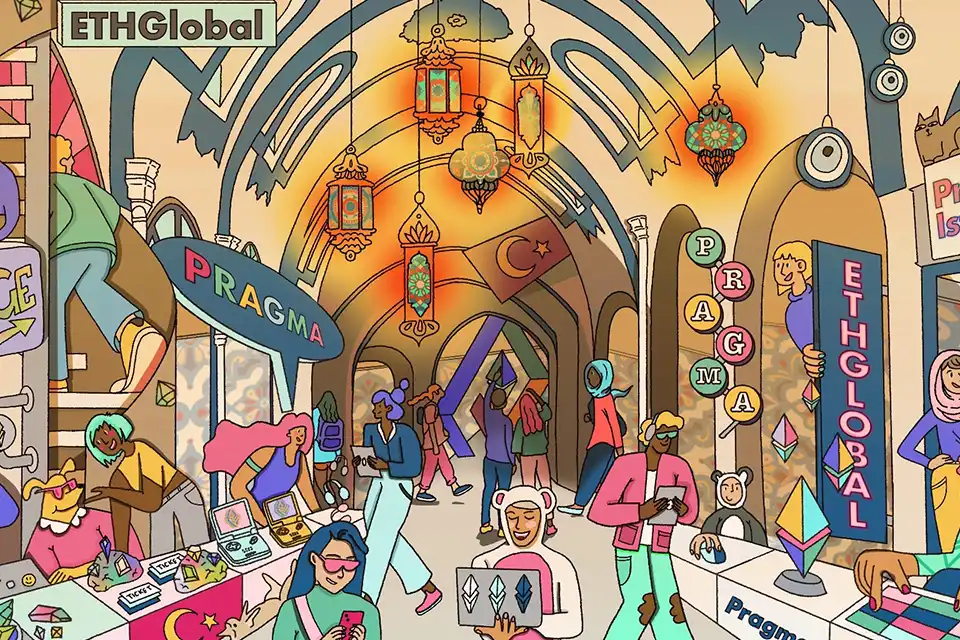
Inventory of 11 ETHGlobal Waterloo 2023 finalist projects.
Source: ETHGlobal
Translation: Deep Tide TechFlow
1.AquaNet
AquaNet uses non-fungible token binding accounts (ERC-6551) to create and record NFT activities in AI-driven social media networks. Each eligible NFT can create its own account on the "myPuddle" network, allowing the NFT to establish and develop a unique AI identity primarily generated by its existing features. They will autonomously post messages to their own accounts, list their interests, and share information about themselves.
2.Smarter Contract
Have you ever thought about how to optimize the efficiency of smart contracts, seamlessly leverage the unique advantages of various blockchains, and simplify the complexity of cross-chain operations? Now you don't have to think about it anymore. Welcome to use Smarter Contract to enter the future. The solution of this protocol is supported by the cross-chain protocol Hyperlane, which takes smart contracts to a new level. This is not just about making them smarter, but making them more intelligent. The following is how Smarter Contract works:
The core components of Smarter Contract include:
GasEstimator: Think of it as a strategist for contracts. It simulates the functions of contracts on various chains and determines the most cost-effective blockchain for each function at any given time.
Function Dispatcher: Once the GasEstimator selects the most efficient chain, the dispatcher acts like a courier service, using Hyperlane to accurately transport these functions to their optimal chain.
Result Aggregator: After the functions have completed running on their respective chains, the Result Aggregator appears. This is like the grand finale of a performance, gathering the results together and presenting them in a unified view.
Users can connect their wallets, select the function they want to execute, and input data. They can monitor the running status of the function in real time and see the gas fees they save directly.
The goal of Smarter Contract is to redefine the efficiency and cost-effectiveness of executing and maintaining smart contracts. By delegating functions to different chains based on real-time conditions, it improves the performance of your smart contracts while reducing costs.
By utilizing Hyperlane's cross-chain protocol, Smarter Contract has leveraged the potential of multiple blockchains to meet your smart contract needs. This is not just an upgrade, but a leap towards user-friendly, accessible, and cost-effective blockchain technology applications.
3.Fukuro
This project created an auction market using EIP-6551. Users can list and bid on Fukuro bundles.
The name "Fukuro" is inspired by the Japanese "Fukubukuro," also known as "lucky bags." They are mysterious sealed bags sold at a fixed price. EIP-6551 enables ERC-721 to control its own "wallet address" and hold assets.
Each Fukuro can contain anything that can be contained in an Ethereum address, such as other NFTs, ERC20s, and so on. This makes it possible to trade various assets, such as art collections, trading card sets, and even planned investment portfolios.
4.Roll a Mate

Our Ethereum mainnet based on memory pool payment Rollups allows users to send and receive ETH, covering transaction fees from zero to 4 cents. This protocol, called "Roll a Mate", aims to address the needs of users and businesses for frictionless entry into the Ethereum ecosystem and daily payment expenses. Whether it's buying a meal or paying for a taxi, high transaction costs should not be a deterrent.
As Vitalik Buterin emphasized at the opening ceremonies of Pragma Waterloo and ETH Waterloo, it is unreasonable to pay a transaction fee of $5 for a $15 bill. This dilemma has driven cryptocurrency companies to use centralized exchanges like Binance, which offer free or very low transaction fees, but do not truly align with the development principles of the ecosystem.
Providing competitive transaction costs on the Ethereum mainnet is a very challenging problem, as it is the most widely adopted chain. However, Roll a Mate has successfully addressed this issue by leveraging the functionality and flexibility of the memory pool.
The memory pool of the Ethereum mainnet provides a broadcast channel specifically for validating potential transactions, which can be accessed by any node and several graphical services through it in certain situations.
Anyone can broadcast valid transactions, but must meet the following conditions:
Effective structure, encoding, and signature.
Enough balance to pay for Gas fees, at least 21,000 Gas units.
Valid nonce.
The high transaction costs are a direct result of high Gas prices, which often turn simple transactions that may only cost 4 cents into $5 transactions. This inflation makes any system based on Ethereum mainnet payments meaningless.
By operating the memory pool to validate and broadcast low gas transactions, and then including them in sidechain order book rollups (without requiring user interaction), Ethereum mainnet users can send and receive payments at zero to 4 cents cost, and even faster than mainnet transaction completion time.
Users who use the Roll a Mate payment protocol only need to pay Gas fees in two situations:
Deposit the ETH that needs to be spent, this is an inexpensive transaction.
Withdrawal, trigger the construction of the order book Rollup for order verification.
In short, using the Roll a Mate payment protocol, an Ethereum mainnet user can deposit 1 ETH, pay gas fees only once, and use this balance for "100 transactions within a year", with a maximum payment of only 4 cents per transaction on average. On the other hand, merchants can receive and accumulate any number of transactions, paying gas fees only once when withdrawing funds. Considering that they can also send transactions from these accumulated funds without having to withdraw them.
5.Piggybank 6551 NFT

Piggybank 6551 is an interesting NFT savings account. Users can mint Piggybank NFTs and then load them with ETH by using a payable function or sending ETH directly to the NFT's 6551 account address. As ETH accumulates in each Piggybank, the NFT's metadata for color, text labels, and attributes are immediately updated. Once ETH is locked in the NFT, the only way to extract it is to destroy the NFT either by calling the burn function or manually sending the NFT to one's own 6551 account. When the 6551 account receives the NFT, it immediately returns the contained ETH to the account that destroyed the NFT and updates the metadata to "destroyed".
6.Smile DAO

This project is an experiment in the field of zero-knowledge machine learning (ZKML), aimed at attempting to verify the output of a machine learning (ML) model given private inputs. The idea behind Smile DAO is that a user of a front-end application wants to take a picture of themselves smiling, run it through an ML model, and create a proof of the process on the client side. Smile DAO has deployed a validator on-chain, and once a user obtains their proof, they can publish it to the chain during the NFT minting process. This NFT has voting power within the DAO and can participate in decision-making through proposal counting, voting, and executing DAO operations.
7.a(i)udit

Only in 2022, due to the exploitation of 167 major security incidents and hacker attacks, over $3.6 billion in funds were lost - with a staggering 51.5% coming from audited protocols! We do not deny the value of audits, but they are centralized, expensive (both in terms of time and money), and not enforceable - the security of our Web3 future cannot rely solely on audits. So, how can we make it easier for developers to become part of the solution and adopt security-first practices earlier in their development cycles?
A(i)udit has the answer: an integrated platform that allows engineers to write, audit, test, and deploy smart contracts to any chain using natural language and perform any testing.
For developers, A(i)udit brings security best practices to the early stages of the development lifecycle by enabling dedicated security testing and rapid prototyping. Master security and auditing tools in your dev cycle before expensive audits.
For junior auditors, A(i)udit allows you to focus on finding vulnerabilities, eliminating the burden of learning and managing multiple tools, programs, environments, audit report templates, and frameworks. Use A(i)udit to start running faster and more efficiently.
Specifically, A(i)udit is a tool that developers can use to execute blockchain-specific workflows using natural language. Here is a description of an example workflow:
1. Users upload their smart contracts to the platform. Alternatively, developers can also use A(i)udit to help them start writing smart contracts. Currently, only smart contracts compatible with EVM are supported.
2. Users can simply request A(i)udit to write and execute simple unit tests and Fuzz tests. Currently, the quality of unit tests cannot be guaranteed or warranted, and only Foundry Fuzz tests are supported.
3. Users can request A(u)dit to perform static analysis testing. Currently, Mythril and Slither are supported for static analysis testing.
4. Users can request the model to store test results in IPFS and use web3.storage for smooth review, classification, and collaboration to address identified vulnerabilities.
5. Users repeat steps 1-4 until no vulnerabilities are detected.
6. Users can then request A(u)dit to deploy smart contracts to the testnet or mainnet. We currently only support Ethereum, Gnosis, Polygon, and local Ethereum nodes as targets.
8.Tokenbound Titans

This is an NPC game implementation that combines ERC-6551 with dynamically generated NFTs. Players are the owners of NFTs, each with different abilities and characteristics.
The core of the game is the battle between these NPCs, and players can bet their own Tokens on the digital arena. The algorithm used to calculate the battle results is off-chain and can be verified using ZK-proof.
Winning battles can allow players' NPCs to level up, enhancing existing attributes such as health, attack, speed, and armor. A natural extension is unlocking new skills and combinations, making their NFT gameplay more diverse. As NFTs level up, they become more powerful and flexible. This advancement system adds depth and longevity to the game, motivating players to strategize, adapt, and continuously improve their NFTs to dominate the game.
9.zBay
zBay is a project aimed at changing the online marketplace industry through decentralization and democratization of the existing eBay platform. Its mission is to provide a secure, transparent, and efficient market for everyone by removing intermediaries and empowering both sellers and buyers. Inspired by eBay's massive fees of up to $10 billion earned in 2022, zBay believes that now is the time to reshape the online commerce landscape. To achieve this goal, we have implemented three key components within the zBay platform:
Importing Data and Reputation: We recognize the value of established sellers with a reputation on eBay and understand the importance of reputation in the online marketplace ecosystem. Through our decentralized approach, we allow sellers to easily import their existing data and reputation from eBay, ensuring a smooth transition for those looking to take advantage of our decentralized market. By preserving and transferring reputation, our goal is to build trust between participants and allow them to benefit from the records they have already established.
Guarantee Mechanism: Trust is the foundation of any successful online marketplace. To enhance trust and security, we have implemented an innovative guarantee mechanism in zBay. This mechanism serves as a safeguard to ensure that funds are securely held until both the buyer and seller fulfill their obligations. By incorporating this layer of protection, we aim to mitigate fraudulent activities and instill confidence in the decentralized market. To ensure smooth and secure communication between buyers and sellers, we have implemented XMTP chat functionality centered around the product.
Dispute Resolution: Inevitably, disputes may arise during the transaction process. To address this challenge, we have integrated the Uma oracle framework into zBay's infrastructure. This cutting-edge technology utilizes decentralized consensus and verifiable off-chain data to achieve efficient and fair dispute resolution. Through Uma, we ensure that disputes are transparently and promptly handled, promoting a fair market experience for all participants.
10.Token Rescue Buddy

The popularization of L2 and breakthroughs such as Account Abstraction (EIP-4337) indicate that the future clearly lies in multi-chain and smart contract wallets. However, current solutions face several major problems. Unlike EOAs, smart contract wallets can only be deployed on one chain at a time. Even more frustratingly, the most popular smart contract wallet, Gnosis Safe, does not support multi-chain safes with the same address, a technically feasible feature that their community has been requesting for years!
This very dangerous UX issue has caused huge losses due to the error chain on the Token.
The working principle of Token Rescue Buddy is to redeploy your safe deposit box to the same address on a different chain. This is usually a complex process that can result in loss of funds/hacker attacks, but Token Rescue Buddy makes it easy for any user to complete.
The ease of use also makes it very suitable for centralized trading platforms. As long as they have the private key technically, they can now easily programmatically recover Tokens sent to the wrong address.
11.Copix

Copix is a public canvas built on the Polygon testnet Mumbai, where each pixel is a non-fungible token. Verified World ID holders can modify the metadata to create art by changing the color of pixels. After selecting a color, users now own the pixel they just edited. A 2-minute cooldown limits a user's consecutive modifications to pixels. Additionally, users can access the full pixel metadata history, including past colors and contributors.
Welcome to join the official BlockBeats community:
Telegram Subscription Group: https://t.me/theblockbeats
Telegram Discussion Group: https://t.me/BlockBeats_App
Official Twitter Account: https://twitter.com/BlockBeatsAsia

 Related Articles