"Unmanaged" and "retail investors": Understanding the EDX compliance framework in five points.

Author: Leo, LeftOfCenter, BlockBeats
(Note: This content contains HTML tags and English characters, which will not be translated. The content within the "blockquote" tag and the "br" tag will be returned as is.)
On the morning of June 21st, BTC surged due to a key reason - Wall Street's entry into the crypto market. The United States is launching its own cryptocurrency trading platform, EDX Markets. In the past few weeks, the SEC has frequently taken action, putting pressure on Binance and Coinbase for regulation, and the industry has been filled with various FUD, causing the crypto market to plummet. Many people believed that under the SEC's crackdown, the crypto market would collapse. However, it seems that the SEC has other intentions.
Just last night, a very "new" cryptocurrency trading platform, EDX Markets, announced its entry, causing a lot of attention. Compared to previous cryptocurrency trading platforms, this time EDX is completely owned by the US national team. It is supported by Wall Street forces such as Citadel Securities, Fidelity, and Charles Schwab. As of the time of writing, the platform has provided services to industry giants such as Charles Schwab, Citadel Securities, Fidelity Digital Assets, Paradigm, Sequoia Capital, and Virtu Financial. And this cryptocurrency trading platform represents the "compliant" traditional financial entry into the crypto platform. So how does EDX achieve compliance?
1. Non-custodial
Unlike mainstream cryptocurrency exchanges, EDX is a non-custodial exchange, which means it does not directly handle customers' digital assets. Instead, it only provides an exchange platform for institutional users to execute cryptocurrency and fiat currency trades and settles externally.
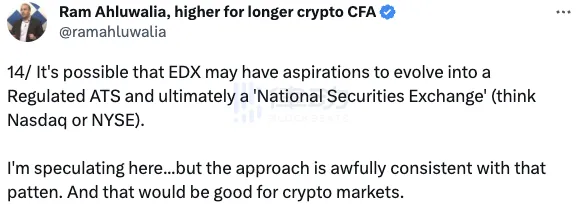
LumidaWealth CEO Ram Ahluwalia (@ramahluwalia) believes that EDX may want to develop into a regulated ATS and eventually become a "national securities exchange" (think Nasdaq or NYSE), which would be beneficial for the cryptocurrency market. EDX is applying federal securities laws to cryptocurrencies and by utilizing third-party banks and cryptocurrency custodians for asset custody, EDX minimizes conflicts of interest and prevents asset misuse, as we have seen in issues with FTX, Celsius, and DCG/Genesis.
The so-called non-custodial trading refers to the settlement process. Unlike mainstream cryptocurrency exchanges that require customers to deposit their cryptocurrency assets into wallets controlled by the exchange, EDX plans to have third-party banks and cryptocurrency custodians hold customer assets. The actual asset trading takes place directly between these third-party companies.
During the settlement phase, EDX Markets will act as an agent to calculate the settlement obligations between the parties and notify each member and authorized custodian which counterparty the member traded with and for how much. Members will independently own their own trading data to verify the settlement data provided by EDX Markets. EDX Markets does not participate in the transfer of fiat currency (cash) or tokens - this is done solely through authorized custodians. Similarly, EDX Markets does not participate in the flow of funds. Settlement will be governed by legal agreements between members and their authorized custodians, without recourse to EDX Markets. In the event of a dispute, EDX Markets will recalculate, but the resolution of any dispute will depend on the terms of the agreement between the member and their authorized custodian.
In addition, EDX plans to launch its own clearinghouse later this year to simplify settlement processes.
2. Non-Security Tokens and Their Trading Rules
According to the information provided on the EDX official website, the trading platform currently only supports four types of token trading: BTC, ETH, LTC, and BCH spot trading. These four types of assets are not classified as securities by the SEC. For EDX, this conservative selection of tradable currencies can avoid conflicts with the SEC and is part of EDX's compliance framework. In the future, as definitions and interpretations of securities and crypto tokens emerge, EDX may add more crypto token types. Currently, only institutional trading is supported, and institutions must pass a "membership screening" to join the EDX trading list and conduct transactions. Retail investors cannot trade on this trading platform.
Regarding trading rules, some of EDX's rules differ from traditional cryptocurrency trading platforms. BlockBeats has summarized the trading rules currently disclosed by EDX on its official website as follows:
- The trading platform is open for trading 365 days a year, 24/7, unless otherwise notified by the platform, such as for maintenance, system upgrades, or other reasons. In such cases, the platform will inform institutional users in advance.
- The trading platform has the right to stop or suspend the trading of any or all tokens on this trading platform in order to maintain market fairness, protect investor interests, or take other actions, such as canceling all unprocessed and open (unexecuted) order instructions, or restricting instructions to certain types of order instructions (such as limit orders). The trading platform has the right to decide the duration of such "suspension, suspension, closure" behaviors and notify institutional members, and the system will reject all orders related to the suspension of trading tokens.
And there are significant differences in the rules for the new token launch compared to traditional cryptocurrency platforms, as follows:
- If the trading platform lists a new token type for trading, the platform will suspend all orders related to the new token and initiate a quotation period for the token. The length of the quotation period will be determined by the trading platform. During the quotation period, members can submit orders to the system, but these orders will not be executed.
-After the quotation period ends, the trading platform will initiate a limit order trading period during which the system will only accept limit orders. The trading platform will determine the length of the current price order period on its own. Limit orders for tokens submitted during the current price order period will be accepted, but regular token market orders will be rejected by the system.
-After the limit order is over, the trading platform will transition to the formal trading period, and the trading platform will open the system for trading. All orders that meet the conditions will be accepted by the system.
- The system should be able to allow authorized members who have access to the system to input and execute orders. All members selected through EDX Markets can use the system in a fair, transparent, impartial, and non-discriminatory manner.
It can be seen that compared to other trading platforms, EDX is very cautious and has more processes in token trading, trying its best to avoid being caught in the "non-compliant" queue.
3. Do not directly serve retail investors
Coinbase and Binance have set a precedent, and in order to avoid regulatory conflicts, EDX Markets does not directly provide services to individual investors. Instead, EDX will provide order routing services through retail brokers, sending retail investors' buy and sell orders to the trading platform.
Simply put, EDX Markets is a non-custodial trading platform that does not directly handle clients' digital assets or serve individual investors. It will provide trading access based on APIs, rather than traditional front-end user interfaces. At the same time, EDX Markets does not directly hold client funds, but manages them through third-party banks and professional custodians. The transfer of funds does not "pass through" EDX Markets, but is only completed between relevant service providers.
This is similar to the operating mode of the traditional stock market, where investors do not directly enter the New York Stock Exchange or NASDAQ, but submit orders through brokers such as Fidelity and Schwab.
4. Market making must be done by third parties
The US Securities and Exchange Commission (SEC) has filed 13 charges against the world's largest cryptocurrency exchange, Binance, one of which is "conflict of interest". The basis for this charge is that a trading company owned by Binance CEO Zhao Changpeng artificially inflated the platform's trading volume and manipulated trades.
In most traditional financial markets, exchanges generally match buyers and sellers at the most competitive and transparent prices, and market-making is usually operated by independent private companies, so there is no "conflict of interest".
Although this internal market-making model has been a common practice among centralized exchanges, it is clear that this model does not meet the ideal compliance conditions in the eyes of the SEC. This has also been one of the evidence listed by the SEC in its frequent accusations against cryptocurrency exchanges in recent times.
According to Gary Gensler, the chairman of the US Securities and Exchange Commission, "these so-called cryptocurrency exchanges are mixing multiple functions, and in the traditional financial field, we have not seen the New York Stock Exchange operate hedge funds and market making." In other words, he does not recognize the current model of cryptocurrency exchanges that combine trading, market making, and custody.
The Financial Times reported, citing anonymous sources, that Crypto.com has always had its own proprietary market-making team and privately prohibited employees from disclosing the existence of internal market makers. Coincidentally, shortly after the SEC filed a lawsuit against Binance, Crypto.com closed its institutional trading services for the United States.
This time, the new compliance trading platform created by EDX Markets seems to separate market making from custody, and it exists only as a pure trading platform. By introducing third-party banks and cryptocurrency custody institutions, EDX minimizes conflicts of interest and prevents asset abuse.
It is worth mentioning that among the consortium supporting EDX Markets, two (Citadel and Virtu) are professional market makers on Wall Street themselves. Therefore, we have reason to speculate that the market-making services of EDX Markets in the future may be provided by these two top market makers on Wall Street, Citadel and Virtu.
5. Strong support from traditional financial institutions
Similarly, the supporters behind EDX are also traditional financial giants on Wall Street, which is also a point of considerable attention for the platform. The supporters behind the institution include Charles Schwab, Citadel Securities, Fidelity Investments, Sequoia Capital, and Paradigm.
EDX Markets has a luxurious founding team, bringing together former executives from major financial institutions. EDX Markets founder Jamil Nazarali previously served as Global Head of Business Development at Citadel Securities before joining EDX. EDX Markets CTO Tony Acua-Rohter previously served as the Chief Technology Officer at ErisX. The General Counsel is David Forman, who previously served as Chief Legal Officer at Fidelity Brokerage Services and General Counsel at Fidelity Digital Assets.
Welcome to join the official BlockBeats community:
Telegram Subscription Group: https://t.me/theblockbeats
Telegram Discussion Group: https://t.me/BlockBeats_App
Official Twitter Account: https://twitter.com/BlockBeatsAsia

 Related Articles