Opside Whitepaper V2 released: Introducing a multi-chain ZK-PoW mechanism.
Source: Opside
What is Opside
Opside is a decentralized ZK-RaaS (ZK-Rollup as a Service) platform and a PoW network that supports ZKP (Zero-Knowledge Proof) mining. Opside adopts a hybrid consensus of PoS & PoW and provides Web3 developers with a one-click generation of zkEVM application chains. At the same time, the large number of ZK-Rollup brings huge computing power demand for ZKP calculation tasks, thus providing a meaningful mining scenario for global miners.
In the field of expansion, the concept of L2 is not unfamiliar. However, L2 cannot effectively coordinate various types of hardware resources, such as data availability, ZKP computing power, and packaging nodes. In addition, operating an L2, especially ZK-Rollup, requires high hardware maintenance costs and professional technical thresholds, so many developers are discouraged. To address these issues, Opside has proposed the concept of ZK-RaaS for the first time, allowing developers to start their own zkEVM chain in one minute without mastering the knowledge of ZK or chain nodes. At the same time, Opside has also proposed the concept of ZK-PoW, introducing the role of miners to participate in the maintenance of zkEVM nodes and the calculation of ZKP.
Opside's mission is to make ZK-Rollup more user-friendly and accessible, enabling zkEVM-based application chains to be widely adopted on a large scale.
· ZK-Rollup as a Service: For developers, they can deploy their own ZK-Rollup (zkEVM) on multiple chains with just one click.
· Opside ZK-PoW Cloud: For miners, Opside is also a multi-chain PoW protocol that supports ZK mining and generates zero-knowledge proofs for ZK-Rollups on multiple public chains.
ZK-RaaS
ZK-RaaS (ZK-Rollup as a Service) can provide a one-click service for anyone to generate ZK-Rollup.
Opside provides a universal ZK-Rollups launchbase, allowing developers to easily deploy various types of ZK-Rollups to different base chains through the launchbase.
· Base chain, including Ethereum/Opside chain/BNB chain/Polygon PoS and other public chains.
· ZK-Rollup types, including zkSync, Polygon zkEVM, Scroll, StarkNet, and other types of ZK-Rollups.
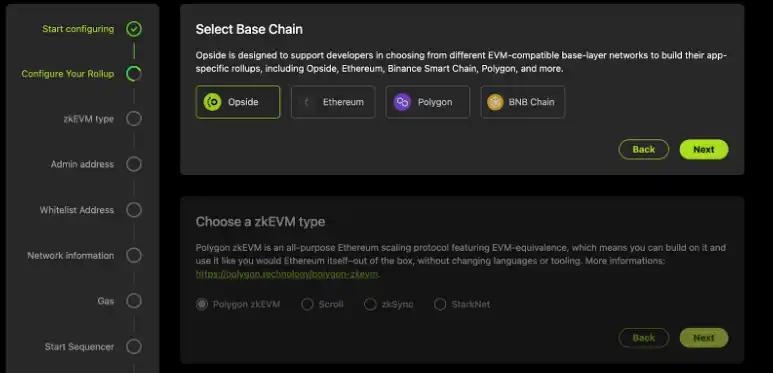
After a developer rents a Rollup slot, they have an independent operating environment. For example, a developer can have a separate zkEVM chain. The developer has sovereignty over ZK-Rollup and can customize the rollup economic model, including choosing gas tokens. Developers can freely adjust gas fees, even to 0, so users do not need to pay any fees.
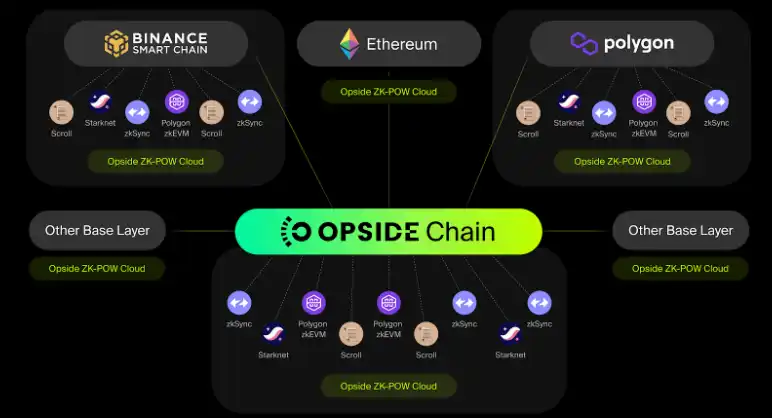
Developers do not need to bear any hardware costs. All hardware resources, including data availability, sequencer, ZKP computing power, etc., are provided in a decentralized manner by Opside ZK-PoW cloud below.
In addition, on the same base chain, native cross-rollup communication can be achieved between different ZK-Rollups. Cross-rollup communication is a messaging mechanism. This means that an address on one rollup can directly call a contract on another rollup. This greatly solves the problem of fragmented user assets and enhances the composability between applications.
Opside ZK-PoW Cloud
Compared with OP-Rollup, ZK-Rollup has many advantages, including greater security, no need for trust, and faster withdrawal speeds. There is also a significant technical difference, which is that ZK-Rollup requires additional powerful ZKP computing power to support the generation of zero-knowledge proofs.
Multi-chain ZK-PoW Mechanism
Opside ZK-PoW Cloud will be deployed on multiple chains, including but not limited to Ethereum, BNB Chain, Polygon PoS, and Opside Chain itself. In Opside's design, developers can deploy ZK-Rollups on the aforementioned different base chains. As ZK-Rollup technology gradually matures, hundreds or even thousands of ZK-Rollups may be born in the future, which will bring great demand for ZKP computing power. Therefore, we need to incentivize miners to join this ecosystem and make contributions. After Ethereum's transition from PoW to PoS, many Ethereum miners lost their application scenarios. In terms of funding scale, the value of miners is about 12 billion US dollars, and many of them are currently idle. With the large-scale landing of ZK-Rollup, the generation of ZKP requires a large amount of CPU, GPU, FPGA and other hardware and miners to provide computing power.
Opside uses the ZK-PoW mechanism to incentivize miners to provide ZKP computing power, thereby providing a complete hardware infrastructure for ZK-Rollup. This is also one of the core ideas of Opside. All roles, including users, developers, and miners, can benefit from this Opside economic model.
ZKP's Two-Step Commitment Algorithm: Standard Decentralized Prover Mechanism
In order to encourage more miners to participate in ZKP computation tasks, Opside has proposed a two-step submission ZKP verification mechanism. The PoW reward share corresponding to a ZKP will be allocated to the submitter, i.e. the miner, who has submitted a valid ZKP according to certain rules.
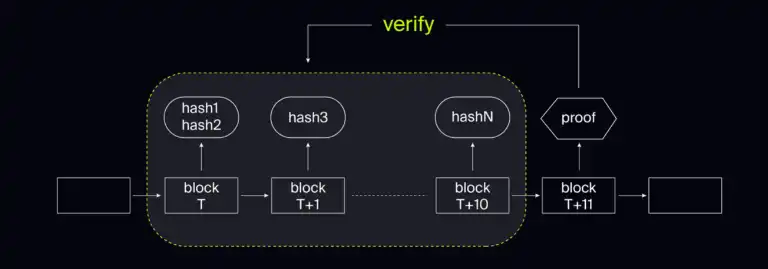
1. Submit proofhash: Within a time window, multiple miners are allowed to participate in the calculation of zero-knowledge proof for a certain sequence. After each miner calculates the proof, they do not directly submit the original proof, but calculate the proofhash of (proof / address) and submit it to the contract.
2. Submit ZKP: After the time window, miners submit the original proof and verify it with the previously submitted proofhash. Miners who pass the verification can receive PoW rewards, and the reward amount is distributed according to the proportion of the miner's staked amount.
For more details, please refer to ZKP's Two-Step Submission Algorithm.
Optimized ZKP Generation Algorithm: Miner Efficiency Increased by 80%
When verifying ZKP in Rollup, submitting raw proof data may trigger on-chain attacks. To prevent malicious attacks, ZK-Rollup often requires additional effort to hide the original proof data. One solution is to include the aggregated result of the miner's address in the ZKP submitted by the miner. Opside's ZKP two-step submission algorithm cleverly adopts a submit-then-verify approach, eliminating the need for unnecessary aggregation calculations on proof and addresses.
In addition, in some open-source zkEVMs, the calculation and submission of ZKPs are serial. When ZK-Rollup submits a large number of sequences, miners cannot calculate multiple ZKPs at the same time. In Opside, the two-step submission algorithm for ZKP enables parallel calculation and serial submission of ZKPs, allowing miners to execute multiple ZKP generation tasks simultaneously, greatly accelerating the efficiency of ZKP generation.
The Opside team has also made a series of optimizations to the ZKP recursive aggregation algorithm, fully improving the utilization of machine resources within the cluster and further enhancing the calculation speed of ZKP.
In the actual stress testing environment, miners have a cluster of 20 machines consisting of 128 core CPUs and 1TB RAM, and the tested transaction stability is about 27.8 TPS for about 40 minutes. Under the same conditions, Opside reduced the average confirmation time of transactions from about 5-6 minutes to about 3 minutes, and the ZKP generation efficiency increased by about 80%. In the future, with more ZK-Rollups and miners joining, the demand and supply of the ZK computing power market will further expand, and the efficiency improvement brought by Opside's PoW algorithm will be more evident.
Opside Chain
Opside Chain, as one of the base chains, not only supports Opside ZK-PoW Cloud, but also has made more optimizations for ZK-Rollup. For example, it uses precompiled contracts to accelerate ZKP verification, supports data sharding, and adopts PoS consensus based on ETH 2.0. In the future, it will also support full sharding solutions such as EIP-4844 and DankSharding, reducing Rollup gas fees to a minimum, even to 0.
Ethereum is currently the world's largest decentralized network with over 500,000 nodes. These nodes not only provide large-scale decentralization, but in the future, thanks to data sharding technology, these 500,000+ nodes will also provide massive data availability.
The inspiration for Opside Chain comes from Ethereum, which is also one of the reasons why Opside chose to improve based on the PoS consensus of ETH 2.0. We expect that there will be over 100,000 nodes on Opside Chain.
For Rollup, how to make the sequencer more decentralized instead of being centralized by a single node? A good approach is to let the block proposers of the Opside Chain propose blocks for the Rollup Layer at the same time. For the Rollup Layer, it actually separates the builder and proposer: the builder is supported by a P2P network without permission, and the proposer uses the block proposer of the Opside Chain, which avoids the availability risk brought by a single node and also has certain resistance to MEV and censorship.
Therefore, Opside Chain provides a standardized decentralized sequencer mechanism, and Opside Chain's block proposers are responsible for proposing blocks for Rollup. Opside Chain allows ZK-Rollup to inherit not only the security of the upper layer, but also the decentralization of the upper layer.
Below is the PoS & PoW hybrid consensus of Opside Chain:
Opside chain
· PoS: Opside will adopt the PoS algorithm of Ethereum 2.0 and make necessary improvements to it. Anyone can hold Opside tokens and become a validator. Validators can receive block rewards and gas fees in the Opside chain.
Rollup layer
· PoS (Sequencer): Validators not only propose blocks on the Opside chain, but also propose blocks (i.e. data batches) on the Rollup layer. Therefore, validators are also the sequencers of the rollups in the Rollup layer. Sequencers can earn gas fees from the transaction fees in the Rollup layer transactions.
· PoW (Prover): Anyone can become a prover for the rollup in the Rollup layer, as long as they have sufficient computing power to perform ZKP calculations. According to the PoW rules, the prover generates zk proof based on the Rollup layer block submitted by the sequencer.
A ZK-Rollup is similar to a computer. A computer has two core components, a hard drive and a CPU. The data availability provided by PoS is equivalent to the hard drive, and the computing power provided by PoW is equivalent to the CPU. The task of Opside Chain is to find a balance between PoS and PoW, so that each role can fully play its value and benefit from it, and to improve the performance and experience of large-scale ZK-Rollup networks.
Token Supply and Demand
Opside token, also known as IDE, will be issued through PoS and PoW rewards, corresponding to Validators and Miners respectively. During the Pre-Alpha testnet phase, the ratio of PoS to PoW block rewards is temporarily fixed at 1:2. In the future, the ratio of these two will dynamically adjust with the ZKP computing power supply and demand of the entire network.
PoS
As mentioned above, Opside Chain adopts PoS consensus based on the improvement of ETH 2.0. To participate as a Validator, users must deposit a certain amount of IDE into the deposit contract and run three independent software: execution client, consensus client, and Validator. These Validators are responsible for checking whether new blocks propagated through the network are valid and occasionally creating and propagating new blocks themselves. If the Validator behaves dishonestly or lazily, the deposited IDE will be destroyed as collateral.
Under PoS, the block generation speed of the Opside Chain is fixed, with time divided into slots (12 seconds) and epochs (32 slots). In each slot, a validator is randomly selected as the block proposer. This validator is responsible for creating a new block and sending it to other nodes on the network. Similarly, in each slot, a validator committee is randomly selected, and their votes are used to determine the validity of the proposed block. For more information on the specific mechanism, please refer to ETH PoS.
Opside Chain is expected to support EIP-4844 on the Alpha testnet, and Data Availability Sampling (DAS) will be used to ensure that ZK-Rollup provides its transaction data after execution without putting too much pressure on any single node. Each Validator randomly samples transaction data provided in the blob to ensure that all data exists. The same technology can also be used to ensure that block producers provide all their data to secure light clients. Similarly, under the Proposer-Builder Separation (PBS), only block builders need to process the entire block - other validators will use data availability sampling for verification.
On some specific parameters, Opside will be different. Readers can find the latest values in the code repository.
Overall, Staking makes it easier for individuals to participate in network security and promote decentralization. Validator nodes can run on regular laptops. Some proxy staking pools even allow users to stake without having enough IDE.
ZK-PoW
Based on the ZK-Rollup launchbase provided by Opside, developers can choose to have an exclusive ZK-Rollup on a base chain. In order to support the massive hardware resource demand brought by numerous ZK-Rollups, Opside provides a unified ZKP computing power market, encouraging miners (i.e. provers) to generate ZKP for these ZK-Rollups. This is the ZK-PoW mechanism of Opside.
Calculation of reward share for a single Rollup sequence
ZK-PoW is a multi-chain protocol, which means that PoW rewards will be distributed across various base chains, including Ethereum, Opside Chain, BNB Chain, and Polygon PoS. The amount of PoW rewards for each base chain depends on the corresponding Rollup slot registration quantity, ZKP workload, and so on.
For each base chain, within a block, each Rollup can only submit one sequence (which can include multiple blocks of that Rollup). Each sequence shares the current block's PoW reward. This means that if 4 Rollups submit sequences in a block of the base chain, the PoW reward is divided equally into 4 parts, and each sequence receives 1/4 of the block's PoW reward. Of course, there may be some blocks where no Rollup submits a sequence, so the actual PoW inflation may be lower than expected.
In the future, each sequence will estimate the workload based on the corresponding ZK-Rollup type, the number of Rollup transactions included, gas usage, etc., and price different sequences differently.
Prover's Staking and Punishment
In order to prevent malicious behavior related to Prover, Prover needs to register in a special system contract and stake tokens. Prover can freely choose to participate in one or more Rollup's PoW mining. Prover needs to stake a certain amount of IDE (Opside token) for each Rollup to participate in the system contract before submitting ZKP. If the current stake amount is less than the threshold, submitting ZKP for that Rollup is not allowed. The reward for submitting ZKP by Prover will also be distributed based on the proportion of the stake amount, thus avoiding malicious behavior of Prover submitting ZKP multiple times.
When the prover exhibits the following behaviors, different degrees of punishment will be imposed:
· If the prover submits an incorrect hash· If there is no ZKP verified, all provers who have submitted the hash will be punished.
The confiscated Opside token will be burned.
For more details and considerations on the two-step commitment mechanism of ZKP, please refer to the official documentation. The specific numbers for prover staking and punishment may be subject to change in the future.
Developers rent Rollup slot
On various base chains, Opside has deployed the ZK-PoW protocol. Developers can register a Rollup slot with one click through ZK-Rollup launchbase to launch their own ZK-Rollup. All hardware resources for this ZK-Rollup are provided by Opside's decentralized network. Developers need to pay rent for the Rollup slot to the Opside network, and this rent will be burned directly.
除了一个固定金额的租金以外,开发者还可以为自己的 ZK-Rollup 提供额外 ZKP 补贴,以激励矿工提供算力。
Apart from a fixed rental fee, developers can also provide additional ZKP subsidies for their ZK-Rollup to incentivize miners to provide computing power.Specific rental and subsidy rules and parameters can be found in the official documentation or code repository.
治理与发展
translates to
Governance and Development
in English.
The functionality and performance of the Opside network will continue to evolve over time. Here are a few examples of higher priority:
· Validator's data sharding and data availability sampling will provide more abundant storage space for the entire Rollup Layer, allowing for more ZK-Rollup ecosystem to be accommodated.· The proposer and builder of Rollup are separated, allowing the Rollup layer to share the validator of the Opside chain as the block proposer, inheriting the decentralization of the previous layer.· Optimization of miner's pledge and slash mechanism, encouraging miners to provide continuous and stable ZKP computing power.
· Application developers provide subsidies for their Rollup's ZKP generation to incentivize miners to provide computing power.
· Workload estimation and personalized pricing mechanism for Rollup batches are established based on ZK-Rollup type, Rollup transaction volume, gas usage, etc.
These improvements will significantly enhance the network utility of Opside, thereby promoting the long-term development and prosperity of ZK-Rollup as a Service.
After the launch of the Opside mainnet, an Opside DAO will be established, which includes reasonable processes and mechanisms to jointly determine the future of the network. All updates to the parameters and mechanisms of the Opside mainnet will be determined through the Opside DAO. It should be emphasized that Opside is a collaboratively built economic entity that evolves over time. Future improvements will be explained in detail in the form of DAO proposals, outlining how these schemes will benefit the long-term interests of the Opside economy and each category of participant. As the network develops, it is crucial to build an economy that can operate independently and robustly without requiring a large number of tools and subsidies.
This article is from a submission and does not represent the views of BlockBeats.
Welcome to join the official BlockBeats community:
Telegram Subscription Group: https://t.me/theblockbeats
Telegram Discussion Group: https://t.me/BlockBeats_App
Official Twitter Account: https://twitter.com/BlockBeatsAsia

 Related Articles