Binance's latest Launchpool boasts a daily capital efficiency of over 100%. What is Maverick?
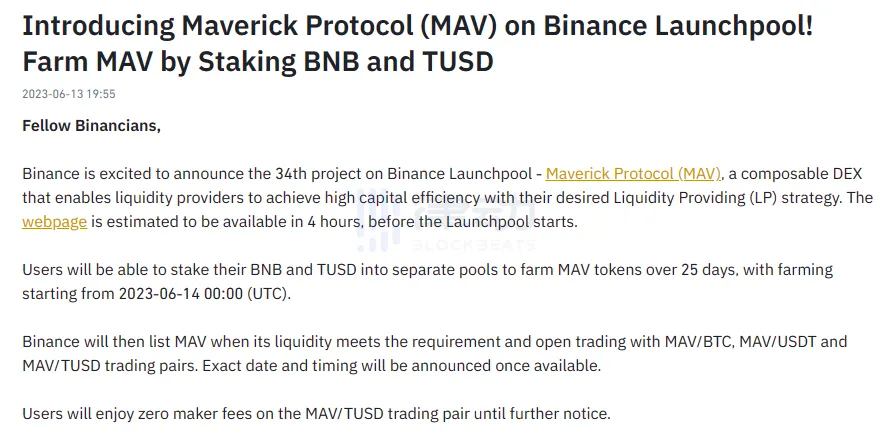
Tonight, Binance announced the launch of the new project Maverick Protocol (MAV) on Launchpool. Users can deposit BNB and TUSD into the MAV mining pool on the Launchpad website after 08:00 on June 14, 2023 to receive MAV rewards. The total mining period for MAV is 25 days. Once the liquidity of MAV Token meets the requirements, Binance will open the MAV/BTC, MAV/USDT, and MAV/TUSD trading markets. The exact date and time will be announced once confirmed.
After one month online, Maverick, which is one of the top three Ethereum mainnet transaction volumes, has a TVL of less than 1% of Uniswap and Curve.
After the Shanghai upgrade of Ethereum on April 12th, more than 18 million ETH were unlocked, and there was a noticeable increase in the activity of the DeFi market and some significant changes.
However, there is still an obvious problem, which is the huge limitation in the current AMM field. One is the low capital utilization rate of AMM, whether it is the early xy=k model or the later Uniswap V3 model, most of the trading pairs on decentralized exchanges do not have enough depth. The second is that impermanent loss has not been fundamentally solved, and relying on token economics for compensation is ultimately unsustainable.
For example, despite dominating in total locked value (TVL) and trading volume, most liquidity providers on Uniswap are still losing money. Transaction fee revenue is often insufficient to offset impermanent losses, especially for concentrated and passive liquidity.
The DeFi industry urgently needs to solve this problem, and the Maverick protocol has come into view of users at the right time.
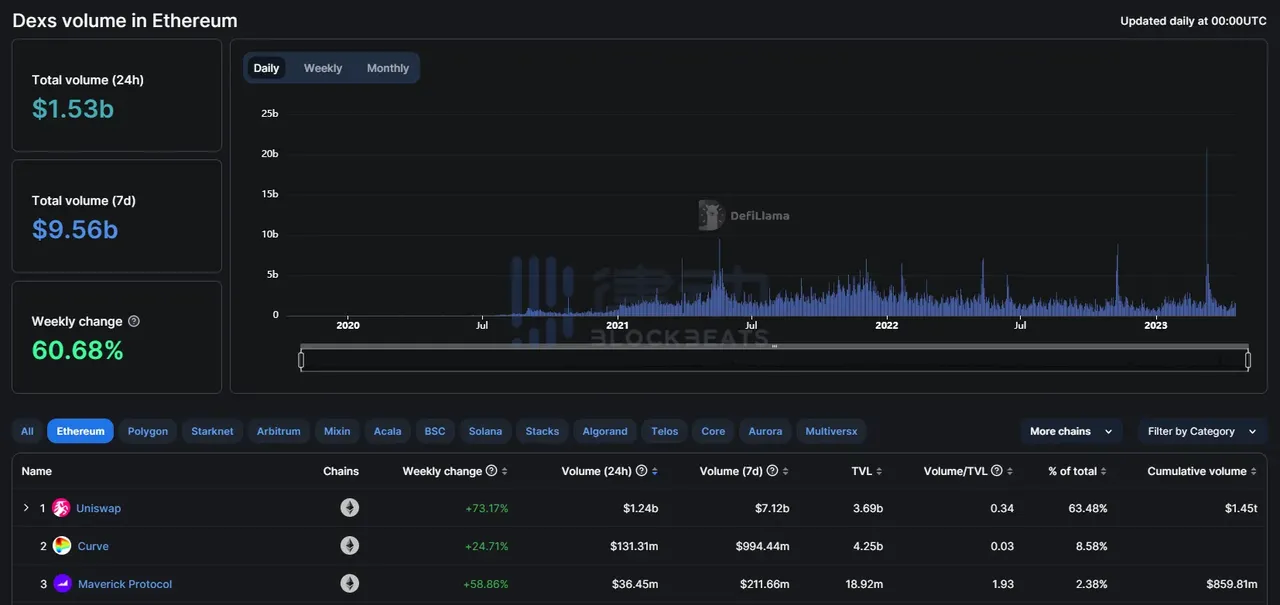
According to Defillama's data, as of April 21st, Uniswap ranked first on the Ethereum network DEX leaderboard, with a 24-hour trading volume of $1.24 billion and a weekly increase of 73.17%. Following closely behind is Curve with a trading volume of $131 million and a weekly increase of 24.71%.
Remarkably, Maverick Protocol has successfully ranked third with a 24-hour trading volume of $36.45 million and a weekly increase of 58.86%.
Maverick AMM How to Improve Liquidity Efficiency
Maverick Protocol is a dynamic and distributed automated market maker (AMM) that moves according to the transaction price. It aims to provide deeper liquidity, bring the best liquidity to decentralized financial markets, and improve capital efficiency. On this basis, it provides tools to maximize transaction fee revenue, or reduce and avoid gratuitous losses.
The uniqueness of the protocol lies in Maverick AMM's pioneering design of Dynamic Distribution AMM, which includes the following three major features:
1. The first AMM with the native ability to automatically move concentrated liquidity based on transaction prices.
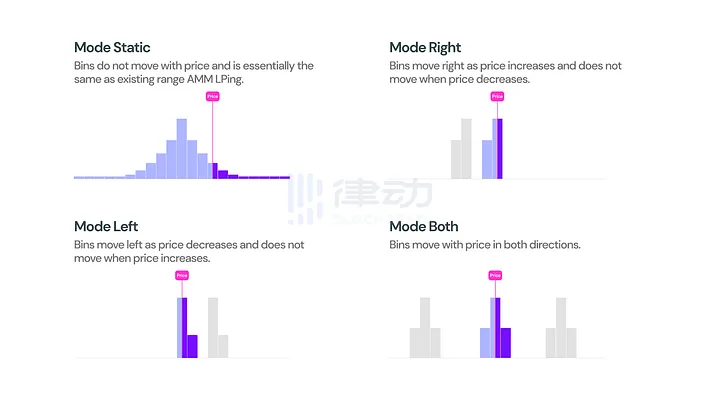
2. Provide tools to empower LPs to execute different liquidity provision strategies: only move with price increases, stay in place when prices decrease; only move with price decreases, stay in place when prices increase; move with both price increases and decreases; and provide fixed liquidity at certain price points.
3、AMM helps LP earn real-time compound interest.
The innovative AMM concept of Directional LP was first introduced in the left and right flow modes of the four liquidity modes, allowing liquidity providers (LP) to follow the direction of liquidity movement based on the price of the trading pair, to obtain excess returns in the correct direction, while avoiding impermanent loss.
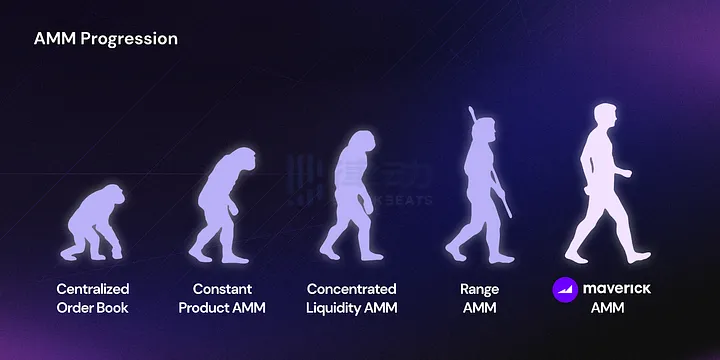
It allows liquidity providers to freely choose to automatically move their liquidity to maintain proximity to the current price. This liquidity movement can improve capital efficiency, provide better capital utilization for LPs, and allow them to make powerful bets while charging fees.
Maverick AMM aims to help users maximize capital efficiency, thereby creating more liquid markets; this means that traders can get better prices, while liquidity providers can also get higher fees. In addition, the built-in features also help reduce the high GAS fees incurred due to position adjustments.
Liquidity providers can choose to follow the asset price in one direction, effectively betting on the price trajectory of a specific token. These directional betting strategies can be understood as one-sided liquidity strategies, as liquidity providers expose most or all of their assets to a single asset in a given pool. The flexibility of Maverick Protocol makes it one of the most liquid markets in decentralized finance, and facilitates linear hedging with advanced or high-level LPs and protocols on top of it, ensuring delta neutrality and safer profit generation.
In addition, Maverick AMM allows liquidity providers to customize liquidity distribution, providing liquidity unilaterally or in any liquidity distribution shape.
AMM provides three functions: automatic movement of native liquidity at the underlying level, custom movement direction of centralized liquidity, and automatic compounding of LP fees. These functions make Maverick AMM the most efficient capital tool for liquidity providers, DAO treasuries, and project development teams in DeFi, as well as the most accurate liquidity management tool.
Directional LP for one-sided bullish or bearish views
In the current AMM field, liquidity providers cannot set a single, definite bullish or bearish position when providing liquidity.
For any existing AMM in the DeFi field, liquidity providers implicitly bet that the price of the asset pair in their pool will fluctuate horizontally, allowing them to collect transaction fees, while the ratio of their deposited assets will not change significantly. If this bet is wrong - that is, if the price moves in any direction other than sideways - liquidity providers will suffer impermanent losses that may exceed any fees they collect.
In static liquidity AMMs, it is advantageous for LPs to have bilateral asset allocation, so that LPs can immediately access trading volume and therefore charge fees. However, bilateral LPs increase the possibility of impermanent loss.
In AMMs like Uniswap V2 with xy=k, even one-sided LP is not supported. In existing range-based AMMs like Uniswap V3, one-sided LP is possible, but with one-sided LP, your capital may become stagnant as the AMM price deviates from your range. Without a built-in mechanism to move liquidity closer to the price level, the capital efficiency of one-sided LP is zero.
In Maverick, directional LPs can provide liquidity for an asset while maintaining high capital efficiency due to the underlying Maverick liquidity transfer mechanism.
Liquidity providers can now choose to follow the price of an asset in one direction, effectively betting on the price trajectory of a specific token. These directional bets are similar to one-sided liquidity strategies, as liquidity providers will be mostly or entirely exposed to a single asset in a given pool.
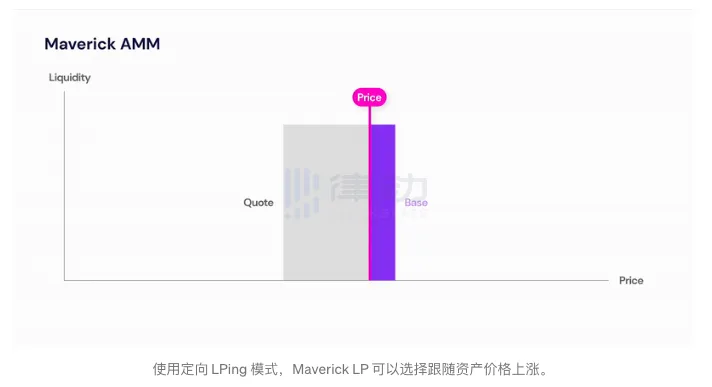
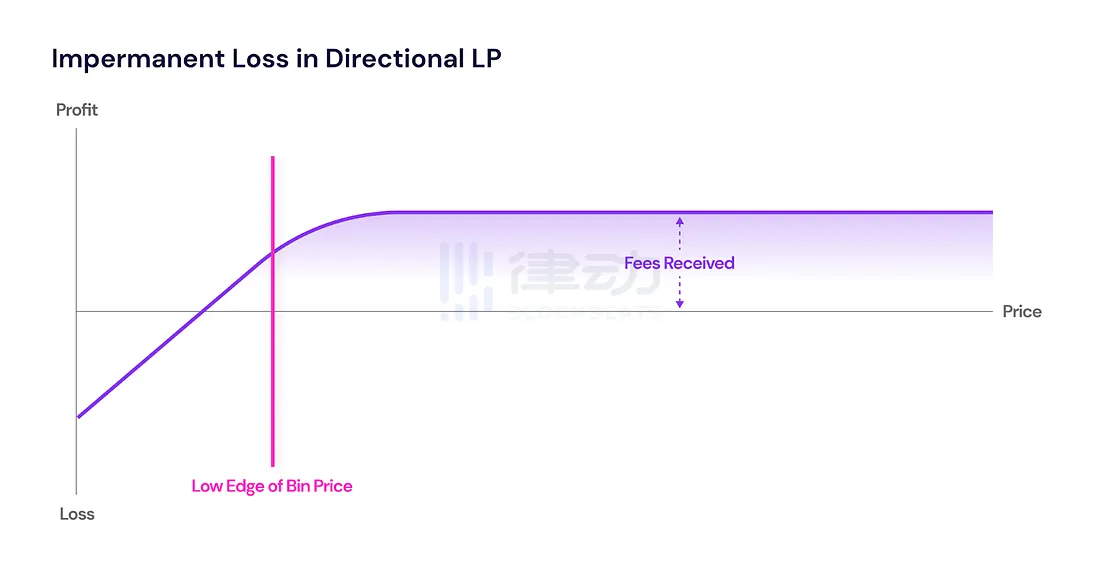
As the price moves in the chosen direction, AMM will automatically re-concentrate liquidity to follow it and obtain more fees. If liquidity providers make the correct bet on the price direction, they can enjoy liquidity that is re-concentrated around the price when it moves in their chosen direction without suffering any impermanent loss (IL).
That is to say, the directional LPs in Maverick with a single asset, i.e. LPs using Mode Right or Mode Left, are only exposed to IL in one direction. If the LP chooses the mode of change corresponding to the price change (e.g. the LP is in Mode Right and the price rises), the LP will not experience IL. Therefore, IL is only one-way, meaning that LPs only face the risk of price changes in one direction, not two.
4 Types of Liquidity Transfer Modes
Facing concentrated liquidity is not always capital efficient and can lead to improper allocation and decreased efficiency. Maverick AMM helps users improve capital efficiency by automatically re-concentrating liquidity. Liquidity providers can choose from four liquidity transfer modes to eliminate high GAS fees incurred from adjusting positions around prices.
These four modes include:
Static mode - fluidity does not move.Right mode - liquidity changes as the price rises, but remains unchanged when the price falls.Left mode - liquidity changes as the price drops, but remains unchanged when the price rises.
Bidirectional mode - liquidity moves with both price increases and decreases.
After more than a year of research and development, Maverick has built the next generation of universal AMM from scratch. The automated market maker (AMM) engine based on smart contracts provides support and integrates the automation of liquidity movement into smart contracts. Maverick has rebuilt a brand new set of smart contracts, and AMM helps users move liquidity without any interaction with the interface, without paying high GAS fees. Since liquidity movement is automatically performed by the AMM smart contract, liquidity providers do not need to pay GAS fees when providing liquidity services. The only time they need to pay GAS fees is when they increase or decrease liquidity.
Maverick AMM aims to be a complex enough tool for LPs to design and automate individual strategies for concentrating and moving liquidity. It provides a range of out-of-the-box liquidity patterns - static and mobile - that allow users to execute a wider range of liquidity strategies. This innovative solution helps liquidity providers manage their liquidity more efficiently, resulting in higher returns, while also providing traders with a better trading experience.
In a previous interview, Bob Baxley, the core developer of Maverick, stated: "If liquidity providers in existing AMMs want to keep their capital active as much as possible, they are forced to adjust their liquidity positions every hour, which wastes their time and fuel." "By allowing liquidity providers to choose whether and how their liquidity changes with the price changes in a given pool - something that other AMMs themselves do not do - Maverick makes the market more efficient, resulting in more consistent fees."
Using the wstETH-ETH pool on Maverick as an example, since its launch on Ethereum, the pool's 24-hour trading volume has significantly increased while maintaining a stable growth in TVL.
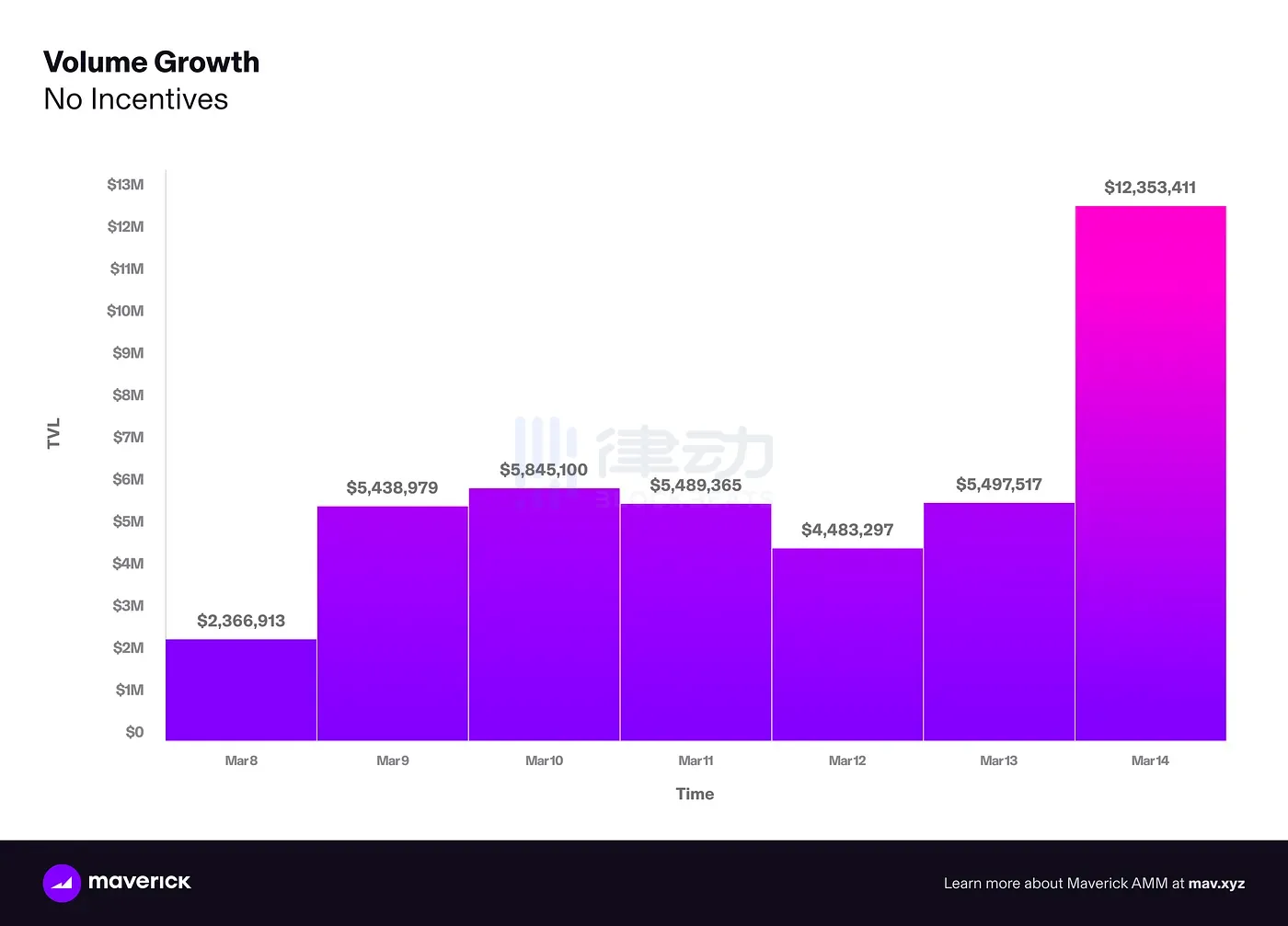
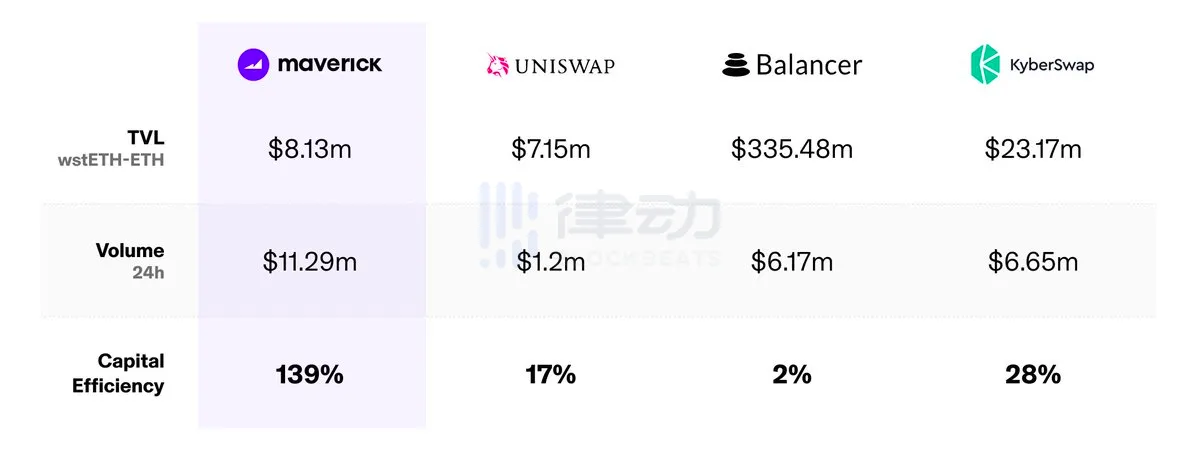
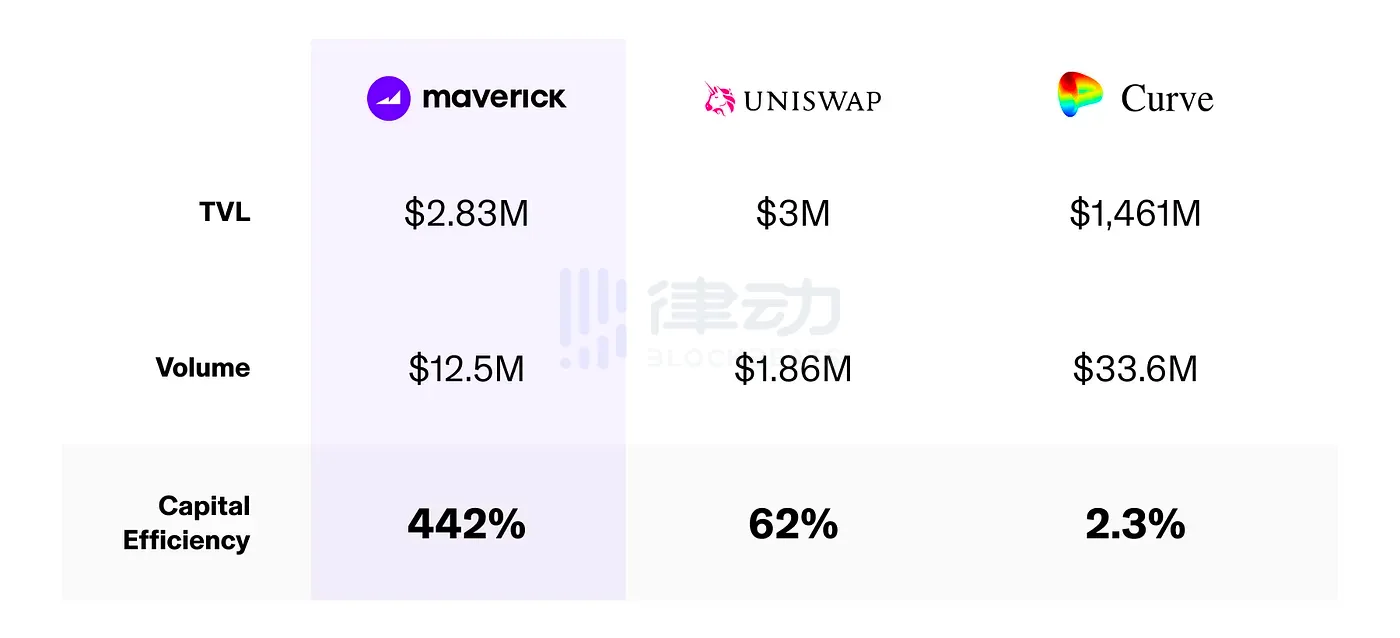
Meanwhile, the capital efficiency of Maverick's wstET-ETH pool (24-hour trading volume divided by pool TVL) has always maintained a market-leading level. Based on market data from April 5th, its capital efficiency is 8.17 times that of Uni V3:
In addition, Maverick launched the "Boosted Position" feature on May 2nd, which allows project parties to accurately and flexibly incentivize any liquidity distribution on Maverick through their tokens. This feature provides project parties with precise control over liquidity incentives:
1. Accuracy of precision to a single position
2. Maximum flexibility in stimulating the flow distribution of any shape and flow mobility pattern.
The DAO organization of the LSD head project Lido has approved the addition of LDO incentives to the wstETH-ETH gain position on Maverick in early May. This incentive will be launched on Maverick in May.
Maverick 什么来头?
Maverick What's the background?
Maverick Protocol has completed two rounds of financing, led by Jump Crypto and Pantera respectively, with other participating investment institutions including Circle Ventures, Gemini, Spartan Group, Coral Ventures, etc.
On March 9th, Maverick Protocol, a decentralized cryptocurrency derivatives protocol, announced the launch of its decentralized exchange (DEX) Maverick 1.0 on the Ethereum mainnet. Since its launch on Ethereum, Maverick has consistently ranked among the top three to five in terms of trading volume on the Ethereum mainnet. Additionally, Maverick went live on the zkSync Era mainnet two weeks ago.
Soon, Maverick Protocol has announced new news, officially partnering with OKX Web3 wallet and integrating with OKX Web3 wallet. Users can perform low-slippage trading and staking on Maverick Protocol by connecting to the OKX Web3 plugin wallet.
And the latest news is that Binance has announced the launch of the new project Maverick Protocol (MAV) on Launchpool. Users can deposit BNB and TUSD into the MAV mining pool on the Launchpad website after 08:00 on June 14, 2023 to receive MAV rewards. The total mining period for MAV is 25 days.
Currently, Maverick's smart contract code has been audited by three auditing companies and one auditing community: Zellic, Certik, ADBK, and Code4rena. In addition, professional smart contract developers from the company that invested in Maverick have also conducted an external audit of the code.
When it comes to the future of Maverick, core developer Bob Baxley said: "Our goal is to become one of the top three decentralized exchanges in terms of trading volume within the next six months." It is believed that Maverick AMM will continue to integrate with cutting-edge decentralized protocols, including LSD, perpetual futures, quantitative strategies, DeFi hedge funds, lending, and leveraged trading, as the latest generation of DeFi infrastructure.
This indicates that the Maverick team is confident in its development prospects and will continue to work hard to provide users with better services and experiences. With the addition of more partners and investors, Maverick Protocol is expected to achieve greater success in the decentralized finance field.
Welcome to join the official BlockBeats community:
Telegram Subscription Group: https://t.me/theblockbeats
Telegram Discussion Group: https://t.me/BlockBeats_App
Official Twitter Account: https://twitter.com/BlockBeatsAsia