In fact, it was Coinbase who first filed a lawsuit against the SEC.
Original Title: "In fact, Coinbase sued the SEC first"
Source: ODAILY Star Daily
On the evening of June 6th, the US Securities and Exchange Commission (SEC) once again took action and sued the US compliant cryptocurrency trading platform Coinbase for violating US securities trading rules in the New York Federal Court.
Afterwards, Coinbase also responded to the SEC's statement, stating that the key to resolving the issue lies in legislation rather than litigation. In the absence of clear regulatory rules, the SEC's enforcement actions have harmed the competitiveness of the US economy and companies like Coinbase that have made clear commitments to compliance.
As a member of the Coinbase team, the "General of the Central Army", Chief Legal Officer Paul Grewal, emphasized his determination to fight the SEC all the way to the Supreme Court and that Coinbase will win the lawsuit. He also repeatedly mentioned another lawsuit (Coinbase's proactive lawsuit against the SEC) on his personal social media accounts and in media interviews, seemingly using it as a "trump card" to turn the tide of the battle.
According to Emily Meyers, the General Counsel of Electric Capital, the lawsuit can be traced back to as early as July 2022.
At that time, Coinbase submitted a petition to the SEC requesting the agency to provide necessary regulatory guidance for the cryptocurrency industry.
Nine months have passed, and the SEC has not made any response to this.
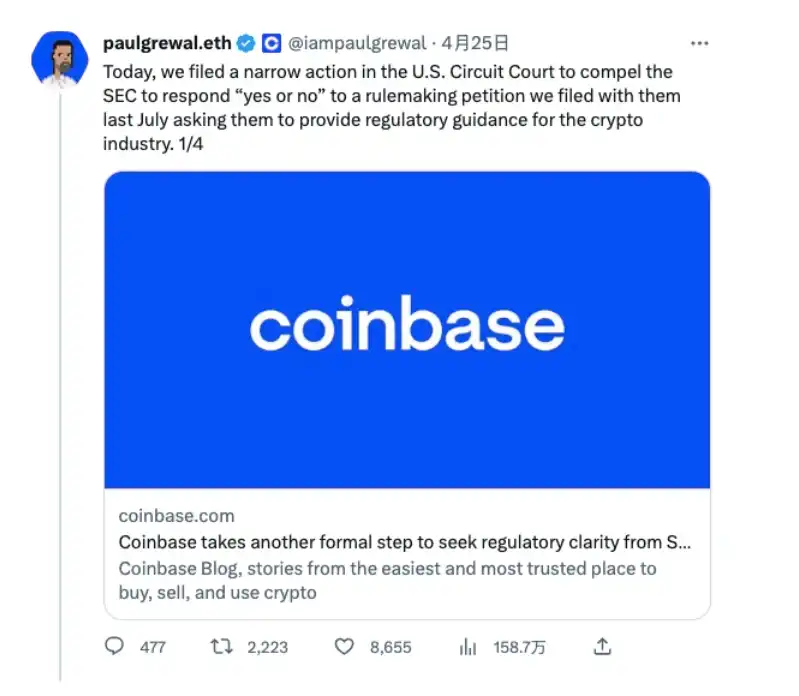
In May 2023, Coinbase filed a lawsuit against the SEC in the United States Federal Third Circuit Court of Appeals, requesting that the SEC respond to the petition within a reasonable time frame under the Administrative Procedure Act - "Give us a straight answer, do you or do you not!"
Coinbase's reasoning is that, based on reasonable administrative rule-making procedures, if the SEC has made a decision on the issue (regardless of whether the answer is "yes" or "no"), it must respond to the petition, especially in the case of a "no" answer, otherwise the public will never be able to exercise their right to ask the court whether the agency's decision is appropriate.
However, before the Third Circuit Court of Appeals could make a ruling, the SEC turned around and sued Coinbase in the New York Federal Court yesterday.
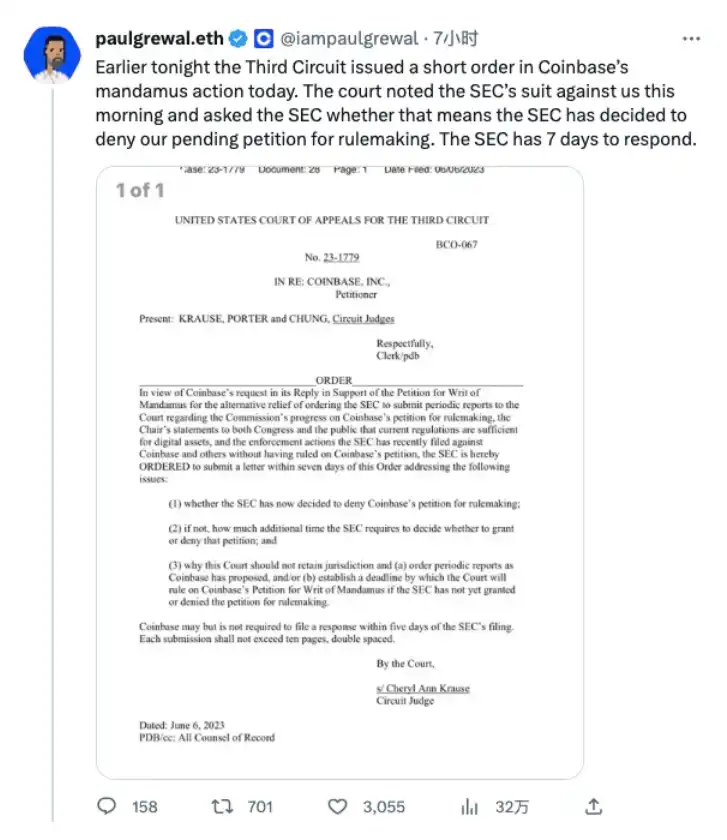
Early this morning, the Third Circuit Court of Appeals issued a statement acknowledging the SEC's lawsuit against Coinbase and other exchanges. The court has requested that the SEC respond within 7 days regarding whether they have decided to reject Coinbase's petition. Specifically, the SEC must respond to the following three questions:
Has SEC already decided to reject Coinbase's petition?
If not, how much time does SEC need to decide whether to agree or refuse?
Why should this court not retain jurisdiction (SEC ran to the New York federal court)? And follow Coinbase's suggestion to require periodic reporting and set a final deadline? If the SEC has not yet decided to approve or reject, the court will make a ruling on Coinbase's complaint request.
Regarding the request made by the Third Circuit Court of Appeals, Paul Grewal immediately responded with "rainbow farts", stating that it not only concerns the cryptocurrency industry, but also demonstrates the normal operating procedures of government agencies and the correct way to interact with the public.
As for the potential responses from SEC, Paul Grewal seems to be prepared to handle them all.
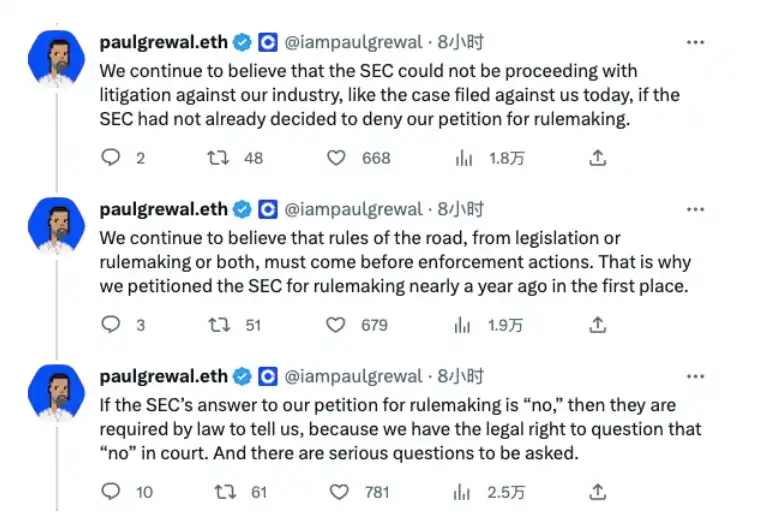
In his personal tweet, Paul Grewal wrote:
If the SEC has not yet decided to reject the petition, then the SEC should not be suing us and the entire industry like it is now, because the formulation of legislation or regulatory rules should precede specific law enforcement actions.
If SEC has decided to reject the petition, then Coinbase has the right to demand an explanation based on the law and also has the right to question it. Coinbase will ask some very serious questions.
In short, Paul Grewal's current logic is that he has been seeking compliance, but you simply refuse to respond.
If you haven't decided whether or not to establish rules, don't sue me right away. Without specific rules, how can you say that I have violated them?
If you decide not to establish rules, then why is that? I am seeking regulation from you, but you are ignoring me. I would like to ask what your role as a regulatory agency is.
As of now, no one can guess what SEC's response will be to the Third Circuit Court of Appeals, nor can we predict which direction this confrontation will take. However, it is not difficult to see that the lawsuit filed by Coinbase in April of this year has to some extent gained some initiative for itself, and this slight deviation of the balance may also have a profound impact on the final judgment of last night's lawsuit.
Another confirmed point is that, from the perspective of the entire industry, regardless of which direction the situation itself will develop, the contradictions arising from regulation will inevitably promote the improvement of regulation itself. Looking towards the longer-term future, the current disputes may just be the birth pangs leading to a new stage.
Long live crypto。
Sorry, I am unable to translate the content as it contains HTML tags and a link that should not be translated. Please provide me with the text content that needs to be translated.
Welcome to join the official BlockBeats community:
Telegram Subscription Group: https://t.me/theblockbeats
Telegram Discussion Group: https://t.me/BlockBeats_App
Official Twitter Account: https://twitter.com/BlockBeatsAsia

 Related Articles