



Ethereum Summit: Hot Trends and Key Focus Projects
Original Title: " Ethereum Black Mountain Conference: Hot Trends and Key Projects "
Source: Biteye
The annual EDCON (Community Ethereum Development Conference) was held in the Republic of Montenegro from May 19th to 23rd. EDCON is held in different locations each year (Paris in 2017, Toronto in 2018, Sydney in 2019, online in 2020-2021 due to the pandemic, and San Francisco in 2022).
The main purpose of this round was to promote communication and interaction among the global Ethereum community.
In addition to EDCON, there are other Ethereum community events such as EthCC, ETHDenver, Devcon, and ETHglobal.
Each Ethereum event attracts significant attention from institutions, developers, and investors. Therefore, participating in these conferences helps to stay in touch with the latest Ethereum ecosystem and technical developments, as well as expand your network.
This article brings an interpretation of this EDCON event to readers who could not attend in person.
01 Republic of Montenegro: European web3 Vanguard
Before formally introducing the noteworthy projects of this conference, let's take a look at what kind of country the Republic of Montenegro is.
The Republic of Montenegro is known as the European web3 vanguard. It is located in Southeastern Europe, adjacent to the Adriatic Sea, geographically connecting the European continent and the Middle East. When it comes to crypto-friendly countries/regions, we often think of places like Singapore, Malta, etc., but we tend to forget about Montenegro, a country where the Prime Minister personally granted V God national citizenship.
Furthermore, it's worth mentioning that Terra founder Do Kwon also chose Montenegro as his haven. The fact that these two prominent figures in the crypto world favor this "small" Balkan Peninsula country is not without reason:
(a) Legislative Environment: The Republic of Montenegro has a series of laws and policies supporting and regulating cryptocurrencies. Through flexible legislation and regulatory measures, the Montenegrin government has provided a favorable environment for cryptocurrency companies. These regulations protect investors' rights, promote innovation, and technological development.
(b) Tax Benefits: Montenegro has the most affordable tax rates in Europe, with lenient taxation for cryptocurrency transactions and related businesses. This policy has attracted a large number of investors and companies to establish cryptocurrency businesses in Montenegro, promoting the country's economic development.
(c) Government Activeness: In April 2022, the Prime Minister of Montenegro granted Montenegrin citizenship to Ethereum founder Vitalik Buterin, hoping that V God would help this Southeast European country in its efforts to become a blockchain innovation hub, with the choice of holding the EDCON conference in Montenegro being an example.
After this EDCON, participants will have a deeper understanding of Montenegro, and it is believed that in the near future, Montenegro will have the opportunity to attract more Web3 industries.
02 Highlights of Participating Projects
EthStorage Ethereum Storage Rollup (@EthStorage)
EthStorage, the first place in this EDCON, is a programmable dynamic storage Layer 2 solution based on Ethereum data availability.
Most existing L2 solutions, such as Optimism/ZK Rollup, focus on scaling Ethereum's computing capacity, i.e., the ability to pack more transactions per second. With the popularity of NFTs/DeFi/dApps, the need to store a large amount of data and reuse Ethereum mainnet security has also grown sharply.
Layer 2 storage infrastructure is a major direction in the Layer 2 space that most people overlook. Similar to traditional Layer 2 logic, the original intention is to leverage the security of the Ethereum mainnet to achieve scalability.
EthStorage's storage function mainly serves two business areas: data storage for Web3 applications and DA expansion. Each of these two main businesses, when discussed separately, represents a highly anticipated track, making EthStorage well worth paying attention to.
EthStorage's Twitter following has just exceeded 1,000, which is very early for a public chain infrastructure project that has received funding from the Ethereum Foundation, making it worthy of significant participation.
EAS Ethereum Attestation Service (@eas_eth)
EAS (Ethereum Attestation Service) is a public good that allows anyone to attest to anything on-chain or off-chain. Users simply need to register a schema about any topic (or use an existing one) and attest to it using that schema.
For decentralized services to include not only currency and assets, we also need a universal ledger to make statements on Ethereum. This ledger will help establish more trust in online interactions. Proofs will play a crucial role whenever you need to prove or verify certain content. By allowing anyone to create and verify proofs, EAS has the potential to change the way information is shared and verified online and drive the development of the entire Ethereum ecosystem.
The EAS is now live on the Ethereum mainnet, Polygon, Arbitrum, and Optimism, and everyone can try interacting. Additionally, the EAS team has not yet opened official user communities such as Discord, so it's worth paying attention. Early joiners will receive OG status upon community opening.
Aspis Protocol On-Chain Asset Management Protocol (@AspisProtocol)
ASPIS is a no-code platform where users can create custom asset management vaults through web interactions without the need for programming knowledge. It offers a user-friendly, transparent, and secure passive investment alternative. It provides a toolkit for creating, fundraising, and operating Decentralized Autonomous Funds (DAFs), aiming to manage the relationship between vault creators/managers and investors by transferring the logic behind legal terms to smart contracts.

Currently, Aspis Protocol is recruiting testers for decentralized asset management vault constructors for Beta testing.
Test users can create their own on-chain funds to help improve transparency, security, and efficiency in asset management.
Nerif Network Automated Smart Contract Platform (@NerifNetwork)
Every transaction on the Ethereum Virtual Machine (EVM) requires triggering by an Externally Owned Account (EOA) and cannot be triggered automatically. Operations such as limit orders, liquidating bad debt, etc., need to be triggered by an external centralized server. Therefore, there is a market demand for a decentralized automated contract platform.
Nerif is a complete automated smart contract solution that can automate dApps (smart contracts) across multiple chains based on user-defined rules, requirements, and conditions.
The cross-chain automation feature can be applied to any on-chain/off-chain condition/event/operation/trigger, such as event emission, eth_call results, offline triggers, etc. Nerif can also automate any other custom on-chain/off-chain computations.
Nerif has integrated with a wide range of blockchains, sidechains, and layer-two networks. It enables developers to run expensive On-chain applications on a cheap and fast chain and execute final state change logic on the expensive chain like Ethereum.
For example, a full cross-chain bridge application may consist of two smart contracts deployed on two or more different blockchains. One side may have expensive computation but simple business logic; the other side may have cheap computation but complex dApp operational logic. In this scenario, Nerif can economically balance the costs on both sides, saving expenses.
Today, multi-chain deployment has become a common practice in many successful DeFi verticals and use cases: SushiSwap DEX spans 15 chains, Beefy Finance yield aggregator spans 12 chains, Aave money market spans three chains. This demonstrates a strong demand for a multi-chain narrative in the crypto space.
This space has many similar automated contract products, but Nerif's advantages are:
1. Can automate simultaneously on multiple EVM and non-EVM chains
2. Fully decentralized, able to function even if a third of the network is down
3. Flexible solutions, allowing execution of any function through multiple triggers and conditions
4. User-friendly general interface for building cross-chain Web3 applications
At the same time, the various professional trading order services provided by Nerif are indeed essential for some professional traders. However, one should also beware of platform vulnerabilities. In the past, similar professional trading order product Dexible had vulnerabilities where users' authorized tokens were transferred out. Therefore, it is best not to interact with the main wallet and to promptly revoke authorization after interaction.
Cell Protocol Composable Large-Scale Layer 3 Social Protocol
Cell Protocol received the Special Award for the Future of Social Network at this conference and was also the first selected project of Dr. Xiaofeng's Wandering Island Entrepreneurship Camp.
This project provides a composable large-scale Layer 3 solution tailored for Web3 social, with an ambitious project narrative, benchmarked against Lens Protocol, Momoka, and CryberConnect, and a more complex technical architecture.
It includes both Layer 2 products and self-built Layer 3 infrastructure (public chain), and the architecture also incorporates a composable design that can be easily compatible with popular infrastructure and public chains, such as data availability layers and storage projects.
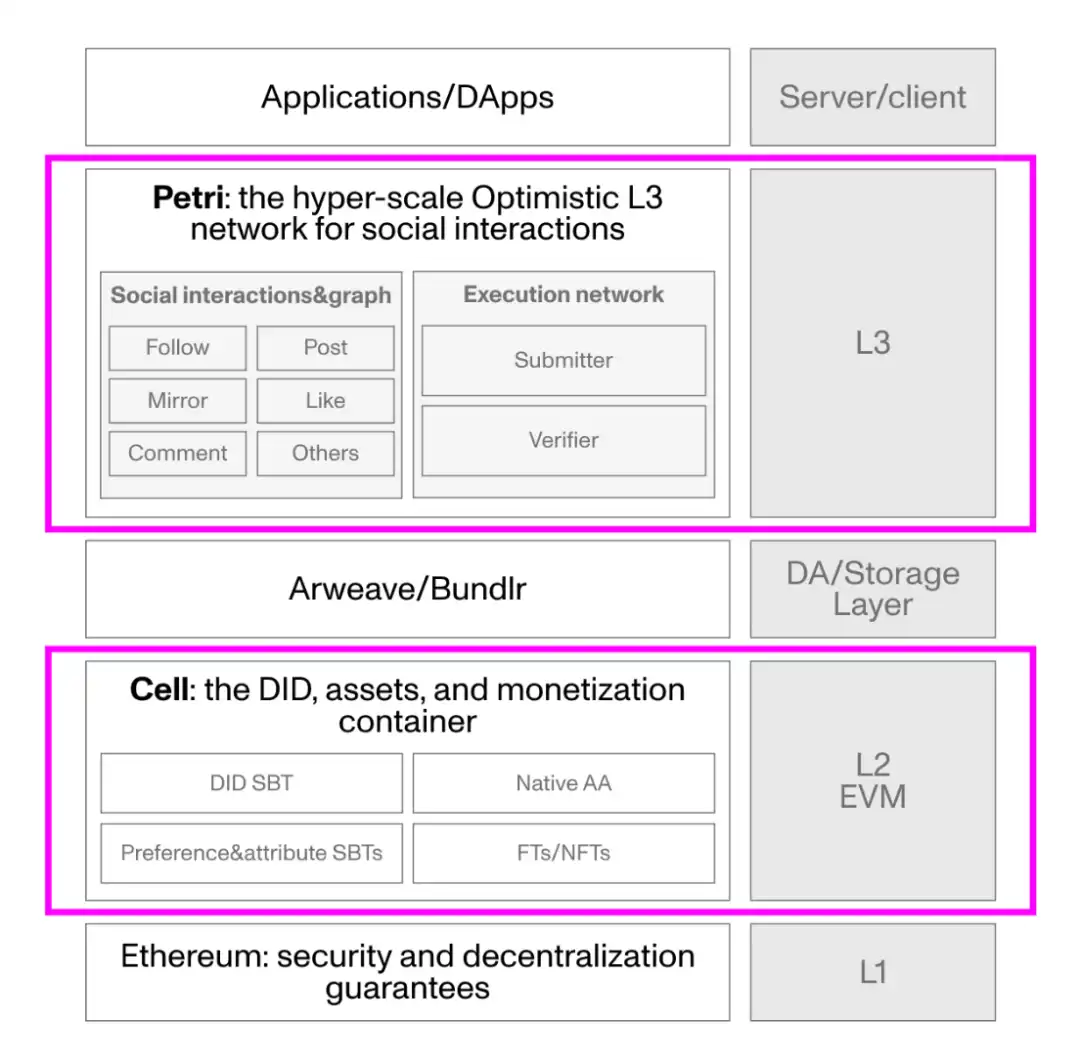
From a product positioning perspective, Cell Protocol not only focuses on diverting traffic from the current stock market of Web3, but also plans many features to attract traffic from Web2 social apps, which is exactly the shortcoming of current Web3 social products.
It is reported that Cell Protocol will deeply integrate with mainstream Web2 social media such as Twitter, and will also go further by incorporating Web3 exclusive solutions into the mature Web2 business model, where advertising is the main revenue stream, financializing the valuable user data in Web2. This upholds the baseline that Web3 data belongs to users themselves and solves the revenue problem.
Both technically and in terms of business model, there are innovations that are worth paying attention to.
Topia L2 Shared Data Availability Layer Protocol
Recently, there have been two fairly popular Topias that may cause confusion. One is the NFT project, Topia (formerly NFT WWorld), while the Topia introduced in this article, participating in this year's EDCON, is an L2 shared data availability layer protocol and is also the first-phase selected project of Wanwu Island Startup Camp.
Compared to traditional DA projects, such as Celestia and Polygon Avail, L1 DA projects, Topia is creating a shared DA layer for all future Ethereum L2s.
Therefore, Topia will seamlessly integrate with Ethereum's mature L2 and developer ecosystem.
Topia will create a dedicated L2 for this DA layer network. On this L2, Topia's storage can be seamlessly integrated and specifically optimized, such as supporting concurrent transactions and allowing contracts to access Topia storage directly, which is an important step in achieving "L2 interoperability."
All applications built on Topia storage and L2, regardless of their diversity and quantity, will share the same Topia storage.
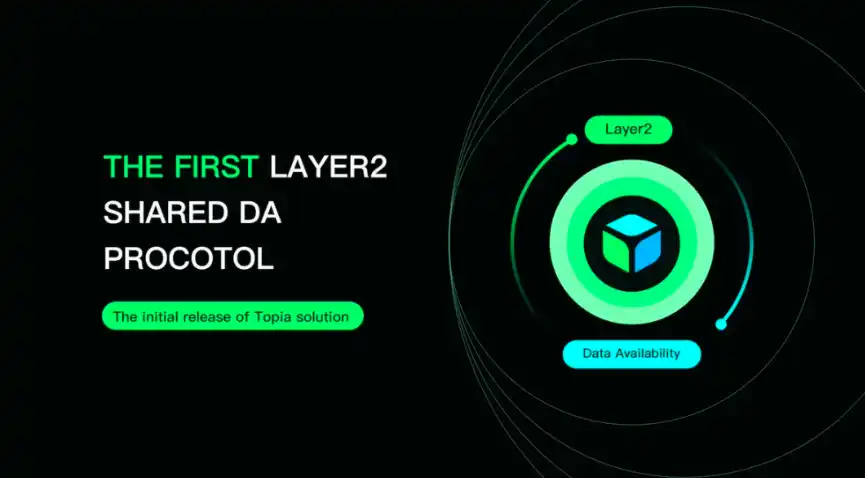
As you can see, Topia and the previously mentioned EthStorage are doing very similar things. However, Topia is the first EVM-compatible storage layer based on optimistic rollup, with strong interoperability between its storage and smart contracts.
In order to ensure security and efficiency, storage nodes need to submit storage proofs on-chain, and storage nodes can receive Topia token economic incentives. According to Topia's official introduction, it excels in terms of fees and storage limits compared to its competitors.
This conference sends a signal that Ethereum Layer 2 data storage + DA will be the core narrative for a long time in the future.
Both of these projects are worth paying attention to; competition drives technological innovation.
DataverseOS
The term Dataverse originates from a database developed by Microsoft, originally designed to allow users to share and analyze data on a web app. Microsoft has positioned Dataverse as the data storage center for various services of the Power Platform.
The DataverseOS team has introduced decentralized concepts into the original Dataverse, transforming DataverseOS into a web-native personal computer for everyone.
In the information age, everything is a file. DataverseOS adds a social file layer on top of the fragmented network. Every user interaction with DataverseOS dApps will automatically link online data to the local file system.
Currently, DataverseOS positions itself in the Web3 social/storage track as a project belonging to the infrastructure category. If you think of it as a web3 personal computer based on its name, the narrative is very grand and worth attention.
03 Summary
From the projects showcased at this conference, it is evident that the current hot topics have shifted from building L1 blockchains to focusing on infrastructure projects around L1, such as automation, storage, Web3 social, and other themes. These projects still have a lot of room for imagination and practical use cases. If they can truly develop, they still have the same wealth creation effect as L1.
As practical projects gradually emerge, perhaps this signifies that the prelude to the long-awaited Mass Adoption is just beginning.
References
[1] Nerif Whitepaper https://whitepaper.nerif.network/
[2] What is ASPIS https://info.aspis.finance/introduction/what-is-aspis
[3] Montenegro makes Vitalik a citizen, part of plans to promote it as a blockchain hub https://cointelegraph.com/news/montenegro-makes-vitalik-a-citizen-part-of-plans-to-promote-it-as-a-blockchain-hub
Original Article Link
Welcome to join the official BlockBeats community:
Telegram Subscription Group: https://t.me/theblockbeats
Telegram Discussion Group: https://t.me/BlockBeats_App
Official Twitter Account: https://twitter.com/BlockBeatsAsia



