Detailed explanation of Spiral DAO: an earnings aggregator that retains third-party protocol rewards in the DAO's fund reserve.
Original Title: "Asset Risk Assessment: Spiral DAO (COIL)"
Original Author: LLAMARISK
Original Translation: Kxp, BlockBeats
Spiral DAO Introduction
Spiral DAO is a capital-efficient yield aggregator designed to optimize yield farming and bribery markets in applications that use veTokenomics (such as Curve and Balancer). Unlike traditional aggregators (such as Yearn and Beefy), SpiralDAO retains rewards tokens from third-party protocols in its DAO treasury, reducing selling pressure and circulating supply. The protocol draws heavily on the smart contract design of Olympus DAO while introducing a novel concept of "yield binding." The protocol accepts LP token deposits to mine rewards into its treasury and issues additional value to depositors beyond the value of their native tokens as compensation.
The dual token model of Spiral DAO includes COIL and SPR. COIL is an inflationary token mainly used for staking as SPR. Most of the un-staked COIL supply is protocol-owned liquidity (POL) stored in Curve and Balancer pools. The adjustable SPR is a governance token that incentivizes liquidity providers to contribute their earnings to the Spiral DAO treasury through yield farming. This structure allows users to gain governance rights over SPR while mitigating the impact of COIL inflation. Spiral DAO incentivizes user participation by offering rewards that exceed the existing protocol through SPR distribution. It aims to rapidly increase support for the treasury to counter inflation and ensure the stability and sustainability of the protocol.
Spiral DAO claims to provide support for the DeFi ecosystem by reducing selling pressure on mining tokens such as CRV and BAL, improving risk-adjusted returns for farmers, and optimizing the bribery market.
Spiral DAO Launch
Spiral DAO was launched through an Initial Treasury Offering (ITO) in March 2023, with the aim of accumulating a large amount of USDC, CRV, BAL, FXS, and SDT. The protocol was launched through an initial oversubscribed auction between April 3rd and 5th.
The initial schedule for the launch of Spiral DAO is as follows:
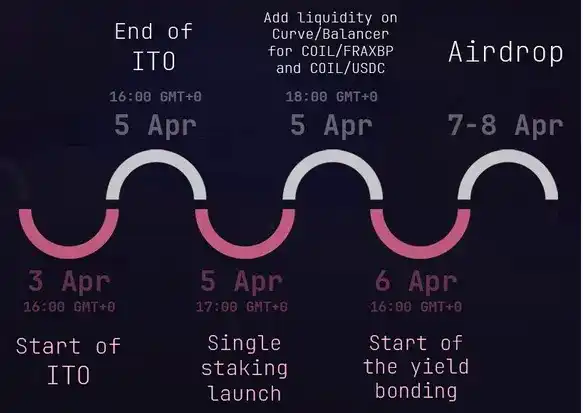
Source: Twitter
· 4,240,516 USDC
· 956,810 CRV
· 114,797 BAL
· 37,391 FXS
· 561,657 SDT
COIL that was not sold in the auction was destroyed, and provided initial liquidity for the COIL/FraxBP Curve pool through 730,360 USDC and 235,600 COIL.
The protocol subsequently deployed it to various other protocols including Aura Finance, Convex, Conic, Aave V3, Balancer V2, and Silo Finance. It initially received 955,854 sdCRV tokens to participate in Curve dashboard voting and its holdings have since increased to 1,415,869 sdCRV tokens.
You can find a quick overview of the current vault's exposure to various protocols on DeBank.
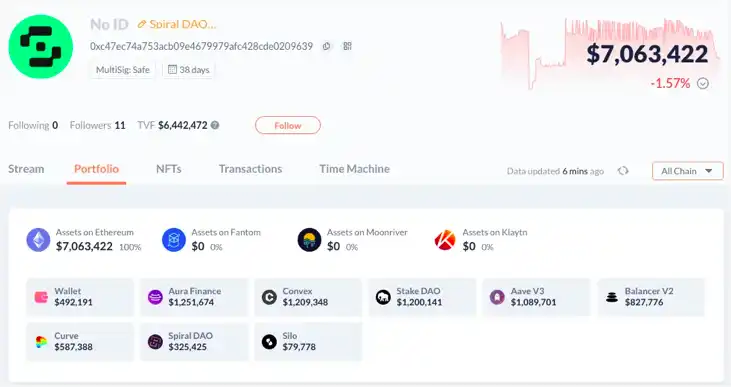
Source: DeBank
Airdrop
For the purpose of encouraging adoption, Spiral DAO has planned a two-stage airdrop:
· The first phase was initially planned to take place immediately after the first auction. Through snapshot voting, it was postponed for a few weeks to allow sufficient time to prepare marketing activities and distribute tokens to a wider user base. The first phase began on April 29th, distributing 3% of the initial token supply to Curve/Convex, Balancer/Aura Finance, FRAX Finance/StakeDAO, and 1,000 DeBank users who own the DegenScore Beacon NFT.
· The second phase will be distributed to the most active community participants.
Protocol Mechanism
Spiral DAO has adopted several mechanisms introduced and promoted for the first time by Olympus DAO (OHM), such as the dual token model, rebalancing, treasury management, and yield bonding. By addressing a key issue of potential underperformance by the execution team, limiting treasury redemptions, and ultimately leading to the possibility of token value falling below the supported treasury, Spiral DAO has solved the problem of protocols similar to OHM.
COIL/SPR Dual Token Model
1. COIL: Share of vault assets
COIL is an ERC-20 Token with 18 decimal places, representing the user's share in the growing DAO treasury. Newly issued COIL is distributed at a discounted rate as an incentive to attract users to deposit their LP Tokens generated from earnings into Spiral DAO (such as B-auraBAL-STABLE, pax-usdp3CRV-f, etc.). COIL can be directly exchanged for USDC shares in the treasury through the protocol's SpiralRedeem contract (with penalties), or can be exchanged for USDC through the SpiralSwap liquidity aggregator at the best exchange rate.
COIL can be pledged to obtain SPR, which gradually increases based on the "stock price" logic, meaning that the exchange rate continues to increase based on the value of the underlying fund pool assets. The current annualized yield data for pledging can be viewed on the Staking page or directly on the SpiralStaking contract. The supply of COIL is unlimited, and there is significant inflationary pressure. The token economic model of Spiral DAO mitigates dilution pressure by encapsulating COIL (SPR). This structure protects users from COIL inflation while providing a derivative aimed at outperforming both pledged and non-pledged veTokens. Therefore, almost all unpledged circulating COIL is flowing in Curve and Balancer pools.
2. SPR: Benchmark Resettable Assets
By pledging COIL, you can obtain SPR. It is used for governing the Spiral DAO system and treasury. This token is distributed as a reward to users who pledge LP tokens on Spiral DAO. SPR can be exchanged for native COIL assets at a certain exchange rate (index variable) through the SpiralStaking smart contract. Spiral DAO plans to offer an option to lock SPR in the future to achieve the increased yield promoted by veToken.
Through the changeAPR() and changeLength() functions of the SpiralStaking contract, the parameters of the staking APR can be adjusted. This is done by the contract owner (currently the 4-7 Protocol multi-signature, composed of core contributors). A Twitter post on May 2, 2023 promoted an update that adjusted the APR from 100% to 271.828%, which was decided through the Snapshot governance process.
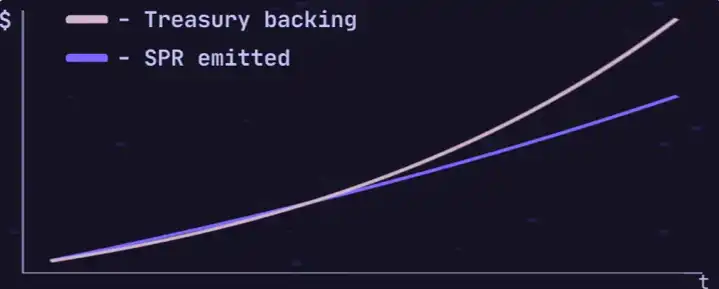
As time goes by, it is expected that the revenue of the vault will exceed the issuance of SPR.
Source: Spiral Dao Docs: Tokenomics
Reset Benchmark
Resetting the benchmark is the process of issuing new COIL to the pledger. For Spiral DAO, this is achieved through Rebase, an unlicensed function in the SpiralStaking contract that is automatically called during each pledging/unpledging event without relying on offline scripts. This is different from other protocols that may require licensed actions or offline scripts to perform rebasing.

Source: Etherscan: SpiralStaking Contract
Redemption and Liquidity Withdrawal
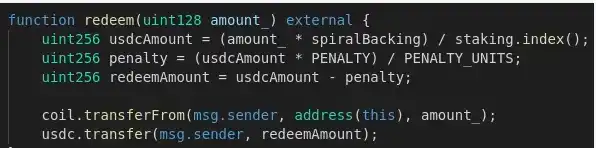
COIL and SPR both have inflationary properties, but through redemption from the treasury, the treasury's support creates a certain price floor guarantee for them. Spiral DAO aims to provide users with an additional exit strategy through the redemption page; this page uses USDC treasury assets and provides users with the option to exit the DAO by redeeming treasury support with a 10% penalty (this penalty can be configured by the SpiralRedeem contract owner, currently set to be controlled by the team's EOA).
SpiralRedeem has reserved any amount of USDC from the Spiral DAO treasury. At the time of writing this report, the contract holds 312,000 USDC, corresponding to a total supply of 4,091,200 COIL, worth approximately $9.8 million.
Source: Etherscan: SpiralRedeem contract
Although user redemption is usually unwise (as selling through Curve's COIL/FRAXBP Factory pool is more advantageous), the redemption page serves as the ultimate price floor in specific cases, ensuring users have a safe exit strategy.
It is said that the asset portfolio of Spiral DAO's treasury ensures that each user has sufficient exit liquidity, even if the COIL price is lower than its backing value. The structure of Spiral DAO's treasury reserves a portion to prevent the COIL price from falling more than 10% below its actual backing value, allowing the protocol to engage in arbitrage when the value of Spiral Token is below its fair value.
Protocol Revenue Model
The revenue model of Spiral DAO adopts various strategies to generate income. The main source is liquidity mining through staking assets in the treasury (such as CRV, BAL, CVX, and AURA). The protocol also uses yield farming strategies to accumulate these assets through user deposits. In addition, the protocol takes advantage of arbitrage opportunities in the bribe market to obtain discounted tokens.
Spiral DAO also plans to participate in the initial liquidity fundraising of other protocols to diversify its sources of income and expand its aggregation of veCRV gains. The treasury charges a 10% fee upon redemption and a 0.5 fee for each COIL issued, contributing to the total revenue.
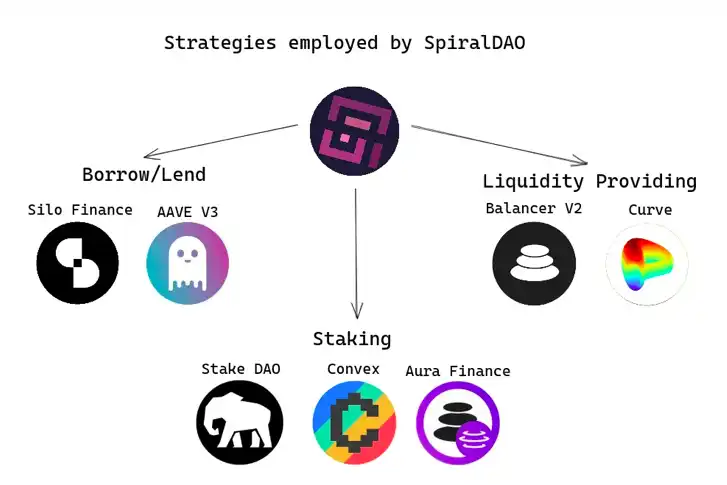
By taking advantage of the inefficiencies of the bribe market and deploying a large number of protocols with liquidity (POL), Spiral DAO aims to maximize its revenue stream and benefit users. The protocol plans to develop a Dune dashboard to track the efficiency of the bribe market and make informed decisions.
Protocol Liquidity (POL) and Treasury Management
The treasury of Spiral DAO deploys liquidity across a variety of diversified strategies, utilizing multiple governance tokens and stablecoins to support host protocols and optimize returns for token holders and users. The unique treasury balancing mechanism and token economics enable Spiral DAO to capitalize on the inefficiencies of bribe markets, increasing bribe returns and liquidity depth.
The treasury management of Spiral DAO pursues three main goals:
· Maintain market share
Spiral DAO is constantly striving to increase the market share of relevant tokens. For example, if the DAO obtains a 10% market share of a certain token, its goal is to increase the share and prevent it from falling below 10%, unless the community decides otherwise.
Profit Binding Strategy
Yield Bonding is a variant of the binding concept promoted by OHM. Spiral DAO has improved upon this by no longer requiring users to sell their tokens at a discounted price to the protocol in exchange for protocol tokens. Spiral DAO does not require users to give up ownership of their principles. Users can exchange the yield farming rewards they would have received from Curve/Balancer LP tokens and receive excess returns distributed by the protocol in the form of native token SPR. The additional yield is adjusted daily based on COIL market value and treasury value. Users can withdraw their LP tokens at any time.
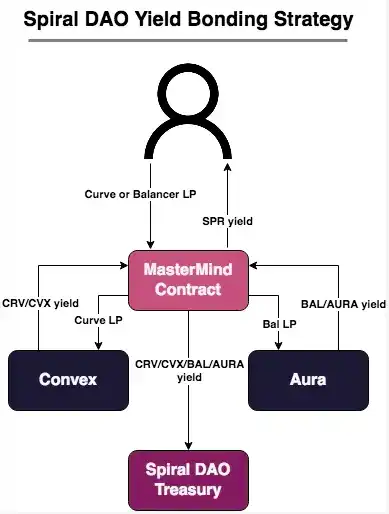
Only when the market value of COIL is significantly greater than the value of the treasury, can the yield binding mechanism be effective and become a deflationary measure. The treasury of Spiral DAO will grow exponentially, surpassing the natural inflation of tokens and corresponding reward tokens. Spiral DAO aims to address the problems faced by competitors, such as inflation, self-destruction, lack of stable supply, poor use of funds, and overexposure to a certain token.
Currently, you can check the current composition of LP Tokens deposited in the Spiral DAO yield farming program on DeBank. As of writing this article, the total value is 1.6 million US dollars, which will contribute to the treasury's earnings.
Issuance tied to revenue
The protocol of Spiral DAO aims to incentivize users to maintain their investments by ensuring that the value of SPR issued under normal circumstances exceeds the value of the treasury backing it. The protocol regularly updates its weights for new SPR issuance, adjusting to achieve 100% issuance value equal to underlying returns plus a 40% "extra surplus value" parameter. This approach aims to attract more yield farmers by offering a higher annualized yield than just a 5% discount on SPR.
The choice of 40% ratio is to achieve a balance between the vault (protecting about 60% of the COIL market value) and individual yield farming participants. Although this ratio is not fixed and may be changed based on community proposals, the protocol plans to introduce some funding pools that do not include this mechanism. Therefore, the yield enhancement only applies to some reliable assets in the Curve-Bal ecosystem.
In order to better adapt to the issuance of all liquidity pools, the weight update of SPR issuance will be conducted once in a few days. The calculation of SPR rewards is based on the liquidity provided by 1 ETH, which enhances the robustness of the protocol in TVL fluctuations.
Spiral DAO has implemented various mechanisms to prevent potential errors or malicious behavior and intends to introduce additional measures. One of the mechanisms involves limiting the total distribution of SPR rewards, effectively restricting potential fund misappropriation within the range of approximately $100,000 worth of SPR.
Occasionally, emissions may exceed the support of the treasury. This can occur, for example, during daily weight updates when prices rise and the protocol still issues SPR equal in value to the treasury support. It is worth noting that this disproportionality is two-way, resulting in users receiving reduced USD value rewards, offsetting the negative impact.
Rebalancing Mechanism: Bribery Strategy
The re-balancing mechanism of Spiral DAO's treasury plays a crucial role in maintaining the exposure of the treasury by utilizing arbitrage in the bribery market.
For example, if a DAO intends to increase the weight of BAL in the treasury relative to CRV, it will operate as follows:
1. Sell CRV votes on the bribery market to obtain stablecoins.
2. Use these stablecoins to purchase votes on the Aura/BAL bribery market.
3. Allocate the obtained votes to the POL measuring instrument.
4. Obtain additional BAL/AURA issuance.
The rebalancing mechanism aims to adjust the holdings of the treasury based on market dynamics and the risk preferences of the Spiral community. Specifically, it increases the exposure to BAL-AURA, thereby relatively increasing their weight in the treasury. This process does not reduce the exposure to CRV, but rather adjusts the balance to support BAL-AURA. This ensures the liquidity of Spiral Token while adapting to constantly changing market conditions.
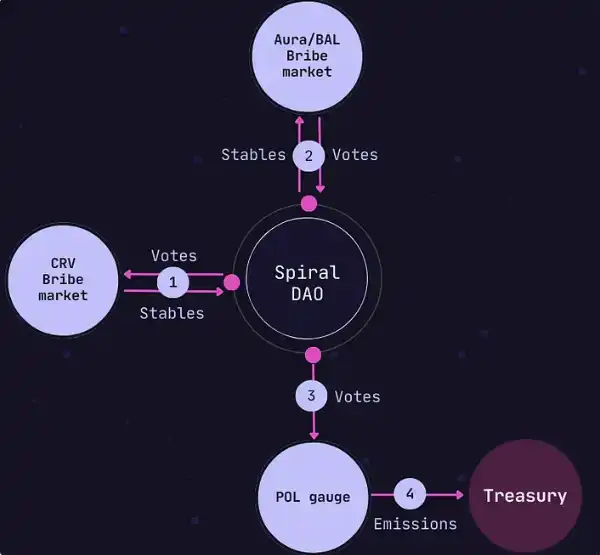
Actually, we observed that Spiral DAO bribes 33.2K USDC every week on StakeDAO VoteMarket to incentivize liquidity in the COIL/FraxBP pool. A total of 144K USDC has been deposited from the Spiral DAO treasury for bribes, which can be found here and here.
金库资产
translates to
Gold Vault Assets
You can find an overview of the current treasury composition and revenue and expenditure forecasts in this Google Sheet. After considering interest and bribe expenses, Spiral DAO expects its treasury investment activities to achieve an annualized return rate of 28% (of course, the return rate of Crypto may change rapidly, so this is just a very rough estimate).
The guiding principle for the future vault composition is proposed and voted on through snapshot voting. Core contributors have proposed a plan that involves two main aspects of future token weighting in the DAO: 1) establishing a target asset portfolio for rebalancing using various methods, and 2) determining the handling of byproducts and additional rewards (such as GEAR).
The proposal suggests modifying the existing treasury assets in the next few months to increase exposure to CRV/BAL and potentially cultivate external partnerships. Additionally, the proposal suggests adopting a default approach of holding rather than selling other tokens until they make up less than 1% of the treasury assets. At this point, a reassessment will be conducted. This strategy aims to prevent internal competition within the protocol while maximizing potential returns.
As of early May 2023, the assets in the treasury (including the Redeem contract) are as follows:
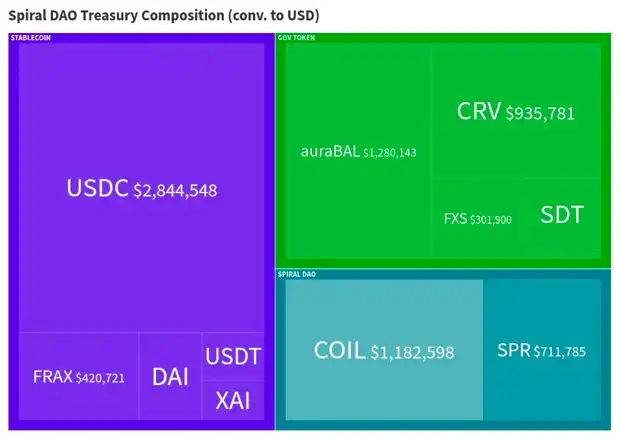
The target asset portfolio for the next few months is as follows:
· 45% Stablecoin/USDC
· 20% CRV/CVX
· 15% BAL/AURA
· 6% FXS
· 4% SDT
· 10% Others (ETH + BTC + partner assets)
DAO plans to submit any major changes to snapshot voting, whether it is to increase, decrease, or maintain exposure to specific assets. According to Spiral's risk framework, they plan to adopt the following ratios: potential risk assets account for about 10-15%, moderate risk accounts for about 20-30%, and safe risk accounts for about 50-70%. They take proactive measures and conduct continuous monitoring; for example, Spiral has excluded Conic finance's exposure due to its large scale and experimental nature.
Spiral DAO Governance System
Contributors
Despite the fact that most contributors are anonymous, the team behind this project has a diverse background in the crypto industry, including market making on centralized exchanges, quantitative analysis, angel investing, arbitrage, and liquidity mining. Some contributors have been involved in this field since 2012-2013. The project also benefits from advice and guidance from well-known figures in the DeFi space, such as the founder of cp0x (a validator for multiple DeFi applications) and Sami (founder of Redacted Cartel). Core contributors also participated in a white hat attack in 2021, returning over $1 million in assets.
We have requested more information about the contributor role from Spiral DAO. We were informed that the DAO plans to further increase its transparency in later stages. Below is a partial list of contributors based on the latest information obtained:
Contributor:
· VaeVictis
· Cuttlefish
· Ivan
Advisor:
· Farmer Brown - Advisor· SuperChad - Advisor
· Starny
· cp0x
· CIA Official - Security Researcher· Founder of Sami - Redacted Cartel
· Valentin Mihov - Co-founder of Daedalus
治理流程与投票
Governance process and voting.
Governance proposals can be submitted on the governance channel of the Spiral DAO Discord server. According to the guidelines in the document, proposals should last at least 24 hours before voting. Voting is conducted through Snapshot and the voting results are confirmed based on the amount of SPR held.
Due to the non-binding nature of Snapshot voting, in most cases, the protocol or fund management multisig will be responsible for executing the voting results.
Multi-Signature
Treasury (3/6)
The multi-signature feature of the vault is used to manage protocol funds:
· GnosisSafeProxy.sol: Fund management multi-signature - 3/6 Gnosis Safe 1.3.0 (after the proxy)
VV - 0xC011240FAb026E08EC18E12a506f45b9aaEE84dD
Cuttlefish - 0xC541A7b893eFD384d3E0013DfCb3e563a777fDBC
Farmer Brown - 0xFBD9123f3CA030632C5fC5948dfebb38B0b115f2
SuperChad - 0xDD9bF0A45452a4F22cfd2C963c15B191D97Ce106
Starny - 0x79603115Df2Ba00659ADC63192325CF104ca529C
cp0x - 0x53BD3C14e2a076EB55a7e2BE73Fa0fA7918CF300
Protocol(4/7)
The protocol owner's multisig has majority ownership of the protocol contracts, including the MasterMind, SpiralStaking, and Token contracts:
· GnosisSafeProxy.sol: Protocol Multisig - 4/7 Gnosis Safe 1.3.0 (after the proxy)
VV - 0xC011240FAb026E08EC18E12a506f45b9aaEE84dD
Ivan - 0xc0cbd3a183E634f630F4658526A1D8309008c6b8
Farmer Brown - 0xFBD9123f3CA030632C5fC5948dfebb38B0b115f2
cp0x - 0x53BD3C14e2a076EB55a7e2BE73Fa0fA7918CF300
CIA Officer - 0xB25C5E8fA1E53eEb9bE3421C59F6A66B786ED77A
Sami - 0x2AFb6A75Ee833A84d534C62894BB348234b5d219
Valentin Mihov - 0x3F0c2A4654A63110ED3b15cF9C0fa07476B389cF
Overview of Smart Contracts
Contract Architecture Overview
The smart contract architecture of Spiral DAO aims to incentivize users to stake in the selected yield farming pools while maintaining necessary relative inflation.
MasterMind contract is an upgradable proxy yield aggregator and the core of the yield binding system, consisting of three roles: service provider, reward distributor, and owner. The service provider role handles low-level threats and non-impactful activities, while the reward distributor can receive corresponding rewards (CRV/BAL/others) and send them to DAO/treasury addresses. The owner role is the multi-signature of Spiral DAO, which can add pools, change delegation call adapters, and increase withdrawal fees (in addition to the privileges of other roles).
MasterMind has two types of "adapters": XXXAdapter.sol, which contains fixed paths for zaps and views information on the reward tokens issued, and XXDelegate.sol, which holds the code MasterMind uses for delegating calls to different protocols. The latter is crucial for security reasons. The MasterMind contract owner can set the Rewarder contract address, which determines the token allocation based on the rewards each user receives for each 1 LP token in each pool. The reward rate is updated by the administrator role, based on off-chain scripts calculating Coil's price, staking protocol earnings, and the required annual interest rate to maintain the target pool for each 1 LP.
This architecture also includes a SpiralStaking contract based on Olympus DAO, which mints COIL and SPR through the insurance vault, a router for efficient exchange between COIL/SPR and USDC, and a SpiralRedeem contract that allows users to exchange USDC from the treasury for COIL.
Deployed Contract
This agreement has two Tokens and a staking contract for these Tokens:
· SPR.sol: Protocol encapsulating Token (ERC20), with 18 decimal places.· COIL.sol: Reward Token (ERC20), with 18 decimal places.
· SpiralStaking.sol: A staking contract where COIL can be deposited to obtain SPR (similar to OHM staking with a rebase mechanism, but without penalty function).
The following contracts are related to the MasterMind contract and are responsible for managing the AMM liquidity pool and user deposits:
· UpgradableProxy.sol: MasterMind proxy (OpenZeppelin branch)
· MasterMind.sol: Current implementation
· ProxyAdmin.sol: Proxy administrator for the MasterMind proxy contract (OpenZeppelin branch).
· Rewarder.sol: A multi-pool reward contract that sets deposit fees and reward rates for depositors. This contract is set by MasterMind.
· RewarderVault.sol: Executes the issuance operation for Rewarders with SPR reward tokens.
Other features include SpiralSwap router and SpiralRedeem contract:
· Router.sol: SpiralSwap Router is a COIL liquidity aggregator that allows for swapping between COIL/SPR and USDC.
· SpiralRedeem: The redemption contract allows users to exchange COIL for USDC in the treasury with a configurable penalty ratio. The current penalty ratio is 10%.
Access Control
We have reviewed the access control of the contracts deployed by Spiral DAO. You can find detailed information here. Here are the key points:
· Most contracts are owned by 4-of-7 protocol multi-signature, which has extensive privileges to upgrade contracts, add and remove privileged addresses, and is usually responsible for critical system functions.
· If the owner of the multi-signature takes irresponsible or malicious actions, it may result in unlimited issuance of COIL and/or SPR. The multi-signature protocol must ensure that the vault address is not set to a vulnerable address. It can call setVault() to set any address as the designated vault, which then has the authority to call the mint() function of the token contract. Currently, the SpiralStaking and RewarderVault contracts are set as vaults and have protection conditions for issuance.
· The Rewarder contract is controlled by EOA. It is responsible for setting pool parameters in the MasterMind contract and distributing fees from the RewarderVault.
· The SpiralRedeem contract is owned by EOA and can set parameters for COIL exchange to USDC. It can also withdraw all USDC deposited in the contract (the contract will be regularly replenished by the protocol treasury, details can be found here).
· All deposits in the Spiral farming pool are made through the MasterMind contract, which can be upgraded by a 4-of-7 multi-signature. Depositors in the Spiral pool must trust the contract owner to responsibly manage the funds in the Spiral farming pool.
Time Lock
Spiral DAO has chosen not to use time locking in critical protocol-related matters. Instead, the project has adopted a 4-of-7 multi-signature approach involving only two contributors. This decision stems from the challenge of gathering all signatories for approval, as well as the signatories' desire to maintain control and cross-verification over all activities. While this approach may increase efficiency, it is crucial to ensure that sufficient security measures and checks are taken to prevent potential risks.
Risk Analysis
Considering that Spiral DAO has introduced new mechanisms on top of the Olympus DAO model, it is crucial to analyze its potential risks.
Basic Vault Assets
COIL and SPR represent a portion of the assets held in the Spiral DAO treasury. Therefore, we have analyzed the risks faced by token holders. These tokens bear the associated risks of each asset held in the treasury, including potential fluctuations in the value of these assets, exposure to market volatility, and any other inherent risks of individual assets.
The composition of the vault can be audited here, currently exposed to 7 additional protocols (Aura, StakeDAO, Convex, Aave, Balancer, Curve, and Silo). Each protocol has different risk characteristics, and COIL/SPR holders face these risks. Anchor risks in DeFi liquidity locks, such as AuraBal and sdCRV, may pose risks to the underlying holdings of Spiral DAO, and stakeholders must be aware of this. Users should consider the specific mechanisms of each asset and understand the impact of anchor events on the value of the vault.
Although Spiral DAO has indicated in this snapshot vote that its treasury goal is for stablecoins to account for 45%, users should be aware of the market risks faced by the underlying strategy. Currently, only 30% of the treasury assets are stablecoins, which are not exposed to market risks (such as USDC collateral in Aave). Nearly 40% of the stablecoin portion of the treasury assets has been used for LP (liquidity provider) in Curve and Balancer, as well as COIL asset portfolio. This greatly increases the market risk of the stablecoin portion in the investment portfolio, and this has not been fully conveyed in Spiral DAO's own dashboard.
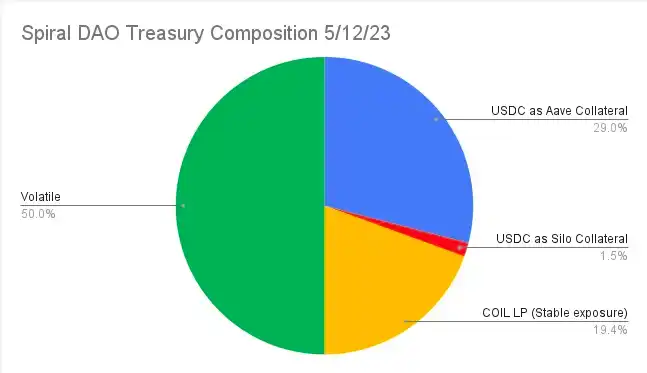
Our analysis of stablecoin market risks
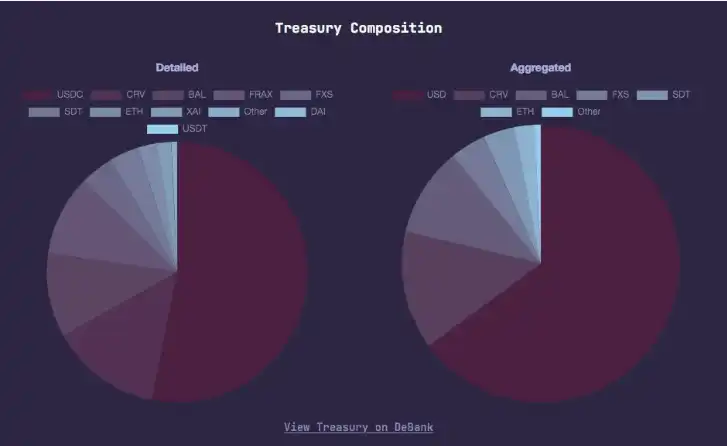
Source: Spiral DAO Dashboard
除了与每个基础协议相关的智能合约风险和经济风险外,还依赖于 3-of-6 金库多签机制来负责管理投资策略。
Translation: Apart from the smart contract risks and economic risks associated with each underlying protocol, it also relies on the 3-of-6 vault multi-signature mechanism to manage investment strategies.Smart Contract Risks
Pessimistic released an audit report in January 2023. The audit revealed a critical issue with the Spiral DAO smart contract, which involved the deletion of a logic contract through delegatecall. Several medium severity issues were also identified, such as outdated addresses, roles with excessive permissions, testing issues, incorrect variable values, skipped operators, and inaccurate reward calculations. Additionally, multiple low severity issues were discovered.
Spiral Dao has confirmed that all identified issues have been resolved. Some changes and additions were made after the audit, such as the SpiralRedeem contract. The vulnerabilities in the smart contract pose a risk to Spiral DAO, especially since it is unclear which contracts have been modified after the audit.
In order to address potential threats, the project offers a bug bounty program with rewards of up to $250,000 or 15% of affected funds for critical discoveries. Additionally, Spiral DAO recently voted to partner with Hats.finance to launch a bounty program aimed at incentivizing responsible vulnerability disclosure for Spiral DAO. According to snapshot voting results, the protocol treasury assets have sent 30K SPR, currently valued at approximately $77,000.
Potential Bank Runs and Redemption Restrictions
Although Spiral DAO has implemented a contingency mechanism for redemption, there is still a risk of COIL liquidity. The USDC balance in the SpiralRedeem contract is supervised by a multi-signature of the treasury. Most of the treasury's assets are liquid, with only about $50,000 SDT locked up. Although the market value of COIL may drop below the treasury value, the redemption smart contract ensures that the drop does not exceed 10% of the total amount as a protective measure.
However, there are some limitations to the redemption mechanism that need to be considered. Firstly, if a large number of users choose to redeem their COIL at the same time, the USDC reserves in the SpiralRedeem contract may be depleted, resulting in reduced exit liquidity for remaining users. This situation could potentially trigger a bank run-like event, where users rush to redeem their tokens before the reserves are depleted.
Secondly, the redemption penalty rate can be controlled by the EOA (external owned account) owned by the team, ranging from 0% to 100%. Although this flexibility allows the protocol to adapt to different market conditions, it also brings uncertainty to users about the actual redemption rate when exiting.
In order to mitigate these risks, Spiral DAO finds it necessary to maintain a sufficient USDC reserve in the SpiralRedeem contract and establish clear guidelines for determining and adjusting redemption penalty rates. Ideally, the owners of EOA should be replaced by a 4-of-7 protocol multi-signature to enhance user confidence.
Llama Risk Assessment Standards
Centralization Factor
1. Can a single entity abscond with funds?
The user's funds are stored in a 3-of-6 vault multi-signature and other system funds (including COIL/SPR Token security) are stored in a 4-of-7 protocol multi-signature. Both multi-signatures include core contributors and project advisors of the protocol. The owners of the addresses have been made public, although most are anonymous, including many well-known figures in the crypto industry. It is possible for someone to run away with the funds, although it appears relatively safe at this stage.
2. If the team disappears, can the project continue?
This depends on how "team" is defined. If the three core contributors disappear, the project advisor can still reach the multi-signature threshold required to recover funds from the treasury. If most of the multi-signature signers disappear, access to the treasury will no longer be possible and the project will not be able to continue.
Economic Factors
1. Does the feasibility of the project depend on additional incentive measures?
The core mechanism of Spiral DAO includes using bribes to expand the treasury. This includes bribes provided to the COIL/FraxBP pool, which is almost entirely composed of POL and earns profits on $1.8 million in liquidity at an annual yield of over 100%. The yield farming strategy relies on being able to obtain ecosystem reward tokens from various Curve and Balancer pools.
2. If the demand drops to zero tomorrow, will all users be compensated?
Users participating in the profit binding pool can always redeem their LP Tokens, regardless of market conditions. On the other hand, COIL holders may not be able to redeem treasury assets. There is only 312K USDC in the SpiralRedeem contract, 900K USDC in the Curve pool, and 800K USDC in the Balancer pool. Once all the USDC is taken out, the remaining treasury funds will need to be allocated by the treasury multi-signature.
Security Factors
1. Has the audit revealed any concerning signs?
In January 2023, Pessimistic's audit report revealed several issues, including one critical issue. All issues identified in the report have been fixed or resolved. The project has a bug bounty program of up to $250,000 for major discoveries and recently established a bounty program worth 30K SPR ($77,000) with Hats.Finance.
Conclusion
Spiral DAO provides innovative yield farming, bribery markets, and veTokenomics solutions in the DeFi ecosystem. With a strong reserve of funds and attractive yields, it differs from traditional yield aggregators by keeping third-party protocol rewards in the DAO reserve. Spiral DAO's unique reserve rebalancing mechanism and token economic model enable it to take advantage of the inefficiencies of bribery markets, increasing bribery yields and liquidity depth.
Although the protocol aims to offset issuance and maintain stability through rapid growth of fund reserves, users should consider the risks associated with underlying fund reserve assets/management, potential bank runs, and smart contract vulnerabilities. Despite being seemingly built by DeFi natives with a community-driven spirit, users should be aware that the 3-of-6 fund reserve multisig and 4-of-7 protocol multisig enjoy significant privileges in managing user and protocol funds.
The rebalanced token economic model (currently paying 1410% APY to SPR holders) makes users unwilling to provide funds to the Curve COIL/FraxBP pool, so almost the entire pool is POL. The pool has a Curve metric that currently pays up to 170% CRV APY to the Spiral DAO treasury. There has been debate in the past about approving protocols with similar mechanisms, such as OHM and BTRFLY, to join the Curve metric. It is worth noting that both protocols have Curve metrics and have transitioned to a low APY rebalancing model. Curve DAO voters should consider whether this strategy constitutes a reasonable use of the metric.
Original article link
Welcome to join the official BlockBeats community:
Telegram Subscription Group: https://t.me/theblockbeats
Telegram Discussion Group: https://t.me/BlockBeats_App
Official Twitter Account: https://twitter.com/BlockBeatsAsia

 Related Articles