Explore the real Japanese cryptocurrency market and uncover opportunities amidst its closed and contradictory nature.
Original title: "Exploring the Real Japanese Cryptocurrency Market: Closed and Contradictory, Where are the Opportunities?"
Source: TechFlow by DeepTech
When you think of Japan, what is the first thing that comes to mind?
Sakura, anime, Mount Fuji, Nintendo...?
When Japan is associated with Crypto, most industry practitioners are not familiar with it, despite the fact that since 2017, Crypto trading and exchanges have been legalized in Japan. However, the Japanese market has always had a weak presence, and many people have the inherent impression of being closed and independent.
The real situation of the Japanese encryption market? Who are the core participants currently? How to participate in the Japanese encryption market?
With curiosity, TechFlow reporters visited Tokyo, Japan in April to communicate with local cryptocurrency practitioners and obtain a wealth of information to share with everyone. There is no long-winded nonsense, only practical information. The co-authors of this article also include Emoote Venture Partner James, whom we salute.
*This article is excerpted from the "Truth of Web3 in the Asia-Pacific Market" report produced by TechFlow. This is the section on the Japanese market.
Overview of the Japanese Cryptocurrency Market
According to discussions with friends and data from third-party organizations, Japanese people who participate in virtual currency investment can be divided into three tiers, and the lower tiers are completely subsets of the upper tiers. Overall, the number of local Japanese cryptocurrency users exceeds 5 million.

The Japanese cryptocurrency market is full of peculiarities and contradictions, mainly in the following three aspects:
(1) Compliance but lack of vitality
In Japan, whether it is trading cryptocurrencies or operating exchanges, it can be done within a legal and compliant framework. It is mainly regulated by the Japanese Financial Services Agency and the Japan Virtual Currency Exchange Association (a self-regulatory organization). The overall principle is to prioritize anti-money laundering/counter-terrorism financing supervision, and then supervise the trading platform to protect user interests. For example, exchanges are required to separate customer assets from their operating funds, and at least 95% of the assets of the exchange must be stored in cold wallets, fully ensuring the safety of individual investors.
However, heavy regulation also brings many restrictions, making the Japanese cryptocurrency market lack vitality. All tokens listed on compliant exchanges in Japan need to be approved by the Japan Virtual Currency Exchange Association (JVCEA), a process that takes at least 6 months to a year.
Secondly, Japan has a high tax burden. According to current Japanese regulations, the tax rate for cryptocurrency-related income depends on an individual's total income. For high-income earners, the tax rate for cryptocurrency may rise to around 50%. This has also led to a phenomenon where, despite the ability to legally convert crypto assets into Japanese yen, there is still a high demand for OTC trading and many OTC practitioners exist.
(2) Hotspot mismatch, strong purchasing power
The Japanese market is a relatively independent and closed market, which also leads to its market hotspots not necessarily completely in sync with the global mainstream market, resulting in a certain degree of mismatch and delay. For example, previously, when the NFT craze in China and the United States had passed, various types of NFTs in Japan instead experienced a wave of explosive growth.
Secondly, the Japanese market still has a strong purchasing power from individual investors. Two of the most direct examples:
1. Cardano conducted its first token issuance (ICO) from 2015 to 2017, mainly focusing on the Asian market. Early fundraising came from Japan, accounting for over 90%, hence it was jokingly referred to as the "Japanese Ethereum", but it is essentially a European and American project.
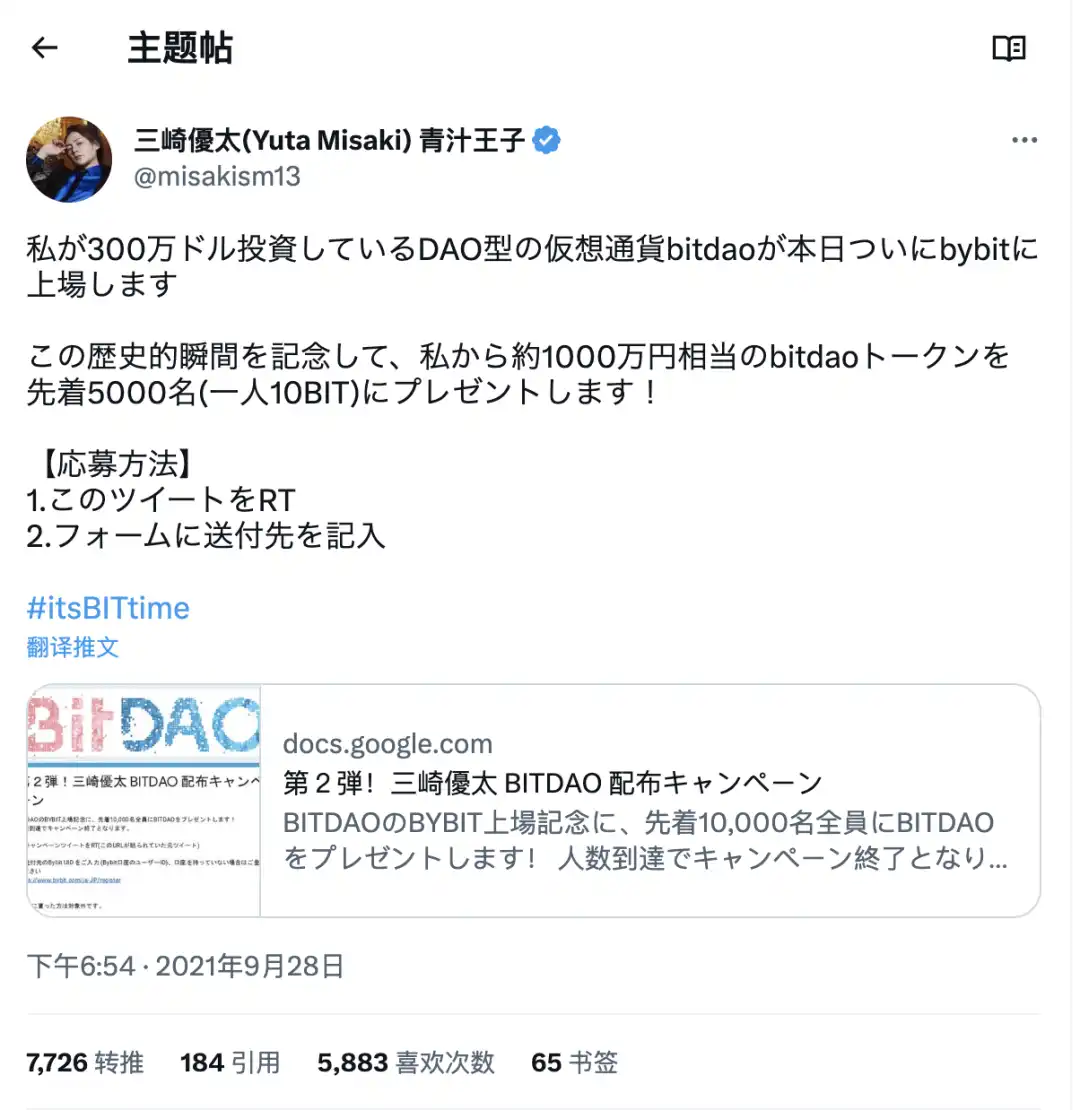
2. Famous trading platform Bybit relies heavily on the Japanese market from its establishment to its rise, and in the Japanese market, it cannot do without the promotion of a super KOL, the green juice prince Yuta Misaki, followed by well-known KOLs such as Tsubasa Yozawa and Hikaru.
Later, another futures trading platform Bitget entered the Japanese market and offered higher commission rates.
Compared to local compliant exchanges, there is less currency and more taxes without leverage; offshore exchanges have more currency and no taxes, with 100x contracts that are tempting for retail investors. Despite continuous warnings from the Japanese Financial Services Agency to Bybit, MEXC, Bitget, and Bitforex, the effect has been minimal, or even non-existent. It is impossible to completely abandon the Japanese market or achieve full compliance. For example, compliant exchanges Coinbase and Kraken both withdrew from the Japanese market in early 2023, becoming a cautionary tale.
Therefore, in the Japanese market, many practitioners have reached a politically incorrect consensus privately: to make money, one cannot be too compliant.
(3) Transfer: Japanese Ministry of Finance or relax some regulations
After communicating with relevant personnel from the Japanese Financial Services Agency, it was found that they have mixed feelings.
Fortunately, despite the bankruptcy of FTX which devastated the entire cryptocurrency industry and the disappearance of billions of dollars of funds embezzled by its founder SBF, individual investors in Japan are proud of the strict regulation of cryptocurrencies in their country which has protected them.
Therefore, Mamoru Yanase, the Deputy Director of the Strategic Development and Management Bureau (SDMB) under the Japanese Financial Services Agency, which is responsible for handling cryptocurrency and fintech issues, stated that the Japanese regulatory body has begun urging regulatory agencies in the United States, Europe, and other regions to implement regulatory measures for cryptocurrency exchanges similar to those for banks and securities firms.
Unfortunately, the cryptocurrency market in Japan lacks vitality, especially after Coinbase and Kraken withdrew from the Japanese market. On the other hand, offshore exchanges are thriving in Japan, so they are also trying to make some adjustments.
In April 2023, Japan's largest political party, the Liberal Democratic Party, released the "Japan 2023 Web3 White Paper" with the slogan "JAPAN IS BACK, AGAIN". The paper aims to loosen regulations in various aspects.
Tax Reform: Previously, investors were subject to a high income tax rate of up to 55% on the appreciation of tokens. After the tax reform, holding tokens issued by one's own company will be exempted from taxation, and holding tokens issued by other companies can also be exempted from taxation if there is no "short-term trading purpose".
Token Review/Issuance/Circulation: The Financial Department assists in reviewing the listing of overseas token trading to increase efficiency and regulate the issuance and circulation of stablecoins.
NFT: NFTs are restricted from being used for gambling, money laundering, etc., and the rights and returns of NFTs are clearly defined and regulated.
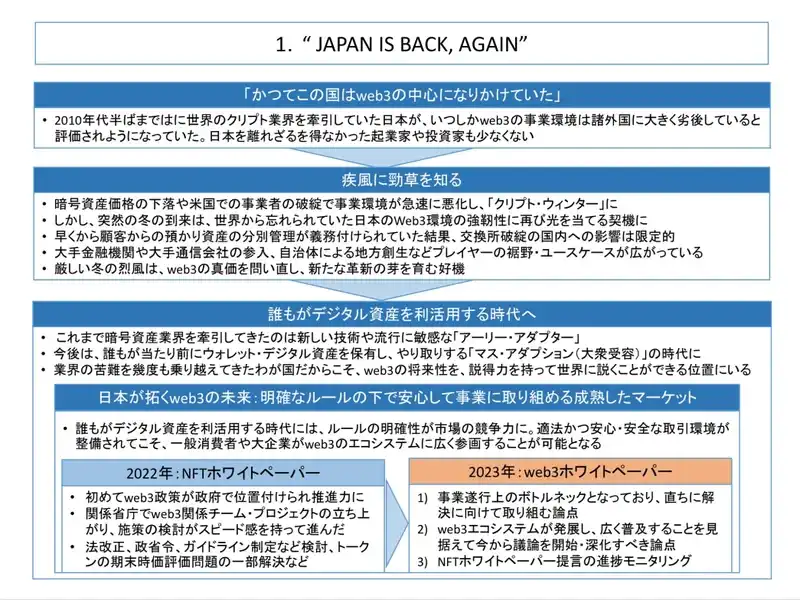
Japan 2023 Web3 Whitepaper
Local Trading Customs
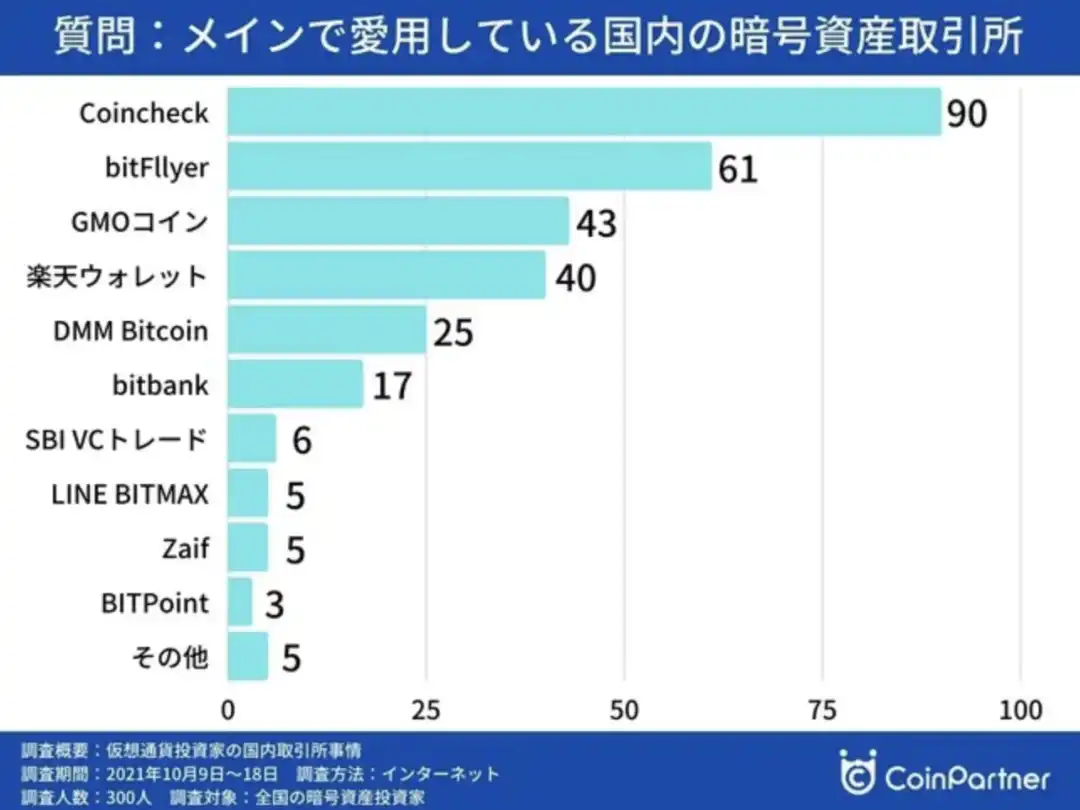
According to a survey of 300 Japanese exchange users, we found that the most popular exchanges in Japan include Coincheck, bitFlyer, GMO Coin, Rakuten Wallet, DMM Bitcoin, and bitbank.
And in unlicensed exchanges in Japan, the most commonly used exchanges by Japanese people are Binance and Bybit, both of which have been warned by the Financial Services Agency.
There are not many well-known encryption projects in Japan, especially lacking grassroots heroes who started from scratch. Most projects have a strong background in traditional resources. Currently, some of the more core projects include Astar Network, Oasys, HashPort, Jasmy, and others.
Regarding social media, the main information and communication channels in Japan are still Twitter, followed by Instagram and Facebook. Some people also use LINE Open Chat (similar to QQ chat rooms where anyone can freely enter and exit) to collect and exchange information related to virtual currencies, but this channel is not mainstream and the largest chat room only has 5000 participants.
In Japan, there are CoinPost, CoinTelegraph JP, CoinDesk JP, 仮想通貨 Watch, あたらしい経済, and bitpress as vertical media for the general public.
From the perspective of influence and traffic, the largest cryptocurrency media in Japan at present is Coinpost. Local cryptocurrency practitioners in Tokyo have revealed that Coinpost has previously received investment from Chinese cryptocurrency capital.
Although the above media all have news flash services, the only service that specializes in news flash and is used by all Japanese companies (including non-blockchain related companies) is PRTimes. This service can be called well-known among Japanese office workers.
At the same time, there are also some self-media on Twitter that collect blockchain-related information from Japan and overseas and translate it into Japanese. Of course, many vertical media also create accounts on Twitter to increase their presence. Some well-known ones include dAppsMarket, CRYPTO TIMES, BlockchainGame Info, and NFT JPN. In addition, CoinGecko Japan should not be underestimated.
When it comes to in-depth research (similar to Messari's service) in the encryption industry, the leader is HashHub Research, whose interface and layout are very similar to Messari.
除了上述类型媒体,还有众多以 SEO 营生的 Affiliate Media(诸如 Kasobu),Newsletter 以及个人博客。Newsletter 中最著名的为 CoffeeTimes、のぶめい、マナブ以及 ikehaya。
Translation:In addition to the aforementioned types of media, there are also many Affiliate Media (such as Kasobu), newsletters, and personal blogs that make a living through SEO. The most famous newsletters are CoffeeTimes, のぶめい, マナブ, and ikehaya.
Regarding KOLs, we have attempted to classify and provide representative accounts for each type (not exhaustive). The analyzed accounts are mainly concentrated on Twitter, and there may be instances where some KOLs span across multiple types.
Researcher/Academic KOL
Japan's orthodox KOL group conducts due diligence when deciding whether to promote a project on behalf of the project party, out of consideration for its reputation. These KOLs need to maintain objectivity and neutrality, so they rarely write advertorials.
shingen: Mainly analyze the technology and projects related to ETH.
arata: Founder of CryptoTimes, a Japanese blockchain media.
やす@ Cryptocurrency: A versatile player whose research scope covers all aspects of virtual currency.
GameFi Related KOL
One important point to emphasize is that Gamefi is not a widely used term in Japan. The preferred term is BCG, which stands for Blockchain Games. When conducting related searches, it is important to keep this in mind.
魔 LUCIAN: Undoubtedly the most influential KOL in the Gamefi industry among Japanese. His influence extends far beyond Japan and he serves as the ambassador for the star GameFi project Defi Kingdom in Japan. His call success rate is frighteningly high, enough to have a substantial impact on the market trend. Recently, he created his own community, LFG (Lucian Finders Guild).
Makai Witch: Rising star in the industry, often translating and sharing various chain games such as XANA, Sand, Star Atlas, etc.
onchan: Although the number of followers is not many, he is a Japanese community administrator for many well-known projects (LOA, Defina, GameStarter, H&E, Monsta Infinite, Guildfi, RIFI, Demole).
DeFi related KOL
(This content does not require translation as it contains only HTML tags and punctuation marks.)
shingen: Please refer to the introduction above.
lagoon: Mainly analyzing the upcoming coins of listed IDOs and projects that may/will airdrop in the near future.
Virtual Warrior Roy: A rising star in the world of frequent Twitter Space interactions with LUCIAN, primarily focused on the AVAX chain and analyzing Defi and gamified Defi projects.
Magic World related KOL
High-risk, high-return cryptocurrencies (similar to the Chinese term "hundredfold coins") are jokingly referred to as "the demon world" by the Japanese due to their "once you enter the deep pit, it's as deep as the sea" characteristics. Demon world currencies are mainly divided into Defi, GameFi, and CX currencies based on their content.
Here are some self-proclaimed KOLs who specialize in the dark world: Mo LUCIAN, Makai Witch, Yuan GA, and Raguragu Pudding, among others.
NFT Related KOL
miin: has been committed to discovering excellent Japanese NFT projects and collecting related information. The Japanese NFT rankings are updated weekly.
ikehaya: Early investor in NFT, holding Crypto Punk and BAYC, with a total of over 340,000 fans.
Yugong: The head of the NFT business department of SBI, a well-known Japanese internet company, who often shares information related to NFT business of major Japanese companies.
KOL Group
Kudasai: Japan's largest and oldest KOL group. Its Telegram community has over 18,000 participants and is one of Japan's largest virtual currency-related communities. Its core members consist of more than 20 KOLs, each with their own responsibilities, including project negotiations, research and due diligence, project promotion, translation/AMA, and more. The leader is Watacchi.
ソフィクラ (Sophie Kura): The second largest group in terms of influence after Kudasai. Their Discord community has over 12,000 participants. The leader is Sophie Cherie.
Scam Dunk: mainly shares information about the Magic World project and conducts AMA (Ask Me Anything) for it, which is a high-risk and high-return cryptocurrency commonly known as "100x coin" in Chinese. The leader is Xian Dao.
Otaku Guild: Mainly shares projects related to blockchain games and the metaverse.
Giveaway / 空投信息收集型 KOL
Giveaway / Airdrop Information Collection KOL
Giveaway type KOLs are quite special, and some of them are not deeply involved in the virtual currency industry, but will accept any type of airdrop (coins, cash, vouchers, etc.), so extra attention is needed. The KOLs mentioned here are all deeply involved in the Crypto field.
Fig: Previously, due to the airdrop of four-digit RT obtained through STEPN and the KOL who became famous for his/her love and one battle.
ADMEN: KOL who frequently conduct airdrops for various celebrity and heavyweight projects recently established their own welfare group, ADMEN DAO, due to their soaring popularity.
Business Leader
Yusaku Maezawa: A Japanese billionaire and the first private passenger to travel around the moon with SpaceX. He has established a personal friendship with Elon Musk and is also known as the "Japanese Musk". He owns a 10 billion yen (approximately 70 million USD) cryptocurrency investment fund called MZ Web3 Fund and also has MZ DAO under his umbrella.
Guo Guang Hong Shang: Founder of Gumi and former president. After leaving Gumi, he founded Third Verse and Financie. Although he left Gumi, his influence is still profound, as evidenced by his role as co-founder of the gaming chain Harmony, which was recently invested in by Gumi.
Yuzo Kano: Co-founder of bitFlyer, one of the largest exchanges in Japan, and also the representative director of the Japan Blockchain Association.
Watanabe Sota: Founder of Astar Network, a Polkadot parallel chain. He carries the earnest expectations of many Japanese VCs to establish a presence for Japan in the Web3 industry.
Yoshida Seihiro: HashPort CEO, operating Japan's first IEO token $PLT, and Japan's largest NFT marketplace PLTPlace, fluent in Chinese.
岡部典孝:CEO of JPYC, the largest Japanese yen stablecoin project in terms of circulation. One of his greatest pleasures in life is to invite people to the sauna for in-depth communication.
Yosui: Founder of the Hokusai project, which provides a comprehensive NFT issuance solution for Japanese enterprises.
Many Influencers operate their own communities, and choosing the corresponding Influencer in the segmented fields such as Gamefi/Defi/investment research/airdrop will significantly improve the dissemination effect.
Japanese Local Cryptocurrency VC
According to our understanding, traditional domestic venture capital in Japan is not particularly active, and Japanese VCs that are truly involved in Crypto and Web3 are rare, and mostly limited to equity investments.
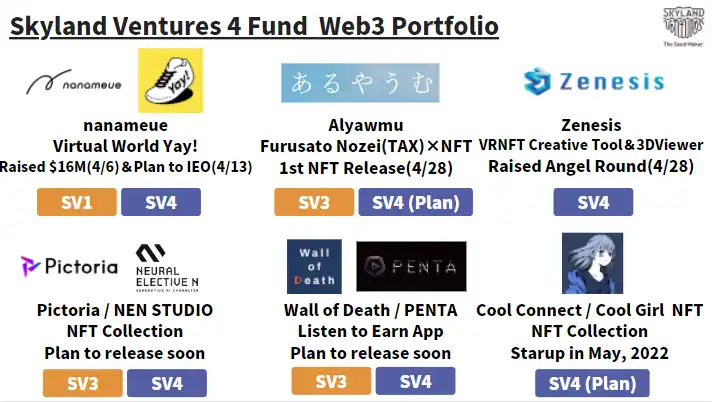
Skyland Ventures is a relatively active Japanese crypto fund, and has established a seed fund dedicated to Web3 investment in its fourth fund.
On April 13th, Skyland Ventures announced that its Web3 fund, "Skyland Ventures No.4 Fund," had raised a total of 5 billion yen (approximately 38 million US dollars) and announced an investment in the Ethereum ZKEVM solution Takio.
Emoote is a Web3 fund established by Japanese gaming company Akatsuki, with an initial fund size of $20 million. Its predecessor was Akatsuki Crypto, and it has invested in a total of 24 projects, including STEPN, BreederDAO, ETHSign, Akinetwork, etc. Miss Bitcoin, a well-known KOL in Japan, is an advisor to Emoote.
The Z Ventures joint venture between SoftBank and Line has also set its sights on the Web3 field, making some layouts and investing in NFT trading platform X2Y2, blockchain game development platform double jump.tokyo, encrypted live broadcast platform Stacked, etc., all of which are equity investments.
The Japanese financial group SBI Group has also made arrangements in the cryptocurrency field, being the core investor and spokesperson for Ripple in Asia, while investing in numerous local trading platforms.
In the incubator mainly operated by Japanese, the most famous one is Fracton Ventures, which does not engage in investment business itself, but the original team recently raised funds from many Japanese VCs to establish Next Web Capital and participated in the investment of projects such as EthSign.
Among the VC firms mainly operated by Japanese people or centered in Japan, the most famous one is Gumi Cryptos. Gumi was founded by Kojiro "Gon" Kunimoto in 2007 and led the company to a successful IPO in 2014. It is worth mentioning that Kunimoto studied at Fudan University in Shanghai for 4 years in 1996, but his Chinese language skills have greatly deteriorated now. In 2021, Kunimoto retired from Gumi and went all in on blockchain and VR, but still has a significant influence on Gumi.
Currently, Gumi Cryptos has invested in dozens of cryptocurrency projects such as Opensea\YGG. However, Guoguang Hongshang is concerned that despite investing in many overseas projects, they are unable to launch them in the Japanese market or promote the development of the Japanese market.
In the Japanese market, another influential figure that cannot be ignored is the billionaire, known as the "Japanese Elon Musk", Yusaku Maezawa, who has millions of followers on Twitter and is considered the largest KOL in Japan. He established the Web3 fund, MZ Fund, using his name abbreviation, with investment amounts ranging from 10-500 million US dollars, and owns Japan's largest Web3 guild, Web3 Club, with 30,000 native crypto users as members; as well as Japan's largest "crypto education platform", MZ DAO, which claims to have a non-crypto native user group of 300,000.
Currently, MZ Fund has invested in many projects, including some projects with Chinese background, such as MetaOasis, Akiprotocol, SINSO, and so on.
In addition, there are also local VCs such as Headline Asia (and its subsidiary cryptocurrency fund Infinity Ventures Crypto), i-nest Capital, and THE SEED.
Japanese Market Strategy
Previously, the successful case of STEPN in Japan demonstrated the potential of the Japanese market. As of February 25th last year, 35% of its active users, totaling 21,000 people, were Japanese users. Analyzing its promotional path, it can be found that many top KOLs have conducted Giveaway activities, and some have even purchased shoes at their own expense for Giveaway. This indicates that as long as multiple top KOLs participate and their token model has good sustainability, Japan is still a market with considerable purchasing power.
However, considering the user base and cautious tendencies of Japanese KOLs, it is recommended not to focus on Japan right away. But if a certain level of popularity can be gathered in Japan, it will make it easier for the project to radiate to surrounding markets, especially Southeast Asia.
In addition, Japan as a whole belongs to a market that is easy to defend but difficult to attack. Although the language barrier (the fact that Japanese people have a psychological barrier to English is well known) and the cautious tendencies of Japanese KOLs make market promotion more difficult, on the other hand, if the project party actively engages in work and does not run away, Japanese users will show a more tolerant and understanding attitude than users in some other markets, which helps to create a positive community atmosphere.
Another interesting question is that we initially thought that Japanese people would be more proud of domestic projects and have higher vigilance towards Chinese projects. However, according to the author's research on Japanese users, Japanese people have a complex sentiment towards Japanese projects, and for Chinese projects, some people actually consider China's attribute as a bonus because many excellent projects are created by Chinese people (of course, the attribute bonus of European and American projects goes without saying).
Looking at China and European and American projects, due to the existence of many successful cases, attention has been paid to this field for a long time. Rational people will consider this attribute as a bonus point. However, it should be noted that the number of people who fit this user profile is limited.
Overall, in terms of localization, the author still believes that having a native Japanese speaker who understands Japanese culture (knows what Japanese comedy is like, knows sports and political references, popular youth language, and can proficiently use popular catchphrases such as "全米が泣いた") is necessary for a community manager to bridge the gap with users based on cultural awareness.
Of course, if the collaboration with the administrator is good, it is worth considering bringing them into the team. After all, from the perspective of user psychology, there is a big difference between core members and external collaborators. This way, having a Japanese member in the team can make Japanese people feel at ease and facilitate closer relationships, while at the same time, the team is sufficiently global, making the project appear promising to Japanese people.
Original article link
Welcome to join the official BlockBeats community:
Telegram Subscription Group: https://t.me/theblockbeats
Telegram Discussion Group: https://t.me/BlockBeats_App
Official Twitter Account: https://twitter.com/BlockBeatsAsia

 Related Articles