Binary Research: Interpreting Gains Network and approaching the dark forest of decentralized leveraged trading
Binary Research: Interpreting Gains Network and Approaching the Dark Forest of Decentralized Leveraged Trading
Binary Dao
"Launched on Ethereum, the Gains Network was a modest hit at first, then migrated to the Polygon chain and gained business. The market took off when it integrated with Arbitrum. To date, the platform has logged more than 870,000 trades and made more than $34 billion in gains. The founder was so good that he hired just one UI developer early on and did everything else, from business design to code implementation." gTrade was the first product to launch on the Gains Network, a decentralized leveraged trading platform now deployed on Arbitrum and Polygon.
1. Core features of gTrade
(1) Synthetic liquidity pool
Synthetic liquidity pools are essential to the efficient operation of liquidity pools. Currently, gTrade uses a DAI based synthetic liquidity pool (gDAI Pool) to act as a counteroffer to leveraged traders.
The design of this liquidity pool has several features. First, its synthesis mechanism allows for more efficient use of funds. Second, its synthesis mechanism makes trading more flexible. Because gTrade can offer more leveraged trade pairs through synthetic liquidity pools, this means that traders have more flexibility in choosing trade pairs and can trade according to market conditions.
Finally, gTrade's synthetic liquidity pool can control risk through different synthetic mechanisms, such as adjusting the leverage multiple or limiting the size of the synthetic liquidity pool to reduce risk. This allows both traders and liquidity providers to feel more comfortable participating in trading.
dydx uses the orderbook mechanism, which requires the orderbook to be stored down the chain and requires market makers to provide liquidity, so it is not decentralized and capital efficient. By contrast, gTrade's gDAI pool avoids these problems and eliminates the need to set up a liquidity pool for each trade pair.
Compared with GMX, gTrade has demonstrated extremely high capital efficiency, although both use liquidity pools to provide liquidity.
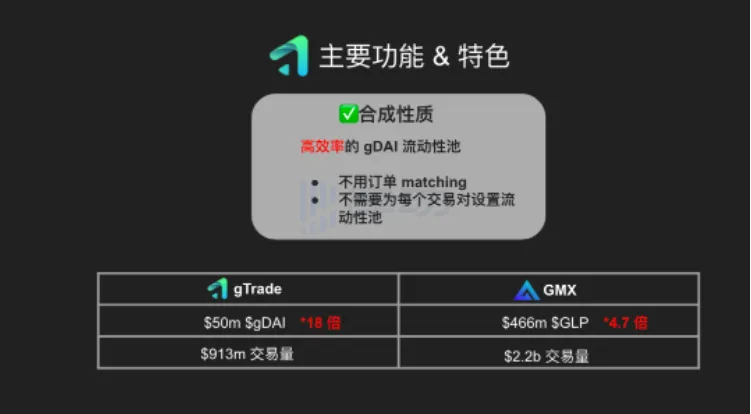
Taking the data of the last 7 days as an example, gTrade's 50m gDAI pool TVL has realized 913m of trading Volume and 18 of Volume/TVL. GMX, on the other hand, achieved a Volume of 2.2b with 466m GLP pool TVL, and the Volume/TVL was 4.7. Tellingly, gTrade was more than three times as efficient as GMX over that period. However, higher capital efficiency also brings some risks, so gTrade has adopted a number of protective measures.
(2) Abundant trading pairs
Support for multiple trading pairs and high leverage are another important feature of gTrade. It is currently the only on-chain leveraged trading platform that supports 91+ trading pairs, which cover cryptocurrency, forex and equities. The leverage of foreign exchange on the gTrade platform can be as high as 1000 times, and the leverage of crypto assets can be as high as 150 times. These are all targets
The former GMX couldn't do it.

(3) Self-made prophecy machine
gTrade's oracle DON is the underlayer of a Chainlink built by the founders. DON has 8 nodes, gets prices through apis of 7 different exchanges, and feeds prices to gTrade in real time. Effectively prevent price manipulation, but also ensure the accuracy of the price.

Centralised exchanges have pins in them, but gTrade doesn't. Since the data they get and subsequent execution are done on the chain, seven apis and eight nodes also minimize the potential for evil.
(4) Transaction costs and protection mechanism
1.Fixed Spread
In addition to the basic Opening and Closing fees, gTrade charges an additional Fixed Spread. gTrade sets a fixed fee for assets that are harder to manipulate, such as large-cap cryptocurrencies like BTC and ETH, Forex and U.S. stocks.
2.Price Impact
Price Impact has a good protective effect on the safety of gTrade that GMX does not have. Because of this, GMX can't let users do small currency transactions. If a trade has a high Open Interest on the floor platform but is not as liquid on other exchanges over the counter, that Price Impact is likely to be greater.

When Luna incident happened, the gTrade team adhered to the principle of decentralization and insisted on not intervening in the transaction and removal of Luna. Finally, the market emptied the liquidity of the platform, and the project was almost in a desperate situation. Since Luna, the platform has added a number of protection mechanisms. In fact, in the case of Price Impact fees, Luna incident has a limited Impact on gTrade, because traders have to pay high impact fees.
3.Rollover Fee
The Rollover Fee causes the user to pay a fee at all times during the course of holding the position, which is related to the volatility of the market; the greater the volatility of the market, the higher the fee will be. Because the more volatility there is, the more impact it will have on gTrade, with the ultimate goal of allowing users to close their positions quickly. Recently, the team increased the Rollover Fee. The reason was that the team calculated that if there were some large positions being hedged and Rollover Fee was not raised, they could hedge and hold positions for a long time at a very low cost on gTrade, which would lead to their Open Interest becoming less, and few people could actually make leveraged trades. As a result, they raise the Fee so that these people can't hold positions for a long time or hedge on gTrade in a very cheap way, which is another protective feature of the Rollover Fee.
4.Funding Fee
The biggest difference with GMX is the Funding Fee. The transaction method on GMX is that users must pay the borrowing fee to the liquidity provider of GLP when conducting leveraged transactions.
On gTrade, it balances short and long traders with a Funding Fee, so the side with the larger position pays less. It is because of the Funding Fee, which balances long and short traders, that leveraged trading on gTrade is more balanced and fair.
In addition, gTrade has other protections, such as a maximum yield of 900%, a maximum of 900% can only be earned on a trade, and automatic liquidation of positions when 900% gain is achieved; It also automatically liquidated the position if the user's collateral or principal loss reached 90%. These protection measures can ensure that users will not take excessive risks when they carry out risky leveraged transactions. General User Participation gTrade can generally use the following functions:

gTrade is a leveraged trading platform that provides a good trading environment for users who are good at trading. At the same time, it also offers a lot of other DeFi gameplay. Because it is a breakthrough platform, you can earn revenue by providing liquidity to its liquidity pool.
The gDAI pool has many features. Most leveraged trading platforms, which provide liquidity with single-currency collateral, are at risk of losing money when traders make a lot of money. But gTrade uses a variety of mechanisms to reduce the risk of losses in the gDAI pool to almost zero.
In addition, Gains Network has its own token, GNS, a versatile token that will enable governance capabilities for the platform in the future. Currently, holding GNS tokens allows you to deposit them on the Gains Network and share in the platform's gains. In addition, all types of transactions on gTrade are executed through decentralized NFT bots. Therefore, if you want to operate accordingly, you must hold the corresponding NFT. gTrade is aimed at people who want to trade. Referral Program, if you have the resources.
2. gToken liquidity pool
Regarding the gToken liquidity pool, gDAI is only its first collateral, and in the future it will join gETH, gBTC, gFrax, gLUSD and other collateral. The USDC risk did create some panic, which motivated the team to make this requirement a higher priority. The next more decentralized liquidity pool is currently being launched. If gETH is the next one to be launched, traders can use ETH as collateral and liquidity providers can get ETH as income.
It is worth noting that the biggest difference from other similar agreements is the way gTrade is settled. If you're billing in an ether, your trade pair if it goes up 10%, your return is 10% in ether. In contrast, GMX's leveraged trade settlement is done in USD, but the profit paid to the trader depends on whether the trader is long or short. If the trader is long, GMX will pay the profit on the assets they are long trading. If the trader is short: GMX will pay the profit in stablecoin.
The liquidity of gToken works like this: if you are a depositor who wants to deposit DAI, the receipt you get is gDAI, you put the DAI in, and you get a receipt (this is actually an ERC20 token that you can use for other DeFi protocols).
. If you go to withdraw money, you take the gDAI back, it burns the gDAI, you can take out your DAI. Right now there's only one gTrade pair, gDAI, but it's worth noting that even though it only has $50 million of gDAI now, it's already handling 18 times that volume. Volumes can scale even more if the team puts in more collateral, so gTrade has more potential to scale than GMX.

What's special about gToken?
As mentioned above, the gDAI pool is the counter order of the trader, that is, if the trader gains, he takes DAI from the gDAI pool, and if the trader loses, the DAI of the trader goes into the liquidity pool. When the user deposits DAI, he can get the receipt gDAI from the pool, which represents the share of the depositor in the pool. There are two factors that can affect the price of gDAI. The first factor is the transaction fee accumulated by the transaction, which is the opening and closing fee mentioned above. This part is always going to go up. The second factor is the profit and loss of the counteroffer as a user, but only under the condition of insufficient collateral, will affect the price of gDAI, because it also has a buffer layer of protection.
The gDAI price calculation method is relatively simple, assuming that there are 100 DAI in the pool in the initial scenario, and then its total circulation of gDAI is 100, now one gDAI is worth one DAI. If the platform now earns $150 in revenue, there are now 250 DAI in the pool, but the circulation of gDAI is still only 100, so one gDAI is worth 2.5 DAI.
So what's a buffer? To explain buffer, we must understand the mortgage rate of its gDAI pool, which will be affected by the trader's profit and loss. Each Epoch of Buffer will settle the trader's profit and loss. As long as the expense earned is greater than the trader's expenditure of profit and loss, the Epoch will have a positive return. If we go to their website and look at the Vault and CR section, and pull down the data, we will see a lot of numbers, but there are two numbers: TVL and Collateration mortgage rate. The difference between the two data is relatively high, and the difference is its buffer, its protection layer. The way to calculate its CR is to divide the total amount of collateral by TVL, and that percentage is its buffer.

Dune Analytics shows that at the bottom of its gDAI pool is the 100% portion, and the extra 4% is the buffer, whose balance is actually higher than that of the TVL. What does it do? Its main function is to absorb the impact of traders' profits and losses.

When the mortgage rate is greater than 100%, the trader's profit and loss has no impact on gDAI at all. Only when the mortgage rate is less than 100%, the trader's profit and loss will start to have a short-term impact on gDAI. It must be emphasized here that it is short-term. This is when the agreement will start to mint GNS and sell them into DAI on an OTC basis to cover the losses in the pool. The gDAI liquidity pool basically has three layers of protection. The first layer of protection is buffer, with which traders' profits and losses have no effect on gDAI holders. The second layer of protection is his TVL. The trader's profit or loss only starts to affect the price of gDAI when buffer is missing, but at this time GNS are already being minted to cover the pool's losses.
The third layer is the casting of GNS at the same time, the platform is still normal operation, on the one hand, the agreement has income, on the other hand, traders may lose money to replenish the liquidity pool. And finally, it brings the pool back to 100% in these three ways. gDAI Pool is an iteration of the previous DAI pool. One of the biggest features of gDAI pool is that you can do a lot of things with gDAI Pool. It becomes a self-compounding ERC20 token, with which you can play a variety of Lego combinations in Defi.
All the shares in the gDAI pool share the profits, share the losses. Because it is a homogeneous token, it is impossible for FTX to withdraw a little earlier and leave, but withdraw a little later and you may not be able to leave, and you have to bear all the losses of the people behind you.

There are two factors mentioned above that can affect the price of gDAI. The first factor is the cost of the platform, which will never change. It's only going to go down a little bit in the short run if you're undermortgaged, but that's the short run. When the pool is filled and the mortgage rate goes back above 100 percent, the gains you earned before will still belong to you. And then, there's a very interesting point here, which is the incentive mechanism described in the third part of the diagram.
When the collateral rate is insufficient, it will provide you with a very good opportunity to buy gDAI. Why is that? Because what you buy at this point is actually helping the gDAI pool, so you can get a corresponding revenue. Also, in the incentive scheme, it will have a discount. Under normal circumstances, the mortgage rate remains above 100%, with a linear decline between 100 and 150%. The higher the mortgage rate, the lower the discount rate. If it reaches 150%, there is no corresponding discount rate.
gDAI is extremely composable. It is an ERC20 token. By locking in, which means promising not to leave the pool for a certain amount of time, users also get a corresponding discount. In this case, however, the user position will be expressed in ERC721 tokens.
It's a very good collateral choice because it steadily increases in value, barring a very extreme black swan event. In addition, it has a time lock for withdrawal. When the mortgage rate is less than 110%, the user has to wait for three epochs, one of which is 72 hours, or 9 days.
The Epoch system is actually very secure. An Epoch is three days, the first 48 hours is the only time you can apply for withdrawal or go to withdraw money, the last day will execute the trader's profit and loss settlement. Thus, throughout Epoch, when a user makes a withdrawal or applies for a withdrawal, they do not actually know whether the Epoch protocol is making or losing money. That way, running first or grabbing cash won't happen.
3. Application Scenarios of GNS
GNS is an application token, and the relationship between GNS and gDAI pool is very close. When the DAI's collateral rate falls below 100%, GNS are minted and then sold to fill the gap in the gDAI pool. When overpledged, 5% of the trader's profit and loss income will be used to buy back these GNS. In addition, there is a case that will cast GNS. This situation involves NFT robots and referral programs, so why would they want to participate? Because there is revenue, and that revenue is the foundry of GNS. But these GNS were not cast in a vacuum. They were created entirely out of real revenue -- real revenue from the gTrade platform, DAI.
But instead of DAI, motivators get GNS. This means that these DAI will enter the buffer zone, thereby increasing the assets in the buffer zone and enhancing the protection of the gDAI pool. In short, the actual number of GNS is completely dynamic. The amount it is cast depends on demand. It will be cast when it needs to be cast and destroyed when it needs to be destroyed. As long as it destroys more than it mints, GNS will deflate.

The amount of casting is capped at 0.05% per day. As a result, the maximum annual inflation rate is only 18.25 percent. Barring extreme circumstances, this ceiling is unlikely to be reached. After all, mortgage rates can't be less than 100% every day. Because the gTrade platform is still making money, traders are still losing money, and these gains are counted every day. Now GNS its inflation is negative, which means its combustion is greater than casting.
4. NFT bots
The NFT bots we just talked about are used to perform all the automatic functions on gTtrade, including clearing, new orders, take profit, stop loss, etc.

Another function is that, for large traders, it can reduce the spread cost of the trade, which is actually quite substantial, so its NFT is now very expensive. If these holders have pledged GNS, it can increase their GNS pledge income. A wallet can pledge up to three NFT. If you have Bronze, Silver, and Gold, you can add them up to 2%+3%+5%, which is 10%. So, if you have pledged GNS, you can increase your yield by 10%.
If you are trading, you will get a discount of up to 25%. GNS now has two sources of income, one from the Market Order, the other from the Limit Order. Roughly 70% of the revenue comes from its Market Order. It has been calculated that GNS pledge gets 36% of the platform revenue, gDAI liquidity provider gets 18% of the platform revenue, and the rest is paid to project development expenses, NFT bots, and affiliate rewards.
By comparison, a GMX pledge gets 30% of the platform's revenue, and a liquidity provider gets 70% of the platform's revenue.
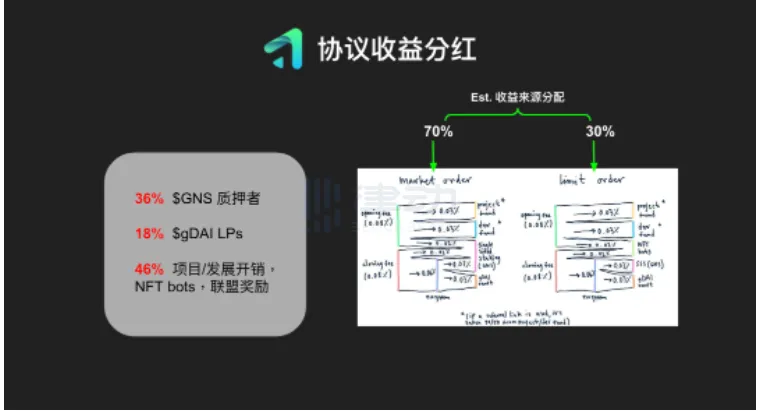
In the case of GMX, the risk is greater for the liquidity provider, and LP must bear the impact of the traders' profit and loss. But it was the GNS pledge who was most at risk on the Gains Network, and his gains were higher, earning twice as much as those of the liquidity provider.
summarize
Gains Network has shown the efficiency and sustainability of its liquidity solution by providing users with a new liquidity pool solution through the introduction of gToken, and has handled a large volume of transactions. The success of the Gains Network lies in its keen sense of user needs and rapid response to changes in the market. The platform is constantly introducing new solutions to meet the different needs of users, and constantly improving its existing services to provide users with a more complete DeFi experience. DeFi derivatives is a track where there are greater business opportunities than in the spot market. The Gains Network has iterated in a bear market environment and has grown to be at the head of the decentralized leveraged trading circuit, gaining market recognition in both volume and trading experience. We believe that with the continuous addition of gToken pool, gTrade will capture a larger market share in the increasingly competitive derivatives circuit.
-- the End --
Data source: https://dune.com/unionepro/Everthing-Gains-Networkhttps://gains-network.gitbook.io/docs-home/https://twitter.com/GainsNe twork_io
Original link
Welcome to join the official BlockBeats community:
Telegram Subscription Group: https://t.me/theblockbeats
Telegram Discussion Group: https://t.me/BlockBeats_App
Official Twitter Account: https://twitter.com/BlockBeatsAsia

 Related Articles