Asset risk assessment: The Stablecoin DCHF anchored to the Swiss franc and its governing body Moneta DAO
Title: Asset Risk Assessment: DeFi Franc (DCHF)
Original article by LlamaRisk
Kxp, Blockbeats
TL; DR
This report takes an in-depth look at the DeFi franc (DCHF) Stablecoin anchored in the Swiss Franc and its Moneta DAO governing body. Specifically, we analyzed the risk of the DCHF-3CRV pool to LP. The Moneta DAO proposes to add a dashboard for this pool, and governance proposals can be found athereFind it.
, & have spentEscrow risk: The AdminContract grants privileges to the owner that may potentially affect user funds, primarily by adding collateral types and prognostics prices. While contracts are not upgradable, a 4/6 multiple signature has all the relevant contracts, including AdminContract, DFrancParameters, and DCHF Token, raising centralization concerns. In response, the team recently improved their multiple signatures by adding a Curve team member and raising the number of signers threshold from 3 to 4.
, & have spentGovernance risk: The team recently launched the Moneta DAO. DCHF is an ungoverned fork of the Liquity Protocol, but is itself governed by the Moneta DAO. Nonetheless, limited community participation at the bottom and the core team coordinating recent activities (namely the establishment of the Community Grants Committee) raise questions about how much decentralization has actually been achieved.
, & have spentMON distribution: The team needs to update information and documentation because the team has conflicting statements about the role of the MON holder. In addition, there are governance risks associated with distributing MON. Although distribution is open and transparent, distribution decisions made prior to the DAO's establishment can be problematic.
Overall, Llama Risk believes the deal's risks are comparable to those of other earlier DeFi agreements. The Moneta team has made a good faith effort to improve the security of Owner multiple signatures and move toward decentralized governance. We believe this agreement meets the requirements for obtaining the Curve dashboard.
DCHF: Introduction
History and background
DeFi franc (DCHF) is an overpledged stablecoin anchored in Swiss francs created by Moneta DAO Deployer on September 25, 2022. On January 25, 2023, Andrs Soltermann, founder of Grizzly.Fi and current member of the DCHF core team, proposed adding the DCHF+3CRV pool to the Gauge Controller. Grizzly.Fi is a liquidity mining aggregator that exists on Binance Smart Chain and Ethereum.
DCHF was initially governed solely by the Moneta team. The original MON is used only for the distribution of agreement fees to the pledgee and for the liquidity mining program. With the launch of Moneta DAO on February 5, 2023, DCHF transitioned to a DAO governance model. The MON holders manage the DeFi franc agreement through a dual governance structure and have introduced initiatives such as the mobility strategy, the extension of the Moneta DAO multiple signature support number, and the Community Grants scheme.
From March 20 to March 27, 2023, Curve DAO took a vote to add the DCHF dashboard, but did not pass a quorum. The team expressed its intention to attempt another vote to add a dashboard for the DCHF-3CRV pool, and said that moving to DAO governance and improving multiple signature parameters were logical steps to alleviate concerns about hosting risk.
Compare with Liquity
The DeFi franc (DCHF) agreement is the fork of Vesta Finance, which itself is the fork of Liquity. The basis of the protocol family includes the over-collated Crypto to support stablecoins and the conceptual preference for decentralized collateral and governance. Protocols have many things in common, including a stability pool that facilitates liquidation, a recovery model that allows anyone holding protocol Stablecoin to redeem system collateral, and a recovery model that programmatically protects the system from bankruptcy if the total collateral ratio (TCR) falls below 150%.
Although DCHF and Liquity share the same basic anchoring mechanism, there are some important differences. For example:
· DCHF anchors the Swiss Franc (CHF), not the US dollar (USD)
· DCHF allows two collateral tokens: ETH and wBTC, with the ability to add new collateral types, while Liquity only allows ETH
· DCHF is governed by the Moneta DAO through its local MON, while Liquity is ungoverned
· DCHF's current system access control grants a 4/6 multiple signature, whereas Liquity has no such access control
Protocol mechanism
When a user opens a position, ETH and/or wBTC can be locked into the agreement for borrowing, with a minimum collateral ratio of 110%, which creates a price ceiling and floor through arbitrage opportunities. The DCHF can be redeemed at par (1 DCHF equals ETH/wBTC worth 1 Swiss franc) regardless of whether it is below or above anchoring. Users can add collateral, pay down debt, or close positions at any time.
The user will encounter a number of parameters when opening a position, which can be adjusted through the dfrancParameters contract. The DeFi franc (DCHF) deal currently requires a minimum debt of DCHF 2,000 and will charge an algorithmically determined borrowing fee of 0.5 to 5 percent. It also sends 200 DCHF to the GasPool contract as a "liquidation reserve". This reserve counts towards total liabilities and is used to pay the liquidator for gas in case the position becomes eligible for liquidation, but is refunded when the position is closed.
Dynamic base rate(baseRate)
The agreement maintains an anchor to the Swiss franc through redemption and borrowing costs and a stability pool. The borrowing and redemption fees are adjusted according to the algorithm to adjust the borrowing and redemption speed. The calculated fees are called "baseRate". When DCHF be redemptive, baseRate will increase, over time, according to predefined DECAY_FACTOR attenuation, lower limit and upper limit of 0.5% to 5%.
Higher redemptions mean DCHF is lower than anchoring. As a result, borrowing and redemption charges are increased to discourage users from borrowing and redeeming ETH/wBTC. These two forces combine to push anchoring closer to 1 DCHF = 1 CHF.
baseRate is calculated by the following formula (from the Liquity white paper) :

As an example, let's say 1 DCHF trades at 0.95 CHF (below anchoring). Assume a total of 1,000 DCHF of supply and 1,500 ETH of collateral with a mortgage rate of 150%, 1% baseRate:
, & have spentThe user borrows 100 DCHF and pays the borrowing fee of 1 CHF (1% of 100 DCHF).
, & have spentThe exchange of 50 people for 10 DCHF each resulted in 50% of the DCHF supply being redeemed, resulting in an increase in baseRate from 1% to 1.5%.
, & have spentHigher baseRate increases borrowing costs, limits the supply of DCHFS in the market and is expected to push its value towards anchoring.
, & have spentThe redemption fee is calculated as (baseRate + 0.5%) * swapped ETH, encouraging DCHF holding instead of redemption to reduce excessive redemption.
, & have spentAs a result of these mechanisms enhancement, the demand for DCHFS is likely to increase, thus pushing up its price towards 1 CHF anchoring.
Stability pool
The stability pool is critical to maintaining the solvency of the agreement. Each collateral asset has a unique pool, and each pool accepts DCHF deposits. DCHFS provide liquidity for clearing events, allowing depositors to profit from their contributions. When the debt position is liquidated, the remaining debt is destroyed from the stability pool and the collateral of the debt position is transferred to the pool. Depositors will have a pro rata share of the liquidated collateral in return for a proportionate share of DCHF deposits being returned over time. This ensures healthy mortgage rates to support the supply of DCHFS.
Anyone can initiate liquidation, and they will receive DCHF 200 as compensation for the cost of gas, as well as 0.5% collateral for the position. Positions are liquidated when the collateral rate (CR) falls below 110%, and the stability provider usually makes a net profit due to a 10% liquidation fee. Depositors may lose money in the case of liquidation of less than 100% CR. Even under normal circumstances, depositors may want to actively reduce their exposure to volatile collateral if they think prices will continue to fall.
Recovery mode
Recovery mode is activated when the total collateral rate (TCR) of the DeFi franc agreement falls below 150%, allowing liquidation of all positions with a collateral rate below 150%. In addition, there are other parameters related to borrowing: only if the position CR > The loan can be made at 150%, and the loan fee is set at 0%. This is intended to encourage borrowers to raise their TCR above 150 per cent and DCHF holders to fund the stability pool. Details about the clearing mechanism during the recovery mode can be found in the documentation.
The chart below shows daily TCRS from October 2022 to the present, indicating that the system has maintained adequate collateral since its inception. As a result, DCHF never experienced recovery mode in production.

governance
DeFi franc draws inspiration from Liquity, but distinguishes himself by introducing DAO governance and the ability to update new features. Governable aspects of the system include:
, & have spentAdd new collateral types, including associated stability pools and predictors
, & have spentAdjust system parameters, It includes setting the price source of prophecy machine, setting the minimum mortgage rate to trigger liquidation (101%-1000%), setting the key mortgage rate to trigger recovery mode (101%-1000%), and setting the minimum/maximum loan rate (0% -) 10%), set liquidation reserve charges (1-200), set minimum loan amount (0-10,000) and set minimum redemption charges (0.1%-10%)
, & have spentIntroduce a white list for DCHF redemptions (note: this is separate from debt repayment, governance cannot prevent depositors from withdrawing their collateral)
, & have spentUpgrade to the new AdminContract, TroveManager and BorrowingOperations contracts
, & have spentDeal with agreement fees between community publishing and stability pool contracts
, Emergency suspension of MON mortgage award and suspension of DCHF issue
While the agreement allows for additional collateral types to be added, the core team has no immediate plans to add any at this time. Based on informal discussions, the team felt that the next logical collateral might involve mortgaging ETH. In any case, the Moneta DAO has the authority to support the new collateral type of the DCHF, and the six owner multiple signatures out of the four signatures have the authority to do so.
Moneta DAO
The most important governance addresses for the Moneta DAO are the 4-of-6 Owner multi-sign and 4-of-6 Treasury multi-sign. The Treasury and Owner addresses are composed of the same individuals.
The Moneta DAO has two governing bodies:
, The Token House is held in trust by the MON holder and manages strategic decisions, including who should be in the Delegate House. It manages the allocation of financial funds and the escalation of agreements.
, The Delegate House is made up of elected members who are responsible for day-to-day governance decisions.
In short, the structure of Moneta is similar to that of many earlier DeFi projects: Token holders can signal voting via snapshots, and trusted multi-signers have the power to enforce (or not) the Token holder's wishes. Moneta DAO recently raised the threshold for multiple signings from 3-of-5 to 4-of-6 to address potential collusion among multiple signers.
The six more signatories are:
1. Andrs Soltermann, Founder of Moneta
2. Christian Killer (Moneta Consultant)
3. Roman Fritschi, Founder of Moneta
4. Nils (elnilz@FiatDAO)
5. Hubert (StakeDAO)
6. Mimaklas (Curve)
Moneta DAO held community discussions at the Commonwealth Forum and was announced on February 26, 2023. The Governance Forum has a total of 55 members, including 138 voting members on Snapshot. So far, the DAO has had four governance votes, including a test vote, starting the Moneta DAO, adopting a liquidity strategy, and expanding multiple signers. You can find more governance details in this forum post and on the Moneta Tokenomics page.
On 7 April 2023, a proposal was made to create a 5-of-9 multi-signature Community Grants Committee. The Community Grants Committee consists of Moneta DAO and representatives of the team, including Dr. LM, Andrea, Markus, Nilic, Daniel, ViTo, Tom, Leon, and Andrs. Moneta DAO Token House (MON Holder) reserves the right to dissolve the Community Grants Committee, which has been empowered to administer its MON financial fund in full.
MON governanceToken
The MON, issued by the Moneta DAO, is designed to manage the DCHF protocol and is described as a revenue share Token that can only be obtained by pledging the DCHF in the stability pool or providing liquidity to the Curve pool. Users can pledge their MON to receive their share of borrowing and redemption costs in DCHF, ETH, and wBTC.
There are inconsistencies in the Moneta DAO documentation and governance forum announcements regarding the governance role of the MON holder. On the one hand, the document states: "The pledged MON is not used for governance because there is no DeFi franc governance," but the announcement post launching the Moneta DAO states that the MON holder and mortgagor "have governance rights in strategic DAO decisions," including allocation of DAO financial funds, key risk parameters, and protocol upgrades. This discrepancy may be due to the recent introduction of the DAO (March 2023), and the documentation should be updated to clarify governance roles.
According to the Moneta DAO Tokenomics page, MON was launched with a maximum supply of 100 million pieces and has been allocated for four main uses:
· 15% -- Airdrop to Grizzly (GHNY), Liquity (LQTY) Token holders and Token lockers in Grizzly Freezer
Protocol Owner Multi-Signature originally seeded 100 million tokens on September 23, 2022. The documentation lists the contracts used for torrent distribution, but many of them have been deprecated with the Moneta DAO. Moneta documentation should be updated to reflect new decisions regarding financial management and distribution. The chart below shows the amount of money that has been returned to the owner since the initial allocation.

We also built a Moneta Dune dashboard showing on-chain transactions signed by the protocol owner, see "MON Collections and Flows."
The figure below shows the actual distribution of MON as of April 17, 2023. Most of the money has been transferred to the new Treasury and Grizzly.Fi multi-signature. The latter provided $1 million worth of seed money to Moneta DAO, priced in USDC, CRV and LIT. Owner multiple Issuance is still a regular source of funding for Curve measurement incentives, stability pool incentives, and airdrops.

Contract address:
Uniswap MON pool (tx) -- MON/WETH UniV3 Pool
UniV3 rewards vest-- MON/WETH Pool LP Award
Team vest-- Original team assignment
lockedMON-- New team member @elnilz;
Treasury multi-sig-- The vault created with Moneta DAO.
Grizzly.Fi multi-sig-- Raised $1 million in seed funding when Moneta DAO was founded
Moneta DAO: Deployer-- Giveaway event hosted by Moneta Team
Curve Gauge Rewards-- DCHF Pool bonus, weekly allocation
CommunityIssuance-- Stability pool excitation, monthly distribution
MON airdrop-- GHNY, LQTY and Grizzly Freezer airdrop; Token acquisition is done through an airdrop contract, which distributes funds from the owner through multiple signings
Treasury Multi-Signature currently holds about 50% of all the tokens. Of the circulating supplies, most are in MONStaking contracts (17m) and Uniswap pools (3m). Since all distributions were made before the DAO was established and without community involvement, questions could be raised about airdrops. The Grizzly.Fi community has received the most tokens (11.17m), and it is worth noting that the core team members are also the cofounders of Grizzly. This overlap can be a cause for concern because most MON circulation supplies come from airdrops, and the team's overall MON allocation is obscured by this airdrop strategy.
Market and practicality
Over 90% of circulating DCHFS are in WBTC/ETH stability pools and Curve DCHF/3CRV pools. UniV3 DCHF/USDC pools are also in the top tier, although only accounting for ~ 2% of supply. As of April 2023, the highest addresses are as follows:

Currently, DCHF is traded on two major DEX, including Uniswap and Curve, and does not appear to be traded on any CEX. The vast majority of liquidity exists in the Curve pool.
Curve has historically led in DEX transactions, although Uniswap has caught up in recent months. The following two charts show daily selling and buying, respectively:


TVL and ununlocked DCHF declined after their initial release in September 2022, and adoption seems to have been relatively flat since November 2022.


DCHF has historically traded at a premium to its CHF anchor pricing, and currently trades at a sizable premium of about 1.04 to 1. This is not entirely surprising, as there is no easily available CHF available for arbitrage, and the Liquity mechanism allows considerable deviation from anchor pricing. The rise is due to 110% MCR. 1.1 will create an immediate arbitrage opportunity for users to borrow at the maximum amount borrowed and sell at a profit. Liquity sees this as a price ceiling. Historically, LUSD has also been priced above anchor pricing due to its conservative mortgage selection (even if arbitrageurs may choose not to step in when prices are above anchor pricing), and systematically loose soft anchor pricing ranges. A rising depeg is less of a concern for users, but could raise questions about stablecoin practicality.
Risk vector
Smart contract risk
DCHF is a fork of Vesta Finance, which in turn is a fork of the Liquity decentralized Stablecoin protocol. Although Liquity is a well-audited agreement, engineers from Vesta have warned against forking the projects because their code is messy and unoptimized and may not have been updated to new features. Despite this warning, DCHF is still a fork of Vesta and seems to have made no effort to follow up on the changes in the original codebase, possibly due to their use of non-upgradable contracts.
audit
DeFi franc Version 1.0 was audited twice by CertiK and General IT, which was conducted by a foreign company. Translation is required in the browser to decrypt the audit content. Two key issues were identified, including:
1. Possible reentrant attack: This vulnerability has been found for StabilityPool and ETHTransferScript contracts. The auditor recommended the use of the "ReentrancyGuard" library, which the team appears to have resolved by committing the changes to the private repository.
2. Incorrect Ether value: This bug appears in the PriceFeed and PriceFeedV2 contracts and involves converting "int256" to "uint256", which may cause arithmetic overflow. The team has considered the problem, but it is not clear if it has been fully resolved.
Four other problems were identified, including:
1.Violation of ERC-20 standards: This problem has been solved.
2. Not enough Gas to complete all loop iterations (DoS)This problem has been taken into account.
3. May be blocked in the balance of the contractTokenThis problem has been taken into account.
4. wrongTokenpriceThis problem has been taken into account.
The CertiK audit report showed that there were no unresolved issues and critical issues with the project. Here are some examples of issues that might be associated with additional risk vectors beyond smart contracts:
GLOBAL - 01 | concentration related risks: Within the AdminContract, the _owner role has extensive authority over several functions, including affecting borrowing/redemption fees, adding or removing mortgage assets to the stability pool, transferring funds from the stability pool, changing lock-in periods, or worse, changing the AdminContract itself, including but not limited to:
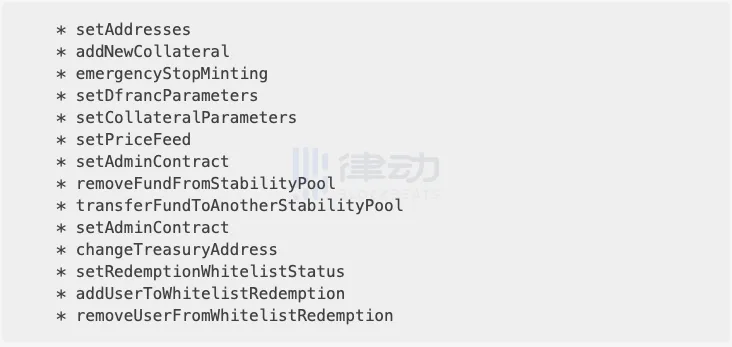
In addition, AdminContract has the right to upgrade multiple contracts without community consensus, including SortedTroves, StabilityPool, StabilityPoolManager, and TroveManager. This opens up the possibility for an attacker to change the contract implementation and bleed the Token.
MOT - 01 | initialTokenDistribution (mitigated): Another major issue in the centralization/privileged risk category involves sending MON to the _treasurySig address when the contract is deployed. This means that MON can be assigned without community consensus. To mitigate this risk, the team has documented their Token economics and how MON is allocated.
GLOBAL - 02 | insufficient storage space (resolved): Multiple contracts are scalable, including AdminContract, StabilityPoolManager, and TroveManager. This means that there needs to be a storage gap to allow new states to be added without compromising existing deployments. In response, CertiK's report noted that the team had revised the design and opted for a non-upgradable contract. Although non-upgradable contracts protect against future changes that might affect the protocol, the system still has the option to update. Protocol owners can still add NewCollateral via AdminContract, or they can update the parameters via DFrancParameters contract.
DPK - 01 | insufficient input validation (solve): In the dfrancParameters contract, the setMCR() and setCCR() functions have a small contract risk of causing the user's MCR to be greater than the CCR, which would essentially prevent the recovery mode from being activated. This is not changed in the deployed code.
Audit recommendation
The team followed CertiK's recommendation, assigning privileged roles to the multi-sign wallet and transitioning to the DAO governance/voting module. The Vault Multi Sign and Protocol Owner Multi Sign (control AdminContract) addresses can be found here and here.
CertiK also recommends implementing a time-lock contract with a 48-hour delay for privileged operations. The team has considered this, but has opted not to surrender ownership to a time-lock contract for now, in order to maintain flexibility. The permanent solution could be to relinquish ownership or remove the ability of the owner role to affect the mortgaged assets from the stability pool, transfer funds, change the lock-up period, or change the AdminContract. This would bring DCHF's trust assumptions in line with Liquity, but would sacrifice flexibility, since new mortgage types and price predictors cannot be changed.
Another solution is to introduce fully chain-based governance, controlled by the Token holder's DAO. The transition to the DAO is still in its early stages of development, with very limited community activities outside of the team. Questions may be raised about the fairness of the MON allocation, given the overlap between core Treasury multiple signers and Grizzly.Fi airdrop recipients. The team has set up a multi-sign proxy address and transferred ownership of the AdminContract to that address, providing transparency (proof of transfer) to users regarding Token allocation. This provides a reference to help users check if MON is assigned as advertised.
Centralization and custodial risk
The 4/6 multi-signature ownership of the AdminContract (and all associated system contracts) gives it extensive control over key protocol functions, raising concerns about escrow risk. The team chose a non-upgradable contract, which means that owner multiple signers must add new collateral via AdminContract or update existing collateral parameters via DFrancParameters contract. The multiple signature can:
Although the centralization risks identified in the audit have been mitigated to some extent, the core team still has plenty of prerogatives to exercise.
The team has expanded the multiple signature threshold from 3/6 to 4/6 and added Curve team members (Mimaklas). They also transitioned to the DAO, which is still in early development. For now, the core team is still necessary for the effective operation of the DAO.
To reduce the risk of hosting, the recommended next step is to transfer ownership of all features that are not time-bound to a time-lock contract. Multiple signatures without time locks should be reserved for emergency operations (suspend MON pledge/suspend DCHF casting). The long-term goal should be to fully adopt on-chain governance or choose to minimize governance by relinquishing ownership of the relevant contracts. An access control list of system contracts is compiled on this Google form.
Control risk
Here is an overview of important MON holders:


Grizzly.Fi hatched DeFi franc and Moneta DAO. The team and advisers were allocated 10% of the tokens (10 million MON), while Grizzly.Fi was given $1M of assets (9174,312 MON) to fund preparation (source).
There are two entities in the Moneta DAO governance: Token House and Delegate House. As discussed above, Moneta DAO Token holders will vote on strategic protocol decisions, including allocation of DAO Vault funds, key risk parameters, and protocol escalation. However, in the early stages of development, it was apparent that there was a lack of a clear process for prominent community members to take on representative and licensed roles within the DAO.
In addition, the allocation of MON takes place prior to the formation of DAOs, without community involvement. Given that there is no clear representation process, we can assume that the current Treasury multiple signers and agreement owner agents are the actual representatives. Although the representative carries out the wishes of the Token holder, the relationship is non-binding and trust-based.
While Token holders will have a voice in strategic agreement decisions, the scope of governance remains uncertain. Clear governance processes and clear communication of representative plans would be helpful.
Predictor risk
DCHF uses Chainlink as its pricing provider. Chainlink is a highly regarded provider of seers, although DCHF doesn't have a backup seer. The fetchPrice function includes a soundness check that allows a maximum deviation of 50% between updates that would otherwise have accepted the last good price. CHF may be priced inaccurately due to malfunctions of the predictive machine. This can have a negative impact on the liquidation and redemption mechanisms and ultimately lead to potential loss of funds.
Liquity, by contrast, uses Chainlink as its primary predictor and Tellor as a backup. If the primary predictor fails to update or produces a value outside the range of the specified guardrail, it will algorithmically reject the primary predictor. This strategy is designed to ensure that price offers can autonomously respond to black Swan events without manual intervention. On the other hand, DCHF policies may require more active monitoring and manual updating in case the predictor fails.
Decoupling risk
The DeFi franc Agreement currently has 6,694,401 DCHFS issued with a value of $1.15 for a total value of approximately $7.6 million and holds approximately $17 million in collateral (a combination of ETH and wBTC). Redemptions are backed by sufficient collateral.


To control the supply of DCHFS, the agreement uses borrowing and redemption charges. With 110 per cent collateral providing a floor and ceiling, arbitrageurs have an incentive to keep prices stable. The agreement does not rely on external AMMs for supply expansion or contraction, and the burn/draw amount is executed through the onchain peg mechanism.
As a Liquity fork - a stablecoin that has stood the test - bankruptcy risk is low for now. Liquity does, however, have long periods of unanchoring. History of $1. By maximizing decentralization, it sacrifices scalability and tends to have significantly different soft anchoring than centralized stablecoins.
The collateral chosen by Moneta (ETH/WBTC) is also quite conservative. We believe the biggest risk to depeg going forward is the possibility of mismanagement of governance. If a low-quality collateral type is added to the agreement (for example, Token MON, the local governance of the agreement, or a complex derivative asset), this may increase the chance of failure or manipulation of the underlying collateral, causing the system to fail, and thus decoupling.
Users (borrowers) should keep in mind external factors, such as currency exchange rate risks in traditional financial markets. DeFi reflects a lag in this price change, taking into account the depreciation of the Swiss franc against the US dollar. In the case of the de-anchoring of the DCHF to the CHF, assuming that the borrower converts the funds into dollars after borrowing, then the premise of the re-anchoring assumption is destroyed and the borrower has the opportunity to repay the loan at a cheaper rate. In the other case, when the DCHF is unanchored by more than CHF 1 (but less than CHF 1.10), the situation is different. Since there is no direct arbitrage of DCHF and CHF to balance anchoring in this case, the only dynamic that could cause DCHF to re-anchor back to 1 is the need to supply DCHF to DeFi.
LlamaRisk evaluation criteria
Centralizing factor
1. Is it possible for a single entity to defraud its users?
Risk is reduced by transferring ownership privileges to multiple signatures. Currently, the multi-signature has four signer Settings, including members of the Curve team. But the multi-signer may still take actions that affect users' funds.
2. Can the project continue if the team disappears?
The protocol can work in the absence of the team, but will not be able to update systems or respond to emergencies. Despite the recent launch of DAOs, there is still no direct way to give Token holders direct control over the protocol.
Economic factor
1. Does the viability of the project depend on additional incentives?
The protocol relies on its own incentives to drive liquidity to its stability pool and DEX such as Curve. It does not depend on incentives other than as a guiding tool.
2. If the demand drops to 0 tomorrow, can all users get compensation?
Yes, about $17 million of ETH and wBTC collateral backed $7.6 million of DCHF value. Users can redeem their savings tomorrow.
Safety factor
1. Did the audit reveal any worrying signs?
The audit did not find any critical issues, but flagged a number of significant issues that were partially or fully addressed. The main problem is the excessive authority of the AdminContract, which has been transferred to multi-signers. Although the DCHF protocol uses non-upgradable contracts, it does have a way to update the system through AdminContract or parameters through the DFrancParameters contract.
Risk panel recommendation
We have three recommendations that will benefit the DCHF ecosystem and community:
1. Update the documentation to clarify the strategic role of the MON holder in governing the DCHF agreement
2. Clarify the perks/permissions that Vault/Protocol multi-signatures continue to have in all relevant system contracts, and provide a clear roadmap for decentralization.
3. Create a policy for acceptable forms of collateral and a process for adding collateral types that the Moneta DAO is willing to support.
Overall, we believe that the decentralization challenges faced by the Moneta DAO are typical for the early stages of DeFi protocol deployment. While there are certainly risks and uncertainties, we think their team has done their best to allay those concerns. We hope they will continue to exercise good judgment and be cautious when adding any new types of collateral. We support the team's proposal to add Curve gauge to the DCHF/3CRV pool.
Original link
Welcome to join the official BlockBeats community:
Telegram Subscription Group: https://t.me/theblockbeats
Telegram Discussion Group: https://t.me/BlockBeats_App
Official Twitter Account: https://twitter.com/BlockBeatsAsia

 Related Articles