Take stock of the 12 DeFi projects in Polygon zkEVM Ecology
原文标题:《 盘点Polygon zkEVM生态12个DeFi项目 》
原文来源: Foresight News
At the end of March, Polygon launched a new product called Polygon. The Beta version of the mainnet is officially released. Polygon zkEVM is a Layer2 Rollup solution, The three main components are the Trusted Sequencer, the Trusted Aggregator, and the Consensus Contract deployed on Layer1.
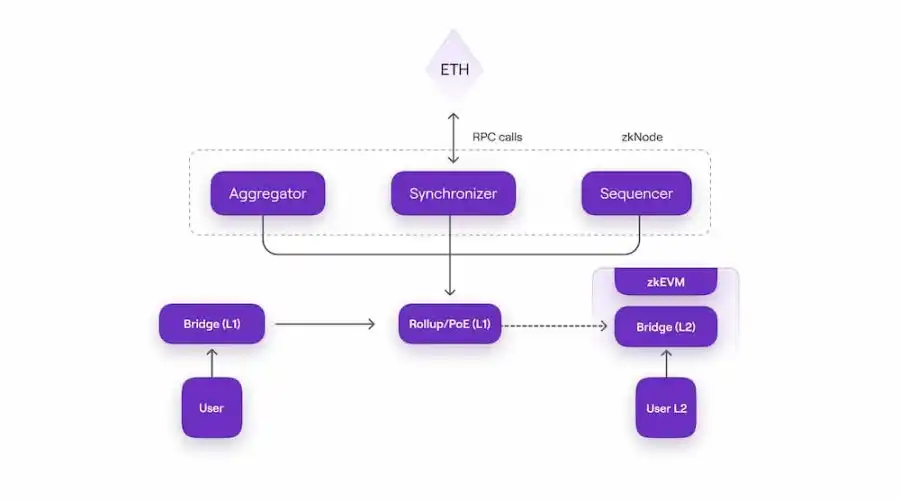
Here, the trusted sequencer component is responsible for receiving Layer2 transactions, sorting and generating batches, and then submitting them sequentially to the storage slots of the consensus contract. A trusted sequencer executing a batch transaction also broadcasts the transaction to the Layer2 network node; The trusted aggregator component calculates the Layer2 state based on the Layer2 transaction batch of the sequencer, takes the batch committed to Layer2 by the trusted sequencer, and generates a zero-knowledge proof to prove the computational integrity of the batch. The logic of the consensus contract verifies the zero-knowledge proof, which verifies the correct execution of the transaction batch, enabling zkEVM to inherit Layer1 security.
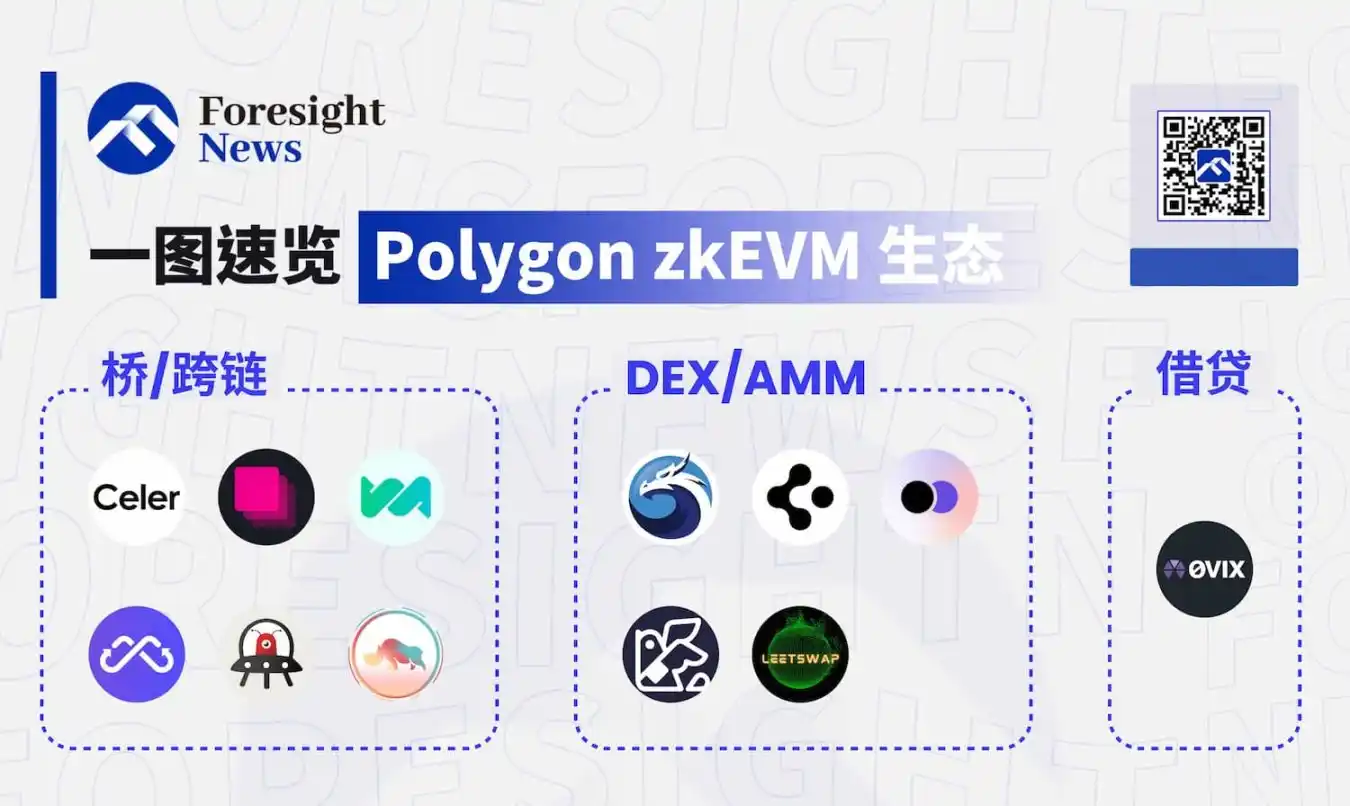
Foresight News has compiled a list of the 12 DeFi projects online in Polygon zkEVM. More than three weeks after the mainnet went online, protocols including cross-chain and DEX have been launched. In addition to the expanded projects, most DeFi projects are still at a very early stage (users are advised to participate cautiously), and rarely touch the fields of NFT, metauniverse, games, lending and so on. Considering that Polygon is already relatively ecologically prosperous, more ecological projects need to be built in the future.
Bridge/span chain
Currently, the Polygon official bridge supports only bridging from Ethereum to Polygon zkEVM or withdrawing from Polygon Zkevm. The supported assets include ETH, MATIC, USDC, USDT, DAI, and Aave. In addition to the official Polygon bridge, cross-chain/multi-chain protocols that support Polygon zkEVM include:
Celer Network
Celer Network announced its cBridge for asset bridging on April 20; Has integrated Polygon zkEVM, originally supported in Polygon zkEVM Bridges ETH chains with Ethereum, Arbitrum, Optimism with BNB Chain, Polygon, Avalanche, and Fantom.
Layerswap
LayerSwap helps transfer user assets from CEX to Layer 2. Layerswap supports asset transfer between Polygon zkEVM and Polygon zkEVM, as well as cross-chain transfer between Polygon ZkevM and other mainstream public chains or networks.
Multichain
Cross-chain protocol Multichain already supports cross-chain transfer between Polygon zkEVM and other networks, but at the time of writing, the capital pool size on Polygon zkEVM is only 0.3585 ETH.
Meson
Meson Is a stablecoin cross-chain transaction protocol that currently supports cross-chain transfer of assets on 16 chains/networks, including Ethereum and Polygon zkEVM.
In August 2022, Meson closed a $4 million funding round led by GSRV, BAI Capital, Plug and Play, Mirana Ventures, M77 Ventures, SNZ, A& T Capital, Smrti Lab and other investment.
Orbiter Finance
Layer2 Span Rollup Bridge Orbiter Finance At the end of March, it began to support cross-chain ETH between Ethereum, Arbitrum, zkSync, Optimism and Polygon zkEVM networks.
rhino.fi
rhino.fi, formerly DeversiFi (previously positioned as a Layer2 decentralized trading platform), announced its rebranding as rhino.fi and transformation into a multi-chain DeFi aggregator in July 2022. Polygon zkEVM was also supported as a bridge in early April.
DEX/AMM
Quickswap
Quickswap is a native DEX protocol on Polygon. Polygon zkEVM is also available. According to statistics compiled by DefiLlama for the eight Polygon zkEVM protocols that went live, Quickswap's lock-in volume is currently $1.16 million, accounting for 57% of Polygon zkEVM's total lock-in volume.
Uniswap
In mid-April, the vote on the chain "Start Uniswap V3 on Polygon zkEVM" has now passed.
Antfarm Finance
Antfarm Finance is a multi-link DEX pool optimizer that is currently online in Ethereum, Arbitrum, and Polygon zkEVM. Antfarm Finance offers a variety of fee options when creating and joining a liquidity pool, including 1%, 10%, 25%, 50% and 100%. There may be some arbitrage opportunities if the fee is high, but the slippery point should be noted.
Antfarm's utility token ATF is used to pay for the conversion, with 85% shared by the liquidity provider and 15% destroyed in any conversion. Antfarm also has a governance token, AGT, which allows holders to participate in the decision-making process. Antfarm's official website does not disclose the background information of the team, so it is recommended to participate with caution.
D8X
D8X is an institutional level decentralized perpetual contract trading protocol on Polygon zkEVM, currently available on the Polygon test network. The collateral assets are USDC or MATIC. The order types are market and current orders, and AMM is the counterparty in each transaction.
In terms of fees, D8X charges three kinds of fees. Transaction fees are used to maintain the operation of the project, limit order and settlement. Since the third party executes the order, the third party will pay certain fees. The clearing fee is 2% of the size of the position to be cleared, the liquidator earns 50% of the total clearing fee, and the other 50% of the fee is paid to the trading agreement.
DoveSwap
Launched by decentralized policy vault management Protocol Dovish Finance (Set Protocol fork), DoveSwap is a native AMM protocol on Polygon zkEVM with a current total TVL of only $78,000. DoveSwap will announce the launch of the governance token DOV this week. Interested users can check out the economics of tokens. DoveSwap V3 uses a centralized liquidity approach to help users improve capital efficiency. The official website of Dovish Finance does not disclose the background information of the team.
LeetSwap
LeetSwap is a DEX protocol built on Canto and Polygon zkEVM. LeetSwap V1 DEX A project built during the Canto Hackathon in November 2022 with zero transaction fees for transaction pairs in V1. LeetSwap V2 LeetSwap V2 was built during the Canto Hackathon in February 2023. The LeetSwap contract forked from Solidly with some optimizations such as full support for transfer fee tokens, dynamic transaction fees, and optional protocol fees.
Borrowing and borrowing
0VIX
0VIX is a lending protocol on Polygon and Polygon zkEVM that provides a lending market for multiple assets. In addition, the deposited assets can be used as collateral, allowing the user to borrow other assets, and the interest earned through the deposit can offset the accumulated interest rate on the borrowing.
0VIX advisers include Keno, a former core developer at Sushiswap, Sameep Singhania, a core contributor at QuickSwap, Polygon DeFi and Hamzah Khan, head of Growth, Chief Information Security Officer at Polygon Labs Mudit Gupta et al.
According to the official website, 0VIX currently has a supply of $9.07 million on Polygon PoS with a total borrowings of $3.1 million and a supply of $1.22 million on Polygon zkEVM with a total borrowings of $570,000. https://twitter.com/0vixProtocol
Aave
The Aave community's ARFC proposal on "Deploying the MVP version of Aave V3 on the main zkEVM network" was approved by the community at the end of March, but the formal proposal has yet to be released.
Original link
Welcome to join the official BlockBeats community:
Telegram Subscription Group: https://t.me/theblockbeats
Telegram Discussion Group: https://t.me/BlockBeats_App
Official Twitter Account: https://twitter.com/BlockBeatsAsia