Iron Fish main net coming: half of the address is anti-witch, its airdrop rules are reasonable?
Original title: "Iron Fish main Net Coming: Half of the address is anti-witch, its air drop rules are reasonable?"
Original source: ChainCatcher
Iron Fish, A privacy project named after the World War II encryption transmission "submarine," is valued at $190 million after a $27.7 million Series A funding round led by a16z. The project will go live on the mainnet at 24:00 Beijing time, and will officially drop tokens to early users tomorrow.
Iron Fish was originally scheduled to go live on the mainnet last month, but officials explained the delay as a result of a bug that needed to be fixed and to give early adopters more time to complete the KYC process. Currently, whitelisted users who successfully KYC can view the rewards. To celebrate the Mainnet launch, Iron Fish will also be hosting a commemorative event on Discord on April 20 at 23:30.
With a strict KYC program in place, Iron Fish Airdrop has reignited the debate over how to motivate early adopters and limit witches. Last night, Iron Fish announced the results of the review: A total of 171,891 users earned points during the beta network, 82,871 users were eligible, and 89,019 accounts (52%) were disabled.
In addition, whether the value of the airdrop covers the cost of early testing is also a key point of discussion among Iron Fish users. According to the financing data, it can be calculated that the cost of a16z, Sequoia Capital and other participating institutions is about $4.50, while the current over-the-counter trading price is about $20. This article will revisit Iron Fish's history, the economics of tokens, and discuss its airdrop program.
Development course
Elena Nadolinski, founder of Iron Fish, is a remarkable woman from Russia. Her upbringing led her to a vision of fighting government surveillance. Eventually Nadolinski found a solution in blockchain technology. Elena Nadolinski developed the original version of Iron Fish in 2018 using the Sapling protocol developed by Zcash. The public chain uses the PoW consensus mechanism and zero-knowledge proof, so that the transaction information, mining information, wallet information in the network is hidden, except for the private key owner, any second party can not see.
The Iron Fish Incentive Test Network will run in three phases from December 2021 to February 2023. The goal of Phase 1 is to invite miners, develop the community, and test the basic building blocks of Iron Fish. The goal of Phase 2 is to stress test the system by encouraging transactions and node uptime. The goal of Phase 3 will be to stress test the multi-asset functionality.

Data source: official Iron Fish blog
Statistically, Iron Fish test node participants are increasingly hot. When it comes to the Phase 3 test network, the number of community members has doubled, but the number of participants with points has increased by 15 times, and the number of managed nodes has also increased by 20 times.
The future Iron Fish networking layer will support WebRTC and WebSockets, which means users can run full Iron Fish nodes directly from a browser. Instead, Iron Fish has taken the Roadmap section off its website. Jason, Iron Fish's Discord community manager, said the move was prompted by U.S. regulations that prohibit it from creating public roadmaps. Jason adds, "The current Iron Fish roadmap is focused on launching Mainnet, and for projects that launch publicly on Mainnet, there will be some changes in the way we approach project planning."
Token economics
The Genesis block of Iron Fish contains 42 million tokens, with 20 tokens per block mined after Mainnet went live. Assuming a block time of 60 seconds, the Iron Fish network would have 525,600 blocks per year, and the total supply would need to be calculated using the formula of attenuation coefficient and year.
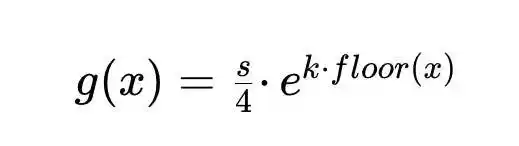
After the first year, the total amount of new coins generated by the mining incentive will be 10.5 million, a quarter of the Genesis amount. After that, the number of coins created each year will gradually decrease until the final supply of 256,970,400 is reached (about 150 years after creation).
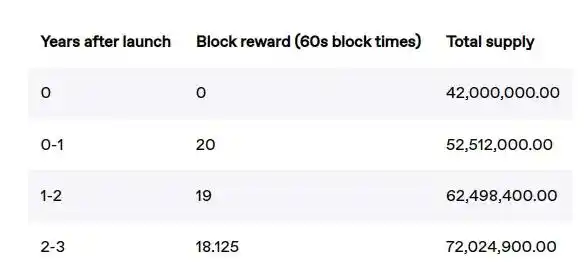
Block awards and total supply for Iron Fish over the next 3 years
Unlike most proof-of-equity based Layer1s, Iron Fish experienced aggressive inflation in the first few years, and as a result, most of the token supply would be transferred more quickly to miners and other community members. Over time, most of the tokens will end up in the hands of miners and other community members.
For the 42 million tokens issued by the founding, investors, team members and advisers will be locked in their shares for 12 months before entering a 12-month unlock period. The specific distribution is as follows:
Iron Fish Foundation - 18% (7,560,000 pieces)
Test net airdrop -- 2.25% (945,000 pieces)
Future Airdrops - 2.25% (945,000 pieces)
Pre-seed Rounds -- 5.1%(2,142,000)
Seed Rounds -- 9.9%(4,158,000)
Series A Financing -- 14.5% (6,090,000 pieces)
Consultant -- 0.6% (252,000 pieces)
Core Team -- 37.4% (15,708,000)
IF Labs -- 5% (2,100,000 pieces)
Future Contribution - 5% (2,100,000 pieces)
Airdrop program
When Iron Fish goes live on the mainnet, 945,000 tokens will be dropped to early test net users. The number of tokens dropped for each test phase is shown below:
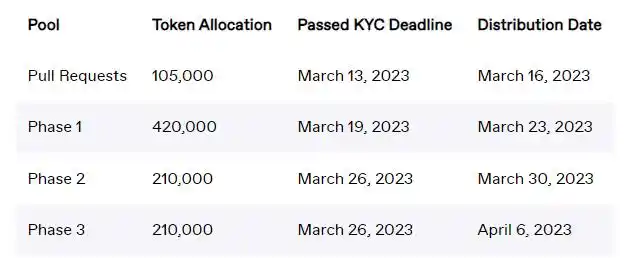
Distinguishing between true early adopters and fleecers is a short-term challenge for Iron Fish. Iron Fish sends e-mails and launches a query website to eligible users. After receiving the notification, users are required to complete the KYC process, and each user is limited to one exchange of Beta reward tokens.
In addition to the KYC process, Iron Fish will also conduct an internal witch screening and approval process. On March 9, the official team announced in Discord that 97,281 (57%) accounts had been banned, 171,891 users had earned credits, and more accounts were expected to fail KYC and be further filtered. Additionally, some users are having problems with the KYC process, but Iron Fish allows multiple KYC submissions, as well as Discord's own KYC channel. Finally, Iron Fish announced the results of its KYC review on April 20:

These airdrop regulations have been widely discussed in the community. In the world of decentralized encryption, KYC has long been an unpopular solution for users, according to Iron Fish's blog Why KYC? "Explained that due to regulatory uncertainty under U.S. securities laws, Iron Fish was unable to send tokens to U.S. citizens and was therefore obligated to perform KYC procedures for airdrop activities.
The fiercest opposition comes from the harsh screening conditions, which seem to have "accidentally injured" some of the real early adopters as the Wool Party tries to disrupt them. On Iron Fish's Discord community, some users expressed dissatisfaction with Iron Fish's screening of participants in the Phase 1 and Phase 2 test nets. They pointed out that the users who participated in the test spent real money, and even repeated "Graffiti" cost time and money. In fact, a few users accused the authorities of banning the witches at an earlier stage, rather than "sneaking" early computing power and then burning the Bridges.
According to Tokenomics, Iron Fish will also air drop 9.45 million tokens in the future for community incentives and development. The tokens are currently held by the Iron Fish Foundation, and there are no details about what such an airdrop would look like.
conclusion
Airdrop is a native Web3 marketing strategy, but at this stage there seems to be an "unspoken rule" : investors need "robust" operational data, and project parties use airdrop PUA wool party to help them increase volume. After the project went live, multiple parties made a lot of money, and the risk was passed on to unsuspecting retail investors. Examples of airdrops such as Uniswap, Blur, and Optimism demonstrate that effective airdrops are still an area worth exploring in the crypto industry.
As regulation is putting greater compliance pressure on the crypto space, Iron Fish will still face considerable challenges when it goes live. Privacy coins are a must-have tool for hackers. In some notorious cases, Monero is used to hijack browser mining and extortion payments, while North Korean hackers use Tornado Cash for money laundering, among others. As a result, cryptocurrencies on the privacy circuit have experienced multiple rounds of "takedown waves," and how Elena Nadolinski faces the chilling effect of strong regulation deserves more attention from the crypto community.
Original link
Welcome to join the official BlockBeats community:
Telegram Subscription Group: https://t.me/theblockbeats
Telegram Discussion Group: https://t.me/BlockBeats_App
Official Twitter Account: https://twitter.com/BlockBeatsAsia

 Related Articles