Ethereum is gearing up for the Cancun upgrade, and the Layer2 expansion will really explode
Original title: Cancun Upgrades -- Layer2 Rollup Is Ready to explode.
原文来源: Marsbit
Directory
Introduction
Cancun Upgrade
The Path to Ethereum's expansion
Capacity expansion outside Ethereum: L2 Rollup
Expansion within Ethereum: L1 Sharding
EIP-4844
A profound influence
Layer2 Rollup is going to really explode.
summarize
Introduction
The long-awaited Shanghai and Capella upgrades have been successfully completed: Finally ready to withdraw! This is another big step in the Ethereum blockchain's successful transition from POW to POS last year. So what's the next step along the Ethereum roadmap?
Cancun upgrade
Following the usual practice of using devcon city names for upgrades, the next upgrade for Ethereum will be cancun. Also available on Ethereum github, "cancun.md" has been created and maintained.
In fact, the Ethereum Shanghai update was originally considered to include other improvements, such as the "proto-danksharding" improvement proposal EIP-4844, in addition to the understanding that the pledge can be used to withdraw money. However, in order to reduce delays, at the core developer conference last December, the core Ethereum developers agreed that the Shanghai upgrade would mainly include withdrawals, a small amount of EOF, etc., as long as withdrawals were not delayed. And "EIP-4844," which was delayed in the Shanghai upgrade, will be the center of Ethereum's next upgrade, "Cancun Upgrade."
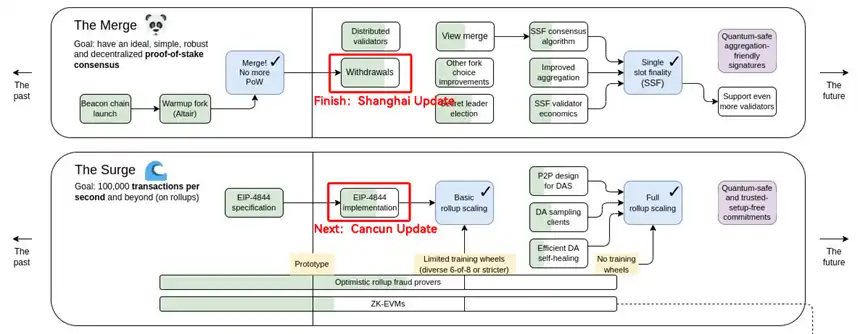
Source: Ethereum Roadmap
Currently, the Cancun upgrade, in addition to the confirmed inclusion of IP-4844, has a number of other EIP under consideration.
Ethereum's path to expansion
In 2022, Aptos, Sui and other new public chains announced to build high-performance public chains beyond Ethereum TPS, which brought great pressure to the Ethereum community. Ethereum has long been plagued, and often mocked, by high gas costs due to lack of scalability. Therefore, whether from the outside competitive pressure, as well as internal user experience, the expansion of Ethereum is forced.
With the further upgrade and development of Ethereum, there are two main expansion directions at present:
1. Use Layer2 for capacity expansion, the current mainstream is rolllups, which batches transactions together and sends the transaction output back to Ethereum, which allows Ethereum to verify the correctness without processing the transaction. Rollup is divided into two kinds: one is zkRollup, which adopts zero-knowledge proof; One is Optimistic Rollup, which uses fraud proof. (PS: Layer2 also had status channels, side chains, and Plasma in the past, but they're all dying off.)
2. Sharding expansion is used in Layer1, which is implemented in three steps: Pro-Danksharding (IP-4844), proposer-builder separation (PBS) and complete sharding (Danksharding).
In these two directions, one is to expand down the chain from the execution level, and the other is to expand up the chain from the data perspective. These two directions are not independent and parallel, but complement each other. In other words, Ethereum L1's shard expansion is designed to lower the cost of Layer2 Rollup.
Capacity expansion outside Ethereum: L2 Rollup
Rollup, as the name implies, is to bundle a bunch of transactions, put them outside the Ethereum main chain (L1) (L2) for execution, and then compress the execution results and transaction data and send them back to L1.
Today's Rollup transaction fees are 3-8 times cheaper than Ethereum L1 by packaging aggregate data for execution off-chain, but in fact L2's transaction fees are still significantly higher than "low cost" chains such as Solana and Polygon.
Where is the transaction cost bottleneck for Rollup?
Ethereum L1 resources are expensive (computing, storage, bandwidth, etc.), so move the execution out of L2 and use the computation on L2 and the storage on L2, so the cost of execution and state storage in L1 is naturally reduced. However, since L2 inherits security from L1, it must send its execution data back to L1 and ensure that its data is validated, which will inevitably require L1 to store the data. Therefore, sending data back to L1 storage is a major bottleneck in Rollup costs.
How to reduce Rollup's transaction costs?
When data is sent back to L1, it is stored via CallData, the argument to a smart contract function call. This CallData is the data downloaded synchronously by all L1 nodes by default. If the CallData is large or many CallData are stored in L1, the storage burden of L1 nodes is bound to be caused. Therefore, to reduce the storage cost of CallData, it has become the direction of our efforts.
To reduce the cost of data storage, there are several ways:
1. Compress data volume: Current mainstream Rollup projects are actively using different algorithms to compress data, so as to reduce transaction costs caused by large CallData data.
2. Offer cheap storage costs: Ethereum sharding (Danksharding).
3. Modularize data availability. Unified standards for data availability, reduced deployment and maintenance costs, are done by professional chains such as Celestia.
In these ways, the compression of data volume, L2 has been done, although the algorithm is different, but each has its own advantages; The latter two are still being implemented. Ethereum sharding scheme, in particular, is a new solution to the expansion problem of Ethereum L1, and also the focus of the next stage of Ethereum.
Capacity expansion within Ethereum: L1 sharding
Full sharding would greatly reduce the cost of publishing data to Ethereum L1. The basic idea is to provide cheap storage costs by scaling up temporary plug-in packets, as well as new ways to encrypt proof that validation nodes have validated a minimal subset of Rollup data, as opposed to full data commit verification.
However, the complexity of implementing a complete shard is high, and the development cycle is estimated to be planned on a yearly basis. Therefore, the implementation process of the sharding scheme is divided into three main steps in Ethereum roadmap: Pro-Danksharding (IP-4844), proposer-builder separation (PBS), and Danksharding.
The next major upgrade of Ethereum, the Cancun upgrade, will complete the first step of the L1 expansion of Ethereum. proto-danksharding, also known as EIP-4844, is the pre-sharding solution, which mainly implements the transaction type Blob in sharding and reduces the Rollup cost even lower. And precompile and so on.
EIP-4844
From the above content, we can know that CallData sent back by Rollup to L1 contains two contents: execution result of Rollup and transaction data. The result of the execution needs to be recorded in the ledger by all nodes at the L1 execution level, while the transaction data is used to verify the correctness of the Rollup operation and does not need to be executed by L1, it just needs to be available for download and review long enough. So, it doesn't have to be kept forever.
Storing Rollup transaction data permanently on L1 is expensive and unnecessary. More than 90% of the transaction costs that users pay for Rollups are due to this data storage. EIP-4844 is designed to further optimize Rollup's transaction costs.
How can Rollup costs be reduced even more?
Ip-4844 introduces a new transaction type, Blob, that provides cheap storage costs by moving the transaction data into a new temporary "blob" store in a manner similar to an external data space. Blobs exist in nodes at the consensus layer, rather than directly on the main-chain execution layer like Calldata, and bloBs do not require permanent storage and are removed from Ethereum once they are no longer needed, thus being cheaper.
Long-term storage of Rollup data can be done by third-party services that need the data, such as Rollup operators, exchanges, indexing services, and so on.
About Blob
Blobs, though introduced by IP-4844, will also be fully compatible with the format used in the final sharding. In EIP-4844, a maximum of 2 blobs are suspended per Rollup transaction, and each block contains 8 blobs to 16 blobs, approximately 1MB to 2MB. In a full sharding scenario, blobs can be further expanded to 16MB to 32MB, but only after proposer-builder separation and data availability sampling are completed.
Far-reaching influence
To sum up, we know that EIP-4844 is the first step on the road of expansion of Ethereum, and its importance and influence is no less profound than the Shanghai upgrade. Therefore, in the next upgrade of Ethereum Cancun, EIP-4844 will be promoted as the main task as soon as possible, and the completion time is estimated to be in the second half of the year.
It is expected that after the full implementation of IP-4844, the transaction costs of L2 Rollups will be reduced by an order of magnitude, even down to < $0.001, this will be a real explosion for L2 Rollups. For Ethereum, EIP-4844 is only the first step in a complete shard expansion solution, and the implementation of the first step will already significantly reduce gas costs, which will give the whole ecosystem more confidence that Ethereum will be more competitive and more promising than other public chains.
Layer2 Rollup is going to really explode
Rollup+ Danksharding is Ethereum's only de-trust extension solution in the short and medium term, and possibly in the long term. Obviously this is going to be totally good for Layer2 Rollup the whole track.
Let's get a visual sense of L2 Rollup from the data, already in the ascending channel, on the eve of the outbreak.
1. At present, the cost of L2 Rollups is one digit lower than ETH.
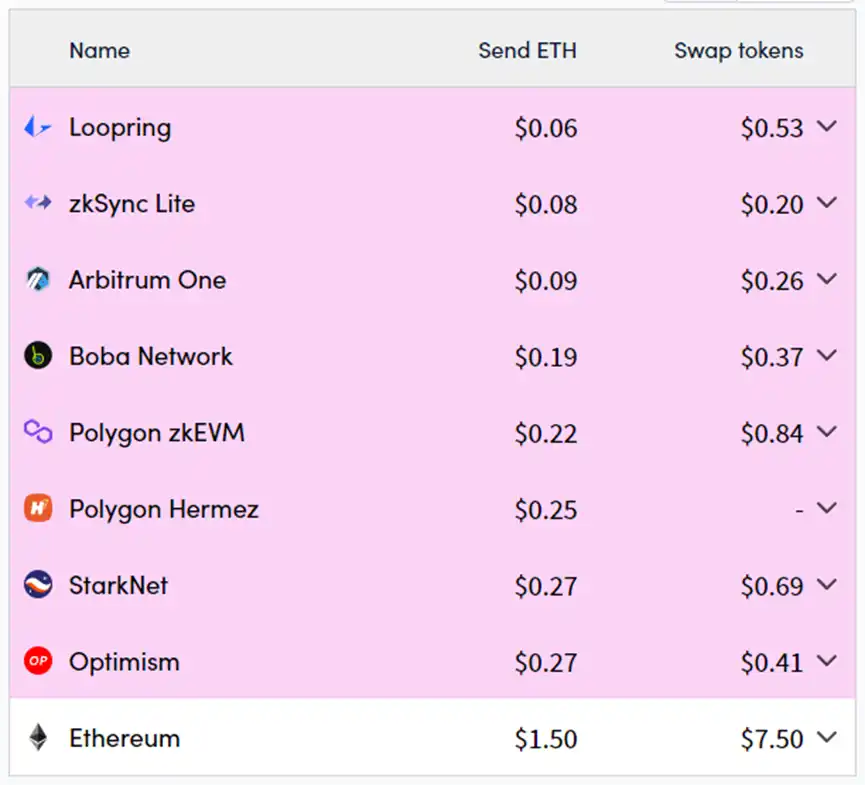
Source: L2 Fees
2. Total Value Locked (TVL) reached $10.46 billion, up 14.22% in the past 7 days.
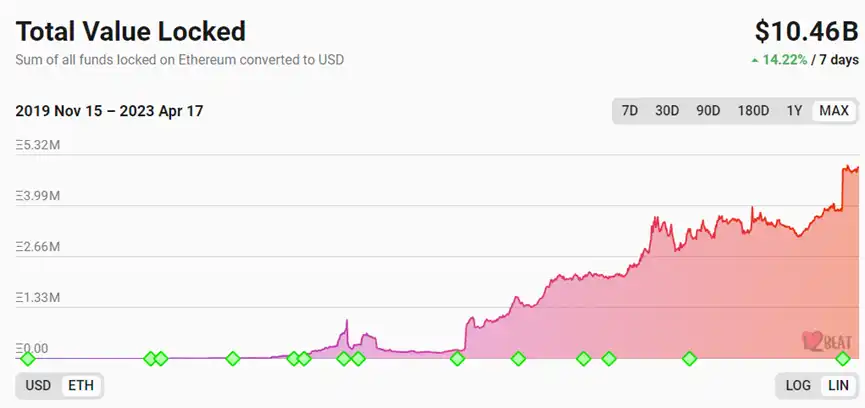
Source: l2beat
3. Top 10 items according to the proportion of total lock-up volume.

Source: l2beat
4. Transaction activity TPS per second

Source: L2beat
From the above data, it can be seen that influenced by the first-mover advantage, Arbitrum and Optimism of L2 track have occupied 87.27% of the lock share of the whole track, both of which belong to Optimism Rollup. Among them, Arbitrum One network total lock-up position is 7.06 billion dollars, monopolies the total of 66.75%, even the past 30 days of the total number of transactions has exceeded Ethereum; The total lockup volume of the Optimism network was $2.17 billion, about one-third (20.52%) of Arbitrum One. ZK Rollup's projects currently have a small market share. Overall, however, all events across the circuit are on the rise, with overall TVL up about 36% since its January '23 low.
At present, the mainstream Rollup can be divided into two directions: Optimism Rollup and ZK Rollup, among which ZK Rollup can be divided into Zksyn-based building and StarkEx building. According to the TVL data ranking of Rollup projects, the proportion of projects using OP and ZK is 1:2. ZK Rollup projects occupy a large number, but OP Rollup has a higher TVL market share.
Although OP Rollup currently occupies a major market share by virtue of its first-mover advantage, the fraud proof system of OP Rollup is currently unavailable, and users have to trust that the current system is not evil and that the state root submitted by the blockchain proposer is correct. However, under the competitive pressure of OP, ZK Rollup rushed to put on the test network, and its share is smaller at present. However, with the gradual upgrade of complete Ethereum sharding, ZK Rollup's advantage will become more obvious in the future. Of course, the realization of this depends on the solving of many technical problems, which may be measured in years.
In addition, the Rollups project ecosystem is growing exponentially, and many of Ethereum's best projects have been started and migrated to these Rollup ecosystems. Given current personal limitations, this article will not extend the analysis of Rollup ecology. Dig a hole and hear more next time.
summarize
Throughout the analysis of the full text, it is concluded that:
Public chain L1 competition, Ethereum's position will continue to be unshakeable. As the Ethereum roadmap is upgraded step by step, the Ethereum ecology will be further expanded and stabilized.
The L2 competition, which is currently Rollup's world, will not change in the short or medium term. With the Cancun upgrade approaching in the second half of the year, the whole Rollup circuit will see general growth. But we also look forward to future capacity expansion solutions better than Rollup.
Rollup's competition, short time, OP with the first mover advantage, only temporarily ahead. In the long run, ZK will likely explode when Ethereum fully shards are implemented.
Rollup project, if it is a rollup operation, focus on the projects that have not issued coins, especially those with good team background and technical strength can be given priority. If another comparison dimension is added, the projects that have been invested by star funds can be considered. If it is a secondary market operation, the project that has issued coins, although the price of tokens has risen some, but with the approaching implementation of IP-4844, the real good has not fallen to the ground, it is expected that there should be a wave of momentum, can find the opportunity to bargain.
On the other hand, the Cancun upgrade is good for the Rollup circuit, and the Rollups are inherently multi-chain running, so it's also good for cross-chain protocols like LayerZero. Modular data availability, such as Celestia, is also promising because, like Ethereum's sharding scheme, it reduces Rollup's current transaction fee bottleneck, "data storage costs".
(The above is only my personal opinion, if there are omissions welcome correction, this article does not represent any investment advice. DYOR!)
Original link
Welcome to join the official BlockBeats community:
Telegram Subscription Group: https://t.me/theblockbeats
Telegram Discussion Group: https://t.me/BlockBeats_App
Official Twitter Account: https://twitter.com/BlockBeatsAsia

 Related Articles