Early Access to Solana Saga: Is a $1000 Web3 phone worth it?
Original title: Early Access to Solana Saga: Is a $1000 Web3 Phone Worth Getting?
Source: Bai Ze Research Institute
Solana has indeed made good on its plans to build its own Web3 smartphone, the Saga - it is currently open for pre-order and will go on sale to the public on 8 May.
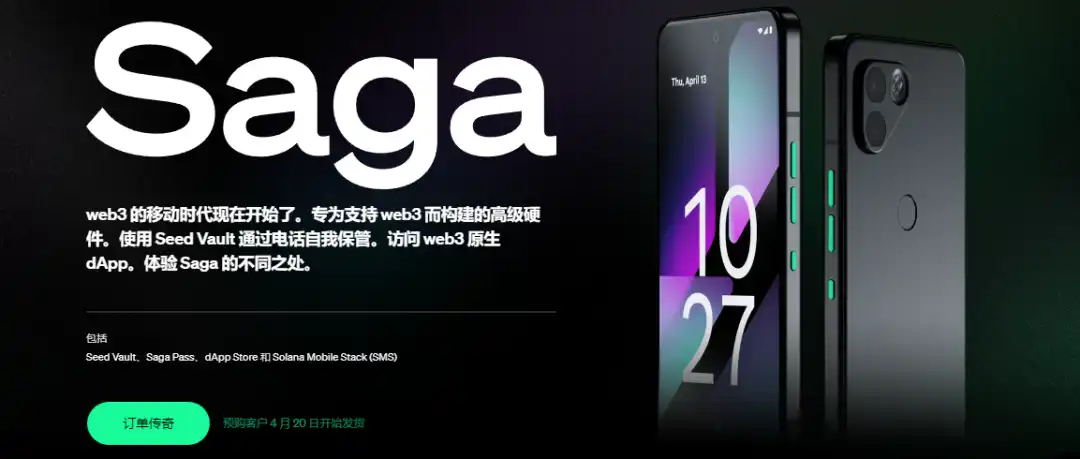
Last year, Solana Labs founder Anatoly Yakovenko called his plans to build his own Web3 smartphone a "moonshot," aiming to be a "developer experiment" that would challenge Google's and Apple's App Store rental models, fully integrate an encrypted wallet, make user interaction DApps silky, Leading the new Web3 paradigm.
Decrypt has gotten its hands on the $1,000 Android phone early over the past week -- and from our point of view, using it feels more like a Web2 device integrated with Web3 (though that makes sense).
But that doesn't stop it from being a powerful phone with a native, secure, encrypted wallet integrated and a compact, intuitive desktop. However, there are very few available DApps, and we have encountered some obstacles when interacting with them.
Using Saga now feels more like beta testing something promising and promising than it does everyday for Web3 enthusiasts. This could be a bit of a fun test for early adopters and hobbyists, a potential catalyst for developers, but it could be hard for the average consumer to swallow - Solana Labs knows this, and they don't expect Saga to sell a lot, 25,000-50,000 would be satisfactory.
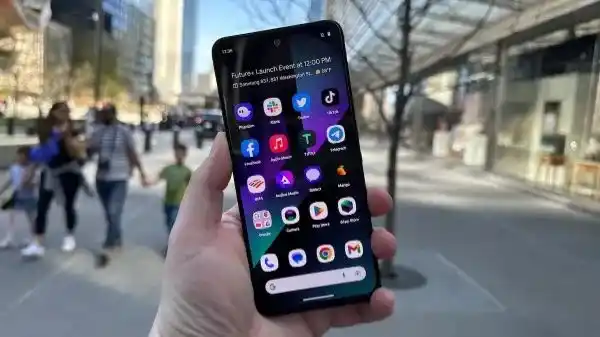
Experience appearance and specifications
As a technology reviewer and someone who uses high-end phones all the time, one of my main considerations when evaluating the pros and cons of a phone is whether I can use it on a daily basis. In other words, would I want to carry this phone in my pocket when I'm constantly being socially connected, taking photos, and working remotely?
Fortunately, Solana Saga satisfies this.
It's a premium Android phone with an attractive (but not overly flashy) design, made of sturdy materials and packed with just about everything you need for networking, office work and entertainment. Even without the Web3 element, this is a very good Android phone.
At first glance, the Saga doesn't stand out like the Samsung Galaxy S23 or iPhone 14, with few cosmetic features to help it stand out -- notably the green side buttons and triangular titanium camera module on the back.
The stainless steel frame and ceramic back are nice, even if the matte black back is littered with my fingerprints and smudges.
It's also a "Big Boy" - slightly larger and heavier than my iPhone 14 Pro Max, with a bright 6.67-inch 1080p AMOLED screen and a smooth 120Hz display. At the same time, it also comes with a powerful 4,110mAh battery, which has a very strong and reliable battery life, and also supports easy wireless charging and faster wired USB-C charging.
In use, the Saga is also very smooth and powerful, thanks to the flagship Qualcomm Snapdragon 8+ Gen1 processor and 12GB of RAM, making it easy to run games and demanding applications. However, the Gen1 chip isn't top-of-the-line: The Galaxy S23 and other new phones typically have a Gen2 chip, which gives a big performance boost.
You might not notice much of the difference now, but with more demanding apps and games coming out, Saga may be less flexible than some of its competitors in the future.
On the bright side, however, the Saga comes standard with 512GB of internal storage - which is what most people need.
It's also a dual-camera setup, with a 50-megapixel main camera and a 12-megapixel ultra-wide camera, providing sharp detail and strong colors for my daily casual shooting needs. But again, the IPhone's lens is sharper and the color balance more natural when compared to the IPhone 14 Pro Max.
In addition to the Web3 elements, Saga comes with a clean version of Android 13 (free of outdated software junk) and a full suite of Google services, including the App Store. Therefore, this phone is available on all major U.S. carriers, so you can take it with you.
Experience Web3 functionality: Web3 anytime, anywhere
That's the standard experience with the "Web2" aspect of Solana Saga -- if you're going to use it as an everyday phone, then it passes muster.
However, it is the integration of Web3 that sets Saga apart from typical smartphones and is a key reason why some would expect Saga to be the flagship product of the "Web3" standard.
On the Web3 side, Saga is built around Seed Vault, a hosting solution that protects your wallet's Seed phrases in a secure environment on your phone. Even a different Android phone can't access it, because Seed Vault is associated with your biometric signature via a fingerprint sensor.
On top of Seed Vault's ability to secure your wallet, Saga has also developed a dApps app store that, while there are currently only a dozen dApps, is smoother and easier to use than using a traditional smartphone. With a wallet like the Phantom or Solflare, you can sign Solana Web transactions more easily just by verifying your fingerprint and occasionally entering a PIN.
Since setting up a wallet on Saga is relatively simple, I converted $USDC to $SOL via the transaction aggregator Jupiter in a matter of minutes, and picked up Saga Genesis NFT and purchased other NFT's through NFT marketplace Tiexo. In addition, I took a random photo in Times Square in New York City and made it into NFT through Minty Fresh, an NFT platform.
(Note: Like the phones pre-ordered, our early access Saga came with $20 worth of $USDC and $0.01 SOL -- worth about $0.25 -- for network charges. After the play is over, Decrypt dumps the phone, any unused funds, and the bought and minted. Assets, returned to Solana Labs.)
Wallets can also be used to connect to Web-based Web3 applications through Solana's Mobile Wallet Adapter (MWA) technology. For example, at the time of writing, NFT marketplace Magic Eden's native dApp is not yet available on Saga's dApp store, but I connected to Magic Eden's website via Phantom Wallet and purchased NFT.
However, I also encountered some stumbling blocks during the experience.
I couldn't connect my wallet to the native dApp of Audius, a decentralized music streaming platform; urFeed, a decentralized social app, remained unavailable from the dApp store for days no matter how many times I clicked the button; And MWA doesn't always work, for example when I tried to connect my wallet to the Web3 game Aurory's website... There was no reaction.
Broadly speaking, while the core of a Web3 phone should only be used to send, receive, and trade cryptocurrencies, and to mint and trade NFT, I'd really like to see more of a fun and engaging Web3 experience.
For example, the Solana network has a growing Web3 gaming circuit, but the dApp Store currently has no games to play. I tried opening Solana-based games on the web, but it didn't work -- the shooter Mini Royale: Nations wouldn't load, and Aurory couldn't get me to connect my wallet.
A Solana Labs representative says that "some games" are being developed for Saga and are "coming soon."
For Web3 early adopters
Despite the errors and obstacles, it is faster and easier to transact with cryptocurrencies and NFT on Solana Saga. While the usual experience of running Dapps and trading cryptocurrencies on a phone is frustrating, Saga's user experience is certainly a step forward -- and in this respect, demonstrates Solana's ambition to launch a "Web3 native phone".
It's trying to foster a decentralized phone ecosystem that doesn't rely on big tech giants like Apple and Google and their 30 percent cut of sales from their app stores - which not only affects developers, but hampers the development of Web3 mobile apps.
It's a big shift, but it's also a big risk -- it could be costly for Solana Labs and Saga if Saga doesn't find a large enough audience to support such a mobile dapp ecosystem.
Saga sales of tens of thousands of units may not be a threat to the Web2 giants, but if it encourages developers to create mobile-native Dapps (which it probably will, since Solana Labs has launched a developer grant program for mobile-native DApps), Then maybe it will lead to more affordable competitors for the Web3 crowd -- and more compelling reasons to buy.
summarize
The $1,000 smartphone is certainly not for everyone. But Saga also doesn't emphasize the Web3 use case, which makes it an excellent product among expensive smartphones in its class. However, its integration with the Solana network as well as many Dapps is an exciting and promising turning point that could ultimately pay off for both DApps and users.
For now, though, the follow-up remains to be seen.
Original link
Welcome to join the official BlockBeats community:
Telegram Subscription Group: https://t.me/theblockbeats
Telegram Discussion Group: https://t.me/BlockBeats_App
Official Twitter Account: https://twitter.com/BlockBeatsAsia

 Related Articles