



Some numbers on the Ethereum Shanghai upgrade
The Shanghai Redemption: Ethereum's Latest Upgrade
Original article by Matas Andrade & Kyle Waters
Kxp, Blockbeats
In this issue of State of The Network, we look at the Ethereum "Shapella" upgrade, the latest milestone in the ongoing development of the Ethereum blockchain. The upgrade, scheduled for tomorrow, April 12 at 22:27 UTC, is expected to bring an important change to the Ethereum ecosystem: the introduction of the ability of verifiers to extract their pledges, which have previously been locked to the beacon chain. Shapella upgrades include the Shanghai upgrade on the Ethereum Implementation layer (EL) and the Capella upgrade, or beacon chain, on the Consensus Layer (CL). The Shapella upgrade is an important step forward for Ethereum and has been eagerly awaited by Ethereum developers, institutional investors, and critics. In this installment, we'll take a closer look at the key features and expected results of the upgrade.
The two lanes are fully open
Before diving into the mechanics, it's important to understand the broader context of this upgrade in order to understand its significance. It has been over six months since Ethereum transitioned from proof-of-work (PoW) mining to a proof-of-equity (PoS) network, a process we detailed last September. In a remarkable event in the industry's start-up history, Ethereum switched the most important part of the protocol -- its consensus mechanism -- in real time, with no downtime and no impact on millions of users and billions of dollars worth of security on the chain.
The merge process connects the existing Ethereum mainnet blockchain with another blockchain called the beacon Chain, which is specifically used to perform PoS activities. In Ethereum's PoS system, users who wish to participate in the consensus commit resources in the form of 32 ETH, which are locked or "pledged" while serving the verification network and reaching a consensus on the status of the chain when submitting new transactions. In order to provide these services, these users (called verifiers or pledgers) are rewarded with fees paid by new ETH and Ethereum traders through agreements. The verifier has an incentive to provide good service in order to maximize potential rewards, and to be held accountable for its actions through the more serious penalty of "forfeiture," which forfeits its pledge when the verifier is proven to have violated the rules of the agreement. To date, more than 18 million ETH (approximately US $35 billion) has been pledged, representing 15% of all ETH.
It should be emphasized that the beacon chain ran in parallel with the legacy PoW Ethereum chain for nearly two years prior to the merger. During this time, the user joins the active verifier collection by sending ETH to the beacon chain, effectively a one-way flow of money. These early validators have accumulated pledge rewards, some even dating back to the beacon chain's launch in December 2020. Although the merger has been a great success in phasing out mining as well as pledging, the implementation of drawdown, including pledging and incentives, remains dependent on the upcoming Shapella upgrade.
Thus, for more than two years, this upgrade has finally brought the important attribute of liquidity to the verifier, opening up a new return route for money on the beacon chain back to the Ethereum mainnet executive layer. In addition to the natural advantages of capital accessibility, validators can now greatly improve capital efficiency. Because of the specification of the beacon chain, Ethereum verifiers have no economic incentive to maintain a balance higher than 32 ETH, as the reward does not increase on the maximum effective balance of 32 ETH. As shown in the figure below, the average verifier now holds a balance of 34 ETH due to the accumulation of rewards, which a rational verifier would reduce to 32 ETH so that these rewards can be redistributed or sold.

Data source: Coin Metrics Network Data
Naturally, the potential selling pressure raises questions about the impact of unlocking on the dynamics of the multi-billion dollar pledge ecosystem and ETH market. But to understand the likely outcome, familiarity with the withdrawal mechanism is required.
Shanghai contest
Withdrawals are a key part of the Ethereum pledge process, allowing the verifier to recover the pledged funds when they are ready to stop participating in the network. The pledgee has two means of withdrawal: partial withdrawal and full withdrawal. The partial draw allows the verifier to withdraw any earned pledge rewards beyond the initial 32 ETH pledges, while still allowing them to be a verifier on the beacon chain. Full withdrawal, on the other hand, refers to the withdrawal of the entire balance, including the initial 32 ETH pledges and any rewards earned.
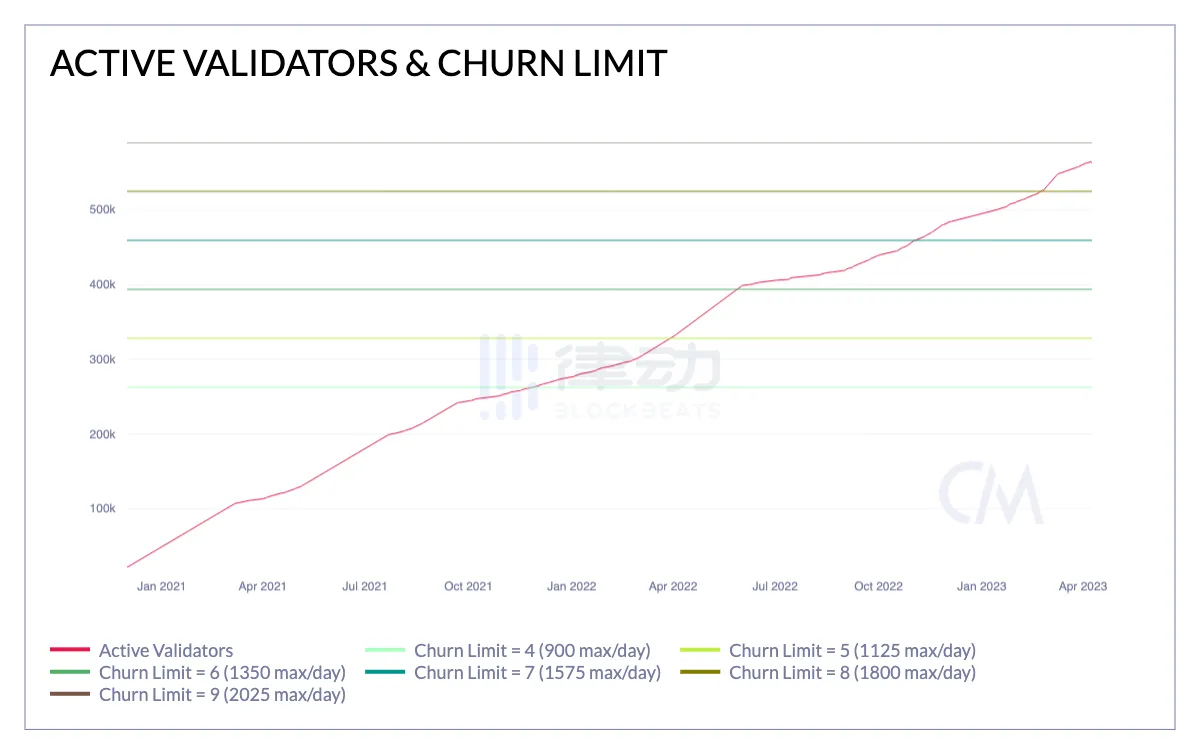
Withdrawals are subject to rate limits and the number of withdrawals is limited using queues, similar to those used to restrict new verifiers from joining the network. The queue accommodates a fixed rate of partial withdrawals, 512 per era, which allows smaller total withdrawals based on the number of active validators. The number of full withdrawals per era is determined by a parameter called "drain limit," which also specifies the number of new verifiers per era that can be added to the verifier set. At the current level of active validators (about 563,000), eight validators can exit per era, and the era duration is 6.4 minutes (225 eras per day). As a result, at current levels, up to 1,800 verifiers per day can make full withdrawals. This means that it will take a long time before the total number of active validators fluctuates significantly. Once a full withdrawal is initiated, the user is no longer considered a verifier on the beacon chain.
Data source: Coin Metrics Network Data
To initiate a partial withdrawal, the user needs to set up withdrawal credentials, which is a one-time process. Once setup is complete, some withdrawals will be made automatically in a polling manner, with each verifier scanning on average once a week. It is important to note that the withdrawal will be done as a status change without Gas fees, so it will not directly increase transaction fee pressure or clog the Ethereum block space.
The beacon chain verifier has a specific field called the withdrawal credential. This property includes the withdrawal prefix, which represents the first two bytes of the field. Currently, this value can only be set to 0x00 or 0x01. When making a deposit through the deposit facility, the withdrawal prefix is also set. A verifier with the 0x00 withdrawal address prefix cannot immediately withdraw its funds. In order for these verifiers to enable some and all withdrawals and unlock their funds after the Capella upgrade on the beacon chain occurs, they must first migrate to the 0x01 withdrawal address. As of today's release, no validators have updated their withdrawal credentials, and we will be watching closely for any developments in the upgrade process.
The impact of liquid collateral derivatives
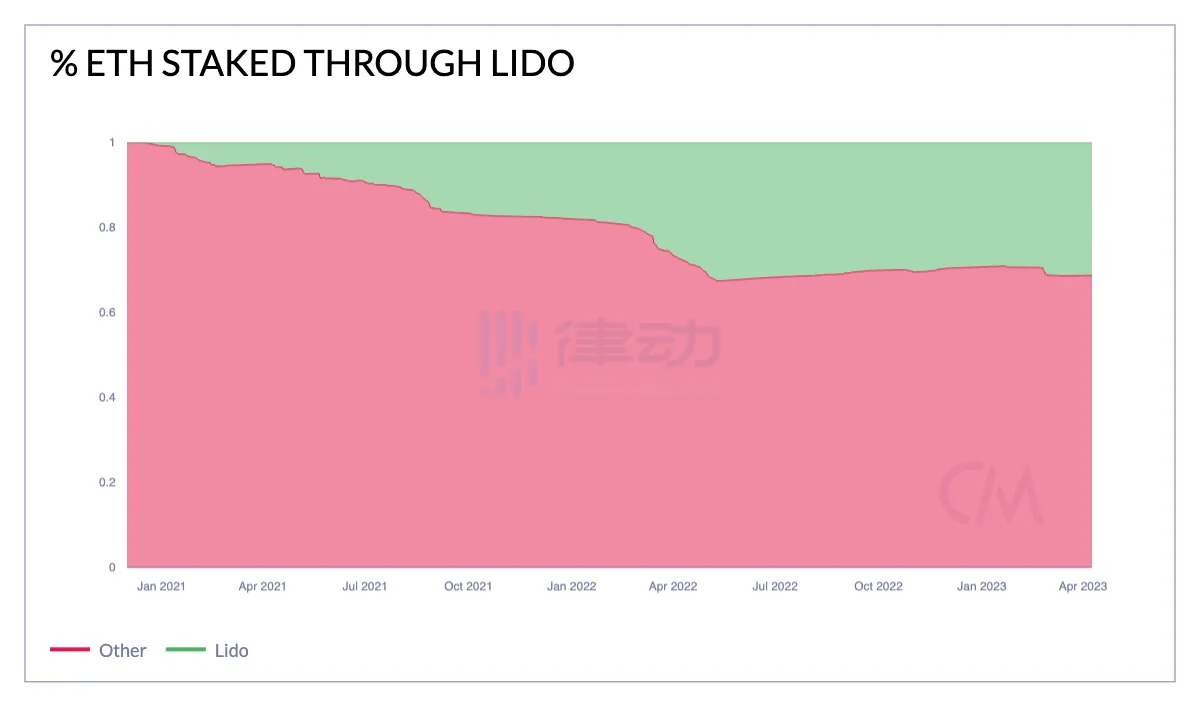
A key factor we consider in estimating drawdown is the different treatment that different mobile pledge pools may take of their respective pledge ETH. The Lido Ethereum Pledge Pool consists of 177,342 verifiers, represented by stETH, representing more than 31% of the total pledged ETH supply. Notably, Lido is expected to be delayed until May next year before it will be able to use the withdrawal function. The purpose of this was to ensure that there was enough time to add supplementary features to the agreement, including the drawdown process for their Ethereum pledge pool, and auditing their smart contracts. These features include special drawdown features to accommodate different sizes and increase Lido's resistance to potential mass forfeiture incidents, as well as other protocol improvements as part of the Lido V2 protocol upgrade. With this in mind, we should lower our expectations for some withdrawals because the validator associated with the Lido will need to wait before making a withdrawal.
Data source: Coin Metrics Network Data
Potential market impact
We can estimate the number of ETH that will be released from the beacon chain after Shapella's upgrade by calculating the balance over 32 ETH (by partial withdrawal) and the total balance of the verifier that has withdrawn or plans to withdraw (by full withdrawal).
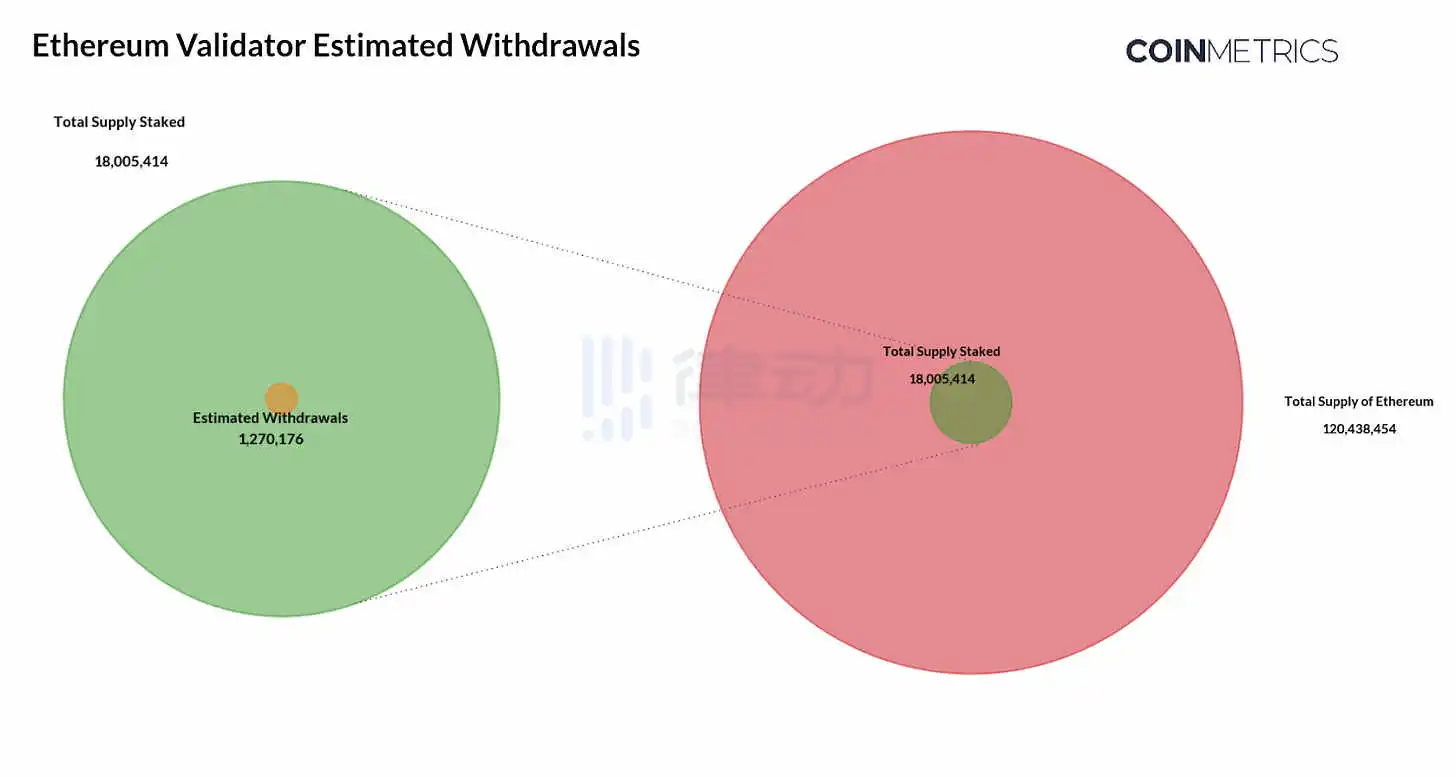
The number of ETH to be extracted by a partial draw can be estimated by assuming that the active verifier will extract a balance in excess of 32 ETH. As mentioned above, the rate of partial withdrawals is 16 withdrawals every 12 seconds, which means that if all active verifiers perform partial withdrawals on excess balances, the queue will clear after about 5 days. The amount of excess ETH held by the verifier is approximately 1,141,800.3 ETH and we can assume that these will eventually be extracted after Shapella. These ETH may be sold or re-pledged to the beacon chain.
In addition to the estimated estimates for partial withdrawals, we can also consider the number of ETH withdrawals through full withdrawals, including verifiers who have withdrawn or plan to withdraw. This includes approximately 128,375.5 ETH. This will be the verifier balance that can be withdrawn after exiting the verifier or exiting. Currently, the withdrawal rate of full verifiers is about 1,800 per day, and there are currently about 3,615 verifiers classified in this category. This means that, assuming that only inactive or currently withdrawn verifiers decide to stop pledging, inactive verifiers can withdraw their balance within a day.
Data source: Coin Metrics Labs
This analysis considers only partial withdrawals from verifiers with balances over 32 ETH and all withdrawals from non-participating verifiers. Under these assumptions, the maximum extractable limit is 1,270,176 ETH within 5 days of the opening of Shanghai. In practice, however, the actual number of ETH extracted will be much lower than this value due to delays in LIdos and the need for the verifier to update the withdrawal credentials.
There are several factors to consider regarding the need for a full withdrawal. First, if the majority of pledges are long-term ETH holders, we would not expect a high demand for the release of pledges, as long-term holders have an incentive to put their ETH to work and maintain their share of the total supply. On the other hand, it is worth noting that macroeconomic conditions have changed dramatically over the past two years, with short-term nominal interest rates rising sharply around the world. This may make the annual ETH pledge yield (currently in the 5-7% range) relatively less attractive, although as a variable rate the ETH pledge reward can rise rapidly during periods of high demand for block space.
conclusion
Although seemingly a small upgrade, the Shapella upgrade on the Ethereum network is expected to greatly improve the ability of institutions and individuals to manage their money more effectively. As a result, this may improve access to the proceeds of the pledged ETH. This development has wider implications for ETH's value proposition to institutions, including funds with a long term horizon or those with a short investment time horizon. As verifiers can now withdraw their funds in about a week's time, this opens up the possibility of achieving ETH spot price risk hedging and collecting the proceeds of the pledge during hedging.
Ethereum market participants will be closely watching the outcome of the Shapella upgrade. Successful activation of withdrawals will in some ways mark the "icing on the cake" of Ethereum's post-merger transition to proof of equity, and will be another step in Ethereum's roadmap.
Welcome to join the official BlockBeats community:
Telegram Subscription Group: https://t.me/theblockbeats
Telegram Discussion Group: https://t.me/BlockBeats_App
Official Twitter Account: https://twitter.com/BlockBeatsAsia






