Financing Weekly Selection of Week 16 in 2023: LayerZero secures 120 million financing with DWF leading the investment in Alchemy Pay.
According to BlockBeats statistics, there were a total of 30 financing deals in the 16th week of last week, with an increase in quantity. The total amount was approximately 284.35 million US dollars, and the average financing amount was 9.4783 million US dollars. Among them, infrastructure financing accounted for the majority, with relatively more financing for asset management payments and DeFi. NFT and other economic fields had a moderate amount of financing, while Metaverse/Gamefi and social/creator had fewer. The following figure shows the financing distribution of each sector last week:
Metaverse/GameFi
In the field of Metaverse/GameFi, a total of 2 financings were completed with a total amount of 6 million US dollars, accounting for 2.11% of the total financing amount last week.
Social Future
Reasons to follow: Blockchain + AI Metaverse social application with original IP.

On April 6th, Social Future, a social metaverse company based on artificial intelligence, announced the completion of a $6 million financing round. SNZ, Everest Venture Group, Folius Ventures, Y2Z Ventures, Mask Network, Tess Ventures, Stratified Capital, Mindfulness Capital and others participated in the investment, with partners including Animoca Brands, Decentraland, Metajuice, etc.
The flagship product of Social Future, "MAY", is built using blockchain and AI technology and supports both PC and mobile devices. In "MAY", users can easily generate 3D virtual world images and corresponding NFTs with just one click. They can also create their own social scenes or live broadcasts based on templates, and interact with other users through sending emojis, text, and even videos in the virtual metaverse for socializing and entertainment. The AI-generated function will be seamlessly integrated with Web2 user wallets in the future.
Social Future also has an original IP called "Three Ears Bunny", a Play To Earn metaverse game project. Currently, the project offers whitelist access through playing mini-games and participating in community activities. In the future, "Three Ears Bunny" will be integrated into "MAY" as a series of NFT-based games with a theme park format.
DegenReborn
Reasons to follow: "Life Restart Simulator" has become GameFi.

On April 6th, DegenReborn announced the completion of a strategic financing round, with P12, CyberConnect, Galxe, and Era7 participating. The native token DEGEN will be launched on Bitget Exchange on April 10th, 2023.
It is reported that DegenReborn has won awards in three well-known hackathons, Mask x Starkware, CyberConnect x BNB Chain, and ETH Denver. During its 72-hour Flash Beta period, it had a total trading volume of 395 BNB and 17,599 paid wallet addresses. In addition, the game's exclusive NFT collection "Degen2009" is now available for trading on the OpenSea platform.
The gameplay of DegenReborn is somewhat similar to "Life Restart Simulator". Players pay $BNB to enter the game and can choose three talents and allocate 10 basic attribute points at the beginning (of course, you can also purchase more powerful initial attributes). Players can earn $DEGEN in the game. The goal of the game is to use talents and attribute points to obtain higher scores and share the total prize pool. $DEGEN can be used to bet on who will be the strongest player of the season. Currently, DegenReborn has integrated with Chainlink VRF and Automation, and has partnered with industry partners such as QuestN, Element Marketplace, Lifeform, TokenPocket, Ultiverse, BitKeep, etc.
NFT/Digital Fashion
In the NFT/digital fashion field, a total of 3 financings were completed with a total amount of over 14.5 million US dollars, accounting for 5.1% of the total financing amount last week.
Ubox
Reasons for attention: Hong Kong NFT trading platform, dedicated to providing better experience for Asian users.

On April 8th, Hong Kong NFT trading platform Ubox officially launched, announcing the completion of a $7 million seed round financing with a valuation of $50 million. The round was led by C² Ventures, with participation from early investors of Huobi. The angel round funds will be used for platform preparation, technology research and development, team expansion, and platform promotion.
Ubox is a new NFT trading scene based on the perspective of Eastern culture, with the core concept of "creating your digital oasis", providing a safe, diversified, and high-value-added trading experience for digital asset enthusiasts in the Asia-Pacific region. It is reported that since Ubox opened reservations on March 29th, it has received over 300,000 user reservations.
From the official website, it appears that Ubox will provide support for multiple networks, including the Ethereum network, in the future. By combining oracle, staking, and other services, Ubox aims to improve liquidity and focus on providing better deposit and withdrawal experiences for Asian users, as well as offering Launchpad functionality.
Lore
Reasons for attention: Multicoin Capital leads the investment, with participation from Seed Club Ventures, driving the construction of NFT culture.

On April 7th, Lore, a Web3 co-ownership platform based in San Francisco, completed a strategic financing round of $4 million. The round was led by Multicoin Capital, with other investors including Seed Club Ventures, North Island Ventures, Balaji Srinivasan, Zeneca, Mischief Ventures, Sfermion, CMT Digital, Patricio Worthalter, Spice Capital, and Sublime Venture.
Lore, formerly known as Prysm, is a new platform for collective ownership and a binding narrative generated by its members. It allows communities to form smaller sub-communities and teams to produce and consume culture in the context of web3, expressing culture or profiting from it through consumption, planning, collection, and holding.
Lore provides a deeper way for communities to express their shared identity - strengthening connections and building new ones. Lore hopes that similar users can form groups around a certain atmosphere or interest, where members can connect, chat, imitate, and establish shared language, rituals, and culture, allowing communities and teams to gather resources or collect NFTs on Lore. Simply put, Lore is a tool for buying NFTs with friends, where you can form sub-communities and teams on Lore, pool funds to purchase NFTs, and develop a certain culture.
So far, Lore has raised $7.15 million. This funding will support new use cases and expand to other blockchains beyond Ethereum, starting with Polygon and Solana.
NFT/Digital Fashion field's other financing includes:
On April 4th, Web3 carbon footprint NFT platform Ecosapiens completed a $3.5 million seed round of financing, led by Collab+Currency, with participation from Celo CFO Alex Witt, former Moonbirds COO Ryan Carson, Boost VC, Slow Ventures, Menlo Ventures, and Alumni Ventures Blockchain Fund. Ecosapiens will provide a range of digital infrastructure and resources, including NFTs, carbon infrastructure, chat groups, and even a comic series, to enable individuals and businesses to easily participate, reduce their carbon footprint, use more sustainable products, and support the transition to a green economy through the community they create.
DeFi
In the DeFi field, a total of 5 financings were completed with a total amount of 42.75 million US dollars, accounting for 15.03% of the total financing amount last week.
M^ZERO
Reasons for attention: Help entities issue tokens without permission in the context of decentralized governance.
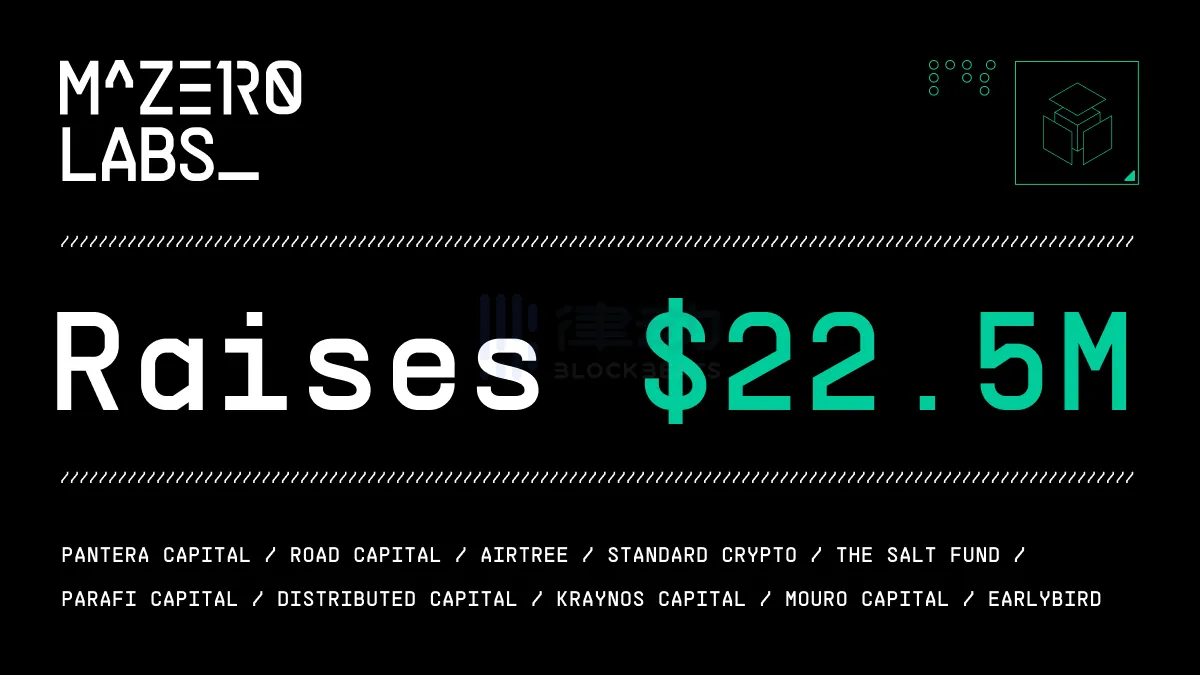
On April 5th, DeFi platform M^ZERO completed a $22.5 million seed round of financing. The round was led by Pantera Capital, with participation from Road Capital, AirTree, Standard Crypto, SALT Fund, ParaFi Capital, Distributed Capital, Kraynos Capital, Earlybird, and Mouro Capital.
Luca Prosperi, CEO of M^ZERO Labs, stated that "M^ZERO aims to achieve institutional value transfer and create a neutral infrastructure for payment flow."
Users can view M^ZERO as infrastructure coverage on Ethereum, where large asset and liquidity providers from around the world can exchange value and builders can create solutions. In addition, Luca Prosperi also stated that M^ZERO may have a governance token, but the initial distribution of this governance token may be targeted towards institutions rather than the general public.
M^ZERO aims to solve the problem of entities issuing tokens without permission in decentralized governance. Entities can set rules and terms for minting tokens, and then deposit their assets into the M^ZERO protocol to issue on-chain assets.
ThalaLaunch
Reasons for attention: Aptos is the largest native DeFi ecosystem on the chain.

On April 5th, Aptos ecosystem DeFi protocol Thala raised nearly $2.2 million through its Launchpad platform ThalaLaunch, with a trading volume exceeding $4 million. Thala had previously completed a $6 million seed round of financing last year, with Shima Capital, ParaFi Capital, and White Star Capital leading the investment.
Earlier, Aptos ecosystem DeFi protocol Thala announced that governance token THL would be released through an LBP pool from April 1st at 7:00 Beijing time to April 6th at 7:00. Up to 7% (7 million tokens) of the total THL supply will be allocated to the community. The LBP will be paired with LayerZero Circle (zUSDC), with an initial weight of 98:2 (THL/zUSDC) and a final weight of 30:70 (THL/zUSDC).
Thala's ecosystem mainly includes the native stable token $MOD, AMM Thala Swap, and Launchpad ThalaLaunch. According to data from DefiLlama, Thala's total TVL exceeds $14.5 million, making it the largest native DeFi ecosystem on the current Aptos chain.
Other financing in the DeFi field includes:
On April 3rd, Acre, a blockchain-based mortgage loan platform, announced the completion of a £6.5 million (approximately $8.05 million) seed round of financing. MGFO, Aviva, and Founders Factory participated in the investment, following a $5 million financing round in 2019. Acre platform uses blockchain technology to verify consumer and property data, providing support for mortgage loan businesses. The platform's annual mortgage loan amount has exceeded £10 billion, and the new funds will be used to expand and establish new partnerships and launch other financial products and services.
On April 5th, DeFi protocol Nibiru Chain announced that it has completed an $8.5 million seed round of financing, with a valuation of $100 million. The round was led by Tribe Capital, Republic Capital, NGC Ventures, and Original Capital. The funds raised in this round will help establish the technology stack, team, and community.
Nibiru has an automated smart contract application technology stack and aims to provide user-friendliness similar to CEX without off-chain settlement, full custody of funds, or external clearing agents.
On April 6th, Steer Protocol, a decentralized liquidity management platform, announced the completion of a $1.5 million seed round of financing, led by Druid Ventures, with participation from Republic Capital and Big Brain Holdings. Steer Protocol solves liquidity management challenges through its Concentrated Liquidity (CL) product, enabling liquidity providers to more effectively allocate funds, thereby increasing returns for traders and reducing slippage. Additionally, it helps DeFi protocol token creation by creating incentive pools, guiding liquidity, and cultivating more efficient markets.
Social/Creative Economy
There were a total of 1 funding round in the social field, with a total amount of 4.5 million US dollars, accounting for 1.58% of the total funding amount last week.
Third Summit
Reasons for attention: The "cloud computing + content creation" application in the basic creator economy.

On April 7th, Third Summit, a startup company that develops investment tools for Web3 content creators, completed a $4.5 million seed round of financing. Florida Innovation Capital (FIC) led this round of financing and has committed to investing $2.75 million. Third Summit will continue to expand its SaaS platform, Alteon.
Alteon allows creators to more easily upload, share, review, archive, and collaborate on a common platform.
Third Summit focuses on building and investing in tools that enable independent content creators, small businesses, and internal brand teams to compete with large multinational organizations and studios. Its flagship platform is Alteon.io - a SaaS platform that utilizes leading technology to help creators upload, share, store, and collaborate on content from a single, unified space.
Infrastructure
There were a total of 9 financing deals in the infrastructure sector, with a total amount of over 167.8 million US dollars, accounting for 59.01% of the total financing amount last week.
LayerZero Labs
Reasons for attention: The core is the full-chain interoperability protocol, which has always been highly regarded and has good user data. No coins have been issued yet.
On April 4th, LayerZero Labs completed a Series B funding round of $120 million with a valuation of $3 billion. Participants in the round included a16z Crypto, Christie's auction house, Sequoia Capital, Samsung Next, BOND, Circle Ventures, and OpenSea Ventures. The funds will be used for growth plans, including hiring and expanding the company's business in the Asia-Pacific region.
LayerZero's core is a fully interoperable protocol. It can be seen as a key infrastructure layer that connects any given contract on any given chain. It is a critical messaging primitive that gives a whole new dimension of cross-chain composability and functionality.
Delphi Labs
Reasons for attention: To safeguard the development of Web3 projects and promote industry growth.
On April 4th, Delphi Labs, the incubation department of Delphi Digital, completed a $13.5 million financing round with participation from Jump Crypto and others.
As of now, Delphi Labs has provided consultation and investment for every vertical field of cryptocurrency, and has helped build multiple protocols worth billions of dollars, which can help start-up protocols avoid many detours and develop towards a better direction.
Polyhedra Network
Reasons for attention: Backed by Binance Labs and Polychain, focusing on blockchain interoperability, scalability, and privacy.
On April 4th, Polyhedra Network completed a $15 million Pre-A round of financing, with Polychain Capital leading the investment and ABCDE, Sparkle Ventures, HashKey Capital, Foresight Ventures, Kucoin Ventures, NGC Ventures, and Arcane Group participating.
Polyhedra Network is a startup that provides Web3 infrastructure supported by zero-knowledge (ZK) proofs and is building a system focused on blockchain interoperability, scalability, and privacy. These systems include zkBridge, which facilitates cross-chain asset and data transfer.
Through zero-knowledge proof, zkBridge provides strong security without relying on external assumptions, and significantly reduces on-chain verification costs. It has recently launched its mainnet.
Safeheron
Reasons for attention: HashKey leads the investment and promotes the research and development of MPC technology.
On April 7th, Safeheron, a one-stop open-source self-hosting service provider, announced the completion of its Pre-A+ round of financing, led by HashKey Capital and Bixin Ventures. This round of financing is the second completed by Safeheron, following the $7 million Pre-A round of financing led by Yunqi Partners and Web3Vision in August last year. Currently, Safeheron is conducting a new round of A-round financing. The financing amount of this round will be used to promote engineering landing and technical research, including a brand new MPC algorithm, TEE hardware isolation technology, and institutional-level solutions to meet the diverse security needs of different segmented market customers.
Safeheron is an open-source and transparent digital asset self-custody service platform, established in 2019 and headquartered in Singapore. Based on secure multi-party computation (MPC) and trusted execution environment (TEE) technology, Safeheron provides institutional clients with a one-stop, comprehensive digital asset self-custody solution, enabling clients to have 100% control over private keys and asset ownership, while enhancing asset security and management efficiency.
Safeheron focuses on providing institutional clients with comprehensive self-hosted solutions based on secure multi-party computation (MPC) and trusted execution environment (TEE) technologies. With this solution, multi-device or multi-party transaction approval and signature can be achieved, effectively reducing potential security risks caused by centralized private key management, as well as eliminating single-device, single-key, or single-person verification risks. Safeheron's vision is to become the industry-leading digital asset self-hosted security infrastructure.
Satsuma
Reasons for attention: Strong investment background, blockchain data indexing platform.
On April 5th, blockchain data indexing platform Satsuma announced the completion of a $5 million seed round of financing. Initialized Capital and Archetype led this round of financing, with participation from OpenSea, Y Combinator, Homebrew, South Park Commons, and others.
Satsuma is a developer tool used to build applications on top of real-time blockchain data. Satsuma allows developers to retrieve decoded data from multiple chains, customize it according to use cases, and access it through API endpoints.
Satsuma was founded in March of last year and uses The Graph's open-source technology to query and index on-chain data. Satsuma is not a decentralized protocol, but rather a business entity that operates on a SAAS (software as a service) model. Satsuma obtains details of the blockchain data that their clients require and processes this data in the form of custom APIs. Their clients include Decentraland, Aragon, and Syndicate.
The blockchain serves as a distributed database for these products, storing the most important data. However, accessing and querying this data is difficult. Satsuma believes that this friction is a huge barrier for web3 developers, and better tools will enable widespread adoption of web3. Satsuma is founded by a team of engineers who were early employees in building the data infrastructure and products for Airtable, Heap, and Y Combinator.
Other financing in the infrastructure sector includes:
On April 5th, modular blockchain Astria completed a $5.5 million seed round of financing, with Maven 11 leading the investment and 1kx, Delphi Capital, and Figment Capital participating. The funds from this round will be used to develop its shared Sequencer network. The Sequencer is responsible for coordinating transactions on Layer2 rollup, and Astria's goal is to enable anyone to deploy their own censorship-resistant rollup without relying on a centralized Sequencer.
On April 6th, decentralized real-time communication network Huddle01 completed a $2.8 million financing round. The round was participated by Superscrypt, M31 Capital, Protocol Labs, East Ventures, Longhash Ventures, Good News Ventures, Balaji Srinivasan, Stani Kulechov, Dan Romero, and Juan Benet. With the new financing, Huddle01 plans to develop its ecosystem to support thousands of applications and launch its node network to facilitate large-scale communication and reward them with Huddle01 tokens.
On April 6th, ZK-RaaS (ZK-rollup-as-a-service) provider Opside announced the completion of a $4 million seed round of financing, led by Web3.com Ventures. The seed funding will be used to accelerate Opside's development, expand its team, and increase its operational scale. Opside has developed a universal ZK-rollups software development toolkit that allows developers to deploy their applications on Opside's Layer 3 without maintaining any infrastructure. Opside is responsible for Layer 2 consensus and data availability, ensuring that all transactions and generated data are hashed and stored on the Opside chain at Layer 2.
On April 6th, Layer 2 cross-chain computing platform Coinweb completed a $2 million financing through token sales. This round of financing was completed in the form of SAVA Investment Management purchasing 6% of the total supply of CWEB tokens. Coinweb is used to run decentralized applications on multiple different blockchains. In 2022, Coinweb released the cross-chain tokenization platform LinkMint and the native marketplace DeconX. Coinweb Labs is responsible for building third-party projects on the Coinweb protocol and incubating new projects.
数字资产管理/支付
translates to
Digital Asset Management/Payment
There were a total of 6 financing deals in the digital asset management/payment industry, with a total amount exceeding 39.4 million US dollars, accounting for 13.86% of the total financing amount last week.
KuCoin Wallet

On April 3rd, the original KuCoin ecosystem Web3 wallet officially upgraded its product name and brand image from KuCoin Wallet to Halo Wallet, and launched halo.social as its new domain name.
The KuCoin Wallet team has officially split from KuCoin Group, and the new Halo Wallet business operates independently and has received first-round financing from institutions such as KuCoin Ventures, IDG, and HashKey Capital. It will continue to embrace more Web3 strategic partners worldwide.
Halo Wallet will further enrich its social attributes on the basis of traditional wallet functions, helping users shape their social identities in all aspects, discover high-quality information and opportunities in social networks, and enjoy the growth dividend of the Web3 industry in a one-stop manner.
Alchemy Pay
On April 3rd, Alchemy Pay, a Singapore-based cryptocurrency payment service provider, announced that it had completed a $10 million financing round at a valuation of $400 million. The round was led by DWF Labs and the funds will be used to expand its business in South Korea.
Alchemy Pay (ACH) is a payment solution provider that seamlessly connects fiat and crypto economies for global consumers, merchants, developers, and institutions. Over the years, Alchemy Pay has invested heavily in expanding its global reach and partnering with mainstream and local payment channels to improve its services. Its partner roster includes mobile payment platforms such as Visa, Mastercard, Discover, Diners Club, Google Pay, and Apple Pay, as well as regional mobile wallet and domestic transfer options. The company has over 300 local alternative payment channels, extending its reach beyond traditional credit cards to local mobile wallet options. Alchemy Pay is highly focused on providing channels to enter emerging markets and has established extensive coverage areas in Europe, North America, Latin America, and Southeast Asia.
ENS Vision

On April 4th, ENS trading market ENS Vision announced the completion of a $2 million seed round of financing, led by 1confirmation. The funds will be used to further develop its ecosystem and products.
ENS.Vision is an ENS trading market and tool that offers a comprehensive range of features, from personal domain name profiles to domain name searches (bulk search, expiration status), bulk registration, trend discovery (domain name classification, transaction status), and shopping cart transaction experience. In terms of trading, the platform charges a fee of 1.5% (compared to OpenSea's platform fee of 2.5%).
Kaszek Ventures
On April 4th, Latin American venture capital fund Kaszek Ventures raised $975 million through two new funds, including $540 million for early-stage fund Kaszek Ventures VI and $435 million for late-stage investment tool Kaszek Ventures Opportunity-III (KVO-III).
Kaszek's investment portfolio includes companies in a range of industries, including blockchain, fintech, enterprise/SaaS, real estate tech, insurance tech, health tech, education tech, e-commerce, food tech, climate tech, and biotech. Previously, they participated in the investment of Brazilian digital bank Nubank.
Other financing in the field of digital asset management/payment includes:
On April 3rd, the cryptocurrency investment platform SwissBorg completed a $23 million Series A community financing round with 16,600 investors participating. It is reported that SwissBorg uses its revenue products to connect users with decentralized financial platforms, generating transparent returns on cryptocurrency assets, and building a comprehensive ecosystem for cryptocurrency wealth management.
On April 5th, the Dutch cryptocurrency trading platform Finst announced the completion of a $4.4 million seed round of financing, led by Sentillia, the parent company of Deribit. The funds from this round will be used to expand Finst's product range and promote its international expansion plan. Finst's trading platform made its debut earlier this year and claimed to have attracted "thousands of active users" in the Netherlands by offering cryptocurrency trading at an average cost 82% lower than eight registered trading platforms in the Dutch central bank.
Other Financing
There were 4 other financing deals totaling $9.4 million, accounting for 3.31% of last week's total financing amount. These deals include:
On April 4th, Kryptview, a research platform for encrypted tokens, announced the release of a cryptocurrency search tool and completed a $1.5 million financing round with participation from KuCoin, Bitpanda, GSR, and Serafund. Kryptview stated that on its platform, users can sort tokens based on specific criteria, such as the proportion of women in the team, whether the team has been doxxed, the location of the project headquarters, and whether the project has released a white paper.
On April 4th, the encryption payroll management company Franklin completed a $2.9 million seed round of financing, which was jointly led by Gumi Cryptos Capital and CMT Digital. Franklin can pay employees and contractors around the world, including the United States, in cryptocurrency. The project is built on the Ethereum mainnet and Polygon, providing tools for automated salary payments and tax reporting for selected cryptocurrencies.
On April 6th, Zealy, a Web3 task platform based on community participation, announced the completion of a $3.5 million pre-seed round of financing. The round was led by Redalpine, with participation from Connect Ventures, Agla Ventures, Kima Ventures, Purple, STATION F, Founders Future, Pareto Holdings, and several angel investors from companies such as The Sandbox, POAP, DFNS, Starton, and Pianity.
On April 6th, Patientory, a blockchain-based health data service company, announced the completion of a $1.5 million financing round with participation from BackStage Capital, Arlan Hamilton, Colorado Permanente Medical Group, RGA Ventures + Moda Health, Expert Dojo, GlaxoSmithKline, Novartis, and the American Heart Association. This Wednesday, Patientory launched an "intelligent" health data wallet application that allows users to securely store their information. Its private medical data ecosystem, based on blockchain and compliant with HIPAA standards, can synchronize medical records and wearable device health data, enabling users to better control and track their own health status.
Welcome to join the official BlockBeats community:
Telegram Subscription Group: https://t.me/theblockbeats
Telegram Discussion Group: https://t.me/BlockBeats_App
Official Twitter Account: https://twitter.com/BlockBeatsAsia

 Related Articles