Eclipse: Build a vibrant Rollup ecosystem with customization capabilities
原文标题:《 一文读懂 Eclipse:可定制的 Rollup 解决方案 》
原文作者: 100y
原文编译: 0x11,Foresight News
Solana's virtual machine SVM is usedSealevelCarry out parallel transaction processing,pipeliningTransactions can be handled efficiently according to a variety of hardware specifications. Eclipse is a Rollup solution that allows developers to customize various components to their liking, such as execution environments such as EVM, SVM and MoveVM, and data availability layers such as Celestia and Polygon AvailEigenDA. Although rollups deployed with Eclipse may use different data availability layers, they can share Eclipse's settlement layer.
Brief Introduction
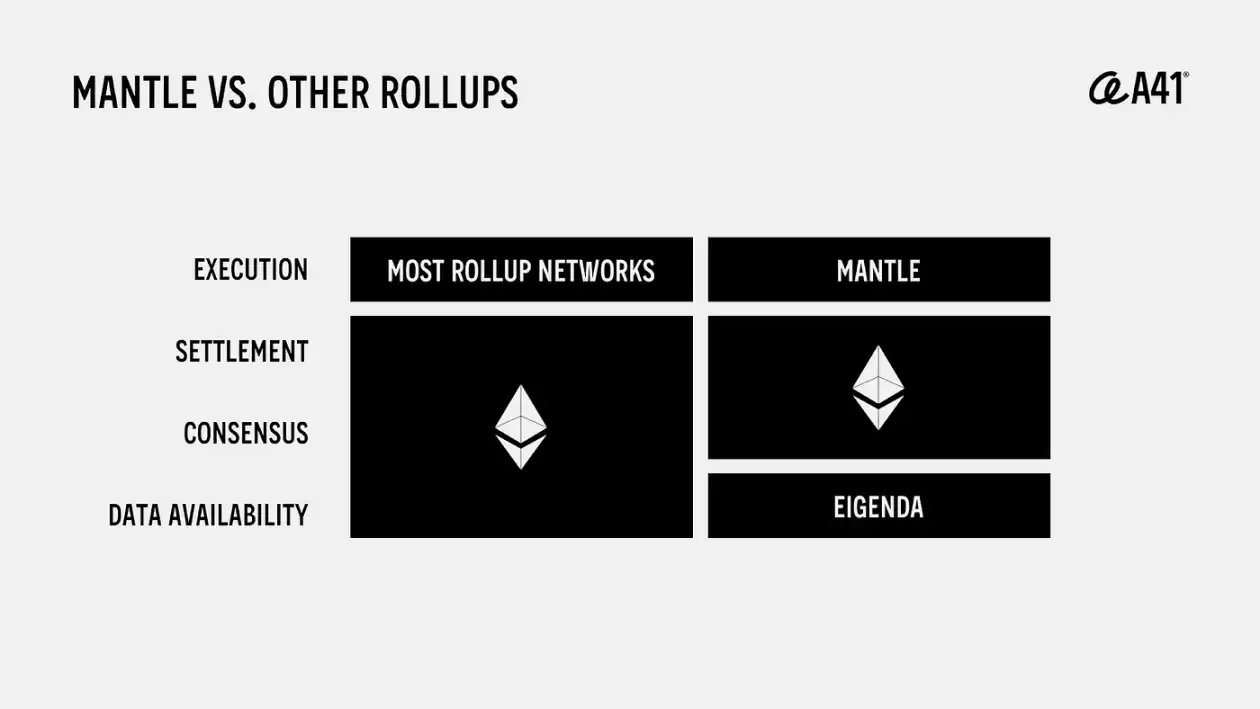
In the last article in the Rollup series, we explored the Mantle Network, which uses a unique solution called EigenDA as the data availability layer, instead of Ethereum as most Rollups do. Common rollups are built on Ethereum and rely on Ethereum for all functions other than execution, such as settlement, consensus, and data availability. The benefit of using Ethereum as a DA layer to store transaction data is to ensure that the data is always accessible, which means that the Rollup network is secure as long as the Ethereum network is up and running. However, the scalability of the Rollup network is limited by the scalability of the Ethereum network itself. Mantle Network got rid of this limitation by using EigenDA as its data availability layer.
Further, Eclipse, the modular Rollup solution, provides a highly customizable environment. Eclipse last yearRaised $15 million in funding, which included a $6 million pre-seed round led by Polychain Capital and a $9 million seed round led by Tribe Capital and Tabyia. Eclipse has a unique feature that allows users to deploy Rollup networks as they like. For example, you can build Rollup on a network other than Ethereum, choose any DA layer, and most importantly, you can even choose Solana's SVM as the execution environment instead of being limited to EVM. Given that most existing rollups are based on EVM environments, this customizability will be a significant innovation and an attractive advantage for the Solana ecosystem to both developers and users. Before delving into Eclipse, let's take a closer look at SVM.
Several networks such as BNB, Polygon, and Avalanche use Ethereum virtual machines (EVMs) as their execution environments, while Solana uses SVM. Smart contracts in the Ethereum context are called programs in Solana and support programming languages such as Rust, C, and C++. The key advantage of SVM over EVM is its high scalability due to several optimizations, including Sealevel associated with parallel processing and pipelining, the transaction processing method.
Sealevel is an execution environment on Solana's network that processes smart contracts in parallel. Unlike Ethereum's EVM, which can only handle one smart contract at a time, different accounts that do not share state can be processed in parallel in SVM. Transactions on the SVM have a state as to whether they are to be read or written, making parallel processing feasible for transactions where states do not overlap. For example, A transaction in which A sends 3 SOLs to B and a transaction in which B sends 2 SOLs to C may not be processed concurrently because they share B's state. However, transactions where A sends 3 sols to B and X sends 10 sols to Y can be processed in parallel.
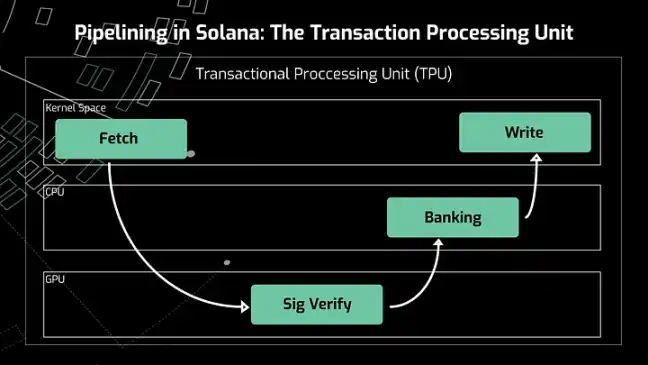
Source: Solana
Pipelining is a transaction processing technology that can efficiently handle transactions across multiple hardware components. As shown in the figure above, the data flow is consolidated into a unit called a transaction processing unit (TPU), which then goes through a series of processing steps. Solana's official Medium likens the process to washing clothes, which consists of three stages: washing, drying and folding. Once the first load is finished washing, it enters the drying phase and the second load begins washing. Similarly, when the first batch is folded, the second batch is dried and the third batch is washed. Although everything goes through a series of steps, each load is handled by a separate unit.
Eclipse
Source: Eclipse
Eclipse is a project to simplify customizable modular Rollup builds for all users. Unlike other rollups that have fixed components, such as virtual machines and base layers, you can easily create rollups in various forms using Eclipse. For example, you can choose Polygon Avail for the consensus layer and Data Availability layer, along with SVM for the implementation layer. Eclipse provides an "Eclipse settlement layer" as the settlement layer (containing IBCs), and rollups built using Eclipse can interface seamlessly with the Cosmos ecosystem. The following details the components of Eclipse.
Virtual machine
Source: Eclipse
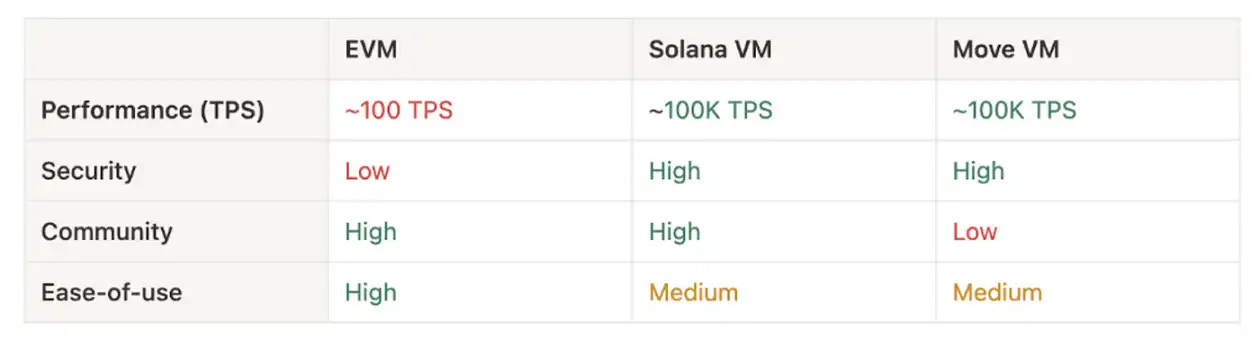
In blockchain technology, virtual machines play a crucial role in executing smart contracts to generate bytecode. Several virtual machines with distinct characteristics have been developed, such as EVM, SVM, and MoveVM. EVM processes transactions in serial, whereas SVM and MoveVM can process transactions in parallel to enhance scalability. Also, in terms of security, Rust or Move languages are less susceptible to error than Solidity, which is an advantage of SVM and MoveVM over EVM. EVM and SVM have significant advantages in terms of community, especially EVM, which has a large community of Solidity developers and users. In addition, EVM has a number of developer tools.
Currently, Eclipse supports both EVM and SVM, with plans to support more virtual machines in the future, including MoveVM. Depending on the chosen virtual machine, compatible development tools (such as Remix and Truffle for EVM, Solana CLI and Seahorse Lang for SVM), wallets, and browsers all provide native support for ease of use. Since there is no existing Rollup that supports SVM, Eclipse's approach is a promising new endeavor.
Customize a VM
Even if you choose EVM or SVM, you can still customize various elements of the execution layer:
Gas fees: The collator can charge the user Gas fees to cover the cost of maintaining the network. The default network cost of EVM is ETH, and that of SVM is SOL. However, gas can be paid in Eclipse using Rollup's native token or USDC, or free or higher gas can be set. Compliance and privacy: You can configure who can operate Rollup (licensed or unlicensed), who can deploy smart contracts, who can use Rollup, whether to comply with OFAC regulations, and whether to restrict access to specific areas. Of course, Eclipse's default Settings are permissionless, allowing anyone to access the network. MEV: Eclipse is working with Skip Protocol to decentralize MEVs. If needed, the MEVs in the network can be efficiently extracted and redistributed again. The default setting is not to reassign MEVs. Dedicated opcodes: You can add dedicated systems for the Rollup network. For example, you can add new verifiable random functions (VRFS) that generate elliptic curves or random numbers. By default, Eclipse does not support custom opcodes.
Settlement
Source: Eclipse
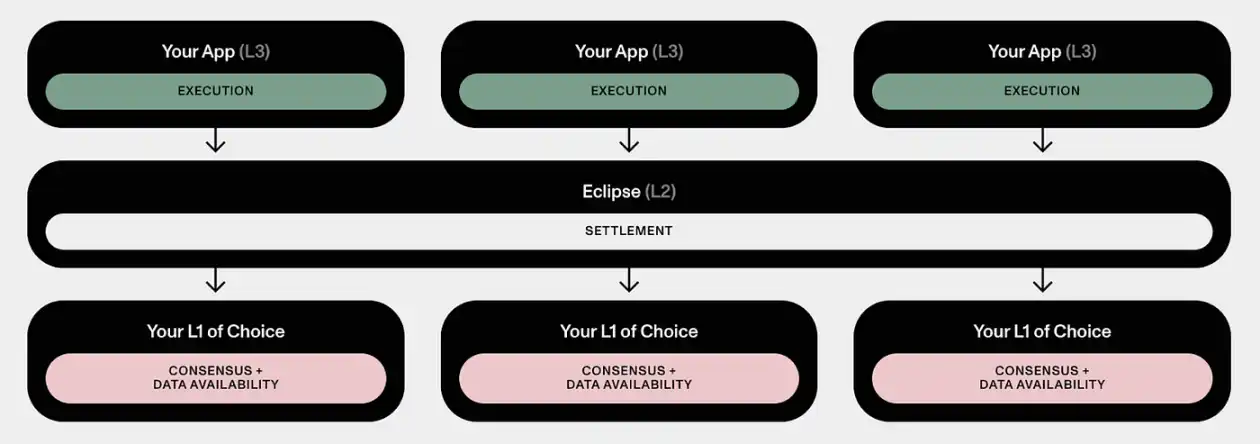
The term "settlement" is used to verify the validity of the Rollup network by proof of fraud or proof of validity and to be able to bridge the trust minimization between Rollup networks that share the settlement layer. The Rollup network created through Eclipse shares the "Eclipse Settlement layer" as the unified settlement layer. The Eclipse Clearing layer runs on the Celestia based sovereign Rollup and is only used to verify the validity of the Rollup network running on it and mediate the funding bridge. Currently, Eclipse only supports Optimistic Rollup, but intends to support ZK Rollup in the future.
Data availability layer
Source: Eclipse
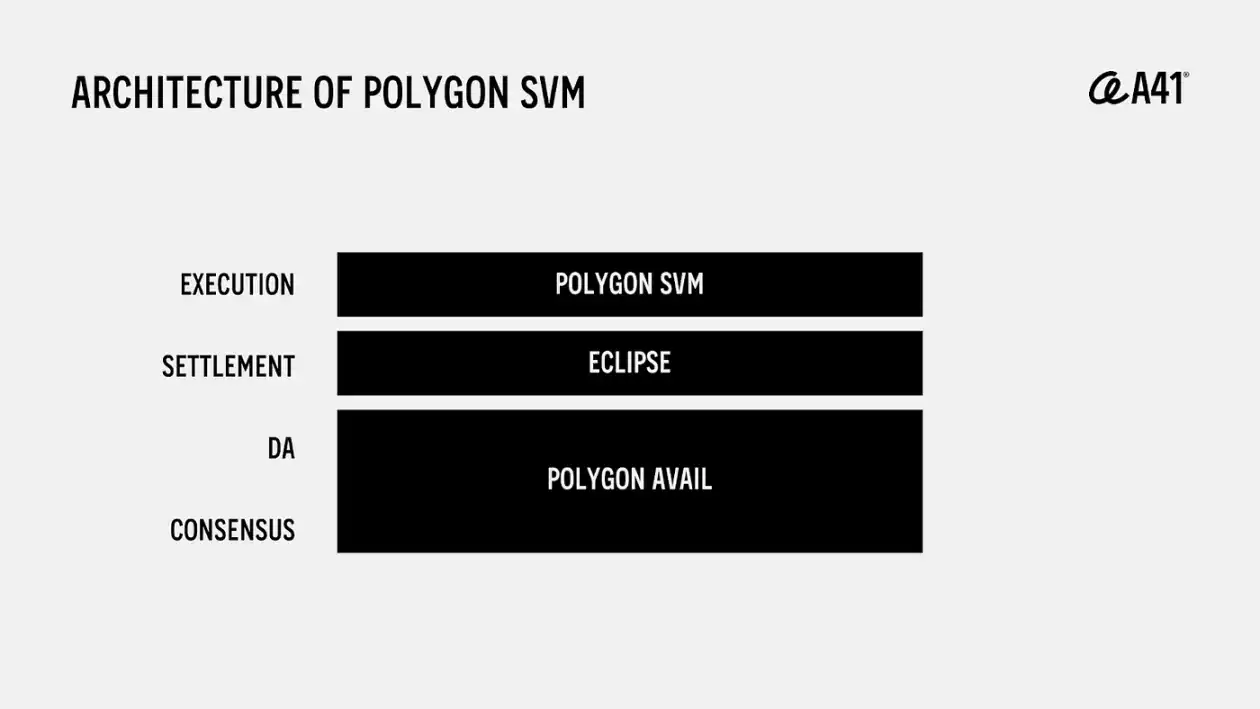
All Rollup networks created with Eclipse share a common "Eclipse clearing layer" for clearing, but they can choose their own data availability layer. Unlike rollups such as Optimism and Arbitrum, which are limited to using Ethereum networks, Eclipse allows the use of different networks such as Celestia, Polygon Avail, Solana, and Ethereum as data availability layers. For example, the recently launched Polygon SVM is the SVM execution environment with Polygon Avail as the base layer and Eclipse settlement layer for settlement. Currently, Eclipse offers Celestia, Polygon Avail and EigenDA as options in the data availability layer, with plans to add more options in the future based on community demand.
ecosystem
Polygon SVM
Polygon SVM is a Rollup network that will be launched in collaboration with Eclipse and Polygon Labs. The network will lower the barrier to entry for DApps on Solana because Solana's SVMS can be integrated into the Polygon ecosystem. It is important to note that Polygon SVM will not be deployed on the widely used Polygon PoS network, but rather on the forthcoming Polygon Avail network, a data availability solution in the Polygon ecosystem. From the perspective of modular blockchain, the network structure of Polygon SVM can be described as follows:
Zebec
Zebec is a salary-related dApp in the Solana ecosystem that has received funding from Lightspeed, Gemini, Circle, and Coinbase Ventures. Zebec provides employers with services to pay employees by the minute and manage payments, funds, tokens, etc. In September 2022, Zebec announced that it would build its own Rollup network through Eclipse. While the Polygon SVM discussed earlier is a more general Rollup network, Zebec can be thought of as an application-specific Rollup network.
Yama Finance
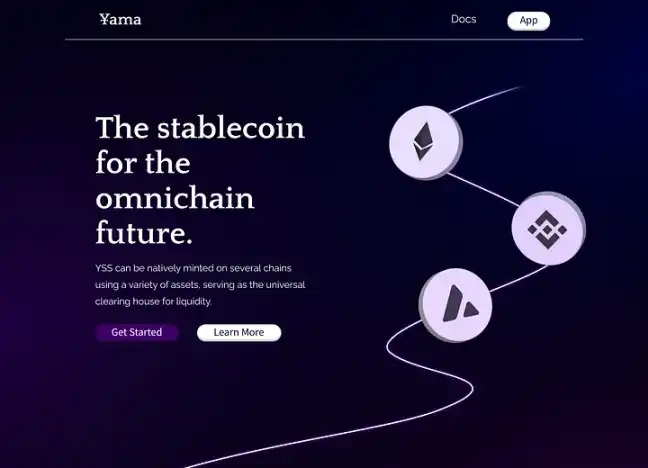
Source: Yama Finance
Yama Finance is a decentralized Stablecoin protocol based on Omnicoin that will be rolled out on various networks, including Eclipse. Yama Finance benefits from the strength of the interchain messaging protocol Hyperlane and can easily use stablecoins across multiple chains.
Potential application
In addition to the high level of security and extensibility provided by the Rollup network, Eclipse technology can be used for other services, including decentralized order book Rollup, web3 games, real world assets (RWA), and messaging and notification services.
summarize
Eclipse provides customizable features, such as an execution environment and a data availability layer. Rollups created through Eclipse share a single Eclipse settlement layer that facilitates a diverse ecosystem. For example, Eclipse provides EVM and SVM as execution environment options, and different L1 can be used as the data availability layer. In addition, the Eclipse settlement layer supports communication with other Cosmos chains via IBC, allowing Solana dApps to migrate to Polygon Avail. As the Layer 2 market continues to expand, growth is focused on the Ethereum ecosystem. I'm looking forward to Eclipse building a vibrant Rollup ecosystem outside of Ethereum with various customizations.
Reference material
https://medium.com/solana-labs/sealevel-parallel-processing-thousands-of-smart-contracts-d814b378192
https://medium.com/solana-labs/pipelining-in-solana-the-transaction-processing-unit-2bb01dbd2d8f
https://www.eclipse.builders/resources
Source of original text
Welcome to join the official BlockBeats community:
Telegram Subscription Group: https://t.me/theblockbeats
Telegram Discussion Group: https://t.me/BlockBeats_App
Official Twitter Account: https://twitter.com/BlockBeatsAsia

 Related Articles