Crypto Market Q1 Review: BTC up 70%, Turning point of Market Recovery?
Crypto Market Q1 Review: BTC Up 70%, A Turning Point in Market Recovery?
Original source: PANews
The IntoTheBlock post summarizes Q1 2023: An in-depth look at the factors leading to a significant recovery in the crypto industry, a brief overview of the macro forces at play, the most relevant on-chain data, and an analysis of catalysts that could impact Q2 this year.
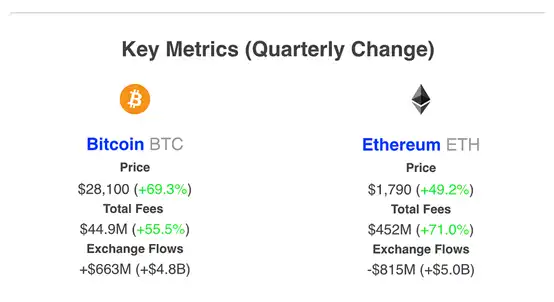
Network charges: The sum of the costs of using a particular blockchain
This indicator tracks the willingness to spend and the demand to use BTC or ETH.
With the advent of Bitcoin NFT protocol Ordinals and increased network activity, BTC's quarterly network fees reached their highest level since Q4 2021.
Ethereum processing fees climbed to their highest level since the second quarter of 2022 due to events such as the USDC decoupling and ARB and BLUR airdrops.
Net Exchange Traffic: Net inflow minus net outflow of a specific crypto asset on a centralized exchange
Cryptocurrency moves into exchanges could signal selling pressure, while coin withdrawals could indicate an increase in holdings under normal circumstances.
Net inflows into centralised exchanges were $663m in the first quarter, compared with net outflows of $4.1bn. Given BTC's recent price rise of about 70 per cent, it may be that some holders want to take their money off the table.
Net ETH outflows in the first quarter were $815 million, much smaller than the $5.8 billion net outflows in the fourth quarter of 2022.
On-chain data
Cryptocurrencies rebounded strongly in the first quarter of 2023, with both BTC and ETH Posting their biggest quarterly price gains since the first quarter of 2021. The rebound in prices follows positive factors such as weak selling after the FTX collapse and an improving macro outlook for risk assets.
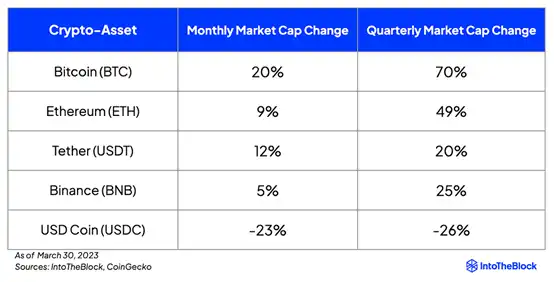
BTC leads the way: BTC outperforms most assets in the first quarter of 2023.
BTC's outperformance may indicate its growing appeal as a digital store of value. Data from ITB Capital Markets show that the correlation between BTC and gold prices rose from minus 0.3 at the beginning of the year to 0.9 at the end of the quarter. The first quarter saw the stablecoin wars come to a head, as Circle struggled through the banking crisis, USDC experienced its biggest decoupling to date and USDT gained more market share. Although ETH has lagged behind BTC since the Silicon Valley bank collapse and the Fed "crackdown," ETH still outperformed many crypto assets (and, of course, stocks) with a 49% quarterly gain.
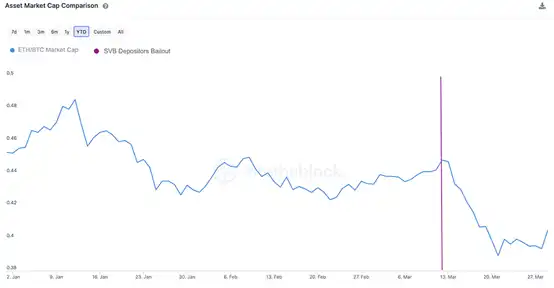
Source: ITB Ethereum Price Indicator
Just as it did at the beginning of its life, the recent banking crisis has boosted BTC. On the first BTC block was the headline on the front page of The Times on January 3, 2009: Chancellor is about to bail out Banks for a second time. Touting the value of BTC as a potential replacement.
Fourteen years later, as America and parts of Europe experienced another banking crisis and subsequent central-bank intervention, BTC was up more than 20%, outperforming most assets.
Since then, the Fed's balance sheet has grown by $392 billion, fuelling bullish sentiment. Many expect increased liquidity and lower interest rates to boost BTC (Balaji's price target is as high as $1 million).
Where will cryptocurrencies go next?
While prices and market sentiment recovered in the first quarter, the next move for cryptocurrencies remains unclear.
From a macro perspective, the headwinds that have been weighing on risk assets seem to be easing, but at the same time, it's becoming increasingly clear that cryptocurrencies have reached "the point of being hit hard," with Elizabeth Warren running for Senate from the anti-cryptocurrency movement, Signature, though solvent, was suspiciously taken over by regulators.
Add in the bearish forces within cryptocurrencies, and after a strong quarter, people wonder if prices will continue to climb or fall.
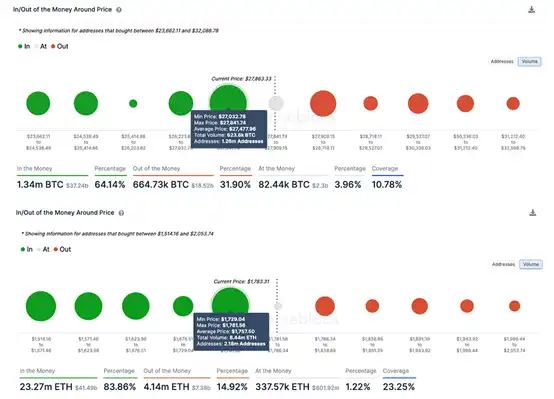
Source: ITB's BTC and Ethereum Financial Metrics
Strong position support: Based on the on-chain data, it can be seen that BTC and ETH are both overbought at present. $27,000 and $1700 respectively are the recent support levels for BTC and ETH, because these two positions have the strongest support strength. 6.238 million BTC (about US $17 billion) and 8.4 million ETH (about US $15.1 billion) respectively.
If this price is breached, based on previous depths, there is not much support until BTC and ETH reach $24,500 and $1,500 respectively. On the seller side, the recent highs of $29,000 and $1,850, there is selling pressure from previous purchases in the area, but there is no more resistance if prices climb to these levels.
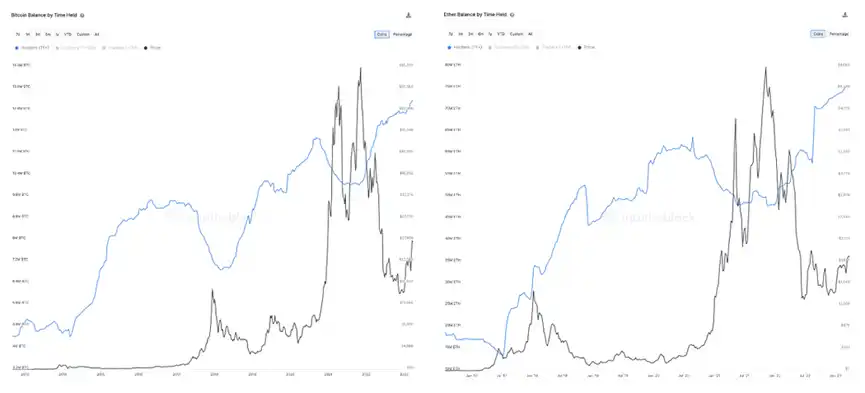
Source: ITB's BTC and ETH holding indicators
Long-term investors add: The number of BTCS and ETH owned by holders continues to hit record highs
Addresses holding assets for more than a year increased by $13.4 billion in BTC and $4.7 billion in ETH through 2023. If the history of previous bull markets repeats itself, these addresses are unlikely to sell until they get close to previous all-time highs
Q2 Catalysts: In addition to macro and on-chain factors, there are other things to watch out for
Ethereum's Shanghai upgrade is expected to go live on April 12, with coin withdrawals starting after a gap of more than two years.
The initial withdrawals may cause some selling pressure, although they will have to be queued to prevent large withdrawals. But in the long run, this encourages more ETH holders to pledge because the uncertainty that cannot be extracted has been removed, which can be seen as a bullish force as it locks in supply for the time being, while also making the network more secure.
BTC halving is still a year away, but given how many see this event as the driving force behind the cryptocurrency cycle, many may start buying before it halves. On the other hand, Mt. Gox is getting closer to the date when it will return $17.6 billion worth of stolen BTC.
Overall, a combination of bullish and bearish factors could make for an interesting second quarter.
Original link
Welcome to join the official BlockBeats community:
Telegram Subscription Group: https://t.me/theblockbeats
Telegram Discussion Group: https://t.me/BlockBeats_App
Official Twitter Account: https://twitter.com/BlockBeatsAsia

 Related Articles