OP Research: The Final Battle of NFT Trading Platforms

Original Article Title: "
OP Research: The Final Battle of NFT Trading Platforms
Original Source: Chaincatcher
The uniqueness of digital assets allows them to be used to prove ownership and scarcity of digital items, providing a new revenue stream for digital artists and creators.
Blur, through a combination of airdrop incentives, order incentives, self-built trading markets, and aggregators, has surpassed Opensea. While Opensea was previously the most liquid NFT market, Blur's comprehensive strategy has garnered increasing attention in the market. Currently, Blur has the best liquidity solution, and its combination of market and aggregator provides users with a wider range of options. This is crucial as liquidity is often key in the NFT market, and Blur's liquidity solution has proven to be very reliable.
In response to the impact, Opensea has reduced fees to 0%, demonstrating its focus on competitors. However, this strategy may have a negative impact on Opensea's sustainability. Optional royalties are another strategic piece. This allows Blur to provide more choices in the market, attracting more users. The segmented Marketplace is unlikely to have another opportunity.
Although there are still many opportunities in the NFT market, segmented markets like X2Y2, LooksRare, and Uni V3 (Genie) are unlikely to have another opportunity. This is because these markets are already dominated by large companies and powerful competitors, making it challenging for new entrants.
Blur's comprehensive strategy in the NFT market has proven to be very successful. Despite fierce market competition, Blur's performance in the market is improving, demonstrating the feasibility and practicality of its strategy.
We will combine the past development trajectory of the NFT Marketplace to explore possible future paradigms.
The Crypto Kitties Market is the most primitive NFT trading platform
The Crypto Kitties Market is the earliest NFT trading platform, originally established as an extension of the Crypto Kitties game. Crypto Kitties (the original NFT) is an Ethereum-based game where players can buy, breed, and sell digital cats. Each digital cat is unique, using NFTs to ensure its uniqueness and fungibility.
Its ecosystem consists of a platform, users, CryptoKitties, and a trading market. The platform provides services for the creation, purchase, breeding, and sale of CryptoKitties, as well as their display, social interaction, and trading market. Users buy, breed, and sell CryptoKitties, and participate in social interaction and promotional activities. The variety of CryptoKitties, breeding seasons, and competition activities also add a lot of fun and interactivity to the platform. The trading market offers users buying and selling services for CryptoKitties, along with transaction history records and price trend analysis. Therefore, the establishment of the Crypto Kitties Market was aimed at improving the currency and asset properties of digital cats.
The development of the Crypto Kitties Market has been very rapid, attracting more and more users and collectors, driving the development of the NFT trading market. In addition to CryptoKitties, the platform has also started supporting other types of digital assets, such as digital artwork, in-game items, etc.
Although the transaction speed of the Crypto Kitties Market is very slow, this is mainly because it is built on Ethereum, whose transaction speed and processing power are limited, and the variety of transactions offered is also limited. However, the Crypto Kitties Market has made a significant contribution to the development and promotion of the NFT market. Its emergence has pioneered the development of the NFT trading market and has also inspired other more advanced and user-friendly NFT trading platforms.
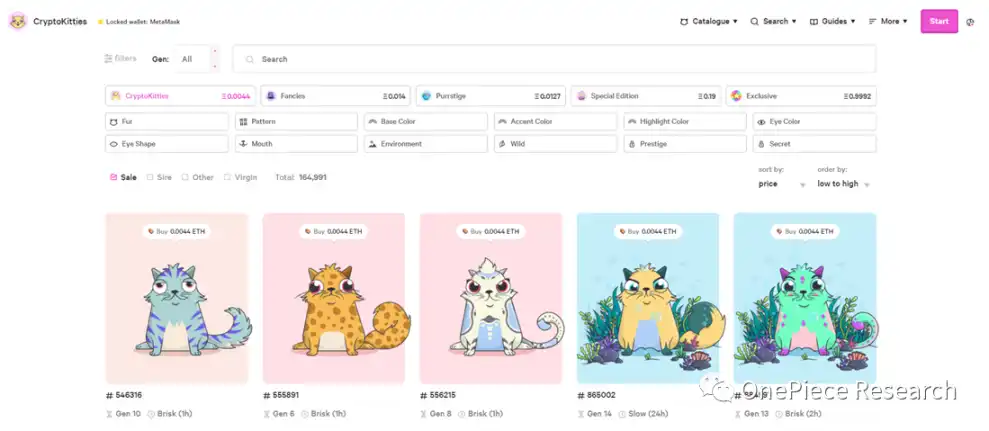
Crypto Kitties Market UI
The NFT Summer Marks the Explosive Growth and Popularity of the NFT Market
In the summer of 2021, the NFT market experienced rapid growth and popularity. During this period, both NFT trading volume and prices reached historic highs. Opensea rapidly expanded during NFT Summer and became one of the largest NFT trading platforms. During this period, both the trading volume and user base of OpenSea increased significantly, and NFT prices on the platform also reached historic highs.
The total NFT transaction volume in 2021 reached approximately $200 billion, setting a new record. This number was about 10 times higher than in 2020. Key platforms in the NFT market include OpenSea, Nifty Gateway, SuperRare, Foundation, etc. During NFT Summer, some projects were particularly popular, such as CryptoPunks, Bored Ape Yacht Club, Art Blocks, etc.
During NFT Summer, various PFP (Profile Picture) projects quickly emerged, attracting a large number of users and investors. PFP refers to avatar images presented in digital form, which can be used for social media, gaming, or other online scenarios. However, these PFP projects are not just simple avatars; they serve as a symbol of identity and community building, similar to fashion items worn in real life.
Thus, a frenzy of buying unfolded in the NFT market. Investors and collectors alike joined in, purchasing various PFP works for millions of dollars to showcase their identity and social status. Even though some designs may appear somewhat peculiar, they still command high prices in the NFT market. Some were even willing to pay transaction fees of thousands of dollars to acquire their desired PFP.
However, NFT Summer was not a peaceful season. As speculative sentiment rose, the prices of some PFP projects started plummeting, prompting investors and collectors to sell off their holdings, leading to market turmoil. Some PFP projects could not survive due to a lack of sufficient community support, much like small boats in the sea eventually being engulfed by large waves. After NFT Summer, people began to reflect on this craze of digital art, with some considering it merely a short-lived speculative frenzy, while others saw it as the beginning of a new era in the digital art market.
Nevertheless, NFT Summer was a period full of opportunities and risks, showcasing the potential and allure of the NFT market.
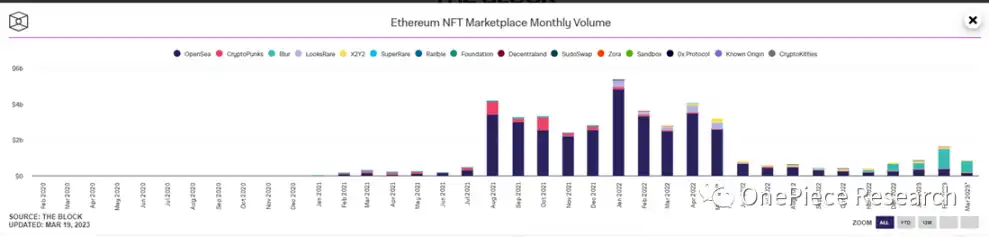
Ethereum Monthly Transaction Volume
PFP Ignites NFT Trading
The total trading volume of NFT assets is around $400 billion, with PFP trading volume exceeding $250 billion, accounting for over 62.5%. This data indicates that PFP's trading volume and amount in the NFT market hold a significant share, reflecting people's emphasis and demand for personal identity and digital image. At the same time, this also signifies that in the NFT market, PFP is one of the most popular and active assets, becoming one of the main driving forces of the market.
From an economic perspective, the popularity of PFP is mainly related to supply and demand factors. First, due to the rapid rise of the NFT market, more and more people are noticing the investment value of NFTs and are willing to pay high prices for them. Second, the supply in the PFP market is relatively limited because PFPs are designed and issued by individuals or teams, and their quantity is usually restricted. Therefore, with limited supply but high demand, PFP prices continue to rise. However, as the PFP market expands, more designers and teams are emerging, bringing more choices and competition to the market, further driving its development.
From a sociological perspective, the popularity of PFP is also related to social factors. PFP can not only display personal style and identity but also serve as a form of social capital. Many people, when purchasing a PFP, choose designs that align with their identity or interests to gain more attention and recognition in their social circles. Additionally, due to the limited supply of PFPs, some designs are often more popular, making owning these popular PFPs a form of social capital. As the PFP market develops, people's awareness of PFP as social capital continues to grow, further fueling the market's popularity.
This has some implications for the development and future of NFTs. First, as digitalization advances, the demand for digital identity and assets will continue to grow, unleashing the market potential of NFT assets such as digital artwork and collectibles. Second, with ongoing technological progress and adoption, more people can participate in the NFT market, further driving its development. Finally, PFPs, as a key asset in the NFT market, also reflect some preferences and trends in the market, providing insights and guidance for NFT market investment and operations.
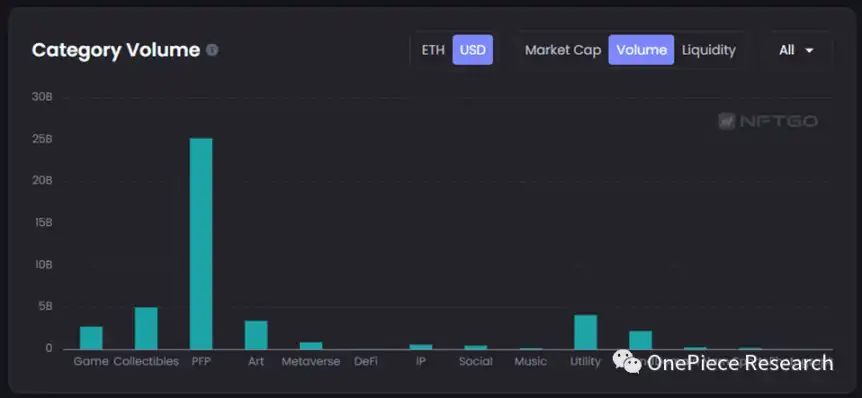
Cumulative Transaction Volume by Type (as of 20230320)
OpenSea Emerges as the Leading NFT Marketplace of the NFT Summer
First-mover advantage. OpenSea is an early-established NFT Marketplace, founded in 2017, and has received support from some prominent investors, achieving a high valuation of $13 billion in early 2022. This early start allowed OpenSea to build a large user base and collector audience before the NFT craze, enabling the platform to quickly attract more sellers and buyers. OpenSea offers the widest range of NFTs, including collectibles, PFPs, virtual real estate, in-game items, music, movies, and other collectibles. This diversity attracts users with various needs, allowing them to transact on a single platform.
Bridging Web2 and Web3. OpenSea's user interface is very user-friendly, allowing even those unfamiliar with blockchain technology to easily transact, thus lowering the entry barrier to the NFT market and even the crypto space, bringing incremental funding to the crypto industry. Additionally, OpenSea provides various trading tools and resources to help users better utilize NFTs.
Multi-Chain Layout. While Ethereum NFTs constitute the largest NFT ecosystem, Opensea's early layout on multiple chains is establishing a stronger moat. Opensea supports various blockchains, including Polygon, Arbitrum, Fantom, and more. This allows users to choose the most suitable blockchain for their transactions and benefit from lower fees.
Opensea provided the earliest solution for an NFT Marketplace but was limited by a traditional operational model. Opensea clearly stated from the beginning that it would not issue its own coin because it opted for traditional equity financing, with shareholders exiting in a traditional manner rather than through tokens. Therefore, its capital operation falls under the traditional financial category. Additionally, its revenue mainly comes from transaction fees. Although it had maintained a high 2.5% transaction fee until the emergence of Blur, it reduced it to 0% to counter Blur's impact on the market. Overall, Opensea appears more like a promoter of applying a Web2 operational model in the Web3 world. However, its current development status does seem a bit out of place.

OpenSea UI Interface
LooksRare, X2Y2 Utilize Vampire Attacks to Seize Market Share
LooksRare and X2Y2 went live in succession, using airdrops of tokens to Opensea users as a strategy to gain initial traffic accumulation. Later, they introduced their own mining rewards to try to capture market share. However, as the reward mechanism kept decreasing, it ultimately led to a continuous decline in actual trading volume.
Nevertheless, LooksRare and X2Y2 remain strong competitors to Opensea as they aim to achieve this through a better user experience than Opensea. In addition to basic NFT buying and selling transactions, they have launched additional features such as batch listing and batch purchasing, integrated other trading tools, and facilitated user queries on NFT rarity. Compared to Opensea, these two platforms have lower transaction fees, which is more user-friendly for those engaged in real transactions and transfers. However, this may also lead to a certain degree of wash trading on the platform.
Overall, LooksRare and X2Y2's design philosophy is to model the Marketplace after an "Amazon-like" mall, providing more convenient and comprehensive services while charging lower fees.
When it comes to low-value NFT transactions, batch trading is a more suitable way of trading. This is because batch trading can reduce the time and labor costs required for a single NFT transaction, thereby lowering the transaction cost and fees. Additionally, batch trading can also increase the efficiency and speed of transactions, making them quicker and more efficient.
However, when conducting batch trading, it is important to ensure the appropriate fees are charged to maintain the platform's normal operation and development. The fee collection should be within a reasonable range, capable of both sustaining the platform's operation and being affordable for traders. During the batch trading process, front-running is also a significant issue to consider. The occurrence of front-running can lead to a continuous decline in real trading volume, affecting the normal operation of the entire trading market. Therefore, measures need to be taken to prevent and combat front-running behavior to maintain the health and stable development of the trading market.
Overall, LooksRare and X2Y2 did not differentiate based on functionality but instead approached it from the perspective of tokenomics, seizing the obvious shortcoming of Opensea's lack of a platform token and implementing a more Crypto Native strategy. However, with the reduction of marginal rewards, the business became unsustainable. This also set the stage for Blur's success.
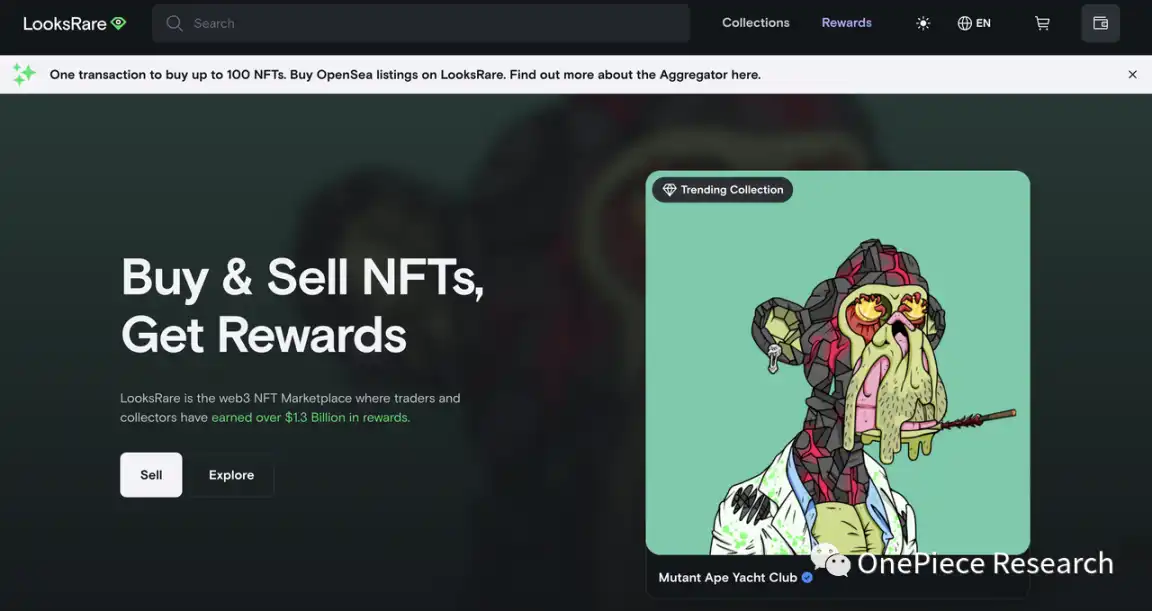
LooksRare UI Interface
Aggregator's Story
Gem is an NFT aggregator project and was the largest aggregator before Blur's launch. It provided a platform that allowed users to easily discover and purchase NFTs from various NFT markets and platforms. Similar to Blur, Gem aggregated traffic from multiple mainstream NFT markets and achieved batch NFT purchases at a lower cost. This can help users get the best deals on different marketplaces while also bringing more traffic and revenue to Gem itself.
Gem serves as a redirector, directing users from various NFT markets and platforms to its platform, which may create a certain traffic hijacking effect, making Gem a hub for aggregating a large amount of NFT traffic. In April 2022, Gem was acquired by Opensea but remained independently operated. This means Gem will become part of Opensea, receiving support and resources from Opensea while still providing its unique features and services to meet the needs of different users. As part of Opensea, Gem can better serve Opensea users, expanding its influence and market share.
Genie is the earliest NFT aggregator project, with similar functionality and positioning as Gem.
Compared to Gem, Genie aggregates fewer NFT markets and platforms, but still provides users with a convenient platform to easily discover and purchase NFTs from various NFT markets and platforms. In June 2022, Genie was acquired by Uniswap and became part of Uniswap. Uniswap is a decentralized exchange based on the Ethereum blockchain that enables asset swapping and liquidity provision through smart contracts. Acquiring Genie can help Uniswap expand its service offerings and provide users with more NFT-related tools and services. This means that Uniswap can leverage its leading position in the decentralized exchange space to attract more users and offer more NFT services.
Additionally, using Genie as a tool, Uniswap can offer a better NFT browsing and purchasing experience. Furthermore, collaborating with emerging NFT markets can help Uniswap expand its user base and revenue streams.
Overall, Genie's functionality, as part of Gem, is relatively straightforward and highly substitutable. Furthermore, neither platform has issued a token, thus missing out on leveraging tokenomics for ongoing business growth. However, post-acquisition, both Gem and Genie can leverage the support and resources of their parent company to expand their service offerings and provide users with more features and services. This will help them stay competitive in the crowded NFT aggregator market and achieve long-term growth.
Gem UI Interface
The Emergence of Blur
Blur's target audience includes NFT professional traders, whale players, and ordinary users (although the number of ordinary users is relatively low), setting this target group apart from the market's other platforms from the start. The platform's model is a Marketplace+Aggregator, aimed at aggregating multiple markets and platforms to provide users with a more convenient experience, so in this model, NFT market makers and LP providers will benefit to some extent.
In addition, its economic model is also noteworthy, including airdrop incentives, royalty fee incentives, and order placement incentives. The purpose of these measures is to reduce order slippage and provide stable liquidity for NFT orders. However, the author believes that Blur's best strategy is its approach to management expectations. For example, the platform's first-season airdrop aimed to incentivize intelligent order placement, the second season’s airdrop aimed to incentivize the Bid pool, and the third season aimed to incentivize market-making. The core of this series of operations is fuzzy rules and eternal expectations.
In addition, Blur has a fee of 0, and the Gas fee is also very affordable. Users can easily make transactions, while the trading tools are comprehensive (including a data analysis dashboard). Furthermore, compared to other aggregators, Blur has a faster transaction speed, providing users with a quicker trading experience. The functional differentiation of Blur caters to a specific user base, with more professional trading depth charts, liquidity monitoring, and floor price tools better suited for professional traders.
Through a unique product positioning, product design, and airdrop distribution method, Blur has initially created a positioning different from that of Opensea, addressing the lack of differentiation issue, standing out among many NFT trading markets. However, the real issue Blur is solving is the lack of liquidity.
Overall, Blur has achieved both functional improvements in differentiation and incentivization of the token, to some extent also addressing the inadequacy of NFT liquidity.
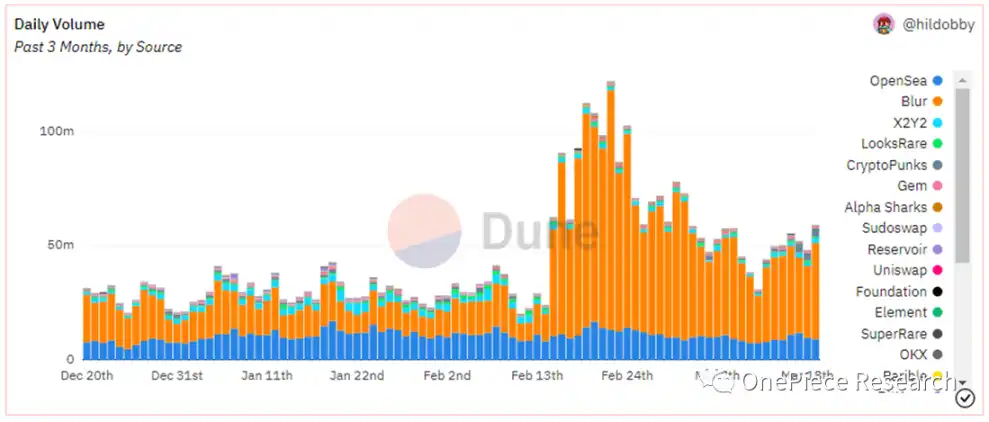
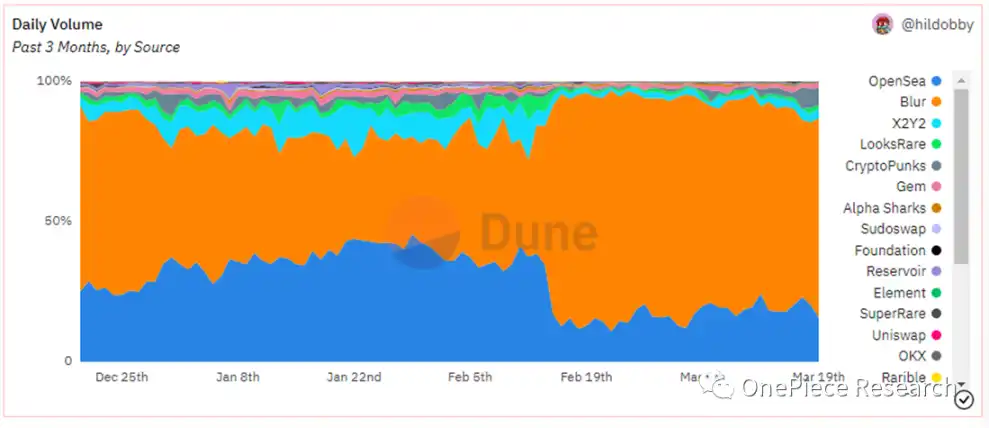
Last 3 months NFT Marketplace daily average trading volume and market share
When we think of Amazon in the context of Web 2.0, what comes to mind is a wide range of products, efficient logistics, and personalized after-sales service. NFTs are essentially consumer goods/products, and the characteristics of providing a marketplace for NFT buying and selling are similar to an e-commerce platform. Therefore, we believe that the NFT market can be seen as the Amazon of Web3.
First, e-commerce has several key business features that enable companies to sell their products online. These include online category and product information, shopping cart and checkout systems, secure payment processing, order management and fulfillment, customer relationship management, analytics and reporting, as well as personalization and customization options. By leveraging these features, companies can create robust online marketplaces, efficiently sell products or services, manage orders and inventory, build customer relationships, and optimize marketing and sales strategies.
Furthermore, NFTs can be considered a commodity. Commodities are defined as raw materials or primary agricultural products that can be bought and sold, such as gold, oil, or wheat. On the other hand, NFTs are unique digital assets representing ownership or authenticity proof of a specific digital item (such as artwork, music, or even a tweet). They can be bought and sold like other commodities, and their value is determined by market supply and demand.
Similar to traditional commodities, the value of NFTs will fluctuate due to various factors, such as the popularity of the underlying digital asset, the reputation of the artist or creator, or the rarity of the NFT itself. Additionally, NFTs can serve as a means of diversifying investment portfolios or as speculative assets with potential economic returns.
Overall, although NFTs are a unique type of digital asset, in terms of their significance in the market, they can be considered a commodity, and their value is determined by market forces. So, NFTs can be seen primarily as a commodity and secondarily as an investment-grade asset.
There are two key factors that contribute to the success of an NFT Marketplace: liquidity and user stickiness. In terms of liquidity, a marketplace needs a sufficient number of buyers and sellers to ensure transaction depth and smooth trading. As for user stickiness, this is largely driven by the tokenomics, and strategies based on this may not necessarily translate into deep "loyalty" among users. However, once the platform's liquidity improves, coupled with the catalyzing effect of tokenomics, the platform's liquidity will continue to form a positive feedback loop until arbitrage opportunities diminish.
Therefore, we believe Blur is a phenomenal project. As the space evolves, we can expect to see a Marketplace with better performance, faster order execution, and lower overall costs.
OpenSea Losing Market Share
The pace of update iterations does not keep up with the pace of changing market demands. This means that OpenSea is progressing slowly in updating its platform and features to meet the constantly changing market needs. OpenSea initially led the market with better liquidity depth and a more comprehensive category of NFT assets. However, the NFT market is highly volatile and prone to sudden demand shifts. Platforms that fail to keep up with these changes may lose customers to competitors. Essentially, OpenSea cannot make something superior in transaction performance that the market would always fork to.
Lack of tokenomics. Tokenomics refers to a system that uses tokens as a means of exchange and incentives. OpenSea currently lacks tokenomics, which may limit its ability to attract and retain users interested in earning or using tokens on the platform. The vampire attacks conducted by LooksRare and X2Y2 and the user migration are direct manifestations of this.
Fragile user stickiness. User stickiness refers to the loyalty of users to a specific platform or brand. OpenSea's user stickiness is fragile, meaning users are not necessarily loyal to the platform and may be more interested in speculative investments (i.e., purchasing NFTs with hopes of future profits) than the platform itself. In other words, most users on OpenSea are more interested in the ability to arbitrage across different platforms than in pursuing the platform's performance. Blur precisely targets this user segment's needs through a token airdrop plan with strong expectation management.
Overall, these factors suggest that Opensea may struggle to compete in a fast-growing market and provide insights to latecomer projects. To stay competitive, Opensea may need to focus on improving its platform functionality and user experience, creating a token economy to incentivize user participation (Opensea's token issuance is unlikely, but it is highly probable through its subsidiary Gem), and building stronger customer relationships to increase user stickiness.
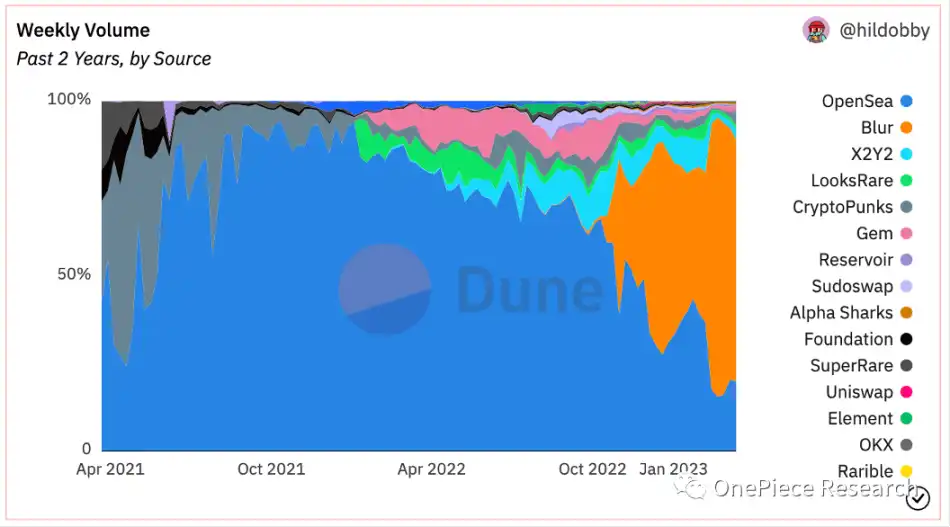
Market Share of NFT Marketplaces in the Last 2 Years
How Far Can Blur Go
One of the biggest challenges facing the NFT market is determining the value of an NFT. Unlike traditional assets, an NFT is unique and lacks any other intrinsic value support. Therefore, determining the floor price or fair value of an NFT can be very difficult. This lack of transparency makes it challenging to conduct additional derivative or secondary market transactions, as the buying and selling parties may not agree on the asset's value. Platforms like Opensea and Blur aim to address this issue by providing a transparent and trustworthy market for NFT transactions.
Opensea is one of the earliest NFT marketplaces. The platform enables users to create different NFTs and nurture a community culture. This approach has successfully built a loyal user base, and Opensea's success has provided a paradigm for other marketplaces like LooksRare and X2Y2, which have adopted similar models but have added a token economy to promote their products.
Blur is another NFT marketplace that focuses more on speculation than collecting. These users' underlying purpose is to make money on Blur; they do not care about the type of NFT they hold, as long as it has a floor price. Blur is seen as a platform for speculators, who are more interested in value discovery and conducting profitable trades than in building collections.
Therefore, we believe the moat of the NFT Marketplace is not deep.
Where Is the Next Phenomenal Project
Currently, we can view platforms with market makers, LPs, and traders' participation as specialized NFT Marketplaces, with Blur representing the project; while those that only offer the most basic Mint, Collect, Buy, and Sell functions can be seen as retail-oriented NFT Marketplaces, with Opensea representing the project. In fact, the competition in the NFT Marketplace is also concentrated between the two. For specialized Marketplaces, the key point to focus on is whether they can provide traders with more stable trading depth and more professional trading tools. And for retail-oriented Marketplaces, they need to think about how to empower the platform and bring sustainable traffic flow to the platform. Because the initial traffic influx is a key factor in whether an NFT Marketplace can take off.
In conclusion, we make the following overarching predictions:
One trend in the future development of the NFT market is the emergence of vertically specialized platforms. These platforms will focus on specific types of assets or markets, such as gaming NFTs, sports NFTs, or music NFTs. By concentrating on a particular market, these platforms can provide more tailored services and attract a corresponding user base.
Another trend is the emergence of new trading assets. Not limited to just PFP (Profile Picture NFTs), as the NFT market continues to evolve, new types of assets will arise and become speculative targets.
In terms of technological advancement, a more efficient and robust NFT Marketplace is needed. Currently, most NFT markets use the same AMM/bonding curve protocols, which may be susceptible to manipulation and inefficiencies. New protocols may emerge to provide a more transparent and efficient trading mechanism.
Finally, due to the network effects of the Ethereum blockchain and the established user base, multi-chain NFTs and L2 NFTs may face challenges in competing with ETH NFTs. However, as other blockchains continue to develop and gain traction, there may be opportunities for cross-chain transactions and interoperability.
Original Article Link
Welcome to join the official BlockBeats community:
Telegram Subscription Group: https://t.me/theblockbeats
Telegram Discussion Group: https://t.me/BlockBeats_App
Official Twitter Account: https://twitter.com/BlockBeatsAsia