EigenLayer has received $50 million in funding, so Why is Ethereum's secondary Pledge Narrative so interesting?

Original title: Bixin Ventures: Why Are We Investing in EigenLayer?
Original source: Binxin Venture
Blockchain is known as a "trust machine", where users build networks without central regulatory permission (permisionless) -- Bitcoin is where it all started, creating a layer of trust on top of which all value transfers occur by helping miners agree on the allocation of value through the PoW consensus mechanism.
But one problem with Bitcoin is that it's more like a single application specific blockchain that only supports money transfers, and other apps like Namecoin need to create their own layer of trust to run, creating a huge barrier to app innovation. Ethereum was groundbreaking in that it added a universal Turing-complete execution layer (i.e., EVM) on top of Bitcoin's innovation. After splitting the application layer and the trust layer, applications can directly deploy their own smart contracts on Ethereum, and get the security guarantee of the trust layer, instead of creating their own trust layer from scratch.
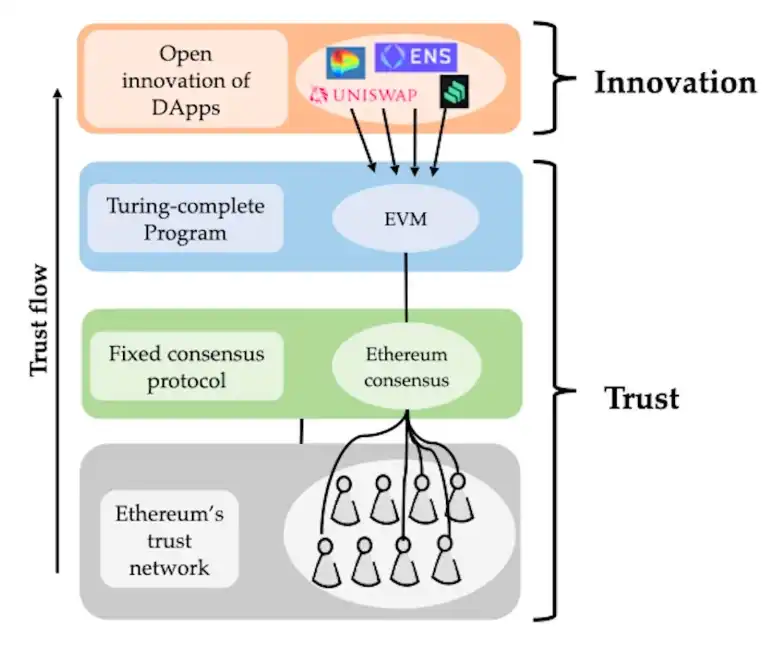
After The Merge, Ethereum changed from PoW consensus to PoS consensus. Compared with PoW mechanism, which requires miners to use hardware calculation power to reach consensus, PoS mechanism requires nodes to pledge certain funds and vote to reach consensus. Honest nodes get network rewards and will be punished once they violate the rules. This has two advantages:
First, the punishment mechanism can increase the Cost of Corruption while the Profit from Corruption remains the same, which helps to enhance the economic security of the trust layer.
Secondly, the protocol can achieve a finer governance structure for nodes, which can guide node behavior in more dimensions while expanding node governance ability. For example, Ethereum can dynamically determine the amount of forfeiture of malicious nodes according to the total amount of forfeiture within a period of time, and increase the severity of punishment for malicious collusion nodes. Or in inactivity leak mode, where so many nodes go offline that the consensus among the four epochs cannot reach finality, Ethereum can restore finality by forfeiting the funds of the offline nodes, ensuring the overall network activity.
Relying on this mechanism, Ethereum manages the rights and obligations of the trust layer nodes in a more balanced manner.
Limitations of the Ethereum trust layer
Ethereum's management of the trust layer is based on the in-protocol forfeiture mechanism of the consensus protocol layer. When non-Ethereum applications want to take advantage of the trust layer of Ethereum, they cannot forfeit node funds that violate the application rules but comply with the Ethereum consensus rules. In other words, these non-Ethereum applications cannot directly use Ethereum's trust layer as a foundation.
These non-Ethereum applications or middleware, such as protocols such as Prophets or cross-link Bridges, all require creating their own trust layer or active validated service (AVS), which effectively raises the barriers and economic burdens to innovation at the application layer and slows it down. Different AVS also lead to fragmentation of liquidity, which affects the economic security of each AVS.
EigenLayer is the answer
repledge
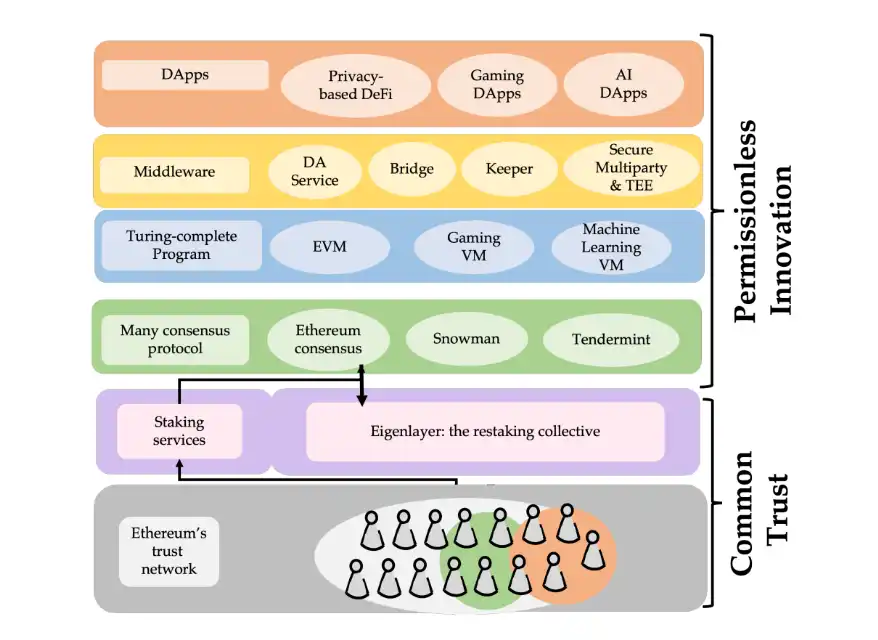
Given the limitations of the Ethereum trust layer, EigenLayer is staking its staking staking on the Etherum trust layer forfeiture system. EigenLayer creates a new smart contract-level forfeiture mechanism by retrieving credentials from nodes' funds via smart contracts.
When an Ethereum authentication node participates in authentication with EigenLayer, its money fetch address is set to the smart contract of EigenLayer, and if the node violates the rules of the application layer, EigenLayer can forfeit the ETH retrieved by the forfeit contract. Such a forfeiture mechanism enables the application layer to confirm the rights and obligations of Ethereum trust layer nodes through smart contracts, making it possible for other applications or middleware to exploit Ethereum trust layer.

The market for trust
On top of that, EigenLayer will build an open trust marketplace to monetize trust. First of all, Ethereum trust layer nodes as suppliers and as demand-side application layer protocol through the free market mechanism to determine the transaction content. Secondly, the node decides whether to participate in the verification of an application in order to obtain additional revenue according to its preferred risk-benefit ratio and forfeiture conditions. Application-layer protocols can easily purchase "trust" at market-based prices, so that they can focus on protocol innovation and operation at the application layer and achieve a balance between security and performance.
Externalities of EigenLayer
EigenLaler's impact on the Ethereum ecosystem is also positive and negative, based on its innovative design of a repledge and trust exchange marketplace
Positive externalities
1) Accelerate application layer innovation
Eigenlayer further separates and modularizes Ethereum's trust layer from its execution layer by building a marketplace for trust. Non-ethereum applications can easily gain trust using a modular trust layer, greatly reducing the financial barrier to security. This benefits applications and middleware protocols that value economic security such as predictors, data availability layers, decentralized sequencer, cross-chain Bridges, side chains, and so on, allowing them to focus on protocol innovation and user experience. Similar to Web3 social protocols, when social data sinks to the data layer and all social protocols can easily access the data layer without access, application innovation and user experience will be rapidly improved.
2) Help protocol layer innovation
Since EigenLayer has a forfeiture mechanism at the level of intelligent contract with the same effect as that at the level of consensus protocol, it can also create some other rules for nodes to obey without changing the existing consensus mechanism, achieving the effect of quasi-consensus mechanism.
For example, to solve the problem of single-slot finality, Ethereum currently uses the Gasper protocol, which can only provide finality for the first block (checkpoint block) in each epoch, but cannot provide finality for each slot in the epoch temporarily. But by using EigenLayer, the node is guaranteed the option to continue building along the main chain containing a slot block so that each slot gains finality, and the node that breaks that promise is forfeited money.
Another example is solving partial-block Mev-Boost problems in MEV. Currently, block builders can only submit full blocks through MEV-Boost, and a proposer can only see the full block content after signing a block header and pledging to add blocks as the builder wants -- in an attempt to prevent a proposer from stealing blocks for their own profit.
EigenLayer can have the builder submit part of the block, the rest is constructed by the proposer itself, and its funds are forfeited by EigenLayer when the proposer fails to include part of the builder's transaction in the final block, as agreed. In this way, a wider range of block proposers can also participate in block construction and receive a portion of the MEV revenue, thus inhibiting the centralization of block builders. In addition, since more centralized block builders cannot be responsible for building all blocks, proposers randomly selected by the consensus mechanism can also participate in block building, improving the censorship resistance of Ethereum transactions.
3) Promote economic security of Ethereum trust layer
EigenLayer lets Ethereum nodes choose to obtain additional benefits after evaluating the risk-benefit ratio, and the return rate of Ethereum node pledge will become higher, which will further lead to more ETH being used for pledge, promote the economic security of Ethereum and the security provided for application protocols, and form a good positive feedback.
4) Improve the decentralization of Ethereum trust layer
On the one hand, EigenLayer offers higher collateral revenue for individual nodes and will incentivize more people to run them themselves. On the other hand, the application protocol can require only individual nodes to participate in the authentication, which can not only improve the degree of decentralization of the application, but also improve the degree of decentralization of the entire Ethereum trust layer.
Negative externalities
1) Damage to Ethereum trust layer caused by abnormal forfeiture
In addition to the normal forfeiture caused by rule violations, the entire system may also have abnormal forfeiture due to code bugs or malicious protocols, even honest nodes will be forfeited money. When improper forfeiture results in massive forfeiture of honest nodes, the economic security of the Ethereum trust layer is also greatly damaged.
To minimize this negative externality, EigenLayer has two strategies. The first is to reduce the risk through strict audit, and the second is to provide a one-vote veto system for forfeiture. The governance committee can veto forfeiture by one vote through multiple signatures, providing a guarantee for extreme cases.
2) Trust leverage caused by repledge
In the open trust trading market, trust layer nodes can obtain additional revenue by repledging to provide validation services for different protocols. When the trust layer fund provides verification services for the application/middleware layer with a large cumulative value in order to obtain more benefits, it may bring leverage extreme to the trust, making the damage benefit higher than the damage cost and reducing the economic security of the trust layer. Therefore, the subsequent practice needs to give more accurate answers to the limitations of node repledge and the balance between benefits and security of the trust layer.
summarize
In the future, blockchain will enhance its performance through a high degree of modularity and outsourcing of some responsibilities. EigenLayer is building something that will benefit not only the Ethereum ecosystem as a whole, but the ecosystem beyond it. In addition to the points mentioned above, EigenLayer is positioned to radically change the current block-limited model and become a new testing ground for breaking Ethereum's tradeoff between democracy and flexibility by leveraging node excess pools, thus infusing new business models with more possibilities.
EigenLayer, meanwhile, is also working on new products including EigenDA, the Ethereum Hyper-scale Data Availability Layer, which aims to enable cheaper, more consistent fees, as well as higher data availability bandwidth. EigenLayer also has plans to work with teams like Mantle Network to push this technology into the broader scene, and we're excited to see how EigenLayer will impact L2's future.
Original link
Welcome to join the official BlockBeats community:
Telegram Subscription Group: https://t.me/theblockbeats
Telegram Discussion Group: https://t.me/BlockBeats_App
Official Twitter Account: https://twitter.com/BlockBeatsAsia

 Related Articles