The ARB Trade shines, revealing the secrets of Trade Joe V2

Original title: "ARB Deals Shine, Reveals Trade Joe V2"
Originally written by CapitalismLab
Recently, Trade joe V2 was hot because it grabbed a lot of Arb trading share from Uniswap, and the price of the currency quickly doubled. So how exactly does it work? What does it take to provide liquidity?
This article will help you understand the DEX better by taking a look at Joe V2's mechanics, analyzing why it is capturing a large share of $ARB transactions, and analyzing the product's strengths and weaknesses.

Trade Joe V2 in a nutshell:
Amms are similar to order books and use discontinuous liquidity
Minimum price accuracy is based on scale rather than fixed value
Vertical convergent mobility leads to better composability
The liquidity incentive is based on the transaction commission of LP acquisition and the effective TVL
AMM mechanism
The ARB/ETH 20bps pool in Joe V2 is taken as an example for further analysis. First let's look at the mobility distribution of the pool, which at first glance looks very similar to UNI V3.
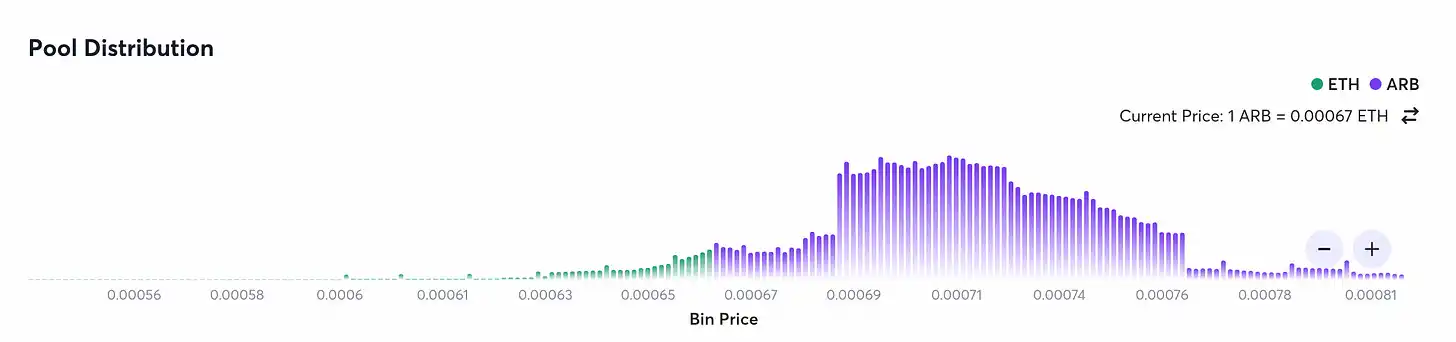
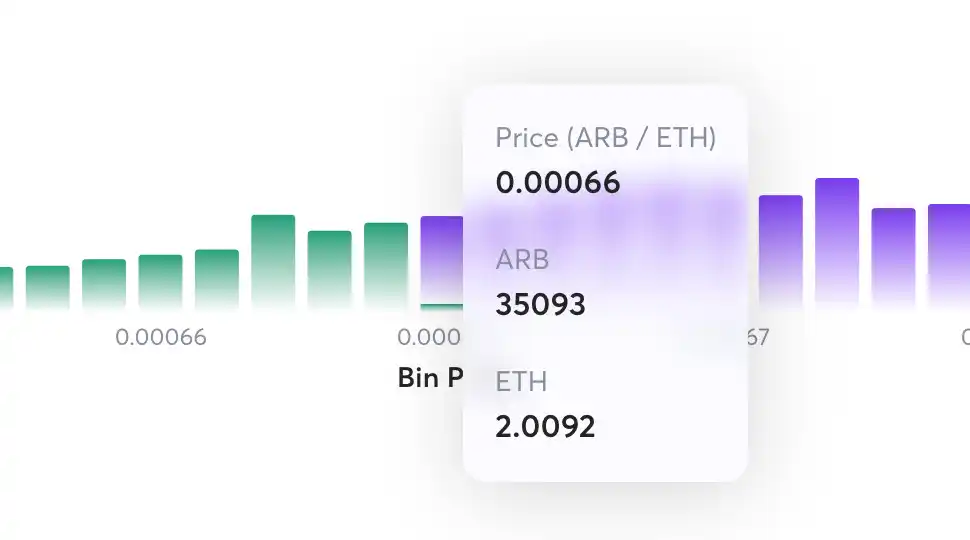
So what's the fundamental difference? A strip (bin) of Joe V2 corresponds to a single point price, which means that the price will not change until you run out of liquidity in this bin. For example, in the figure below, you can see that the Bin contains about 35k ARBs and 2 ETH. If someone sells ARBs worth 2E for 0.00066, then the transaction Bin will move one digit to the left and the price will change.
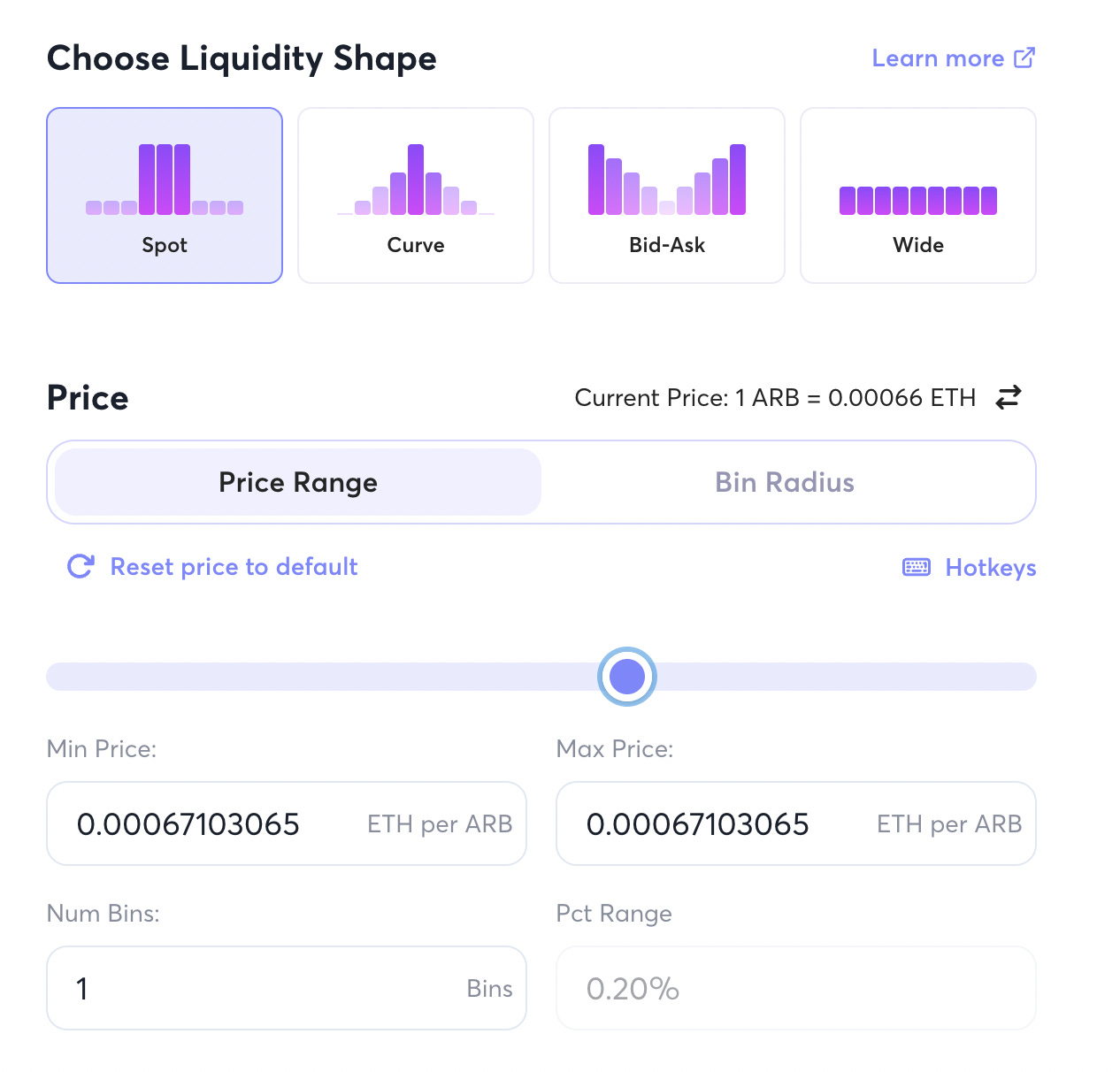
We tried to add liquidity to the pool, and found that it was possible to add a single point of liquidity, that is, the added liquidity is at a price, which is actually equivalent to placing a Maker order in the order book. What about the Pct Rage = 0.20% next to it?
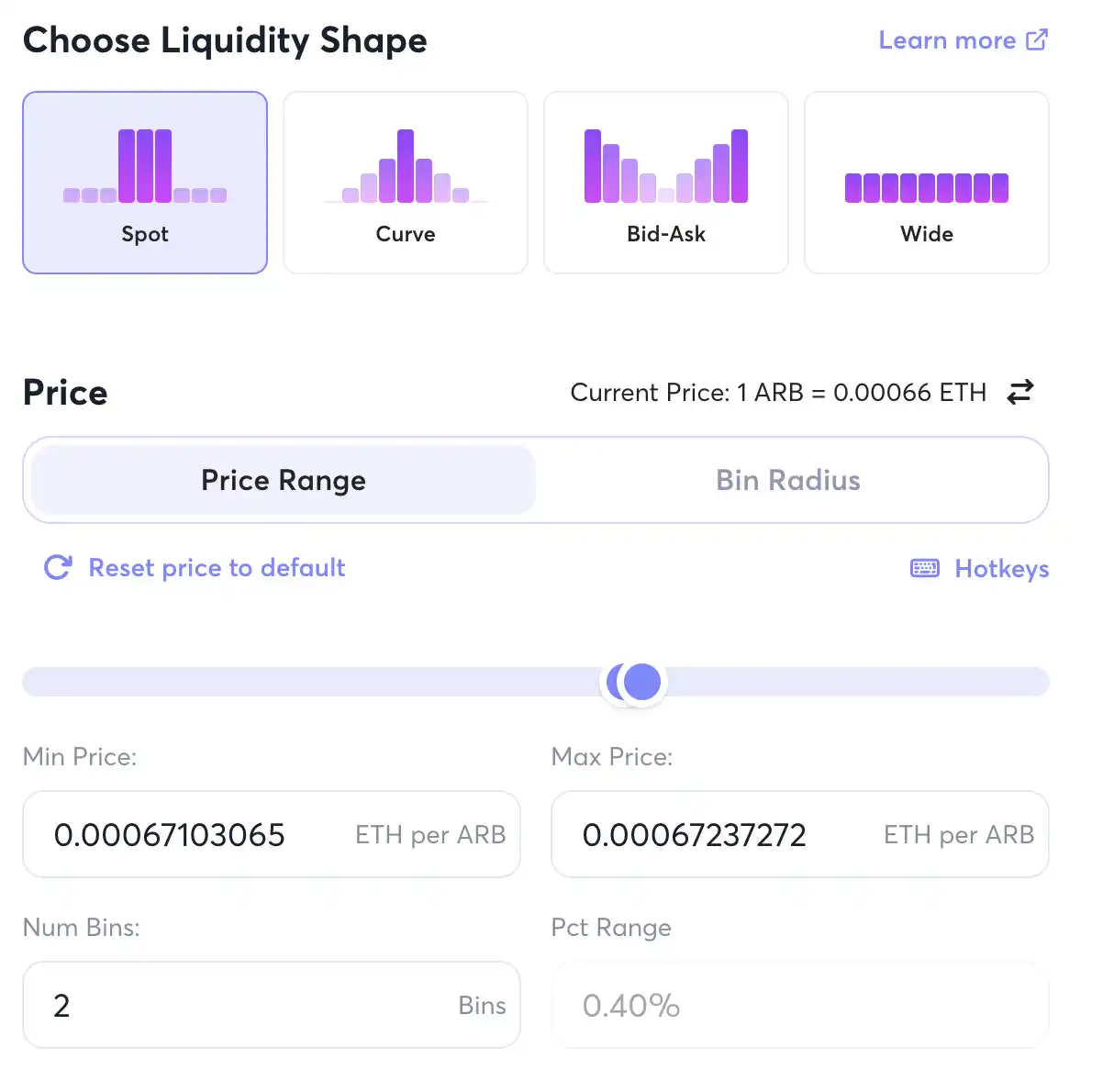
We move the right slide button slightly to expand the price range to 2Bin and calculate the relative difference between the two prices.
(0.00067237272-0.00067103065)/0.00067103065 = 0.20%
In other words, 0.20% is the minimum price accuracy
Let's look at big deviations from the current price, such as ARB/ETH = 0.0001. It can be concluded that
(0.00010035504-0.00010015473) /0.00010015473 = 0.20%
Right, so it means that the difference between the top and bottom prices in any position is 0.2%, based on a scale rather than a fixed number. This is quite different from the traditional order book, which usually gives a fixed minimum accuracy, such as 0.01 USDT.
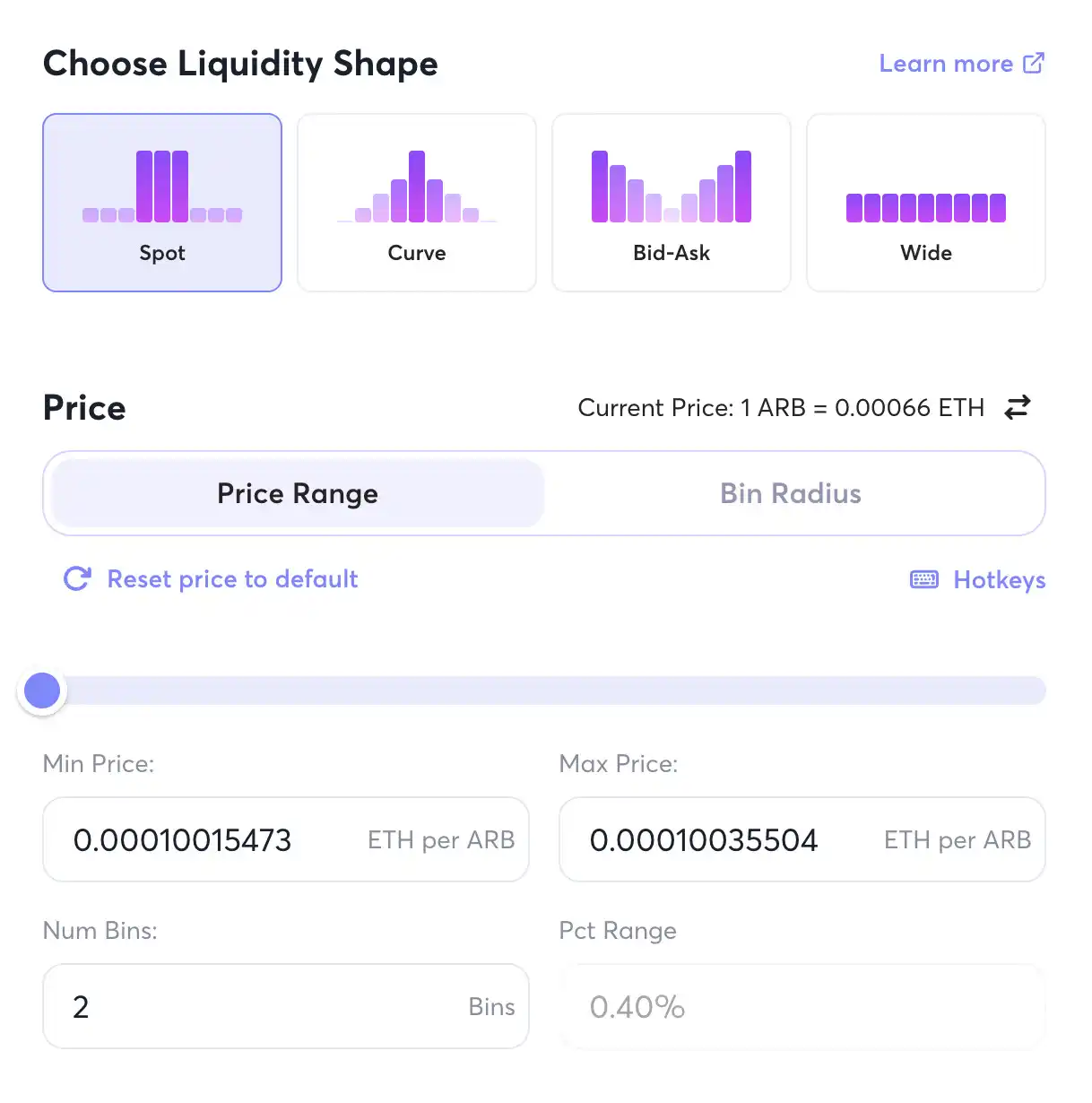
Joe's UI also provides four ways to add liquidity. Click on "learn more" in the upper right corner of the image for a detailed definition, but with the exception of Spot, the other four use official parameter values, which are not controllable. So I suggest using Spot, save in a similar way to UNI V3, but save in several different price ranges. Also, Joe V2 currently has liquidity incentives, so you have to think about the payoff of this.
Liquidity incentive
Currently, these pools with the "Rewards" tag after their name have liquidity mining incentives
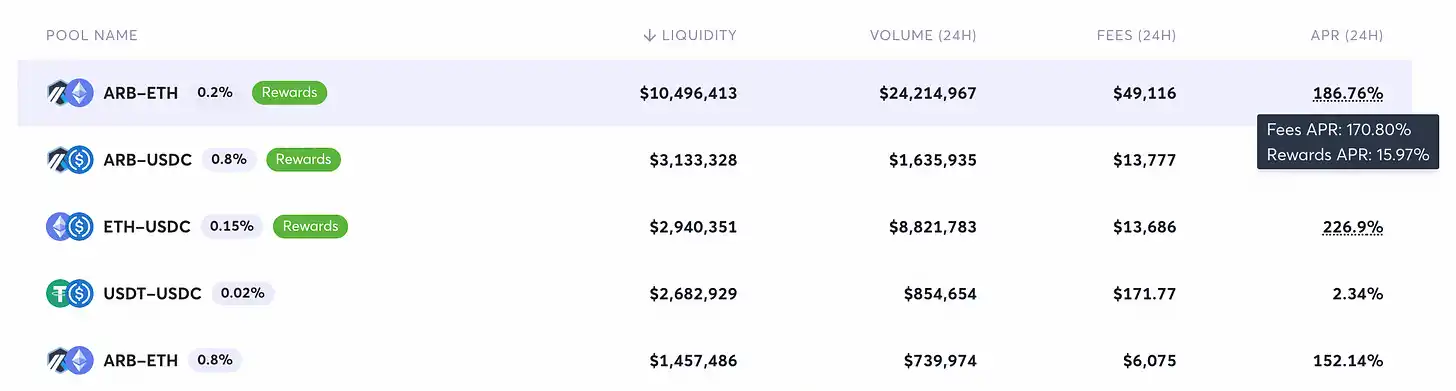
Joe V2's Liquidity Mining incentive distribution model:
1. The score is calculated according to the transaction commission actually obtained by LP and MakerTVL, as shown in the figure below
2. MakerTVL currently only looks at the current price + -5bin, such as 0.2% Bin width of Arb/ETH, then only the TVL within the current price +-1% will be credited
3. After the end of an Epoch, collect statistics on the scores within the Epoch and allocate them in a centralized manner
That is to say, if you want to get liquidity incentives, you need to provide liquidity more centrally.

For more details, seedocument
Why is the $ARB deal gaining so much share
Assume the current market is continuously buying Arb, Uniswap Arb/USDC = 1.005, assume Joe V2's price accuracy is 1%, and bin distribution is [0.99, 1.00, 1.01... . At this time, the current bin of Joe should be 1.00, which is 0.5% cheaper than Uni. As long as the transaction fee is smaller than this gap, the transaction of buying ARBs through aggregators such as 1inch will naturally give priority to Joe, whereas the transaction of selling ARBs will have no advantage. That is to say, it has advantages under the high volatility unilateral market, while the low volatility monkey market is more mediocre.
In addition, Joe set 0.2% fee for ARB/ETH trading pair, and at that time, due to high fluctuation expectation, UNI could only set four levels of 0.01%, 0.05%, 0.3% and 1%, and most LP was above 0.3%. Compared to Joe's 0.2 percent.
The recurring exchange rate advantage under high volatility plus relatively low rates makes Joe V2 in ARB 0.00 & have spent The initial startup acquired a large share. Now, with the decline in volatility, its exchange rate no longer has a recurring advantage; UNI V3 LP returns to the 0.05% fee pool, and basically loses the rate advantage. Fortunately, the reputation has been hit, and it has a good incentive mechanism, which gives the project side more room to operate.
Product advantages and disadvantages
In fact, the advantages and disadvantages of the AMM mechanism have been illustrated in the above discussion of Arb transaction shares. This section discusses other aspects:
Advantages:
1. Vertical converging mobility leads to better composability
2. High efficiency + support incentives, can get incentives from partners, such as expected to benefit from LSD war
Disadvantages:
1. There is no mature token enabling mechanism such as Bribe, and token holders benefit from it is limited
2. Transient loss is relatively large
Advantage: Composability
This is because in Joe V2, liquidity is aggregated vertically through each bin, whereas in Uniswap V3, liquidity is aggregated horizontally. The main benefit of vertical convergence is that it allows liquidity to be fungible.

If we look at a specific transaction of adding liquidity, we will find that Joe returned a large number of ERC-1155 LBT with different Token ids to the user after the user added ETH/USDC, reflecting the liquidity distribution of the user at different price levels.
This is quite different from UNI V3, which returns a single NFT. Because the same Token ID represents liquidity within a single Bin/ price level, it is homogeneous and has better composability.

Advantage: Partner incentive expectations
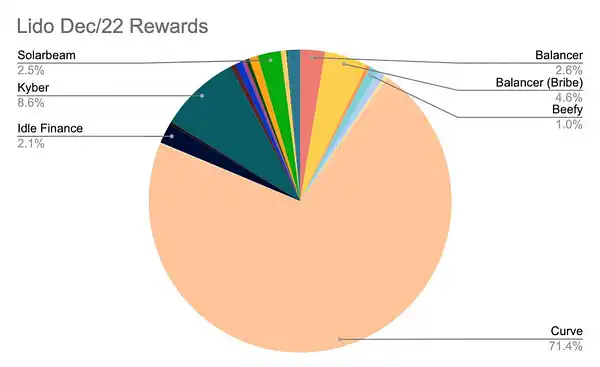
Concentrated liquidity efficiency + support incentives, which is expected to attract partners with liquidity needs such as LSD to provide incentives. For example, UNI V3+ incentive model Kyberswap obtained incentive allocation from Lido that was second only to Curve (see the tweet below). And occupy a large share of Alt-l1/L2 LSD transaction volume.
Joe V2, which offers similar value, theoretically has the opportunity to boost TVL and volume.
Disadvantages: Token enablement issues
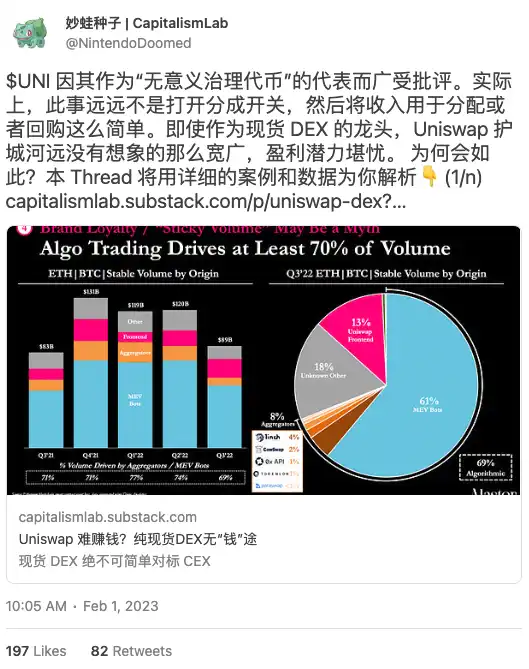
As I mentioned in the tweet below, pure spot DEX is difficult without an extra power mechanism such as bribe. Empty TVL and trading volume will not translate into revenue for the token holder.
At the moment, Joe gets his income by taking a percentage of the fee, but if he takes too much, he will lose his share. The Ve Joe model is still a problem, but it is not a copy of the Curve Bribe, so far it hasn't been very successful.
Disadvantage: impermanence loss is relatively large
As mentioned above, Joe V2 has a recurring exchange rate advantage in a single market, but this is actually a larger transient loss for LP, which is equivalent to selling the currency cheaper.
Joe sets reasonable fees to make up for this, such as 0.8% for ARB/USDC at 1% bin width and 0.2% for ARB/ETH at 0.2% bin width. Plus, it's not easy to notice, so it's fine.
summarize
Compared with UNI V3, the efficiency of Trade Joe V2 is more about the differentiation advantage in specific scenarios, and the play of the advantage of high composability depends very much on its own scale. Therefore, we should continue to pay attention to the BD and other operations of the project side in the future, to see whether BD can generate enough cooperation incentives to build a growth flywheel.
Original link
Welcome to join the official BlockBeats community:
Telegram Subscription Group: https://t.me/theblockbeats
Telegram Discussion Group: https://t.me/BlockBeats_App
Official Twitter Account: https://twitter.com/BlockBeatsAsia