Silicon Valley Web3-GPT DAO was founded: Tech Revolution rhapsody for geeks
Original article by Will, BlockTrain
Silicon Valley Web3-GPT DAO Manifesto: Tech Revolution Rhapsody for Silicon Valley Geeks
Welcome to Silicon Valley Web3-GPT DAO! It is a passionate, innovative and collaborative organization that brings together Silicon Valley entrepreneurs, investors and leaders to discuss the unique power and potential of Web3 and AI technologies.
Our mission is to bring together Web3 and AI, two of the most disruptive forces of our time, to create a decentralized, autonomous and intelligent future. We believe that blockchain, decentralized finance (DeFi), GPT-4 and other AI technologies will bring new business models and application scenarios, bringing unprecedented value to human society.
In this DAO, we will delve into the integration of Web3 and AI technology and explore the potential innovation points and opportunities. We encourage entrepreneurs to try, explore and practice bravely. Whether it is in the fields of DeFi, NFT, DAO, virtual world, or chatbot, smart contract, data privacy, decentralized computing, we will fully support and provide necessary resources.
Ramble, founder of Web3-GPT DAO in Silicon Valley, said, "At Web3-GPT DAO, we value knowledge sharing and mutual learning. Not only will regular online and offline networking events be organized to invite industry leaders and experts to share the latest research findings and insights, but an open resource will also be established to keep members abreast of the latest technical information and industry developments."
In addition, we will strive to build a close ecosystem of mutual assistance and build a cross-industry and cross-field cooperation platform. From startups to industry giants, from technology research and development to marketing, we will provide strong support and promotion for partners, and jointly create greater value.
Share your notes offline
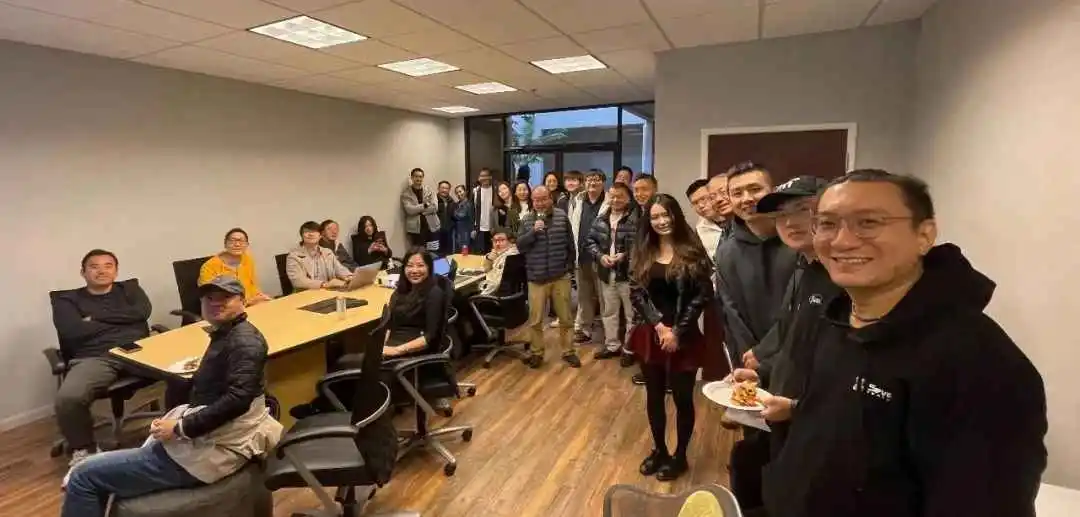
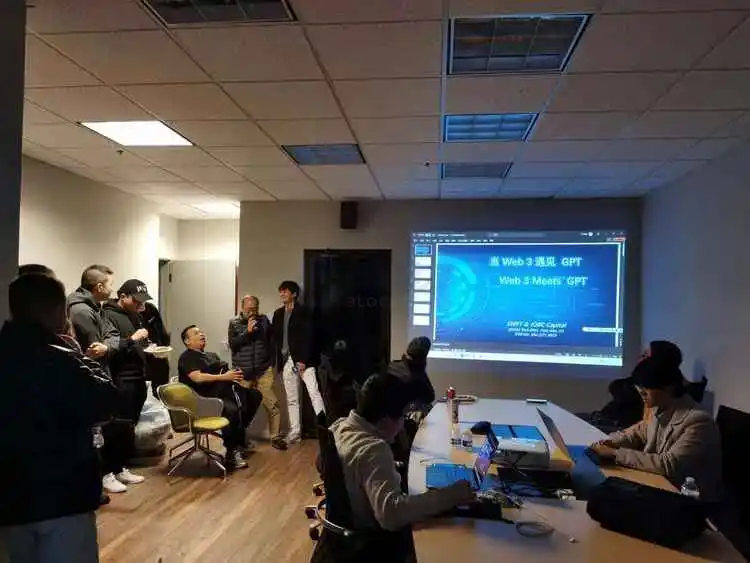
West time, Silicon Valley, the United States, March 22 at 6:00 PM, Silicon Valley Web3-gpt DAO joint SWFT Blockchain and the global innovative Web3 fund IOBC Capital successfully held the first offline activity, the site response is very warm. As of press date, 71 engineers, angel investors, VC founders, incubators, AI developers, community Kols, etc. from Silicon Valley high-tech companies have signed up to join (Registration list).
How does AI help with personal customization of videos and programming efficiency?
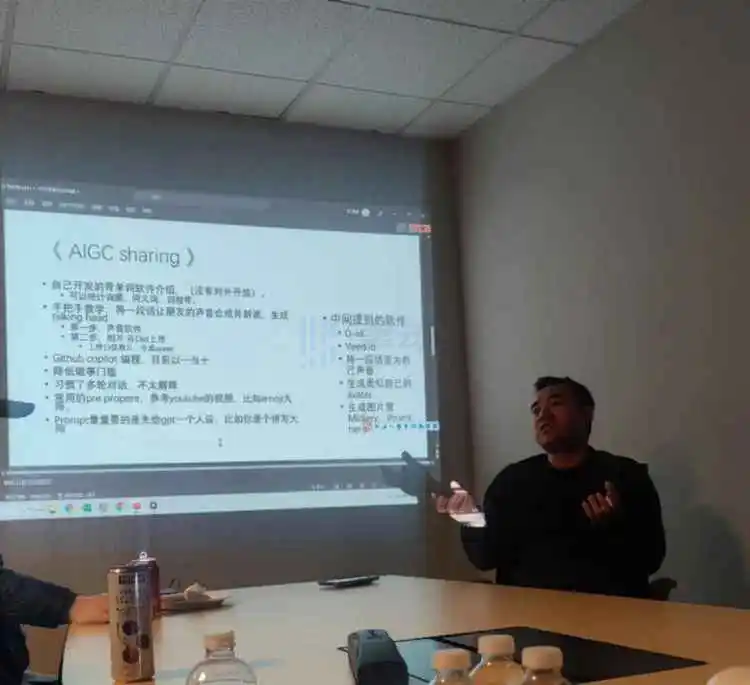
Share: Leo, PA Angel Fund founder, partner of Fission Capital and other funds
Leo shared how to use AI technology to generate customized videos. First, users can upload their voice through Eleven Labs, a sound synthesis software. Next, use FaceTune Labs to upload a photo of yourself to create your avatar. Using DID to generate video, users' avatars can talk to each other using their voice. If you're having trouble, you can just have GPT-4 write Python code that calls both companies' apis to generate exclusive videos with one click. In the future, everyone will have their own avatar.
Leo also shared his experience of learning Python for a year. After using GPT, he dared to write all kinds of programs. He also tried using GitHub Copilot, which allows programmers to be more productive. Through multiple rounds of conversations with the GPT, the GPT can be trained gradually so that it can fix itself when problems or error feedback occurs.
To capture the imagination of a GPT, Leo suggests giving them a title like "Best programmer" or "Master Speller." Then provide a 3-5 sentence example or context to make collaboration with the GPT faster. This lowers the barrier to writing programs, but users still need to have basic programming knowledge. As long as you understand the basic structure of the programming language and have a clear goal in mind, users can watch YouTube tutorials while collaborating with ChatGPT to be productive programmers.
About the potential of GPT, how to use it correctly, and the qualities of an entrepreneur
Sharer: Yang Ning, former founder of Chinaren, president of Skynet and famous angel investor
Yang also talked about the potential and opportunities of GPT. GPT, he argues, was in its early stages, like the Yellow Pages of the Internet, rudimentary but full of opportunity and energy. He believes entrepreneurs need to focus on the early stages of the tech wave, rather than rushing to cash in. He also points out that in the age of AI, creating something fun is more important than rushing to cash in.
On the history and working principle of GPT, Yang said that GPT is a huge breakthrough in the field of machine learning. In 2014, he visited the artificial intelligence lab at Stanford, where a team came up with the concept of a large language model. The grand language model is a model of how people understand the world. When people see a coke, if they close their eyes and want to describe the coke, they can't describe it perfectly, because the coke itself is not stored.
Previously, computers could only store pixels, but the brain doesn't work that way. The brain is a large language model. Coke's description is compressed information, and often makes mistakes. The way humans process information is not at the pixel level, but at the language level, described by language models. GPT works very similar to the brain in that it is based on the common sense formed by the vast corpus that humans acquire from their surroundings, and one cannot understand the common sense of human society if one grows up in the wild. The way GPT works is that there is a robot in the parent body that generates a clone when it opens a window. Over the course of the chat, the doppelganger learns and picks up something other than common sense.
Yang also stressed the proper use of GPT technology, which means having high emotional intelligence and good communication skills, not forcing them to perform tasks with command thinking, but inspiring, persuading and educating them, like communicating with children, to understand human needs and wishes. In the future, he believes that people who master human-computer interaction will be very powerful because they know how to interact with robots. OpenAI is a masterstroke because it applies the mathematical laws of the universe to artificial intelligence. OpenAI's model echoes that of other AI competitors, who struggle to achieve the same results. Currently, GPT-3 is event-driven and therefore very secure. This can be dangerous if the architecture is changed to iterate on itself.
Finally, Yang goes on to mention several qualities that GPT entrepreneurs need to possess, including:
1. Look at the big picture -- the industry, the market, and future trends -- rather than the immediate problems and opportunities.
2. Deep thinking, to have the depth of thinking about the problem, constantly ask why, explore the nature of the problem.
3. Focus on execution, be action-driven, focus on implementing your own plans and strategies, and not be swayed by short-term fluctuations and distractions. Innovation ability: Must have innovative thinking, constantly looking for new solutions and business models.
4. Teamwork, to have good teamwork ability, good at communication, negotiation and cooperation with others.

Insight on Microsoft and GPT
Sharer: Sean, Web3+AI entrepreneur, Dachang AI engineer
According to Sean, Microsoft demonstrated amazing engineering capabilities and foreshadowed other possible moves in the future. Since GPT-3.5 was released in November, Microsoft has been quick to announce its integration into the Bing search engine.
In March, with the release of GPT-4, Microsoft released a promotional video for the integration of GPT into Office. This series of initiatives demonstrates Microsoft's strong engineering ability, as well as their long-term vision in product development and ecological recycling.
Unlike the Internet 1.0 era, Sean points out that during the GPT dividend period, big companies are well prepared and competitive. He recalled Ms. Yang's reference to Stanford's Internet start-up in 1994, when big companies like IBM and Intel were slow to grasp the benefits of the Internet era. However, in the dividend phase of GPT today, big players such as Microsoft, Facebook and Google are quickly following suit, and the competition is fierce.
According to Sean, GPT will change the existing business structure. He suggests that it is best to start a second business based on GPT. He says small teams may face competition and substitution from larger companies, compared with starting a business directly using GPT. He stressed that the best strategy now is to raise awareness and platform content based on GPT. In the early days of the Internet, many people who rushed to make a quick buck failed, while those who focused on creating fun, playful products succeeded. While today's AI-driven business model is still in its early and nebulous stages, the excitement is shared, and the monetisation model is not yet fully mature.
Sean believes that the landing of large language models in the vertical domain is a direction to watch, and that there are great opportunities in the subdivision circuit. He says it is unrealistic to directly challenge Dachang's big language model. However, there are great opportunities to apply large models to verticals, such as GPT in the medical field or Web3 security audit GPT in a niche. Such a strategy would realize the full potential of GPT and bring tremendous opportunities for businesses.
Limitations of AI and human advantages
Share: CAI Kailong, Web3 senior practitioner, investor
CAI urged people not to be too pessimistic about the development of AI, arguing that people should occasionally be optimistic about AI. He recommends reading The 20 Most Important Things to Do in Investing to learn second level thinking and understand insight logic. From the first level of thinking, what AI can do is truly amazing, but from the second level of thinking, CAI is not worried about ChatGPT replacing human parts.
He believes that AI writing is still limited in three ways:
1. Association and leapfrog thinking. AI cannot do leapfrog thinking and association like humans. For example, it's hard for AI to produce a verse that says "flying 3,000 feet straight down."
2. Values: AI can't handle questions about values like humans. For example, when writing about a pandemic, it is difficult for AI to make proper judgments.
3. It can't replace human emotions. AI can't have real emotions like humans. As a result, AI still cannot compete with humans in creative fields, such as painting Van Gogh.
Given these limitations, CAI doesn't think people need to worry about being replaced by AI at this stage. He encouraged everyone to continue working with emotions, associations, thoughts and feelings, bringing out the best in our unique human strengths.
From pessimism to optimism, understanding the potential of AI and the competitive landscape
Sharer: Joe, Web3 entrepreneur
Joe, who studied under Professor Manning, said he was pessimistic about AI development six months ago, but now he is very optimistic. He believes AI's data and architecture are still flawed in many ways, making it difficult for other companies to catch up with the industry leaders.
Joe specifically mentioned NVIDIA (NVDA) as a possible company to watch. As a well-known graphics processor manufacturer in the world, Nvidia's investment and development in the field of AI has also attracted increasing attention from the industry.
The potential and challenges of AI in film and television production
Share by: Kartin; Founder of Hyperoracle
Kartin shared his experience in AI. He tried to start an AI project as an undergraduate and dabbled in AI research and AI-making movies two years ago. His project uses AI to generate images and then frames them to create short films. Scripts and films are created by AI, and humans only have to review the manuscript.
However, Kartin points out that two years ago, the state of AI technology was not ideal. You had to manually adjust every 10 frames, so it didn't actually increase productivity. This is because AI has a lot of imagination, but relatively weak reasoning ability.
At present, the AI can generate a maximum of six minutes of video, after which the chaos begins to appear. AI is limited in its ability to understand the relationship between frames, so it will be some time before the real freeing of human power in video production is achieved.
我们诚挚地邀请您加入 Web3-GPT DAO,成为这个充满激情与创新的大家庭的一员。在这里,您将结识到志同道合的朋友,发现前所未有的机遇,一起书写科技革命的辉煌篇章。让我们携手共创未来,引领 Web3 和 AI 技术的黄金时代!加入 Web3-GPT DAO,成为改变世界的力量!
Focus on BlockTrain, the world's first bilingual Web3 media. We will keep you updated with Web3 news and dry content. Have a great weekend and see you next time
Original link
Welcome to join the official BlockBeats community:
Telegram Subscription Group: https://t.me/theblockbeats
Telegram Discussion Group: https://t.me/BlockBeats_App
Official Twitter Account: https://twitter.com/BlockBeatsAsia
 Related Articles