The next new narrative in the NFT market: Open Loyalty.
Original Title: "The Next New Narrative in the NFT Market: Open Loyalty"
Original Author: starzq
Original Source: SevenUp DAO
After PFP, what is the next new narrative in the NFT market? Everyone is calling for more practical value NFTs, with Starbucks leading the way in creating more Loyalty-based use cases, while Nike is creating a virtual and real combination utility based on Fashion.
Last time when I analyzed Starbucks, I mentioned that once the membership data is put on the chain, there will be a shift in the business paradigm. The private members of each company will become public data, and my members will also be your members. The method for brands to acquire users will shift from pull to push, and the value will return to the users. At the same time, brands need to learn new ways to communicate with users.
However, at that time, more of it fell on the theoretical level, which made many readers feel unsatisfied.
This week, I listened to a podcast called "UnderStanding Open Loyalty". Brent, the CMO of Smart Token Labs, believes that putting member data on the blockchain essentially constructs an Open Loyalty system. He shared valuable insights and case studies, which filled in some gaps for me and provided a learning opportunity.
TL;DR
In the industry that suffered from "offline" in web2, more value has been captured through Token and Open Loyalty.
I have compiled 3 cases and their value points. Please feel free to read.
Karma Electric Vehicles: Accelerating Digitization and Building a Low-Friction Ecosystem Alliance.Bogota Devcon: Building a Flash Open Marketplace, Capturing Incremental Value.
Volkswagen: Building a New Way to Acquire Customers for the Brand
1 Karma Electric Vehicle: Accelerating Digitization and Building a Low-Friction Ecosystem Alliance
We have become accustomed to a world where everything is digitized, but some industries are still relatively "offline". The automotive industry is one of them.
Around the car, there is a rich third-party service ecosystem, including registration (Motor Vehicle Administration), insurance, maintenance, sharing, leasing, mortgage loans, clubs...
In the third-party service ecosystem, each piece of information is incomplete and isolated, lacking a way to comprehensively inform all ecosystem stakeholders about automotive information.
The following two points have caused...
Car owners have a poor experience: they need to actively seek third-party services and repeatedly submit their information (making individual phone calls is really annoying).
Third-party service efficiency is low and costs are high: they need to actively acquire users (through advertising, buying data, etc.). On the one hand, this is low-cost and efficient, but on the other hand, it often disturbs users instead of providing services (such as when a user buys insurance A and then receives a call from insurance B).
The contradiction here is that while networking and autonomous driving seem to turn cars into digital assets, ownership still remains in the paper age and is fragmented.
In 2020, luxury electric car brand Karma Automotive, headquartered in Southern California, launched a hackathon. The Karma Car Token provided by Smart Token Labs has the potential to better address the aforementioned issues.
Karma Car Token is created based on the unique identification number of a car, VIN, representing its ownership.
This token can be stored in any cryptocurrency wallet. Based on TokenScript protocols, Karma Car Token also serves as a digital key that can unlock and start the car, as well as provide information on the car's location.
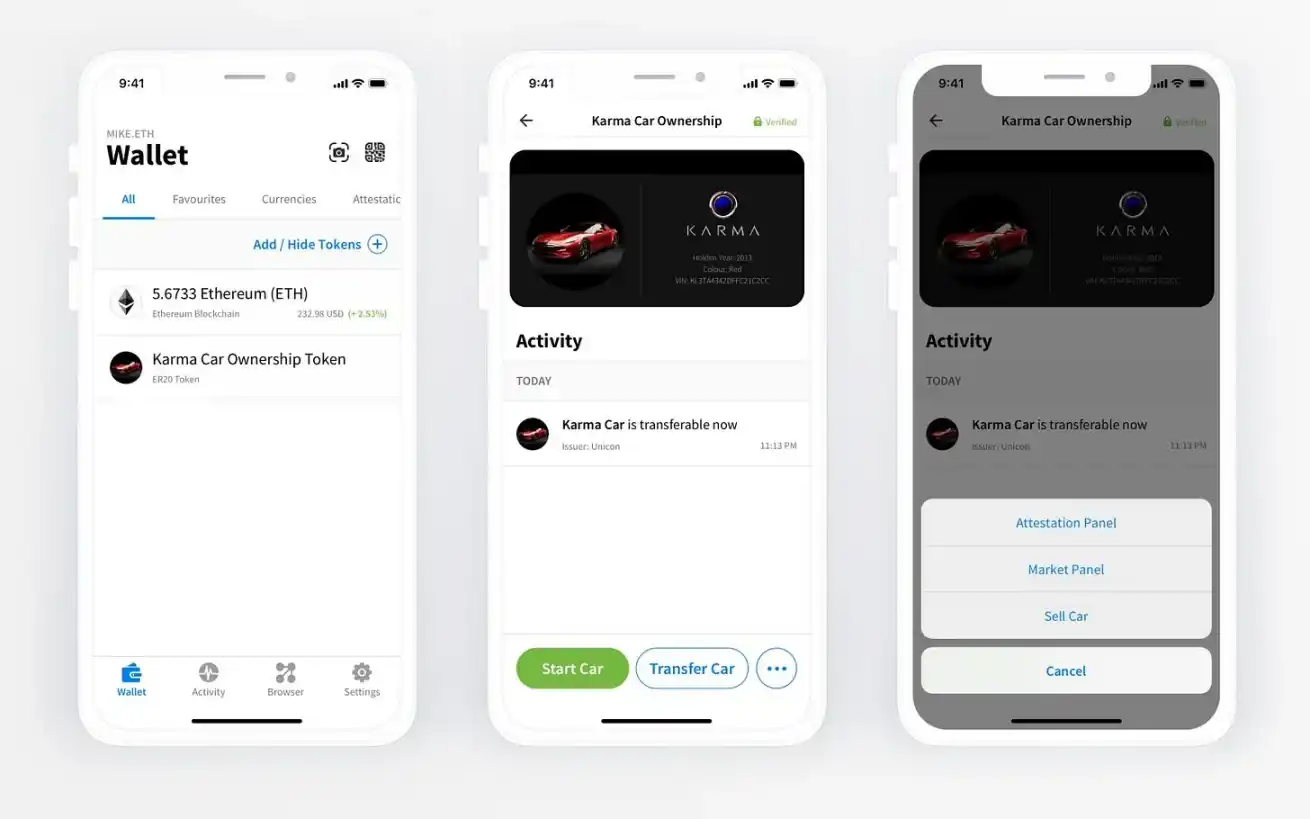
The Token can be transferred and sold on Ethereum.
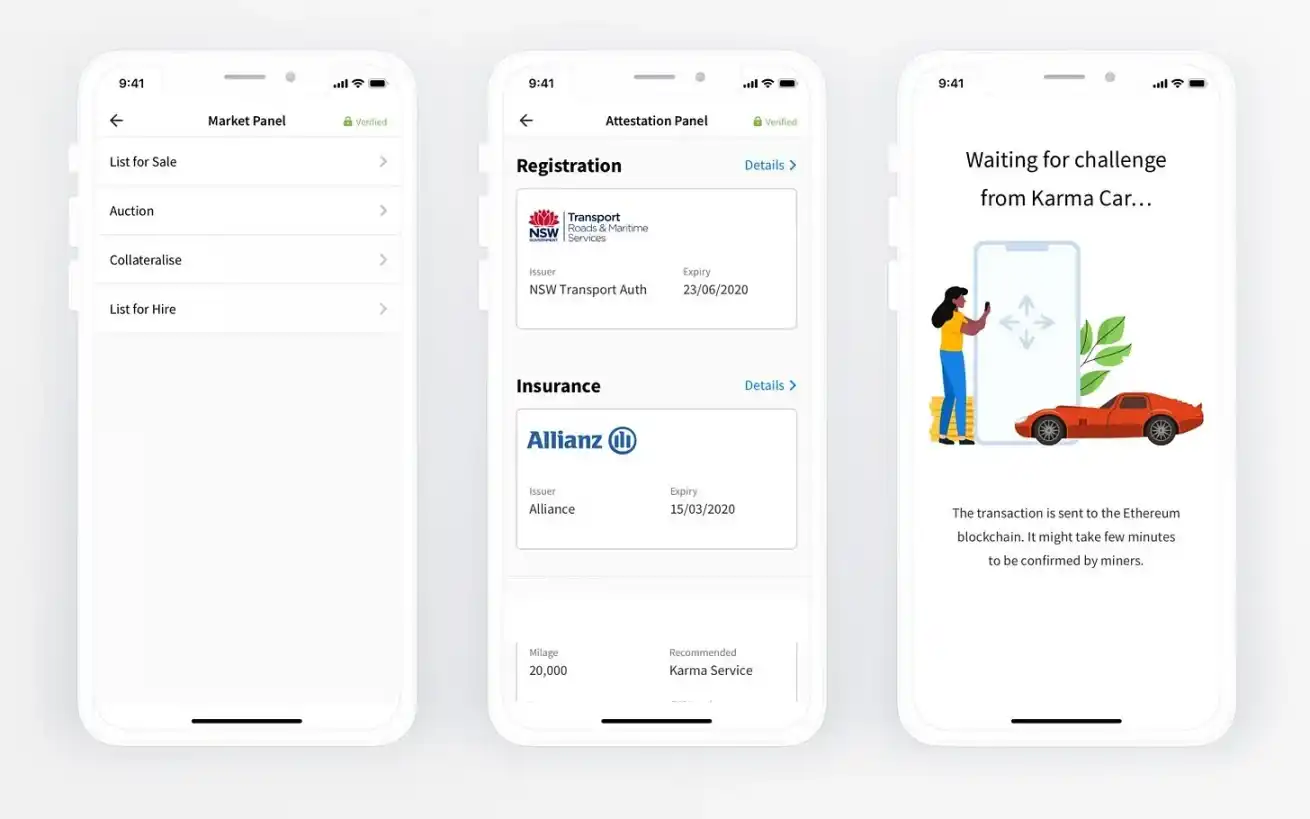
Based on Car Token, the entire ecosystem realizes Open Loyalty, and users become members of all third-party services at the same time. All services become simpler.
Sell & register: Users can directly list Tokens on the marketplace. After discovering the transfer of Token wallet, the vehicle management bureau can directly read the new Token-related information (owner's name, contact information, address) to update the registration information, without the original owner having to cancel it at the vehicle management office and the new owner having to register again.
Mortgage loan: Car owners can complete the loan service through Token on BendDao. Not only can blue-chip NFTs be mortgaged on BendDao, but cars can also be mortgaged.
Insurance: Insurance companies can know the insurance status of this vehicle and provide discounts to the owner as needed, instead of blindly disturbing them.
Car Owner Club: Based on Token, it is easier to verify the identity of car owners, and token gated also ensures the privacy of the community and activities.
Sharing: NFT sharing has not found a good landing scenario. Shared cars are a good use case.
So we see that an ecosystem alliance with less transaction friction is established based on Open Loyalty, benefiting both users and service providers.
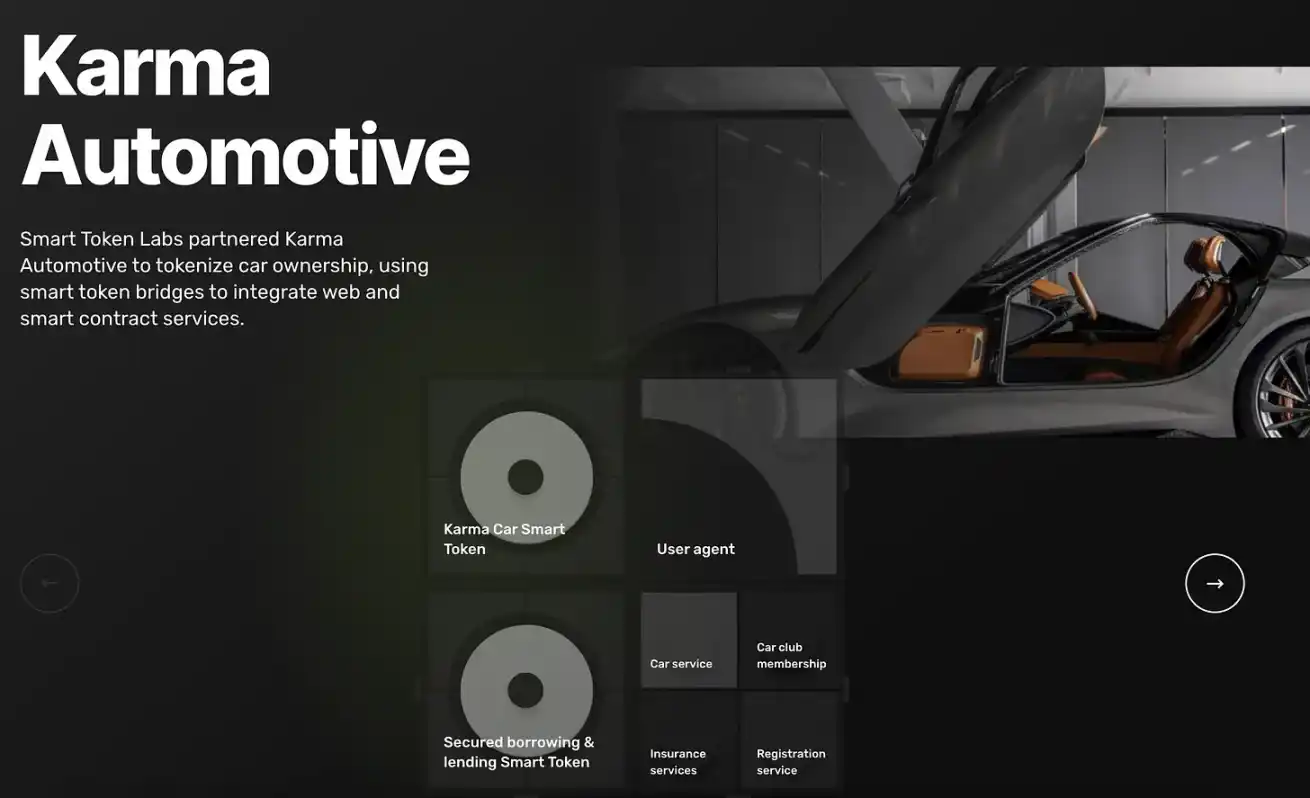
2 Bogota Devcon: Building a Flash Open Marketplace, Capturing Incremental Value
Another "offline" industry is conferences, which share similar pain points with the automotive industry:
The profiles of the conference attendees are very accurate, and there are also a series of third-party services surrounding them, both online and offline.
However, it is difficult to identify participants, and due to the non-continuity of the conference, the ROI of building digital identities and platforms is not high (it is difficult to develop an e-commerce website for a week-long event), and it is even more difficult to form an ecosystem alliance like the automotive industry to capture its value.
Let's take a look at how Token and Open Loyalty solve this problem.
As a public goods partner of the Ethereum Foundation, Smart Token Labs provided token tickets to over 6,000 attendees of Bogota Devcon. This means that through this public token, you can find these 6,000 high-quality Ethereum developers.
Interesting things happened, and 25 service providers emerged to provide rights to these Ethereum developers, including:
Polygon provides VIP seats for the After Party (used to establish connections for recruitment).
VC provides priority viewing rights for the deck.
A project team is offering virtual hoodies in Metaverse.
Designer provides free personal homepage design.
……
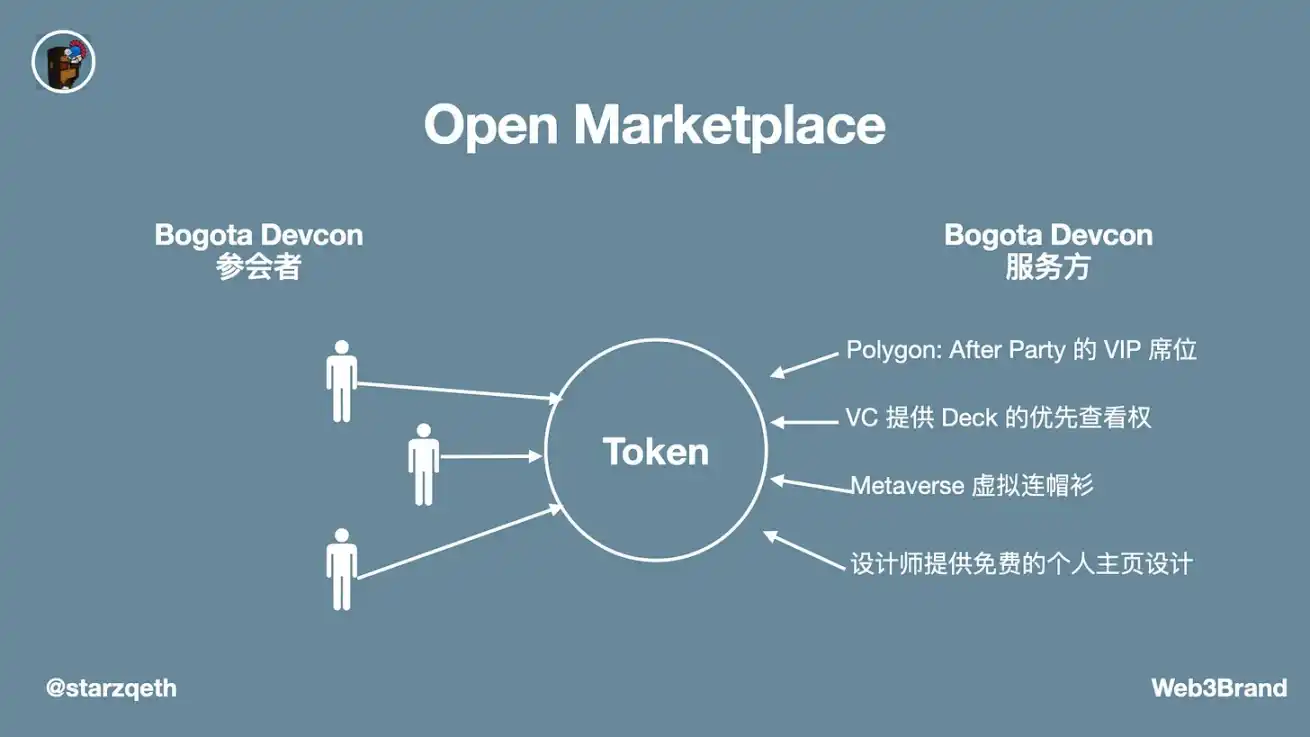
Through Token and Open Loyalty, these scattered service providers, rights, and Ethereum developers naturally aggregate into an Open Marketplace, where previously difficult-to-capture value can now be captured, bringing incremental value to the entire ecosystem.
3 Volkswagen: Creating a New Way to Attract Customers with Branding - Claim to Earn
In the past, brands mainly acquired users through advertising, which was costly and had limited accuracy, making it difficult to find B-class users. For example, if Volkswagen wants to find some influencers, how should they go about it?
Based on tokens, simpler ways can be created. Suppose you are a Reddit user who is very active in the car subreddit and has been rewarded with a related token. Now Volkswagen can create an Open Marketplace to offer rewards to users who hold car subreddit tokens, in exchange for leaving their email.
So the influencer was rewarded for sharing their data and email through Claim, and Volkswagen found their target users, capturing value from each other. At the same time, the advertising costs on Web2 platforms were saved.
Claim to Earn will become a more efficient customer acquisition method for Web3.
This method can also solve the century-old problem in the sports industry: how to measure the ROI of sponsors?
In the past, sponsors spent a lot of money on advertising in the stadium, but it was difficult to measure how many users and revenue it brought. Now, sponsors can use Claim to Earn to set rewards or discounts for users who hold match ticket tokens, accurately targeting users who are interested in them and calculating ROI. The century-old problem has been solved in this way.
Summary & Outlook
Through the Open Loyalty system constructed by member tokens,
- Accelerate the digitization of the "offline" industry, establish a more frictionless ecosystem alliance, and benefit both users and service providers.
In the industry of token digitization and building open membership systems, the pain of "offline" is certainly felt deeply in the web2 era. Are there any suitable industries such as automotive, sports, conferences, etc.?
- Building a fast-flash Open Marketplace to capture incremental value.
The conference industry, due to its offline nature and short lifecycle, makes it difficult to capture the value of its marketplace. Through Token and Open Loyalty, the roles scattered throughout are aggregated in the Open Marketplace, creating incremental value for the entire ecosystem, benefiting both users and service providers once again.
- Brand acquisition methods have shifted from advertising to allowing target users to Claim to Earn.
The user was rewarded for their own data, and the brand found the target user at a lower cost, capturing value from each other. In this entire flow, the value taken away from users in Web2 by the platform is returned.
After PFP, what is the next new narrative in the NFT market? Everyone is calling for more practical value in NFTs, hoping that the external positivity created by membership tokens and Open Loyalty can bring more users and value into Web3.
We're Still Early.
Original article link
Welcome to join the official BlockBeats community:
Telegram Subscription Group: https://t.me/theblockbeats
Telegram Discussion Group: https://t.me/BlockBeats_App
Official Twitter Account: https://twitter.com/BlockBeatsAsia