The bank went bankrupt and the trading platform ran away. The self-hosting OKX Web3 wallet is committed to asset security
At the beginning of 2007, mortgage defaults and foreclosures rose sharply in the United States, followed by the bankruptcy of New Century Financial, the second largest subprime mortgage company in the United States. The crisis caused by the subprime mortgage gradually spread to the credit market, and gradually turned into a financial crisis. Under the influence of the financial crisis, Lehman Brothers, a century-old traditional financial institution, suffered a major financial blow. After the US Treasury Department, Bank of America and Barclays Bank of Britain gave up the acquisition negotiations, it announced to file for bankruptcy. Lehman went into bankruptcy with $613 billion in debt.
A month after Lehman declared bankruptcy, Satoshi Nakamoto published a white paper on Bitcoin, which he described as a peer-to-peer electronic cash system. On January 3, 2009, Satoshi Nakamoto left "The Times 03/Jan/2009 Chancellor on the brink of second bailout for Bitcoin Creation block banks (Chancellor on brink of second bank rescue) "was the headline of the day in The Times.
History does not repeat the details, but the process does. Fifteen years after the 2008 financial crisis, America's banks have suffered another blow. On March 10, the California Department of Financial Protection and Innovation shut down Silicon Valley Bank, citing "illiquidity and insolvency", making it the largest US bank to fail since the 2008 financial crisis.
Silicon Valley banking breaks down, decentralizing opportunities
In fact, the bankruptcy of Silicon Valley Bank is not only a major strategic mistake, but also a systemic risk to the American banking industry. Founded in 1983, Silicon Valley Bank is the 16th largest bank in the United States, with total assets worth about $212 billion. Just three days before its bankruptcy, Forbes named it the best bank in the United States. The US Treasury Secretary Janet Yellen later said that the main reason for the failure of Silicon Valley Bank was the falling market prices of its holdings of bonds and other financial assets caused by the continuous interest rate hike of the Federal Reserve.
The bankruptcy of Silicon Valley Bank was not the end of the story. On March 12, the New York State financial regulator announced the closure of Signature Bank with assets of $110 billion. First Republic Bank of the United States, Western Union Bank and other stock prices plummeted.
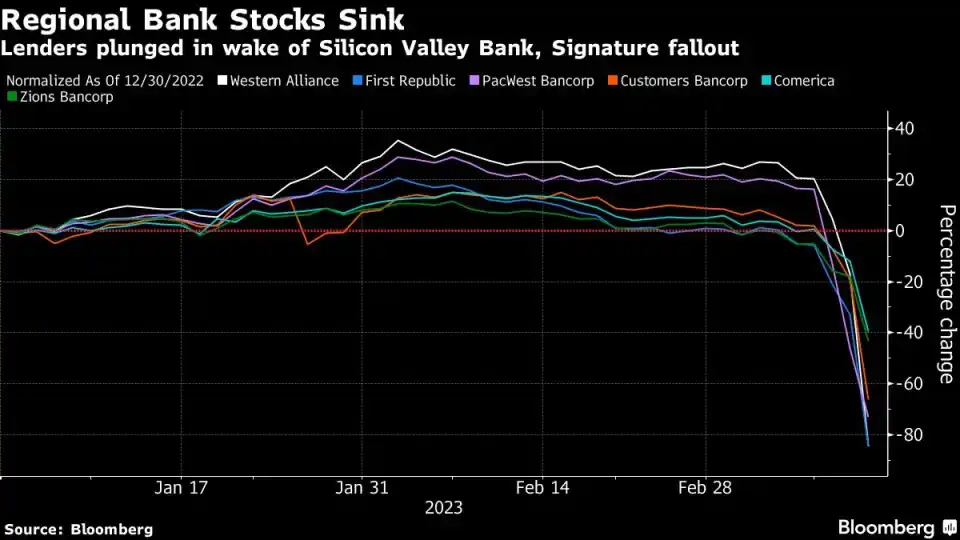
Photo: Bloomberg
Subsequently, the crisis in the traditional financial industry gradually spread to the cryptocurrency industry. Stablecoin giant Circle caused the price of its stablecoin USDC to plunge due to its 3.3 billion dollars deposited in Silicon Valley banks. The plunge in USDC prices triggered wild swings in crypto markets, and after a brief dip, investors seem to be reacting that perhaps it is better to hold decentralized assets than to trust banking institutions. Mainstream crypto assets such as BTC and ETH began to break upward. BTC briefly exceeded $26,000, the highest since July 2022, while ETH also broke the $1,700 mark.
The third revolution, decentralized finance
There have been two revolutions in human history, the agricultural revolution and the Industrial revolution.
The shift from hunter-gatherer to agrarian lifestyles was the first revolution in agriculture. The agricultural revolution, which involved a shift in the way food was available, laid the groundwork for subsequent population growth and accelerated urbanization, making the overall social structure more complex. The Industrial Revolution witnessed the transformation from handicraft industry to mechanized industry, which promoted the improvement of productivity and the division of labor. The result of the Industrial Revolution was a radical change in the economic and social structure of human society.
The industrial revolution made the division of labor more and more detailed, and the financial industry began to rise. All productive resources could be turned into financial assets that could be traded in the market. The booming financial industry gradually developed in every corner of the globe. In the current environment, however, finance is more of a minority business, with power and profits held by a small number of entities. For this reason, there has been one financial crisis after another. Moreover, the damage caused by the financial crisis needs to be borne by most people.
After the 2008 financial crisis, Satoshi Nakamoto launched Bitcoin, and the concept of decentralization became popular. With the popularization of Bitcoin and ETH smart contracts, decentralized finance (DeFi) has started the third revolution in human history. Compared with the traditional financial system, DeFi is free from the control of centralized institutions such as banks and can achieve more fair, transparent and efficient financial services. At the same time, DeFi users are able to hold their assets without having to hold them in escrow with a third party, essentially avoiding the tens of hours of queues for cash caused by runs on traditional banks.
Decentralisation, or DeFi, is the result of dissatisfaction with traditional finance and is a historical inevitability. As traditional centralized banks like Silicon Valley Bank decline, decentralization will be accepted by more and more users and become mainstream.
Self-hosting wallets will go mainstream
When users choose to hold decentralized assets, they often need to buy through a centralized platform. These centralized financial platforms, like traditional banks, are not transparent enough to judge whether they are misappropriating user assets. Therefore, when choosing a centralized platform, a platform with proof of Reserves (PoR), such as OKX, is an option. OKX provides the Merkle tree data architecture to ensure that data is securely encrypted and used to verify all user assets held by the trading platform. According to the latest data, Ouyi OKX holds more than 135,000 BTC, 1.34 million ETH and 3.1 billion USDT, all with a reserve ratio of more than 102%.
Not your key not your coin. The best option, of course, is to store your assets in a self-managed wallet rather than in a centralized platform. And the OKX Web3 wallet happens to be one of the most powerful and best user experience self-hosted wallets on the market today.
The OKX Web3 wallet is built into the OKX App and can be switched from centralized to decentralized with one click, facilitating simultaneous management of CeFi and DeFi assets. In addition, OKX Web3 wallet has completed the support of more than 50 networks, including Bitcoin network, EVM compatible chain, also supports Cosmos, Tron, Aptos and other non-EVM compatible chains, is currently the most comprehensive decentralized heterogeneous multi-chain wallet. OKX Web3 wallet supports current mainstream NFT and FT. Token users without support can also customize and add. With the OKX Web3 Wallet, investors can view the most comprehensive and clear historical information, including transaction dynamics and on-chain interactions.
In addition, the OKX Web3 wallet also comes with a host of DEX, NFT Marketplace, and coin earning apps that allow users to switch to OpenSea, LooksRare, and various GameFi apps with one click, eliminating the need to switch between apps.
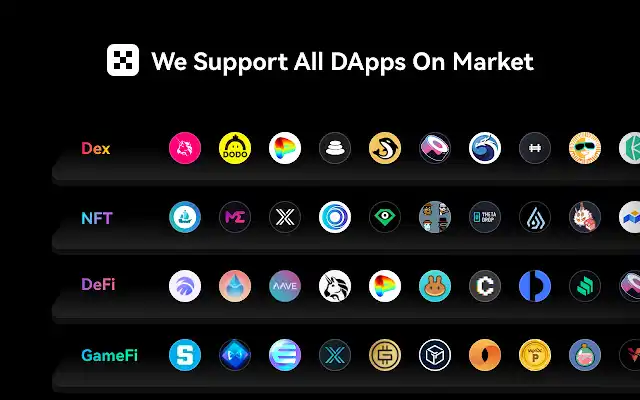
OKX Web3 Wallet App Market
The most impressive thing about the OKX Web3 wallet is its user-friendly design. OKX Web3 Wallet creates the most convenient wallet management method on the market by supporting the creation of multiple mnemonic wallets and a mnemonic derived wallet with multiple accounts. The management and backup of mnemonic words often need to choose between safety and convenience. The way of OKX Web3 wallet is to store the backup of wallet in iCloud and Google Drive. When the user changes the device, the backup password can be verified by the cloud storage to complete the mnemonic recovery, which improves the convenience and safety at the same time. Of course, the OKX Web3 wallet also supports gas conversions and hardware connectivity. When the user initiates the transfer or transaction and meets the insufficient gas fee, the user can quickly exchange the gas fee with one click.
However, self-hosted wallets, despite their current design excellence, are still less efficient than centralized platforms. The main advantages of a self-hosted wallet are security, openness and transparency, so users should weigh their needs and scenarios when choosing.
Decentralization benefits the public, and decentralization means efficiency
According to the past human development path, decentralization and centralization will coexist for a long time in the future process, but the direction of development will be different.
Decentralization will gradually change the economic structure of human society, bringing about a new paradigm shift and promoting greater transparency and sustainability in the financial sector. At the same time, it will eliminate the control of a single institution or individual in a certain field, and promote the whole social system towards more equality and democracy. Centralization, on the other hand, can achieve greater efficiency at the expense of some regulation.
Decentralized or centralized, they all have their own usage scenarios. The two complement each other to provide more perfect solutions and services for all walks of life. It is best to choose different methods according to your own usage scenario.
However, with the expansion of external risks, it is better to store assets in the safer OKX Web3 wallet than to fall into the prisoner's dilemma and participate in the game of asset run. In addition, the OKX Web3 wallet also supports one-button switching to the OKX App, which enables you to enjoy centralized efficiency anytime and anywhere.
Welcome to join the official BlockBeats community:
Telegram Subscription Group: https://t.me/theblockbeats
Telegram Discussion Group: https://t.me/BlockBeats_App
Official Twitter Account: https://twitter.com/BlockBeatsAsia