Deconstructing the Silvergate Crisis: Why did a crypto bank with a thousand top customers fail?
原文标题:《 解构 Silvergate 危机:拥有千名顶级客户的加密银行为何破产? 》
Original article by Danilo Lantas
Bai Ze Research Institute
Do you think the crypto market has been acting a little weird lately?
Last week, Silvergate, the most important bank in the crypto industry, shut down its trading network SEN, which had been used by large investors, companies, and stablecoin issuers to move billions of dollars in and out of the crypto market 24/7.
SEN's closure appears to have had a profound impact on the liquidity of the crypto market, while Silvergate's collapse also raises the risk that regulators will accelerate their crackdown on cryptocurrencies.
In this article, we'll look at Silvergate's origins, how it got here, and what its demise means for the crypto industry.
Ten years of evolution at Silvergate
Silvergate is a California bank founded in 1988. For its first 30 years, Silvergate was a small bank with just a few hundred million dollars in deposits. Thanks to the foresight of its executives, Silvergate was not affected by the 2008 financial crisis.
That same year, Alan Lane became Silvergate's CEO. Alan has over 40 years of experience in the banking industry in a variety of roles.

That's how the story begins. Alan also switched Silvergates' business to cryptocurrency after investing in bitcoin in his personal capacity in 2013.
In an interview in 2019, Alan said he met a company called SecondMarket at a conference that was in the business of providing liquidity to illiquid stocks, and that they were also exploring providing liquidity to smaller banks like Silvergate.
SecondMarket's founder and CEO is Barry Silbert, who also happens to be the founder and CEO of Digital Currency Group (DCG), the largest company in the crypto industry. SecondMarket contacted Silvergate in 2013 to try to get it to provide banking services for DCG.
Crypto companies have historically struggled to get access to banking services.
In fact, Alan was skeptical when SecondMarket first approached Silvergate. But after a few months, he became fascinated with Bitcoin and quickly realized that the crypto industry was an untapped "blue ocean" market. Then it started offering banking services to crypto companies.
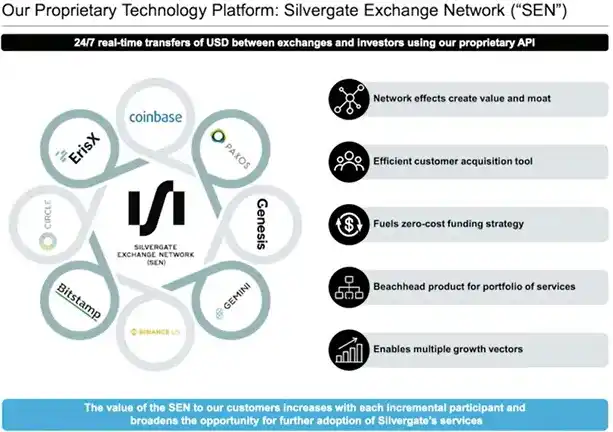
By 2017, more than 250 crypto companies had become companies. Silvergate's customers, whose deposits have grown to $2 billion. That same year, Silvergate came up with the idea of developing its own trading network, which would enable 24/7 trading of fiat currencies and cryptocurrencies. This is necessary because crypto markets trade 24/7. But banks only work 9 to 5 from Monday to Friday.
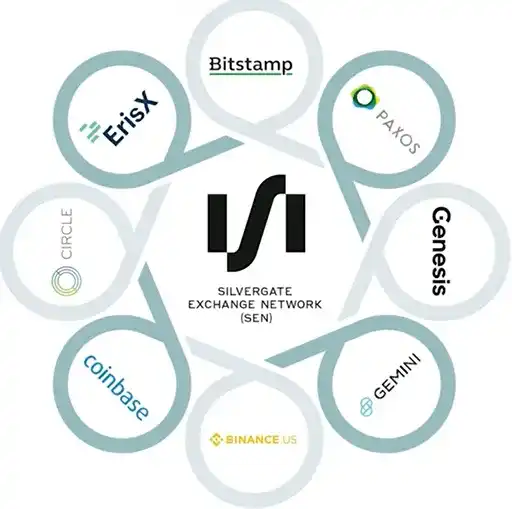
Silvergate's Trading Network Silvergate Exchange Network (SEN) launched in early 2018. It has attracted another 250 crypto companies as customers of the bank. This enables them to convert fiat currencies and cryptocurrencies at any time, ensuring strong market liquidity.
More importantly, Silvergate provides banking services and SEN network access to the largest crypto companies. These include Coinbase, Kraken And Gemini Such as cryptocurrency trading platforms and stablecoin issuers such as Circle, Paxos, and TUSD.
In 2019, Silvergate held an initial public offering (IPO), which meant that the bank's shares began trading on the U.S. stock exchange. Silvergate grew exponentially even though the crypto market was in a bear market at the time.

By 2020, Silvergate's customer base had grown to nearly a thousand, with hundreds more waiting to join. In early 2020, Coindesk offered Silvergates' customer base, and "the bank now has 850 cryptocurrency customers, including 61 trading platforms, 541 institutional investors and 48 other customers." It's worth noting that money from these institutional investor clients accounts for the majority of cryptocurrency market capitalization and trading volume.
In 2021, Silvergate's stock went parabolic with the re-bull crypto market, hitting a high just above $217, up nearly 16 times from its IPO price. Silvergate's deposits also grew parabolic, peaking at more than $14 billion. The total amount of money transferred through SEN at that time was close to $1 trillion.
Silvergate has fallen
Silvergate seems to be doing well in early 2022. The company announced a $200 million acquisition. Facebook The failed digital currency project Diem. The idea behind it seems obvious, Silvergate wants to create its own stablecoin to circulate on its SEN network and be used for payments. Keep that in mind. It's important at the end.
When the crypto market went into a "cold winter" in early 2022, Alan began receiving questions from customers "about bank solvency." This is because Silvergate provides the functionality provided by BTC Backed US dollar loans and provided over $200 million in loans to MicroStrategy using BTC as collateral. Obviously, it's pretty risky.
Alan has a simple answer for all the doubters, which is that SEN has the ability to immediately sell any BTCS used as collateral when the crypto market starts to collapse. Not only that, but Silvergate is robust compared to a regular bank, holding only cash, as well as clients' cryptocurrencies and cash.
Just one problem: FTX And Alameda Research.
Alameda Research Opened an account at Silvergate in 2018 and apparently passed the bank's investigation. FTX used Alameda's account at Silvergate to move customer funds, and Silvergate appears to have sensed something bad was about to happen shortly before FTX and Alameda went bust.
Shortly before FTX and Alameda collapsed, Silvergate issued a statement assuring customers that its SEN network was still working, and in this statement Alan made it clear that the bank had the ability to borrow from the Federal Home Loan Bank in the event of any liquidity problems.
On the same day that FTX and Alameda collapsed, Silvergate issued another statement confirming that FTX itself had accounts at the bank, but that FTX deposits accounted for less than 10% of all deposits. .
Although Silvergate shares rallied on the lack of FTX exposure, the recovery was short-lived. In December, US politicians began calling for an investigation into Silvergate's ties to FTX and Alameda.
In January, Silvergate revealed that it had experienced a run on its bank of up to $8.1bn after the FTX crisis, which wiped out all the profits it had made since 2013. Silvergate also had to lay off 40% of its staff to make ends meet, and later revealed that it had borrowed from the Federal Home Loan Bank.
Oddly enough, the world's largest asset manager. BlackRock Using the opportunity to buy on the dips, it took a 7.2% Stake in Silvergate, and another asset manager called Stake Street took a 9.2% stake at the same time.
In February, the Justice Department announced it was investigating Silvergate over FTX and Alameda. Silvergate subsequently became the most shorted stock in the market.
Earlier this month, Silvergate announced it was delaying the publication of its annual report, admitting it could face more investigations and admitting it might not survive. Last week, Silvergate shut down the SEN network after its highest-profile, top-tier crypto company customers abandoned it and moved to other crypto banks.

The latest news is that Silvergate is winding down its operations and liquidating its assets. Silvergates' assets could be acquired by a large bank like jpmorgan, giving Wall Street control of the crypto industry's most valuable financial infrastructure. So, now that Silvergate is out of business, what happens next?
"Ditch Silvergate for Signature" is not the optimal solution
As I mentioned a few words ago, most of Silvergate's top customers quit and went to other crypto banks. In theory, this sounds like a good solution for the customer, but in practice it creates two more problems.
Remember, Silvergate is the only crypto bank with a 24/7 fiat currency and cryptocurrency trading network that people desperately need. And there are only two other big crypto banks in the United States, Signature Bank and Metropolitan Bank.
Until January of this year, thanks to Operation Chokepoint 2.0. , Metropolitan Bank Announced that it would exit the crypto industry. (The original Operation Chokepoint was a coordinated crackdown on firms that U.S. regulators considered risky. By pressuring the banking industry to stop doing business with companies in specific industries, it marginalizes companies completely. 2.0 is the term coined by the crypto community to refer to the fact that in the past few months, every financial regulator in the United States has been attacking crypto, seemingly not interested in policing cryptocurrencies, but in shutting them down. )
This makes Signature the only viable option for most encryption companies. This is why most of Silvergate's top customers have recently switched to Signature.
The problem is that Signature announced back in December that it wanted to halve its exposure to the crypto industry. Frighteningly, Signature has since started limiting banking services to a few of the biggest crypto companies. Some may recall that Signature limited dollar transactions to Binance US in January. Well, they recently did the same thing with Kraken, which is truly unprecedented given its reputation. If that wasn't bad enough, Signature reportedly received $10 billion from the Federal Home Loan Banks in the fourth quarter of last year. That is almost three times the amount the Commonwealth Bank lent Silvergate.
This is very bad and could also lead to scrutiny of Signature by regulators. While Signature's customers don't appear to have the crypto companies in question, if Silvergate officially crashes, regulators and politicians will have the "crypto threatens the banking industry" excuse to crack down on Signature and any other remaining crypto banks.
Even if the few remaining crypto banks were somehow allowed to operate without censorship, it still wouldn't change the fact that the SEN network was shut down. I will reiterate that networks like SEN are necessary for crypto markets to function properly.
Without it, it's hard for institutions to get in and out of the crypto industry. What's more, without it, the flow of money to banks is limited to business hours, which would be a "disaster" for crypto markets, which trade 24/7.
So the crypto industry desperately needs new, Sen-like trading networks. But so far, only one crypto company seems brave enough to come forward.
A few days ago, the CEO of the BCB Group, a UK-based cryptocurrency payment provider, announced that the company was working on alternatives to SEN. The BCB Group hopes to have the SEN alternative up and running in the second quarter of this year, possibly in a few months.
Prior to the launch of this new network, it was not surprising that the crypto market continued its strange price action. With any luck, whoever buys Silvergate's assets will be able to restart the SEN network sooner.
The recent focus on Silvergate may be due to SEN
Finally, I want to talk about an aspect of Silvergate that seems to have been overlooked. No one asks why regulators and politicians have singled out Silvergate recently. After all, both FTX and Alameda had accounts at a number of crypto banks in the US.
FTX and Alameda had accounts at Farmington, a small village bank in which both companies had invested.
Farmington quietly exited the crypto industry in January without any scrutiny at all.
Either way, the excessive scrutiny of Silvergate makes no sense on the face of it.
Back to BlackRock and Stake Street. Silvergate is working with two of Wall Street's largest institutions to develop cryptocurrency trading platforms. Which is probably why BlackRock and Stake Street are trying to help save Silvergate.
So my question for you is: What makes Silvergate really different from all the other crypto banks?
The answer is in the air: Silvergate's SEN network. The ability to transfer fiat currencies and cryptocurrencies 365 days a day.
Let's go back to Silvergate stablecoins. Keep in mind that Silvergate is ready to launch its own stablecoin, which will run on SEN. In a 2022 interview, Alan explained that Silvergate's stablecoin ambitions came from watching stablecoin issuers operate for years and being able to facilitate their stablecoin issuance and redemption.
Alan notes that the main use case for stablecoins is cryptocurrency transactions. He also realised that regulators were reluctant to see stablecoins issued on blockchain, a smart contract, used for anything else.
Alan eventually realized that SEN was the ideal private network for issuing stablecoins that could be used for payments, as it offered instant settlement 24/7. The Silvergate Stablecoin was supposed to launch in late 2022, but that didn't happen due to FTX's bankruptcy. Interestingly, FTX is planning to launch its own stablecoin around the same time. Both Sam and Alan have said they are working with companies in the crypto industry to launch their own stablecoins. They are likely to work together to realize the ambitions of these stablecoins.
Take a moment to consider that Alameda used to be one of the biggest market makers in the crypto industry. Because of their position, they have close ties to all the biggest companies in the industry. This includes the largest trading platforms, stablecoin issuers, and, of course, almost all crypto banks.
As for Sam, he used to have close ties to regulators and politicians. He worked with Gary Gensler (US SEC Chairman) met more times than any other encryption company.
Thanks to Alameda and FTX, Sam has a lot of sensitive information about the crypto industry. This particular state of affairs is why I suspect Alameda's real purpose is to help regulators gather sensitive information about the crypto industry to orchestrate the current crackdown on the industry. In this case, I suspect Sam may have shared information about the Silvergate stablecoin with the US authorities.
I suspect that when they saw that Silvergate Stablecoin was built for payment and offered 24/7 settlement, they realized that this looked similar to the Fed's upcoming Rapid Payment system. FED Now Same.
So they need to get rid of Silvergate and SEN as soon as possible. Simply put, the upcoming Silvergates Stablecoin could be seen as a competitor to the Fed's upcoming payment system. Unlike commercial banks' private stablecoins and regular stablecoins, Silvergate stablecoins will be adopted quickly with the support of SEN and its Wall Street institutions.
Maybe the Fed sees this, shakes its head and says No. Maybe they don't want Wall Street involved in issuing "digital dollars," and they certainly don't want the crypto industry to be the first to launch something similar. The U.S. government wants to maintain full control over its currency, and perhaps that's the fundamental reason it's fighting the crypto industry now.
Risk warning:
According to the Notice on Further Prevention and Disposal of Virtual Currency Trading Speculation Risk issued by the Central Bank and other departments, the content of this article is only for information sharing, and does not promote or endorse any operation or investment behavior. Readers are requested to strictly abide by local laws and regulations, and do not participate in any illegal financial behavior.
Original link
Welcome to join the official BlockBeats community:
Telegram Subscription Group: https://t.me/theblockbeats
Telegram Discussion Group: https://t.me/BlockBeats_App
Official Twitter Account: https://twitter.com/BlockBeatsAsia

 Related Articles