A look at the RaaS Track's renovation from Coinbase's second-floor layout
原文标题:《 从 Coinbase 的二层布局看 Rollup as a Service 赛道的革新 》
yyy
preface
Coinbase is making bold moves to build on-chain infrastructure. Recently, Coinbase announced to build a two-layer Rollup chain -- Base based on OP Stack, which has sparked a Bullish call of "Bullish on Rollup" in the Crypto market. As the No. 1 crypto exchange in the U.S., this move could be a catalyst for growth and innovation on the Rollup circuit.
background
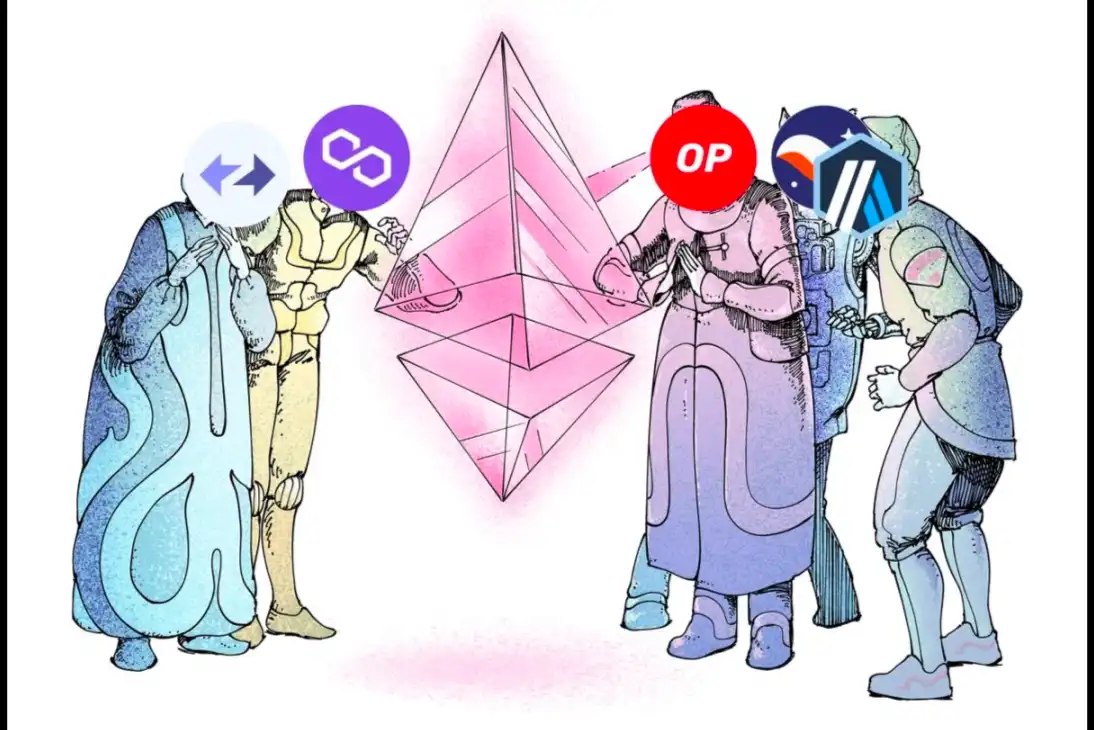
The limitations of Ethereum network performance have led to a variety of Layer 2 expansion solutions, with Rollup leading the way. Ethereum is generally regarded as a single blockchain network, which is mainly composed of three functional layers: data availability and consensus layer, settlement layer, and execution layer. Since the block space is limited, running all functional levels in a single unit consumes a lot of on-chain resources, resulting in network congestion and soaring on-chain gas costs. Rollup is essentially a modular capacity expansion solution that separates the execution layer from the single blockchain, transfers complex operations to the chain, and then transmits the execution results to the chain for verification, greatly improving the network performance while inheriting the security of Ethereum.
According to L2BEAT data shows, as of 2023.03.02, Arbitrum TVL is 3.43 billion dollars, share in the whole Layer 2 circuit accounted for 54.25%; Optimism TVL was followed by optimism TVL, with both TVL combined having more than 80% market share. The competitive pattern of Layer 2 track seems to have been pioneered by Arbitrum and Optimism, but in fact, more and more Rollup schemes spring up like mushrooms, with their innovative narratives, in an attempt to nibble a certain market share.

One of the most eye-catching is a new track called Rollup as a Service. As the name implies, RaaS stand for deployment of Rollup as a service, making it easier for developers to build Rollup from 0 to 1.
The earliest beginnings of the RaaS concept date back to 2021 with Celestia's Optimint(now renamed Rollkit), which was designed to provide developers with a universal software development suite (SDK). Optimistic Rollup(ORU) Coinbase Optimism Rollup(ORU) Base Based on the OP Stack, a reference to the Optimism Optimism expressed by the Optimism Optimism team, is a starting point and opportunity. It ignited my passion and passion for the RaaS.
Before we get to the specific project of the RaaS, let's take a look at the reasons and driving forces behind the emergence, rise or imminent rise of the Raas. I've always believed that the core driver is demand: Ethereum's performance limitations create the need for capacity expansion, hence Rollup; It's not easy to deploy a chain from 0 to 1, and it's much easier if you have a common tool, hence RaaS. Of course, the above view is based on the premise that Rollup itself has a demand. At present, the demand for universal Rollup has been proved by the market. The need for application-specific Rollup has yet to be validated by the market.
RaaS
In addition to the aforementioned Optimism of the OP Stack, Celestia's Rollkit, the RaaS Track contains many more items. From the perspective of whether or not you need to write code, RaaS projects fall into two categories: SDKS and No-Code solutions. The SDK solution provides developers with a common software development suite that makes deploying Rollup as easy as deploying smart contracts; A code-free scheme, as the name implies, does not require a single line of code to deploy a Rollup.
OP Stack and Rollkit belong to SDK schemes, Dymension, Sovereign, Stackr belong to this category. Projects that deploy Rollup without code include AltLayer, Saga, Eclipse, and Caldera. I won't spend too much time here explaining each event of the RaaS circuit in detail, just a brief introduction. This article focuses more on my own thoughts about the RaaS circuit, hoping to make a little bit of an introduction.

SDK
1. OP Stack
OP Stack is a selection of people who expressed Optimism that a blockchain network is divided into three functional levels, namely consensus layer, settlement layer, and implementation layer, in order to realize a software stack of modular blockchain architecture. The process of building a modular blockchain is greatly simplified by decoupling different levels of functionality and then combining them all together in the form of an API software stack.
The OP Stack gives Rollup developers greater autonomy, with the ability to switch, replace, and modify different module levels as well as switching apis. The Optimism team proposes what they call a "superchain" of blockchain endgame forms, consisting of a highly integrated set of OP Stack chains that communicate with each other through a shared messaging format, achieving interoperability between Rollup chains.
2. Rollkit
Rollkit is a modular hair chain SDK developed by the Celestia community. Rollkit versus Rollup is equivalent to Tendermint versus Cosmos Layer 1. Developers can build Rollup based on the data availability (DA) and consensus layer provided by Celestia to further improve scalability. In addition, Rollkit also brings the advantage of customizable, DA layer, collator, execution environment, proof mechanism, etc.

3. Dymension
Dymension's RollApp Development Suite (RDK) functions similarly to Cosmos SDK to help developers deploy Rollapps (application-specific Rollup) on the Dymension settlement layer. The clearing layer's role is to maintain the security of all Rollapps, also known as the Dymension Hub. In other words, all Rollapps built on RDK share the security of the Dymension Hub. Notably, Dymension introduced the RollApp Virtual Machine (RVM) in the settlement layer, which supports a new dispute resolution mechanism and therefore can support a variety of different execution environments.

4. Stackr
Stackr is one of 22 winning projects in Layer 2 Community Grants 2022, hosted by the Ethereum Foundation, and it stands out among the 130+ projects. Stackr SDK designed to make it easy for developers to deploy customizable App-specific OrUs.
5. Sovereign
Sovereign is a bit "different" compared to the four Rollup SDK projects above. The SDK solutions above all start from building ORUs based on fraud proof. Sovereign initially focused on building zk-rollup(zkRU) based on proof of zero knowledge. Zero-knowledge proof is a very difficult branch of cryptography, and the development of zk-rollup requires developers to have a very solid foundation in cryptography. Sovereign's SDK enables developers without a cryptography background to develop public chains using zero-knowledge proof technology, making zk-rollup as easy to develop as a Dapp.
No-Code
1. AltLayer
AltLayer is one of the representative code-free Rollup solutions designed to solve the problem of a single popular Dapp causing congestion throughout the network. Because different Dapps deployed on the same blockchain network share limited block space, when a particular Dapp chain surges in transactions (such as limited time NFT casting activities, etc.), it can cause a spike in gas costs for congestion across the network. AltLayer improves network scalability by providing a one-time execution Layer by providing a deployed Flash Layer, dedicated block space for NFT casting events, complete isolation from other projects on the chain, and closing the execution layer when the casting activity is over.
2. Saga
Saga is a project deployed on the Cosmos ecosystem with the vision of creating a thousand-chain ecosystem through horizontal capacity expansion. Saga architecture is similar to the SDK solution Dymension, Rollup is called Chainlet in Saga architecture. Since they are built on Saga mainnet, all chainlets share the security provided by Saga mainnet. With shared security, Chainlet runs without a native token. Saga will initially focus on Web 3 infrastructure, such as games and entertainment chains, as the improvement and expansion of the underlying infrastructure of online games becomes an urgent issue.
3. Eclipse
Eclipse is designed to provide a common settlement Layer for any Layer 1, and Rollup builds on Eclipse's settlement layer. Eclipse provides a highly composible Rollup framework for developers to choose virtual machines, data availability layers, and more. Currently, Eclipse supports Layer 1 networks including Celestia, Polygon, and EigenLayer, and more Layer 1 networks will be supported in the future.

4. Caldera
Caldera supports "one-click ORU chains", reducing the time to develop a Rollup to the minute level without writing a single line of code. The Cladera Chain modular stack consists of three parts: Caldera Chain(execution layer)/ EVM Clearing Layer/Data Availability Layer (DA). It can be used as a settlement layer based on any EVM compatible chain. Caldera's execution layer is based on the fraud Proof ORU, which maintains the security of the Rollup network by running a fraud proof mechanism.

Rollup Modular architecture
Rollup's modular architecture can be divided into three categories:
1) Universal Smart contract Rollup;
That is, Layer 1(such as Ethereum/Polygon, etc.) is responsible for settlement + consensus + data availability, and the implementation layer (Rollup) is separated from the single piece chain, representative examples such as Optimism/ Arbitrum.
2) Settlement Rollup;
That is, Layer 1 is responsible for consensus + data availability, and the settlement layer is separated as an independent layer. Rollup is built based on the settlement layer, and the Rollup built from it shares the settlement layer. The settlement Rollup can be divided into application-specific settlement Rollup and general-purpose settlement Rollup according to different functions. For example, RollApp built on Dymesion Hub and Chainlet built on Saga Chain.
3) Sovereign Rollup;
That is, Layer 1 is responsible for consensus + data availability, and Rollup is responsible for settlement + execution. Since Rollup can determine the validity of its own transactions, we think it is "sovereign". Similar to settlement Rollup, sovereign Rollup can be divided into application-specific sovereign Rollup and universal sovereign Rollup according to different functions. For example, Rollup built on Celestia Rollkit.
More specifically, Rollup can be divided into 5 categories: Universal Rollup, application-specific + Universal Settlement Rollup, application-specific + universal Settlement sovereign Rollup. If combined with the proof mechanism (zero knowledge proof/fraud proof), 5 2 = 10 Rollup combinations can be derived. More specifically, developers can use Celestia/ Eigen DA for the data availability and consensus layer and Dymension/ Saga/ Eclipse for the settlement layer to build Rollup. As the number of modular projects increases, hundreds of modular rollups can be created, all of which can be easily deployed using the infrastructure provided by Raas-related projects. The potential of RaaS racetracks cannot be ignored.

Some ideas for the RaaS track
The RaaS track is bullish based on the following investment logic: (opinion exchange only, no investment advice. DYOR. NFA)
1) RAAS-related projects are favored by funds;
For example, Coinbase does Rollup based on OP Stack; RaaS racetrack related projects have received investment from a number of star VCS, such as Caldera received 9 million dollars of financing from Sequoia Capital and Dragonfly Capital; Sovereign received $7.4 million from VC including Robot Ventures and Maven 11. Eclipse has raised $15 million in two rounds of funding from PolyChain, Tribe Capital and others...
2) RaaS bring a paradigm of modular blockchain underlying innovation;
As the core underlying infrastructure, the improvement of RaaS will have a profound impact on the innovation of blockchain network architecture. The popularity of RaaS has greatly reduced the threshold for developers to build a Rollup from 0 to 1. The lowering of the threshold of entry will lead to incentivized competition and a good interpretation of the "jungle law" of survival of the fittest, thus driving Rollup innovation.
3) The Rollup circuit has not yet fully exploded, and the RaaS circuit is in its early stages.
Although ORU represented by Arbitrum and Optimism has occupied more than 80% of the market share, zk projects are still in a state of momentum. zkSync and StarkNet are both online on the mainnet, but they haven't been online for long and haven't yet seen an on-chain ecosystem explosion. Therefore, it is too early to say that the Rollup circuit is complete.
Of course, there are both opportunities and challenges. There are a lot of unanswered questions for both Rollup and RaaS. Such as centralization of the collator (although Rollkit/ Optimism/ Dymension and other solutions to decentralized collator have been proposed, none of them have been implemented yet), fragmentation of liquidity, and prolonged challenge period of ORU have yet to be solved. Although there are some problems, but there are corresponding solutions, just focus on whether can be implemented and the effect of the implementation can be.
Concluding remarks
Long before the large-scale outbreak of public chains, people's hot debate focused on the future of the public chain pattern whether it is single or multi-chain. Bullish on Multichain, at least for now, and we're seeing Bullish on Polygon/ BNB/ Cosmos as well as Ethereum L1s on the rise.
For Rollup, we are faced with the same problem: in the near future, will a single Rollup dominate or Multi-Rollup compete to prosper? What I personally would like to see is a Multi-Rollup landscape, where Rollup thrives on competition with RaaS. But who will survive in the fierce competition in the end, and who will exit the Rollup stage of history forever? No one knows. Only time will tell.
After all, it's only when the tide goes out that you know who's swimming naked.
Original link
Welcome to join the official BlockBeats community:
Telegram Subscription Group: https://t.me/theblockbeats
Telegram Discussion Group: https://t.me/BlockBeats_App
Official Twitter Account: https://twitter.com/BlockBeatsAsia

 Related Articles