AI Redefining Web3? How will AI+ Blockchain lead the Next Generation of Internet
AI Redefining Web3: How AI+ Blockchain will Lead the Next Generation Internet
Original article by Zelda, R3PO
Web 3.0, also known as the Semantic Web, is the next stage in the development of the Internet, and applications of Web 3.0 aim to achieve greater security and interoperability by establishing a decentralized infrastructure to run on distributed blockchain and cloud networks, eliminating the need for central servers. Blockchain is often said to be the foundation of Web3, which will redefine the future of business and society. But since ChatGPT went viral, that idea has become controversial.
Who will define the next Internet? R3PO believes that the integration of blockchain technology and AI will redefine Web3, the technology revolution will undergo a transformation from mobile Internet to artificial intelligence Internet, and blockchain will redefine the value, ownership and asset pricing of the next generation Internet.
In Web2, users can create their own content, but the platform still controls the data and assets. In Web3, the data and assets are returned to ordinary users, who can create, control, and trade their own data and assets without having to rely on intermediaries or third parties. Blur, for example, recently became the top NFT aggregator with a market share of over 40% in five months, disrupting the dominance of NFT exchange market giant Opensea. The reason for this is "decentralization", which gives the value of the user's data back to the user. Compared with Opeasea's founders' pursuit of getting listed in the US stock market to make money for major shareholders, the selection of Blur, Dydx and other projects has benefited the people and a group of loyal users. In this process of decentralization and autonomy, the value and ownership have been redefined, which is more in line with the spirit of Web3.0.
How will blockchain and AI lead Web3
Blockchain and AI are actually very different technologies that play completely different roles. The underlying architecture of the blockchain is a distributed ledger capable of storing data in block form. The data stored on the blockchain is immutable and secured through cryptography. As a result, blockchain can keep data secure without a third party.
The essence of artificial intelligence is rote learning algorithms that use the computing power of computers and the foundation of big data to mimic human problem-solving abilities. It simplifies the decision-making process, rationalizes decisions, and takes actions that are most likely to achieve a particular outcome. Ai can learn from the data provided to it and become smarter over time.
Let's take a look at the chemistry that will result from the fusion of these two technologies at the application level.
On the one hand, blockchain could help explain AI behavior. Blockchain technology provides us with immutable records of the data and processes that AI uses to make decisions, making it easier for us to understand and review how AI algorithms make decisions, thereby building deeper trust.
On the other hand, AI can improve blockchain efficiency. "In all Web3 scenarios, the data will be processed by algorithms, and the stronger the AI, the better the experience," said Wang Yuehua, a partner at Draper Dragon, in a recent interview. True, blockchain transactions are proven and thought through, and the process requires powerful hardware and consumes a lot of energy, but AI can make blockchain more efficient by optimizing calculations and processes, reducing miners' loads and improving latency, thereby speeding up transactions and reducing blockchain technology's carbon footprint.
The combination of AI and blockchain may bring new business models and opportunities. For example:
1. Smarter dApps and smarter NFTs
As blockchain developers integrate artificial intelligence and machine learning algorithms, Network 3.0 will likely introduce smarter distributed applications (dApps) with more advanced real-world utility.
A fascinating early example is Alethea AI's Alice- the first non-fungable token (NFT) with the ability to learn on its own, changing the way it interacts with people as it learns from each new interaction. As the first intelligent NFT (iNFT), Alice had her own personality and was able to hold exhaustive conversations with Internet users and learn from them in the process. As AI algorithms advance, the next generation of dApps and NFTs will likely benefit from their efficacy, as decentralized applications gain better data management and analysis capabilities, and the next generation of NFTs will come with human-like behaviors.
2. Realize the value of personal data
While social media giants and marketing companies already collect our browsing data to serve more relevant ads, this is not in the best interest of Internet users. The decentralized spirit of Web 3.0 is designed to bring more user power by putting people back in control of their data -- data that can be shared with service providers who can choose to pay users directly.
By applying AI algorithms, service providers will be able to analyze larger amounts of data and take more factors into account when personalizing user experiences. While Web 3.0 users will receive more customized services, it also realizes the value of personal data from another dimension.
Core AI+ blockchain project analysis
Here are the top 10 projects in the AI+ blockchain circuit by market capitalization, according to CoinGecko.
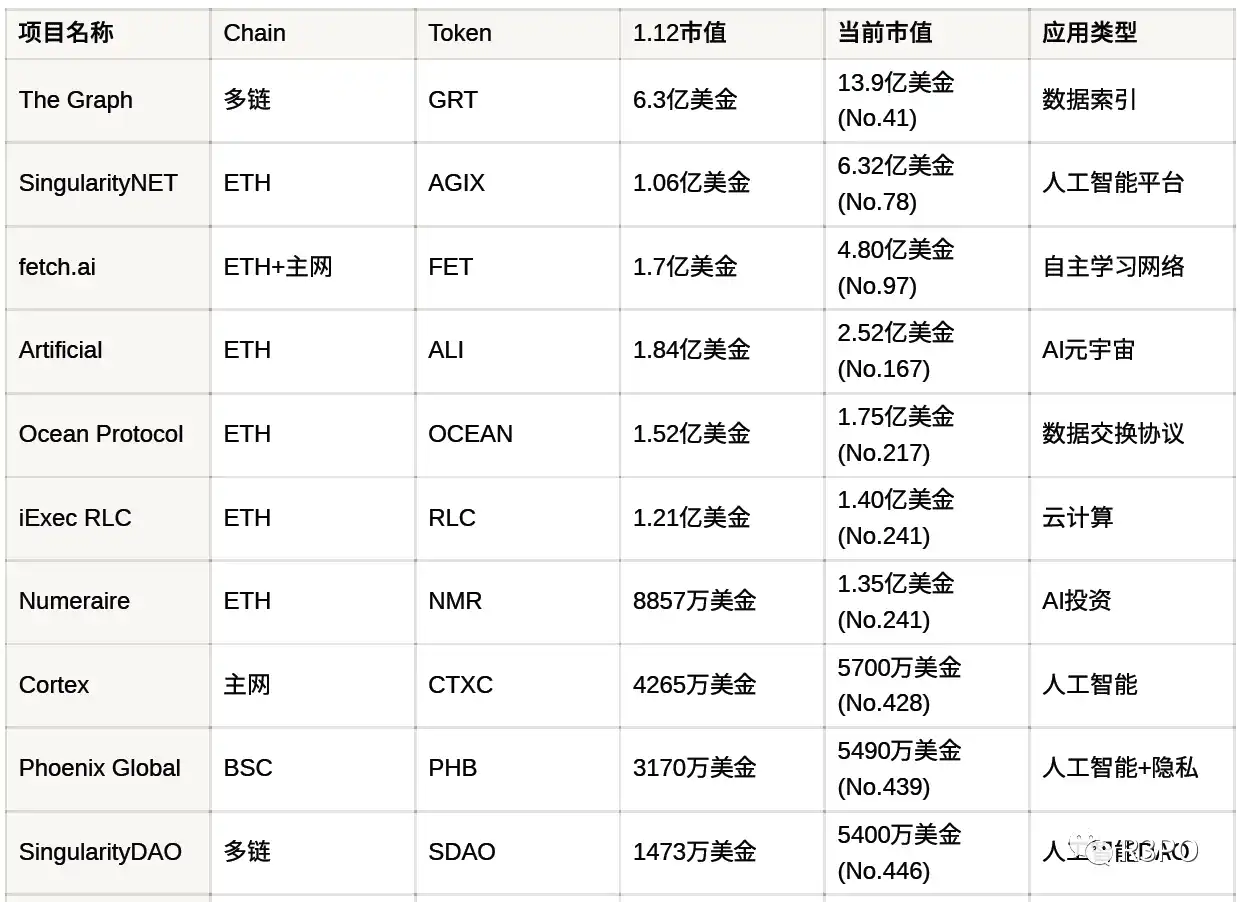
1 FET
Project introduction
Fetch-ai Network is an artificial intelligence laboratory based in Cambridge. The project combines machine learning, artificial intelligence and ledger technology to build an open economic framework and provide a high performance and low cost trading environment to realize an intelligent infrastructure built around a decentralized digital economy.
Application scenario
1. Intelligent recognition: The hospital uses the Fetch-ai collective learning function to train the learning algorithm of the robot to recognize chest X-ray images that need to be detected in the hospital and locate the lesions of patients. According to statistics, the trained AI model has an accuracy rate of 90% in case identification.
2. Cancer cell detection: Through a collective learning collaboration with the Poznan Supercomputing Network Center (PSNC), Fetch-ai and PSNC will train algorithms for hospitals and research centers worldwide to identify and detect circulating cancer cells in patients' blood or tissue biopsies in the future.
3. Predictive maintenance: Predictive maintenance is the process of identifying potential machine failures before they occur. To identify potential failures in manufacturing machinery, Bosch is using Fetch-ai's collective learning to predict potential failures in Bosch machines while maintaining data privacy. More recently, Bosch and Fetch.ai Announced a new partnership to form a new Web3 Foundation --Fetch.ai Foundation to research, develop, and leverage Web3 technology for real-world use cases across the mobile, industrial, and consumer domains.
4. Supply chain integration: The partnership between Fetch-ai Network and LiquidChefs aims to establish a local and transparent supply chain using Fetch-ai Network's autonomous economic agents integrated with its search and discovery framework, Enables LiquidChefs to search and connect to any sustainable suppliers near them.
2 OCEAN
Project introduction
Ocean Protocol is a tool for the web3 data economy that provides developers with tools to build data marketplaces, manage data NFT and DeFi data tokens. Data owners and consumers can use the Ocean Market application to publish, explore, and use data in a secure and private manner.
Project advantage
1. Rich team experience: Rich experience in blockchain, data processing, AI and other fields.
2. The track has potential: it can realize notarial, transparent and safe data sharing in a decentralized way, which greatly liberates the AI market and is the core data layer of the AI sector in the future.
3. Rich in resources: Partnerships with Singapore government, SingularityNET, Mattereum and IBM Watson AI XPRIZE are already in place.
4. Strong ability of continuous iteration: each version of the product is in continuous iteration from V1 to V4. The main features of V4 include: solving the rug pull problem through unilateral pledge, adding data NFT (ERC-721) to improve the flexibility of data IP management, community monetization, etc.
3 AGIX
Project introduction
SingularityNET is a decentralized AI platform and marketplace. Agents running on the SingularityNET platform have the flexibility to outsource work to each other -- trading information, negotiating payments, and making ratings that affect the agents' reputations. In addition, in this open source marketplace, every person who provides artificial intelligence and machine learning services to the ecology is recycled with a certain number of tokens as rewards.
Project advantages:
1. AI Marketplace: The AI Marketplace offers a number of AI-enabled services that users can purchase.
2. AI Publisher: Allowing AI developers to publish and monetize their products on the platform.
4 NMR
Project introduction
Numerai is a new kind of hedge fund built by a network of data scientists that uses artificial intelligence technology.
At the heart of the Numerai Tournament is the free data set. It consists of high-quality financial data that has been cleaned up, normalized and muddled. The main goal of the platform is to bring decentralization to data science and allow developers to compete in creating effective predictive models for machine learning.
Application scenario:
1. Numerai Tournament: A hedge fund that trades stocks based on a summary of thousands of predictions made by a global network of competitive data scientists. Numerai receives about 100 million predictions a day from its users, then creates a metamodel to invest in.
2. Numerai Signals: An ongoing tournament of Russell 3000 stock predictions.
3. Erasure Bay: An information exchange marketplace where any type of information can be traded, including valuation models, product feedback, etc.
Challenges facing AI+ blockchain technology
R3PO believes that blockchain and AI are two of the most disruptive technologies since the invention of the Internet. Decentralized blockchain brings good data foundation to AI, and AI has mature module resources and algorithm resources. The technology applications we have seen so far are just the tip of the iceberg, and the convergence of the two will shape the trajectory and progress of society for decades to come, potentially creating a more efficient, safer and more personalized digital economy, with new business models and opportunities for individuals and companies alike. But at the same time, the combination of blockchain technology and artificial intelligence will inevitably face some challenges.
1. Security issues
Ai needs to process large amounts of data to be effective, and the data on the blockchain is securely encrypted to protect it from hackers. In order to analyze and process the data, it is necessary to decrypt the relevant files and data, making it more vulnerable to malicious attacks. WEB3.0 has not yet formed a complete security system, so unified security standards and specifications need to be further formed.
2. Cost and efficiency constraints
While improving the efficiency of blockchain operation, artificial intelligence also has certain limitations. For example, the application of current distributed technology involves large-scale computing and storage systems, and hardware limitations. Even physically, the generation, transmission and storage of energy for operating equipment limit the practical application of AI and blockchain to some extent.
At present, considering the tps limitation and gas cost caused by the actual running time on many chains, the cost of actually operating AI commercial applications on the blockchain will be unimaginably high, while the actual efficiency will be unimaginably low.
Therefore, at present, the combination of blockchain technology and artificial intelligence is still in the initial groping.
conclusion
While ChatGPT's AI buzz continues to build, the Blockchain +AI project has gone through a short burst of booms and busts. Data shows that the total market value of Token AI concept encryption projects once exceeded $5 billion. For example, SingularityNET rose more than 290.53% in early February, but now these projects have fallen quickly.
Although short-term FOMO has brought more attention to the AI+ blockchain project, fundamentally, the future development of the project still needs to return to its own value. Some projects with only the surface of AI cannot carry the banner of WEB3.0. What is the end of this journey of WEB3.0 innovation? No one can give a definite answer. Or does decentralization beat decentralization? But what we do know is that the integration of AI and blockchain technology will undoubtedly open up even more exciting possibilities. Let's wait and see.
Original link
Welcome to join the official BlockBeats community:
Telegram Subscription Group: https://t.me/theblockbeats
Telegram Discussion Group: https://t.me/BlockBeats_App
Official Twitter Account: https://twitter.com/BlockBeatsAsia

 Related Articles