LD Capital: The MakerDAO of all growth, the spark has been kindled
原文标题:《 「Trend Research by LD Capital」万物生长的 MakerDAO,星火已燃 》
Source: LD Capital
Abstract
As one of the most successful old encryption projects in decentralized governance, development and operation, MakerDAO has now entered the stage of "final planning". By establishing several subDAOs, it will separate out the new functions and products based on the Maker system, build its own autonomy, take responsibility for its own profits and losses, or issue new tokens. In turn, the goal of reducing Maker's operating costs while isolating risks and enhancing the sustainability of the increasingly large complex system is expected to make Maker an ecology like Layer 1, where "everything grows".
The new SubDAO, made up of former MakerDAO members including Maker's core developers and chief growth officer, will release Spark, a lending agreement based on the Aave V3 code, in April, which is expected to unlock more value from the more than $8bn of collateral in Maker's vaults, In theory, it will combine with the cheap D3M lending module and PSM casting pool in the Maker system to create strong synergies, providing the most competitive and relatively stable rates for $DAI.
DeFi "matrixing" has become a trend, and some established DeFi apps are developing more native nested apps based on the strength of user assets or liquidity. Curve introduced l crvUSD, Aave introduced GHO, and Frax introduced Lend. But compared to Aave/Curve to make GHO/crvUSD stableship big, Maker to make the lending business is much less difficult
Spark 的上线,代表着 Maker 生态重大变革的开端,$MKR Token 的边际改善最为明显,估值体系需要从单一项目 Token 变成类似公链的生态 Token 。因原本只有治理权的 $MKR Token 首次有了质押挖矿的场景,或为 $MKR 质押提供 12~37% APY,同时生态应用将有效的扩张 Maker 的资产负债表,悲观和中性情形下为 Maker 带来额外 275~1,200 万美元的年收入,进而使得 $MKR 的销毁量出现 1~3 倍的提升。
A Spark sparks Protocol
When MakerDAO unveiled its Endgame Plan last June, its founders said MakerDAO needed to continue expanding while maintaining maximum flexibility. Therefore, on February 9, 2023, some core unit team members of MakerDAO founded Phoenix Labs, which is committed to developing new decentralized financial products to expand the Maker protocol ecosystem.
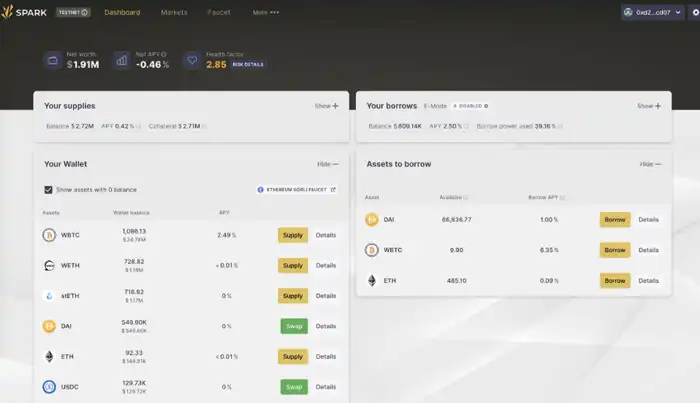
Spark Protocol is the first common lending protocol developed by Phoenix Labs, which uses Stablecoin DAI and other mainstream crypto assets as collateral for excess lending. As the first protocol to illuminate Maker's new DeFi matrix, Spark's name also happens to correspond to the Chinese meaning of "a single spark can start a prairie fire."
The protocol is based on Aave V3 Code construction. The lending business of the latter has been tested by the market for a long time. Users take highly liquid assets such as ETH, WBTC and stETH as collateral and lend out assets in corresponding demand according to the interest rate model. In theory, it will combine with the cheap D3M lending module in the Maker system and the nearly 100% capital efficiency of the PSM casting pool for stablecoin to form a strong synergy, which will be the most competitive and relatively stable interest rate in the whole $DAI market.
Figure 1: Spark App Beta page
Source: Spark, Trend Research
Of course, the Spark team has said that after DAI's loan scale reaches $100 million in the next two years, 10% of DAI's market profits will be allocated to Aave. The proposal has been put forward in the Aave forum.
Advantages of the Spark Protocol
1. Time-tested code
基于 Aave 成熟的代码修改而来,代码经过了历史的检验,安全性高。此外与 aToken 一样,存款方也可以得到头寸的 Token 化 (spTokens) 版本。spTokens 可以像以太坊上的任何其他加密资产一样移动和交易,利于进一步提高资金效率。
2. Borrowing at low and stable interest rates
Spark Lend has direct access to Maker's line of credit, called the Dai Direct Deposit Module (D3M), and users will theoretically be able to borrow as many Dai as they want at a slightly higher rate than the Dai savings rate (the so-called "DSR" is currently 1%) (though there is an initial 200m limit)
3. ETH assets have high utilization efficiency
Spark Lend has also introduced the e-Mode module of Aave V3. ETH assets can be lent to each other at up to 98% LTV. For example, wstETH can lend up to 98% ETH as a pledge, increasing the efficiency of capital use.
4. Double Oracle feeding price manipulation is more difficult
Spark also uses both ChroncileLabs (formerly Maker Oracles) and Chainlink to provide on-chain pricing. The two data sources will be processed through the three checkpoints of TWAPs (weighted average prices), signed price sources and circuit breakers to ensure that prices are not manipulated.
5. Fair Launch
协议 Token 发行完全通过流动性挖矿进行分配,没有任何预分配,公平的分配机制,能够吸引更多的人加入社区,提高社区的共识和价值。项目方也认为 Spark Protocol 需要在公平的环境中竞争,才能赢得 SubDAO 的支持,才能将其作为产品接受。
6. MakerDAO is 100% endorsed
Spark is not an "independent tripartite" agreement in the usual sense. Although the agreement was developed by Phoenix Labs, it is wholly owned by Maker Governance (including all smart contracts, trademarks, IP, etc.), which means that in case the agreement encounters any difficulties that cannot be resolved independently, Maker is likely to come forward.
Three measures to help $DAI become a better "world currency" :
Maker's mission is to create a "fair world currency," but so far $DAI's $5 billion + market cap pales in comparison to $USDT's $70 billion + market cap. So how does it scale and eventually go beyond a centralized stablecoin?
The launch of Spark Protocol indicates three major directions for the future development of Maker products, all of which aim to increase the foundry volume of DAI and reduce the operating cost:
1. Integration of internal D3M and PSM functions
Spark Lend integrates the existing D3M and PSM modules within the Maker to provide liquidity for Stablecoin DAI.
Among them, the most significant advantage of D3M is that it allows the secondary market to directly foundry $DAI, eliminating the need for the first level foundry in the Maker, and then deposit DAI in the secondary market for application, combining the two layers of excess mortgage into one layer, and improving the actual capital efficiency of DAI.
The initial plan is to provide Spark Lend with $300 million of D3M liquidity, with $200 million as Phase I hardtop and $100 million as a buffer. This size limit would in theory be adjusted according to the behavior of actual market borrowing rates.
In addition, Spark Lend front-end page supports MakerDAO's PSM and DSR. USDC holders can convert USdcs in PSM into DAI directly through Spark Protocol's official website and earn deposit interest through DSR. Promote the use of DAI from the demand side.
For example, under the normal path, one $DAI flows out of Aave in the lending market, and there are actually two layers of collateral behind it: About $1.50 of Aave collateral + $1.50 of Maker collateral, a common scenario that actually takes up $3 of crypto collateral without considering revolving lending, but with the integration of D3M and PSM, Lending 1 DAI on Spark only requires $1.50 collateral (or $1 whitelist stablecoin such as $USDC), making it much more capital efficient.
2. Get into the LSD market with EtherDAI
The Spark Protocol guides use of EtherDAI. EtherDAI are liquid collateral derivatives created around ETH, such as Lido's stETH, which allows users to encapsulate stETH as ETHD and use it as collateral to lend DAI.
Maker governance will have backdoor access to ETHD collateral and may incentivize liquidity by setting up short-term liquidity mining for ETHD/DAI on Uniswap. On the other hand, it is possible to set the stability fee for EtherDAI Vault to zero to drive demand for EtherDAI Vault.
Secondly, after the Shanghai upgrade of Ethereum, the official Ethereum will provide more than 4% of the basic income, which is bound to lead to the large-scale migration of ETH assets. Spark supports the liquidity pledge (LSD) package token to prevent TVL shrinkage, and may even attract more funds into the protocol through revenue stacking. This reduces the dependency on the USDC.
More importantly, TVL represents the lock-in value of funds within the agreement. When TVL within the agreement rises, it will be followed by an increase in liquidity and availability, and the agreement itself can also obtain more considerable earnings. For Spark, a significant source of revenue is the spread between depository borrowers.
3. Maker + Spark = The lowest and predictably volatile interest rate in the market
The advent of the Spark agreement will also enable Maker to better proactively control the supply of DAI based on market demand, thereby directly interacting with its secondary market, with the goal of providing better rates to its users and increasing the supply of DAI.
Specifically, when the DeFi sector is hot, borrowing rates tend to spike, which makes users pay higher than expected borrowing costs, thus negatively impacting $DAI's supply and demand market. D3M will influence the main $DAI lending market (Spark) by stabilizing the $DAI interest rate. When demand for $DAI is high, Maker can expand Spark to cast and supply $DAI's hard top to lower its interest rate. Conversely, if demand is sluggish, $DAI liquidity will be removed from Spark to raise its interest rate.
Taken together, keeping $DAI the cheapest in the Stablecoin "battle of the hundred," with predictable fluctuating borrowing rates, is a key competitive advantage to increase its usage. Through the D3M capital pool, the relative stability of $DAI borrowing rate and the most competitive rate in the whole market can be achieved.
MakerDAO protocol current revenue and expenditure analysis
The current cost of MakerDAO is more than 40 million USD/year. If it were not for the aggressive investment in RWA finance, the project would have a net loss of 30 to 40 million RMB. Therefore, there is the "endgame plan" proposed by the founder.
income
MakerDAO's current income comes from four main sources:
Stabilization fee income from over-mortgaging Vault, i.e., interest on minting/borrowing DAI; The liquidation penalty income obtained from the liquidation of under-mortgaged assets; Stablecoin transaction fees obtained through PSM; RWA (Real assets) Vault income.
Stability fees from Vault, a crypto asset, used to be the most important source of revenue for the protocol, but now RWA's wealth management revenue is the largest source.
expenditure
The main expenses of the agreement are employee salaries, market growth/marketing expenses, etc., of which the largest proportion is engineers' salaries, which maintain the core of the agreement.
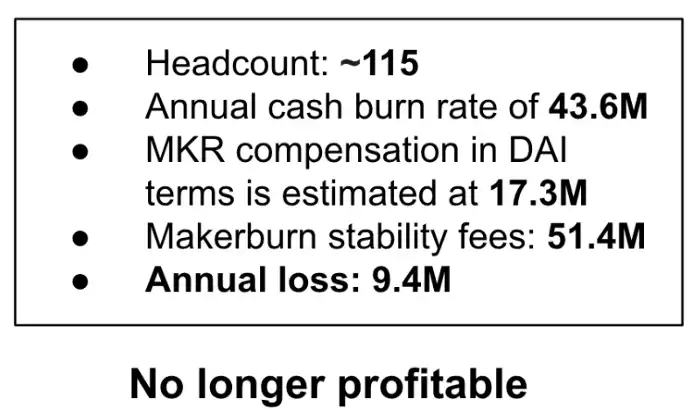
In June 2022, MakerDAO co-founder Rune Christensen released data showing: MakerDAO's annual stabilization fee revenue is about $51.4 million, but maintaining the agreement costs $60.9 million, including $43.6 million in cash flow and $1,730 in $DAI. The cost outlays exceed the agreed revenue. Resulting in a loss of about $9.4 million on the agreement.
Figure 2: MakerDAO agreement revenue disclosure
Source: MakerDAO Forum, Trend Research
The main reasons for the loss of the agreement are: 1) the income of the agreement decreases sharply under the bear market environment; 2) Team spending is generous; 3) Governance redundancy. The existing governance process is complex, requires the participation of a large number of people and the governance cycle is too long, which also restricts the development speed of new product functions.
Hence Rune Christensen's idea of The Endgame Plan, which we will explore in detail below. Among its plans is a solution to the problem of current agreements running out of money by increasing the growth of real assets (RWA).
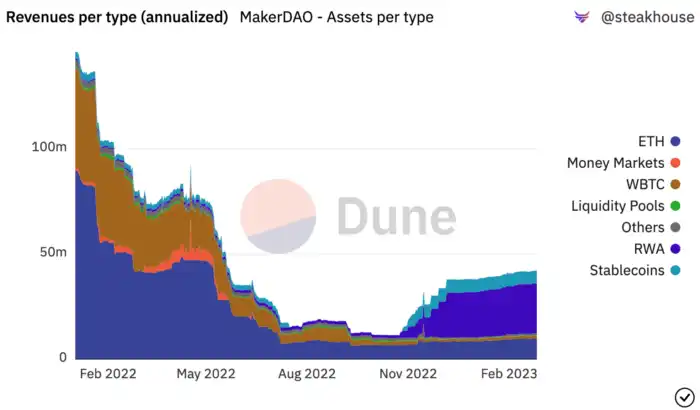
Figure 3: MakerDAO revenue structure
Source: Dune Analytics, Trend Research
As you can see from the chart above: 1) ETH Vault was a significant source of revenue for MakerDAO until November 2022; 2) After November 2022, RWA (real asset) Vault became the largest source of agreement revenue for MakerDAO.
RWA Vault is an investment in off-chain financial markets, primarily bonds and mortgages. Because the RWA collateral was able to give MakerDAO a higher stability fee yield, it did deliver a higher yield on the MakerDAO agreement as expected. The current investment of $696 million is expected to generate interest income of more than $26 million, representing more than 40% of Maker's revenue.
On the other hand, the potential seizure risk of the RWA under regulation is relatively high, so the Endgame Plan proposes a series of strategies to protect against the regulatory risk of the RWA: in a moderate regulatory situation, Maker will maximize revenue by prioritizing an anchoring strategy of 1:1 to the US dollar without limiting RWA exposure. The founders assume tighter regulatory policy in the future, so Maker's exposure to RWA will be no more than 25%, with the possibility of breaking anchor with the dollar if necessary. The ultimate gesture is to maintain the maximum resilience and viability of DAI, no longer allowing easily seized RWA as collateral, and perhaps no major currency as a price reference.
Therefore, it is not a long-term solution to rely on the income from RWA. Only by expanding the source of Maker's income as much as possible, optimizing the organizational structure of the system, and aiming at "open source and save money" can the sustainability of the Maker agreement be ensured to the greatest extent.
The end plan, all things grow
为了能更好的理解 Maker 生态即将到来的的重大变化及 $MKR Token 的供需关系改善,需要先了解『终局计划』(Endgame Plan),该计划虽然有很多为了应对监管、政治的讨论,但本质上将会使得 Maker 成为 Layer 1 一样的生态,让『万物生长』。
The endgame plan was first proposed by Rune in June 2022 and has now been fully discussed in at least three versions in the governance forum. This is a structural restructuring plan for MakerDAO, which aims to make MakerDAO a decentralized, self-operating DAO (decentralized autonomous organization) in order to better meet the needs of its Stablecoin Dai users. Specifically, it includes four main contents:
Establishing full decentralization of MakerDAO improves Dai's liquidity and stabilizes the sustainability of its rate increase protocols, reduces systemic risk and improves decentralized governance and DAO operations
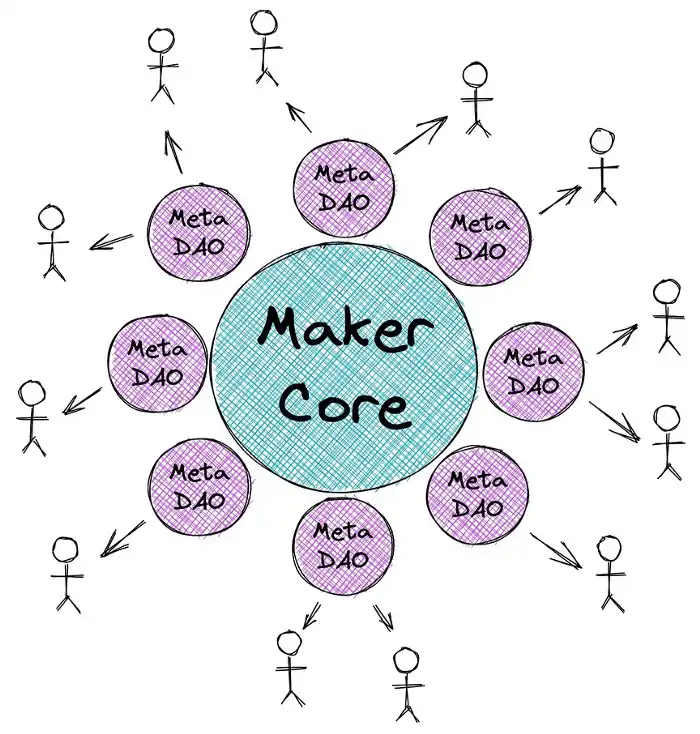
In order to simplify the complexity of the governance approach, Maker creates a series of self-sustaining DAOs called MetaDAO. Rune will nbsp; Maker Core is likened to L1 Ethereum, which is secure but slow and expensive. MetaDAO is an L2 solution that is fast and flexible, but at the same time secure from L1. With MetaDAO, MakerDAO can focus more on its primary goal, which is the issuance and stabilization of stablecoin Dai. At the same time, MetaDAO can provide governance support for other projects in the MakerDAO ecosystem.
所谓 MetaDAO 即将 Maker 协议模块化,每个 MetaDAO 都是小型的社区,可以拥有自己的 Token 和资金库。MataDAO 的核心价值主张是隔离、降低风险,以及并行化 Maker 高度复杂的治理流程。
Figure 4: MakerDAO protocol visualization structure
Source: MakerDAO Forum, Trend Research
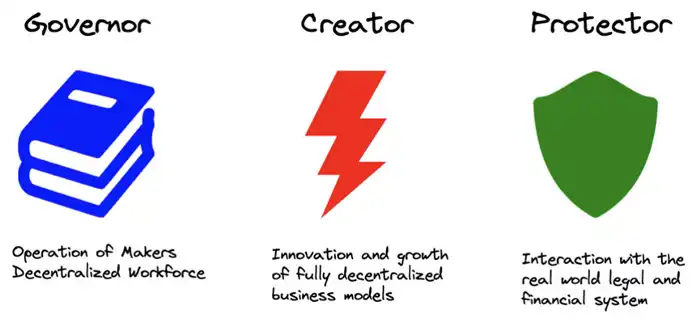
MetaDAO types will fall into three categories:
Figure 5: MetaDAO type
Source: MakerDAO Forum, Trend Research
Maker Core retains all components of the Maker protocol that are indispensable and cannot be removed in order to function fully and achieve its goal of generating and sustaining Dai. Each type of MetaDAO around Core has its own function, and its function determines how it interacts with Maker Core:
Governor (also called Facilitator) is responsible for organizing Maker Core's decentralized staff management, on-chain governance, engineering, protocol management, and brand management; Creator Focus on the growth of the Maker ecosystem and the development of new features, such as the Spark team falls into this category; Protector Will be responsible for managing RWA Vaults, focusing on real world assets and protecting Maker from physical and legal threats to the collateral of its real world assets.
MetaDAO 内部同样拥有类似 Maker Core 的治理流程,通过部署新的 ERC-20 Token 进行治理,这样也能克服当前 Maker 治理过程的单线程问题,允许 MetaDAO 并行执行,加快治理进程。
However, MetaDAO runs its governance process on top of the Maker Core governance infrastructure, with governance signals delivered by MetaDAO voters and then bundled into Maker Executive votes for execution. This means that the MKR holder can act as an "appellate court", with control of the MetaDAO agreement effectively held by the MKR voters.
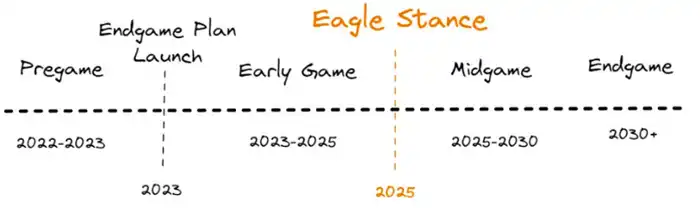
The endgame plan is divided into four phases. The Pregame phase team expects to be online in 2023, including building ETHD, bringing MetaDAO online, and starting liquidity mining.
Figure 6: Endgame roadmap
Source: MakerDAO Forum, Trend Research
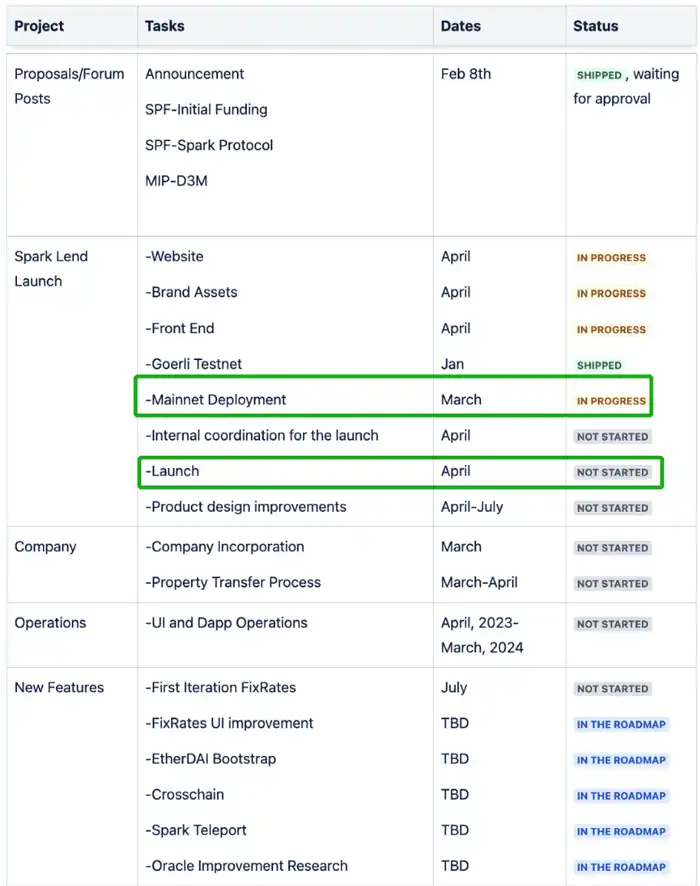
Spark Protocol will be the first MetaDAO and is expected to launch in April 2023. It is currently undergoing mainnet deployment and a number of branding initiatives. Later this year, Spark plans to integrate with Element Finance and Sense Finance to offer fixed-rate borrowing and a more diversified income strategy.
Endgame 计划初期,Maker 将上线 6 个 MetaDAO,且每个 MetaDAO 都将发行 Sub Token,虽然 Spark Protocol 没有在文档中明确介绍 Token 相关的部分,但依据该计划 和 Spark 创始人描述 Spark 应该会有自己的 Token 。
同时,每个 Sub Token 都会与 $MKR 组成核心流动性池,Maker 团队计划通过每年发放 45,000 MKR 对该池进行 LP 激励,也就意味着 Endgame 期间,每个 MetaDAO 会积累 7,500 枚 MKR。当然,ETHD、DAI、 MKR 相关流动性池也会获得少量 Token 奖励。
Figure 7: Spark roadmap
Source: MakerDAO Forum, Trend Research
Spark 作为终局计划的首个应用,预期或给 Maker 带来年 1000 万美元+的收入增长,同时让 $MKR Token 第一次拥有了流动性挖矿场景,我们将在下文展开分析。
Industry trend: DeFi application matrix
Spark will create a lending platform that will directly compete with established lending agreements such as Aave and Compound. Although Aave and Compound once integrated D3M, Maker's limited D3M resources will inevitably give priority to Spark in the future. Because Ethereum's mainstream DeFi protocols seem to be in a "matrix" race.
DeFi apps are developing more native nested apps based on the strength of user assets or liquidity, and "matrixing" has become a trend. For example:
Curve, the original DEX, has been actively promoting its own "stablecoin" of $3CRV, trying to tilt as much incentive as possible to the $3CRV currency pair rather than a single stablecoin pair, and announced a new overpledged stablecoin crvUSD in the middle of last year. TVL's number one universal lender Aave also announced plans last summer to launch its DeFi overmortgage Stablecoin $GHO; In September, FRAX launched Frax Lend, which allows users to borrow/mint FRAX from official contracts by paying market interest rates, rather than through a conventional foundry mechanism similar to MakerDAO's D3M.
Among these applications, MakerDAO's TVL has long occupied the top spot. As of February 25, 2023, its mortgage vault has 8.2 billion dollars worth of collateral, which can be released into new funds available for borrowing theoretically. If realized, it is expected to surpass Aave and become the largest loan agreement. Therefore, its strategy towards DeFi matrix will open new imagination space for its ecological expansion.
At present, GHO and crvUSD have not been officially launched, but we believe that compared with Aave/Curve, it is much less difficult for Maker to make GHO/crvUSD stable currency bigger, while it is much less difficult for Maker to make its lending business bigger. Because:
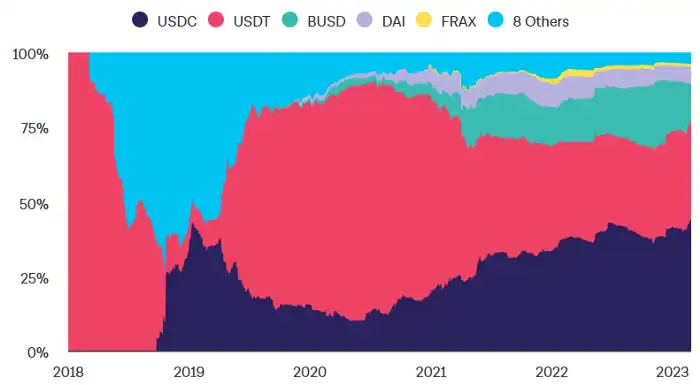
For a new stablecoin, the selling pressure is certain (first-level founters can only choose to sell in addition to pledge), while the buying is uncertain, and it depends very much on whether Aave/Curve can create enough usage scenarios in its own ecology and cooperative ecology. In the two years since its launch, Frax, the decentralized stablecoin in second place, has barely exceeded a quarter of DAI's market capitalisation, despite controlling a significant voting share in the Curve War. So even though the use scenario is hard created by subsidies, the ceiling of scale expansion is still obvious.
Figure 8: Share of stablecoins on Ethereum
Sources: The Block, Trend Research
2. The governance difficulty of stablecoin is high, and the governance representatives with highly professional knowledge are required to participate in the maintenance. MakerDAO is one of the earliest DAOs (founded in 2015) with the most mature governance. It has gathered a group of professional DeFi and money and banking researchers to lead DAI through several spirals of increasing leverage and deleveraging, and effectively accumulated experience in stablecoin governance. Admittedly, the Aave/Curve governance forum is also very active, but unlike lending, the failure of Stablecoin governance can easily lead to a "death spiral" that could derail the agreement, and Aave/Curve has a long way to go.
3. The liquidity establishment threshold is high and the window period is limited. In order to make users willing to use a new stable coin, in addition to the high pledge income in some places, more important or need to exercise their own "medium of exchange", good depth, low slip point. This means that in the early stage, new stablecoin issuers may need to greatly subsidize and encourage users to recharge the liquidity of their stablecoins to other tokens, and cultivate enough stickiness of users before the subsidy declines to lose its appeal. Otherwise, when the subsidy revenue falls below a certain threshold, Once LP began to withdraw -- the transaction experience decreased -- depeg became frequent, and this was the moment when the stablecoin entered a death spiral.
$MKR use case change: Liquidity mining + double destruction
Spark 的上线将不仅是一次产品更新,代表着 Maker 生态重大变革的开端,$MKR Token 的边际改善最为明显,估值体系也需要从单一项目 Token 变成类似公链的生态 Token 。因为原本只有治理权的 $MKR Token 首次有了流动性挖矿的场景,或为 $MKR 质押提供 12%~37%APY,同时生态应用将有效的扩张 Maker 的资产负债表,基准情形下为 Maker 带来额外 1~2 千万美元的年收入,进而使得 $MKR 的销毁量出现 1~3 倍的提升。
Universal mortgage lending opens up the asset - to - loan type, increasing the source of agreement revenue
MakerDAO is the leading project of DeFi protocol, and the siphon effect of DeFi protocol is obvious. TVL that Spark can achieve is expected to be compared with Aave. Among Aave assets, ETH assets and stablecoin account for the largest proportion. Taking Aave V2 market as an example, the total market size reaches 5.44 billion US dollars and the annual revenue is 16.3 million US dollars. Among them, the market size of $USDC, $DAI, $ETH, $WBTC and $stETH is about 1 billion dollars, accounting for 1/5 of the total market size.
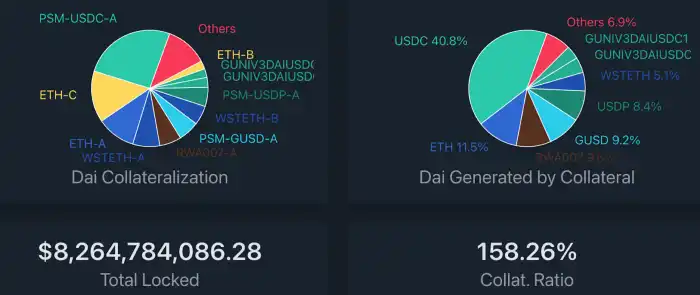
MakerDAO 协议内现在锁定的抵押品价值为 82 亿美元,单币资产(非 LP Token 、非 RWA 资产)价值为 66 亿美元。$DAI 总供应为 52 亿枚,其中由 $USDC 质押产生的 $DAI 达到 40 亿,以这个数值来看,即使仅 PSM 放出 1/4 的 $USDC 就能达到 Aave 如今的 TVL。
Figure 9: MakerDAO mortgage vault type distribution
Source: daistats.com, Trend Research
以 Aave 协议年收入为参考,我们假设在流动性挖矿刺激下,MakerDAO 现有流动性(非 LP Token 、非 RWA 资产规模为 66 亿美元)能迁移过去 20%/35%/60%,Spark 协议收入表现将如下所示:

The official team of Spark also assumes the revenue performance of Spark agreement under neutral, pessimistic and optimistic conditions. Readers can compare and refer to it. In Bull Case, the expectation is higher than ours, which means that they are optimistic and may have 5 billion +TVL, while we think the neutral and pessimistic expectation is relatively reasonable:

Data sources: forum.makerdao.com, Trend Research
MakerDAO 将由目前的双 Token (MKR/DAI)系统转换为多 Token 系统,MKR 开放流动性挖矿场景。
预计新 MetaDAO 在推出时会部署 26 亿枚 MetaDAO(MDAO) Token ,其中 20 亿会通过流动性挖矿释放,前两年释放 10 亿,之后每两年减半一次。4 亿分配给 MetaDAO 贡献者,2 亿分配给 MetaDAO Treasury。
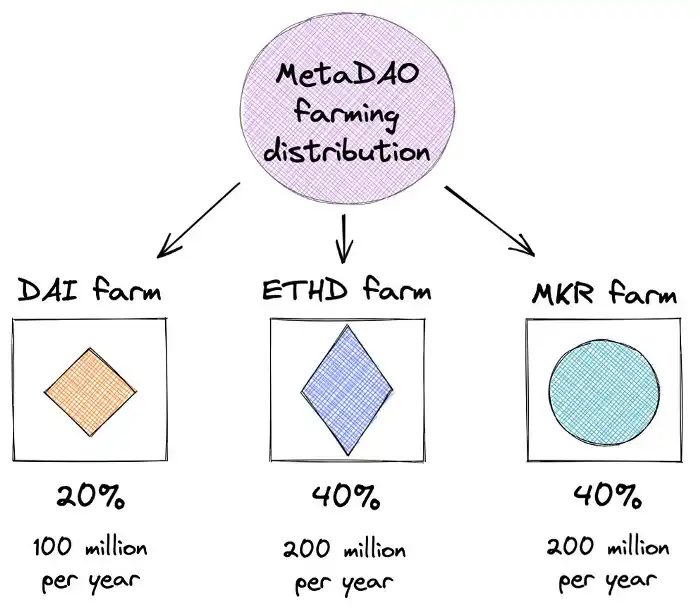
Figure 10: Distribution of liquidity mining incentives
Source: MakerDAO Forum, Trend Research
Liquidity mining allocation scheme: 20% to incentivize DAI demand, 40% to ETHD Vault holders and 40% to $MKR pledge.
质押挖矿对 $MKR 来说,是其经济模型中具有重要意义的变革,因为 $MKR 的供需关系将被重新调整。在此之前,$MKR 一直作为协议治理 Token ,捕获协议价值有限,导致市场需求动力不足。而且在发生债务亏空时还需增发 Token 进行兜底,存在通胀的可能性。
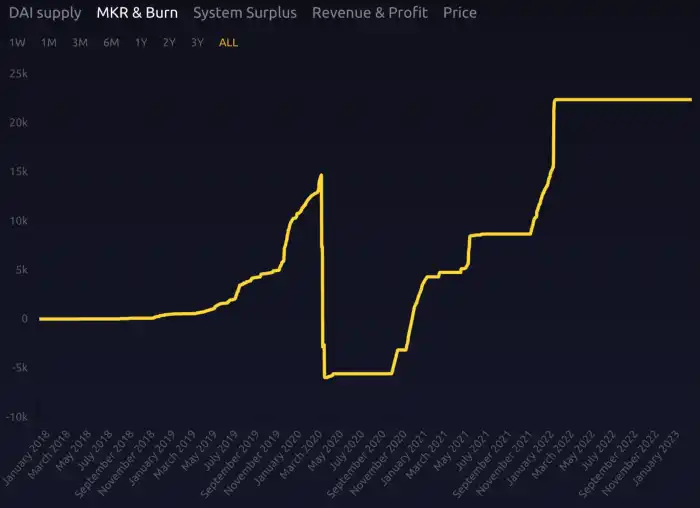
虽然协议盈余可以回购销毁 MKR 使其通缩,但是似乎并不可观。MKR 上线 5 年,总量 100 万枚 Token 仅销毁了 2.2 万枚,平均每年通缩率为 0.4%。
Figure 11: $MKR additional issue & Destruction condition
Source: Makerburn, Trend Research
Because the expansion of Spark lending business will bring additional TVL to MakerDAO and thus generate additional fee income, Spark also provides MakerDAO simulation income for reference:

If the three cases are calculated according to the average 1.5% stabilization fee (annualized foundry interest) and the current price of $MKR $764, the corresponding annual deflation rate of Maker's new TVL $MKR will be expected as follows, which may bring $800 million of new TVL and 12 million years of revenue to Maker under the base case. And an annual deflation rate of 1.6%, four times the current rate, while a pessimistic scenario might generate less than 200 million TVL growth and 2.75 million revenue, but even that would correspond to the destruction of $MKR of 0.37% per year:
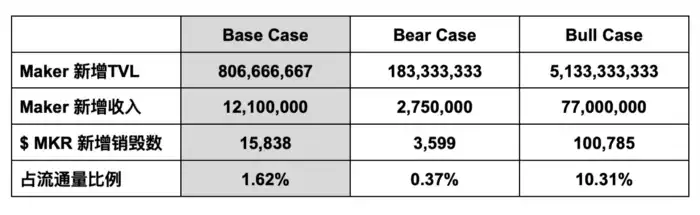
The above is only the assumption of linear destruction. In fact, MakerDAO will trigger the repurchase mechanism only when the agreed surplus reaches $250 million. The current surplus is only $74 million, which does not meet the standard of repurchase destruction.
The deflation rate of MKR should accelerate with the improvement of Maker's revenue structure, and the open pledge mining scene will stimulate a surge in demand for MKR, making the $MKR in circulation more valuable to a large extent.
By building the DeFi ecological matrix around Stablecoin, MakerDAO has transformed from a single currency protocol to a DeFi application chain.
The goal of Stablecoin is to expand the acceptance range and usage scenarios of stablecoin as much as possible, so MakerDAO has been looking for cooperation with external top-level DeFi protocols, such as Aave, Compound, etc. After the MetaDAO model is established, Maker will build its own DeFi ecological matrix centering on Stabecin, which can reclaim the value of stabecin into the Maker ecosystem, thus improving the overall valuation of $MKR.
同样以现价$764 的 $MKR 质押挖 Spark Token 为例进行模拟预测,同样假设 Spark token 在中性、悲观、乐观的情况下能达到 Aave token 35%/20%/60% 的估值,计算 20% 的 $MKR 参与质押挖矿 APR 范围在 12%~37% 之间:
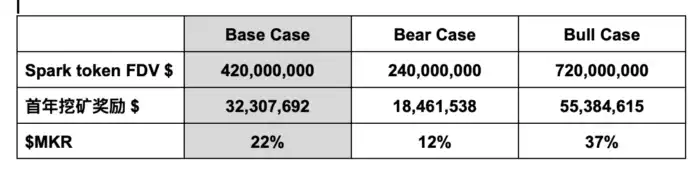
Note that this is a very preliminary and static assumption, the actual APR will have to wait until more details of the Spark token economic model are released, and will also depend on changes in the $MKR price.
MKR spending slowed
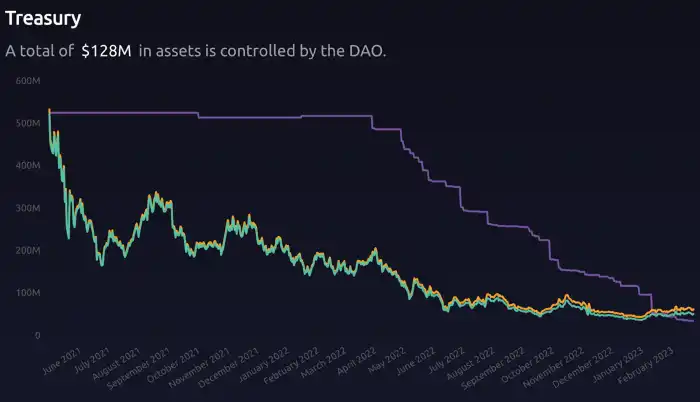
通过把金融功能『外包』给新的团队,财库里的 MKR 未来的支出也将放缓, Token 供需关系将进一步进入市场自然平衡状态。例如 2022 年 2 月至今财库共支出了近 1.3 万枚 MKR,或给市场带来了上千万美元的抛压。
Figure 12: Treasury fund income
Source: Makerburn, Trend Research
summarize
As the first application of "Endgame Plan", Spark Lend is essentially designed to change the D3M module with higher capital efficiency from the original authorized use by three parties to self-use, eliminating the security, governance and other risks that may be caused by external protocols. The addition of PSM module can help $DAI maintain the best competitive advantage in cost in the stablecoin war. Compared with variable-rate competitors like Aave or Compound, $DAI also has more certainty about the interest rate it charges, so users don't have to keep coming back to check if their borrowing costs have risen too high.
自 Spark 之后将有一系列 subDAO 项目 Token 可供 MKR 质押挖矿,在隔离了风险的同时,大大增加 $MKR 的收益场景,让其第一次有了真正意义上的质押挖矿场景,叠加 Maker 生态可能进一步激励 $MKR/$DAI 对 subDAO Token 的交易流动性 LP,或许让市场对该 Token 的估值框架发生改变——从单一项目 Token ,变成类似 Layer 1 生态的 Token 。
$DAI 作为最成功的去中心化稳定币已经被广泛使用在各种 DeFi 应用程序中,无论是借贷、交易、流动性矿或其他应用,都可以看到$DAI 的身影。但缺点是 $DAI 的使用量上升对 Maker 生态的可持续性似乎没有产生足够对应的贡献,项目进入了越大反而亏损越多的状态,除了维持这一复杂庞大系统的技术运维,市场运维,还要对高质量治理人才、提案进行激励才有可能使得 Maker 具有足够的可持续性,鉴于主要的激励手段除了手续费收入只有 $MKR Token ,从这个角度来看,本次 Endgame 系列产品方面升级的本质可以理解成:
1. Break through the non-mutual loan characteristics of the original collateral in Maker, release the efficiency of funds, and increase the source of project income;
2. Capture the value of $DAI usage scenarios originally outside the Maker ecosystem into the ecosystem, similar to the diversified exhibition industry of banks, to serve the whole process of customers' target needs.
As a result, it is expected to realize the lock quantity of Maker ecological assets, the amount of DAI foundry and the price of $MKR.
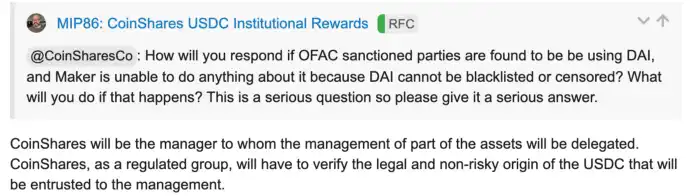
Appendix Risk Tips D3M low interest casting hardtop set is relatively conservative, which will greatly limit Spark Maker's ability to "expand the table", and has certain constraints on the increase of the total asset scale within the agreement. Maker has invested $700 million in RWA assets and plans to invest further. There are regulatory risks: 1) The potential for the RWA collateral itself to be frozen; 2) After Centrifuge in a cooperative institution, 6 million defaults have been generated. And Coinshares, which plans to do asset management for Maker, has acknowledged that it will have to cooperate with regulators in reviewing the source of funds if regulators question it, which could mean a temporary freeze/seizure.
Spark's marketing capabilities are unclear: Sam MacPherson, founder of Bellwood Studios , is a multi-job developer; The CTO and co-founder of Spark, whose commitment to Spark is critical to the future development of the project. Second, the operation leader of Spark is @nad8802, the current chief growth officer of MakerDAO. According to the previous operation performance, Spark is relatively good at market operation.
DAI is likely to abandon the USD anchor, resulting in a massive loss of users in the short term, although it may be good for DAI to become the ultimate decentralized currency with stable purchasing power (rather than the USD exchange rate) (the community has not reached a consensus, it is the sole idea of founder Rune, and it is scheduled to become the focus of discussion around 2025). But God V had expressed concern.
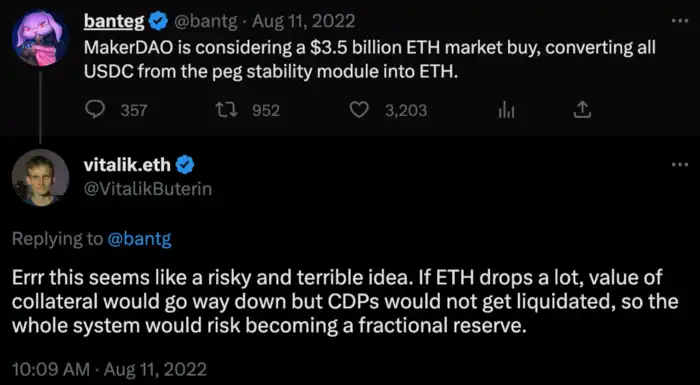
$MKR 回馈机制改变的风险。因为目前关于协议收入如何回购 MKR 或甚至减少回购的讨论主题在治理论坛中是存在的,包括 Endgame 中 subDAO Token 给 MKR 的奖励也有可能随着治理讨论的深入出现变更,总体说来 Maker 社区核心成员风格大多相对保守且并不急功近利。
Regulatory decentralization can be at odds with the true spirit of decentralization for a reason. MakerDAO front-end provider Oasis was recently required by a court order to help Jump Crypto, a third party authorized by the court, recover 120,000 ETH stolen from the Wormhole cross-chain bridge by attackers in February last year. Because the attacker deposits funds in Oasis, Jump Crypto shifts collateral and debt from the attacker's vault by changing the contract logic using the scalable agent mode in the Oasis protocol automation contract. Although Oasis made this decision with regulatory intervention, and the MakerDAO protocol itself does not control any front-end vendors or products that enable end-users to access Maker Vault, it ultimately goes against Maker's mission to maintain DAI as a just world currency. Of course, this also demonstrates the necessity and importance of Rune planning in advance to resist the regulatory strategy.
Potential security risks of smart contracts. Even after strict audit, no code can be said to be completely 100% safe, its maturity and reliability need to be tested by the market, and users must be alert to this risk.
The basic mechanism of MakerDAO
MakerDAO is a decentralized stablecoin lending protocol based on Ethereum. The core of Makerdao is to lend stablecoin DAI, which is 1:1 anchored to the US dollar, backed by excess mortgage assets. By regulating the stability of DAI casting fee, let the market achieve the stability of DAI price in the way of arbitrage. When the value of the mortgaged asset falls short, the system forces the sale of the collateral to the liquidator to guarantee the repayment of the debt.
Main data of Maker system
Top 25 持币地址: Token 分布相对分散
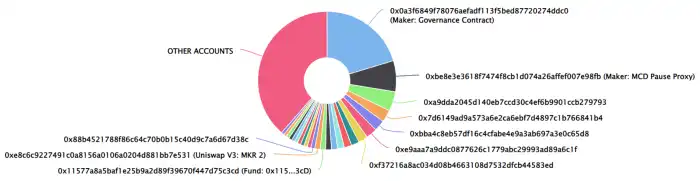
Source: etherscan.io, Trend Research
MakerDAO Vault Collateral Value & type
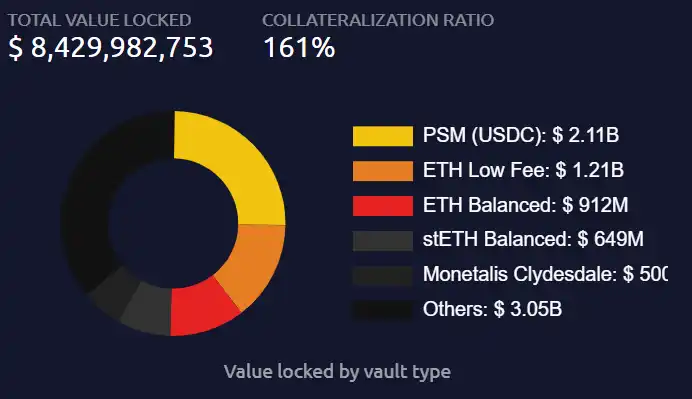
Source: makerburn.com, Trend Research
Changes in ETH/stETH distribution in mainstream lending agreements: MakerDAO has the largest share
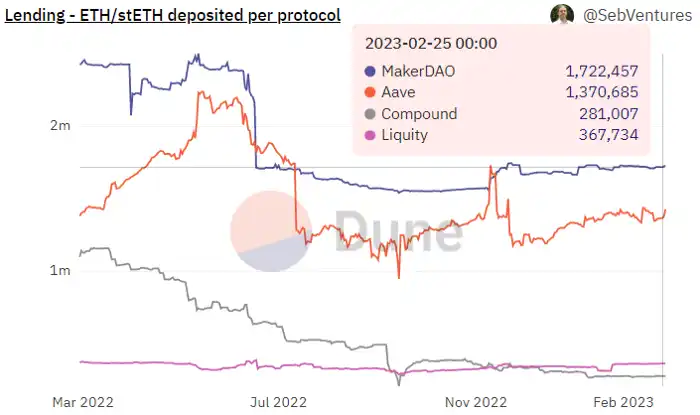
Source: Dune Analytics, Trend Research
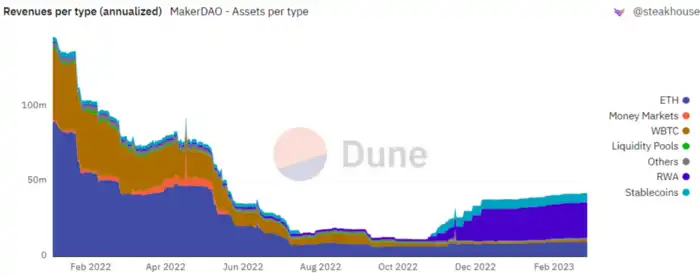
Summary of MakerDAO Protocol annual revenue
Source: Dune Analytics, Trend Research
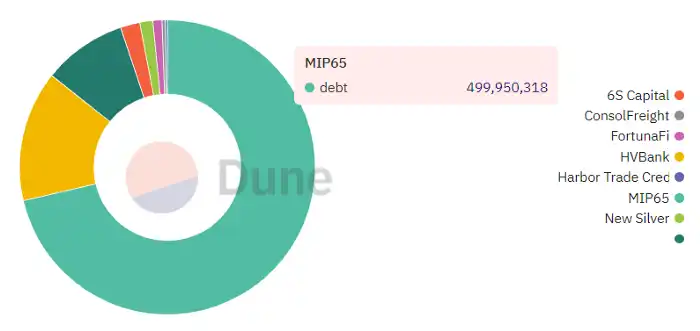
Distribution of RWA debt: The largest debt was incurred by Monetalis Clydesdale
Source: Dune Analytics, Trend Research
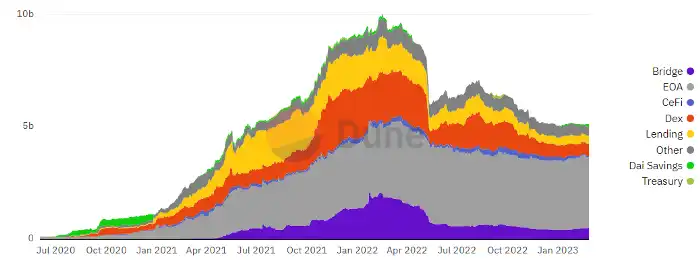
Distribution of DAI: EOA accounts account for the largest proportion, followed by DEX
Source: Dune Analytics, Trend Research
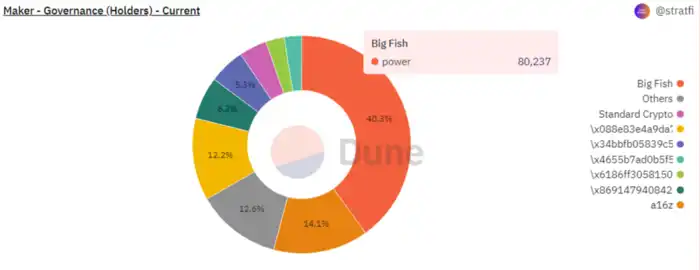
$MKR Governance weight distribution
Source: Dune Analytics, Trend Research
Important events and milestones in the history of MakerDAO:
In 2013, Daniel Laimer (founder of EOS) proposed the concept of Decentralized Autonomous Corporation (DAC), one of the predecessor concepts of DAO.
In March 2015, Rune Christensen founded MakerDAO and began planning a stablecoin pegged to the U.S. dollar.
In December 2017, MakerDAO released the first version of DAI Stablecoin and launched the first version of the smart contract on Ethereum.
In 2018, MakerDAO made the first adjustment to the DAI stabilization fee, adjusting the lending rate for DAI Stablecoin from 1.5% to 0.5%.
2018 年 9 月,风投公司 Andreessen Horowitz 通过购买总量 6% 的 $MKR Token 向 MakerDAO 投资 1500 万美元。
In February 2019, MakerDAO launched the Multi-Collateral Dai (MCD) system, which enables users to generate DAI using multiple types of collateral.
In November 2019, Maker released multi-mortgage Dai (MCDS) to support multiple types of assets pledged to borrow DAI.
In January 2020, the total supply of DAI surpassed 100 million.
In March 2020, when a market crash caused Ethereum's price to fall sharply, the system created a $5.3 million debt hole, which was covered by an auction of the MKR.
In April 2020, the Maker Foundation announced the transfer of control over the MakerDAO protocol to a decentralized community governance system.
In May 2020, MakerDAO launched a decentralized governance system based on on-chain voting.
In November 2020, the total supply of DAI surpassed 1 billion.
In 2021, MakerDAO launched the D3M mechanism, which provides a more flexible and low-cost way of DAI minting for cooperative lending platform users.
In April 2021, Maker Liquidation Mechanism 2.0 went online, and the Wyoming Legislature officially approved the DAO Act, allowing DAO to be registered as a limited liability company in the state.
In May 2021, the Maker Foundation returned the 84,000 MKR assets held by Dev Fund to the DAO.
In February 2022, the supply of DAI surpassed 10 billion for the first time and Maker announced a multi-chain deployment plan.
In August 2022, MakerDAO first linked its native stablecoin DAI to financial institutions regulated in the United States through a partnership with Huntingdon Valley Bank (HVB), a community bank in Philadelphia.
In October 2022, Maker approved a community proposal to transfer 1.6 billion USdcs to Coinbase Prime for financial management.
In December 2022, MakerDAO announced the launch of a $220 million real-world asset fund with BlockTower Credit, in which MakerDAO will deploy four vaults to provide a total of $150 million in capital.
In February 2023, MakerDAO announced the creation of Spark Protocol, a universal lending protocol.
Original link
Welcome to join the official BlockBeats community:
Telegram Subscription Group: https://t.me/theblockbeats
Telegram Discussion Group: https://t.me/BlockBeats_App
Official Twitter Account: https://twitter.com/BlockBeatsAsia

 Related Articles