With its first "passive defense," OpenSea faces the biggest challenge in its history

Writing: Cookie, Beat BlockBeats
OpenSea has finally bowed its head.
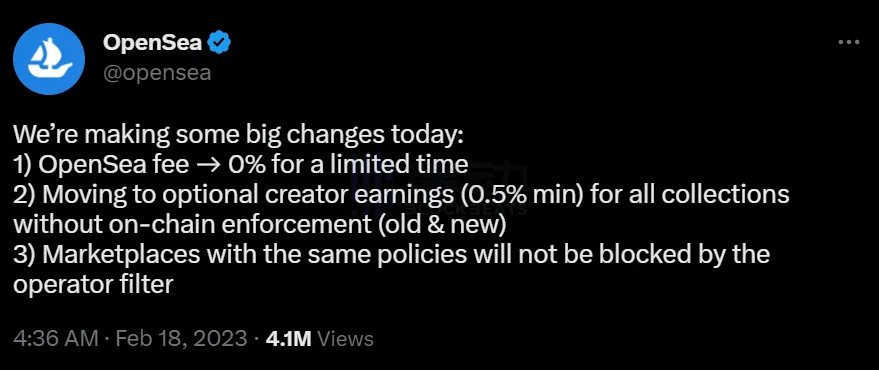
Time zero commission, optional royalties, relax the market blacklist restrictions. Within a few months, OpenSea and Blur were in complete reverse. But the real point at which OpenSea decided to be "flexible" may have happened only a few days ago.
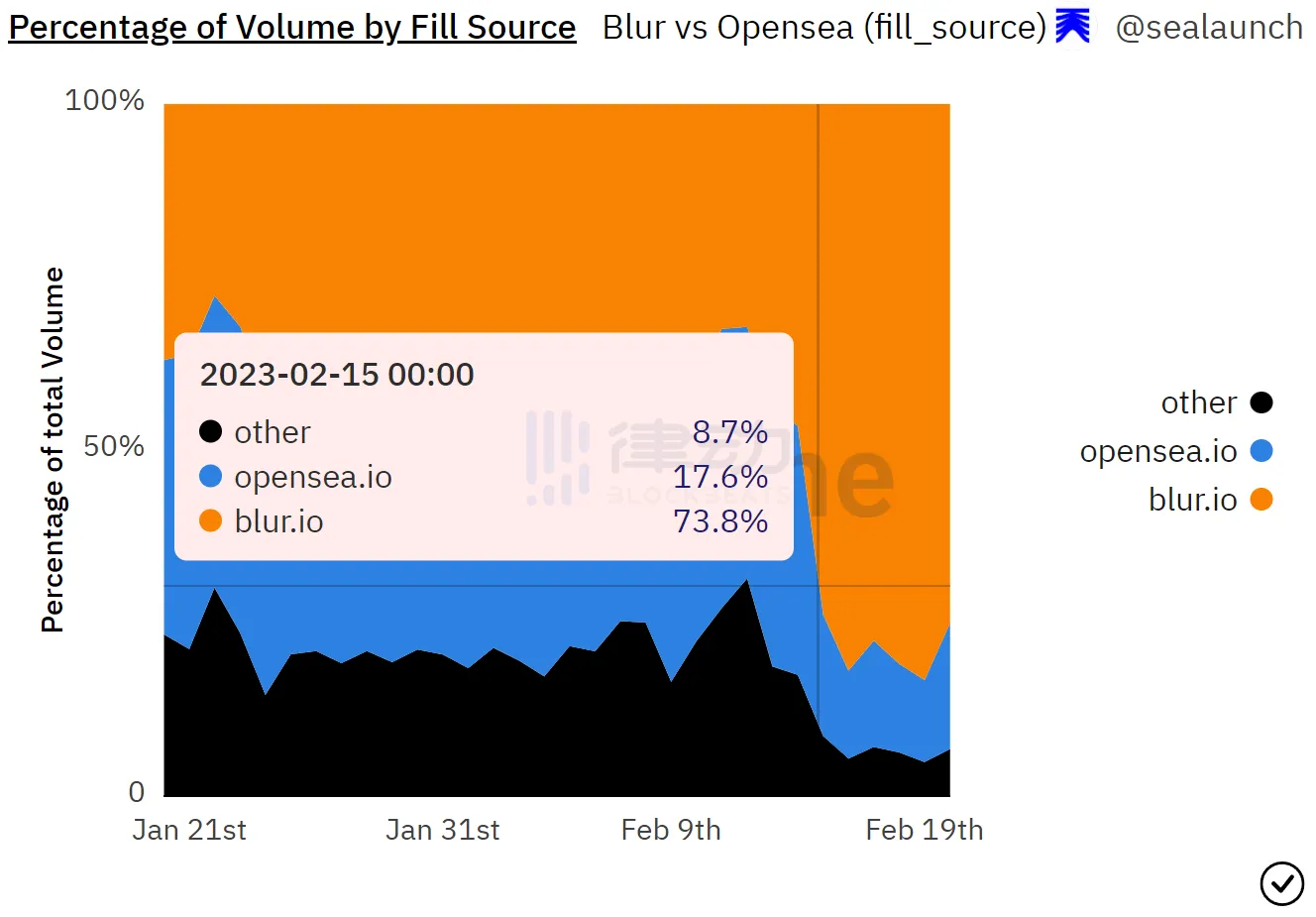
Blur's volume began to weigh heavily on OpenSea on February 15
February 15, which happens to be the date that Blur's native Token $BLUR goes live. The market performance of $BLUR has made many NFT players have a new judgment about Blur -- Blur is no longer just an NFT market, it has become the "engine" of NFT market liquidity.

If you have 10 "boring apes", you can sell them all in an instant by accepting Bid at 77.5 ETH above the floor price. For the first time, the NFT market has the feel of an FT exchange
The "Bid-Airdrop" mechanism has shown more power with $BLUR's good market performance. The NFT players made it clear in real money that the risk of providing liquidity was worth it for $BLUR.

Blur Bidding Pool has already spent nearly 76,000 ETH ($128 million) on bidding Pool
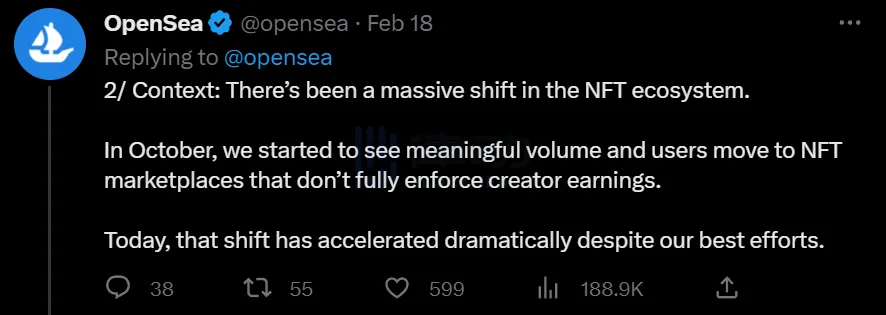
OpenSea claims to have seen a dramatic shift in the market since October -- a massive shift in volume toward the non-mandatory royalty market.
Blur didn't change the market, the market chose Blur. Blur initially positioned itself as "the best choice for Pro Traders", and in a market with insufficient incremental funds, whoever secured the Traders would get the best liquidity.
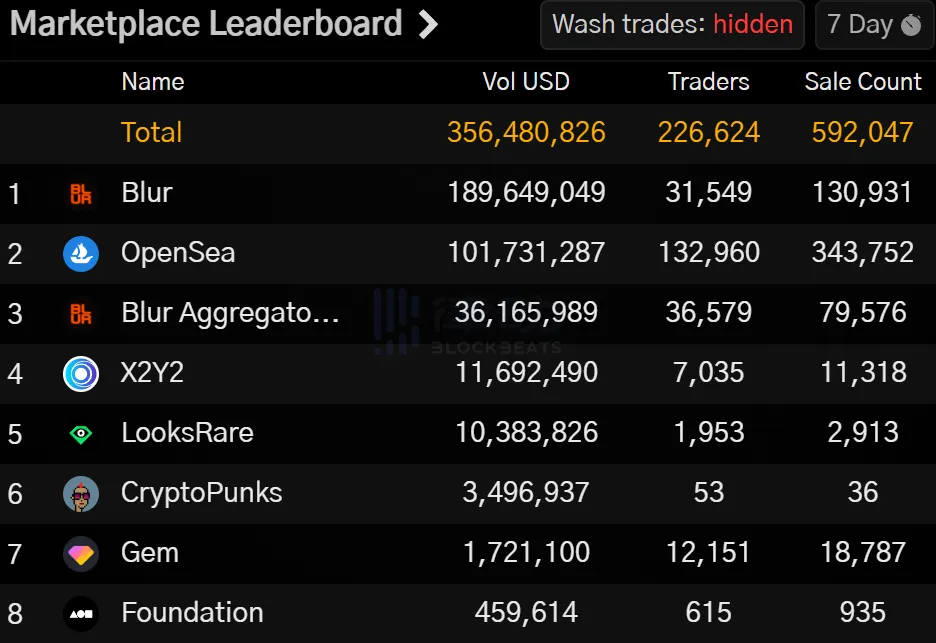
7-day data for each NFT market (source: degenz.finance). While OpenSea has 100,000 more active users than Blur, Blur's turnover is $80 million higher than OpenSea's
Liquidity is the key. People always say that the reason why "vampire attacks" like $SOS, $LOOKS, and $X2Y2 fail to shake OpenSea is that "simple emotions and imitation cannot overthrow OpenSea." But more deeply, the reason is that they do not effectively undermine OpenSea's huge liquidity advantage -- OpenSea's huge name recognition and user base is the "shield" that keeps OpenSea firmly in control of market liquidity.
It wasn't until Blur started the "Bid-Airdrop" cycle of NFT market liquidity through $BLUR's good market performance that the cracks in OpenSea's "shield" really appeared. Many players say, "OpenSea will die if it doesn't send tokens", but can sending tokens really save OpenSea?
Blur's victory at this stage is a victory chosen by Traders, a victory in grabbing market liquidity, and a victory of "exchange" over "hypermarket" in product form. The "massive shift in volume to the non-mandatory royalty market" is just one phenomenon, behind which lie shifts in the narrative of NFT accepted by the market. In the case of PFPS, how much does artistry matter when NFT players make purchase decisions? When buying a PFP is about providing value for the project owner and the community, the logic of the PFP is highly overlapped with the "membership credentials" and is partially "FT".
Whether we love or hate "the FT of NFT", it is a current market trend that NFT is more and more like "meme's graphic ETH copycat Token". In this trend, liquidity is king. Only the better the liquidity, the more FT like the trading experience, the greater the arbitrage space, the more excitement can be sustained and amplified.
For OpenSea, the effect of this "passive defense" is limited. Even if the Token is issued, it still needs to provide Traders with a good use experience and drive the liquidity of the NFT market with real money. This sounds difficult, but it should be less stressful for OpenSea. After all, OpenSea has been suffering for so long, dominating the NFT market for so many years, and charging so much for the opening fee and 2.5% commission. And judging by OpenSea's tweets, the sense of crisis is still acute, and it's only a matter of time before a decent counterattack emerges.
For Blur, the ambition to "kill OpenSea" is already apparent. Blur has now added a "Collector" mode to make collections a better purchase experience for users. Support for the ERC-1155 NFT in the near term could boost Blur's market share even further. Now, Blur's bigger rival may be itself -- there is always an end to the Token incentive. How can we enhance the value capture of $BLUR and make our role as a liquidity catalyst last forever?
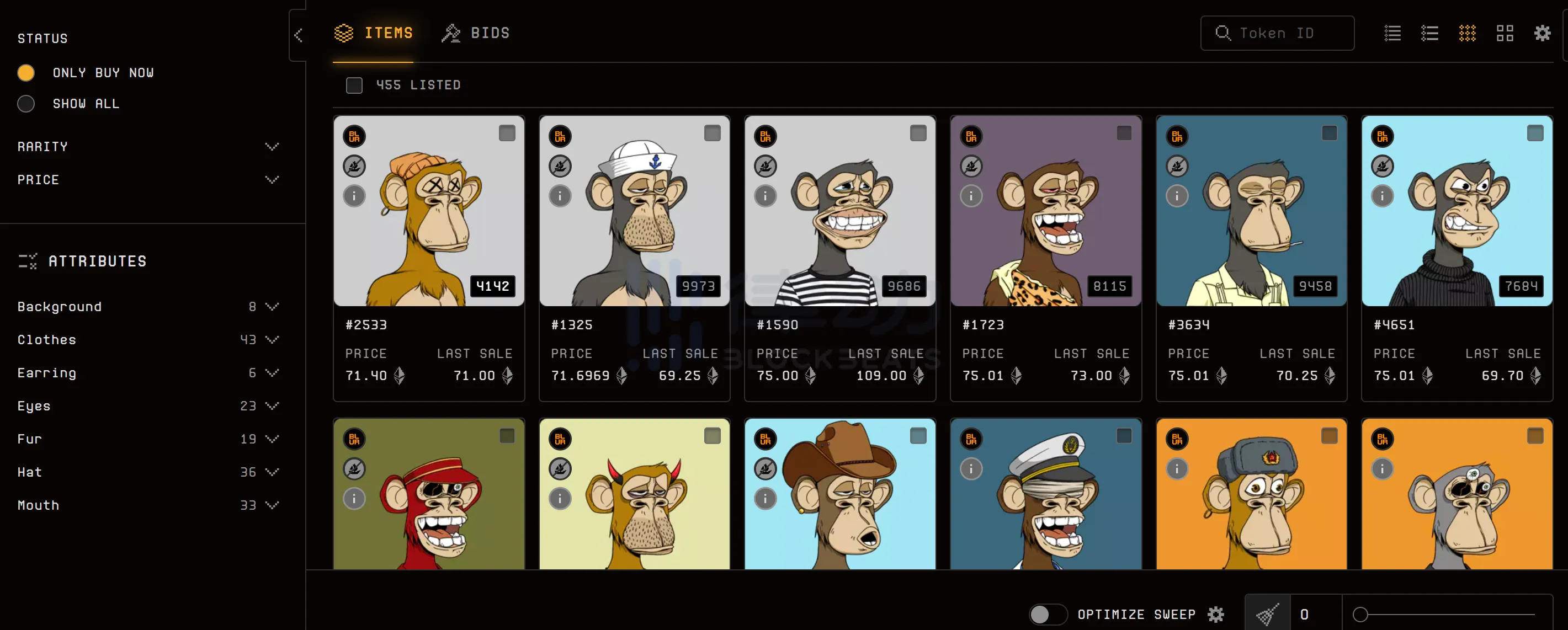
Blur's "Collector" mode
As the NFT market battled to curry favor with Traders, the Creators seemed forgotten. How much trust do Creators have in these NFT CEX and the market as a whole, after a series of royalty policy changes over the past few months -- even OpenSea, which was valued at $13.3 billion, changed its royalty policy overnight?
NFT DEX gained more attention as a result and was expected to strike a balance between Traders and Creators. Healthy mobility, after all, depends on high-quality projects. Sappy Seals tried it with SudoSwap, and it worked. Half a year ago, they purchased 50 of their own NFT to personally provide liquidity on SudoSwaps as Creators. So far, they have made about $50,000 by providing liquidity and have received $20,000 in $SUDO drops.
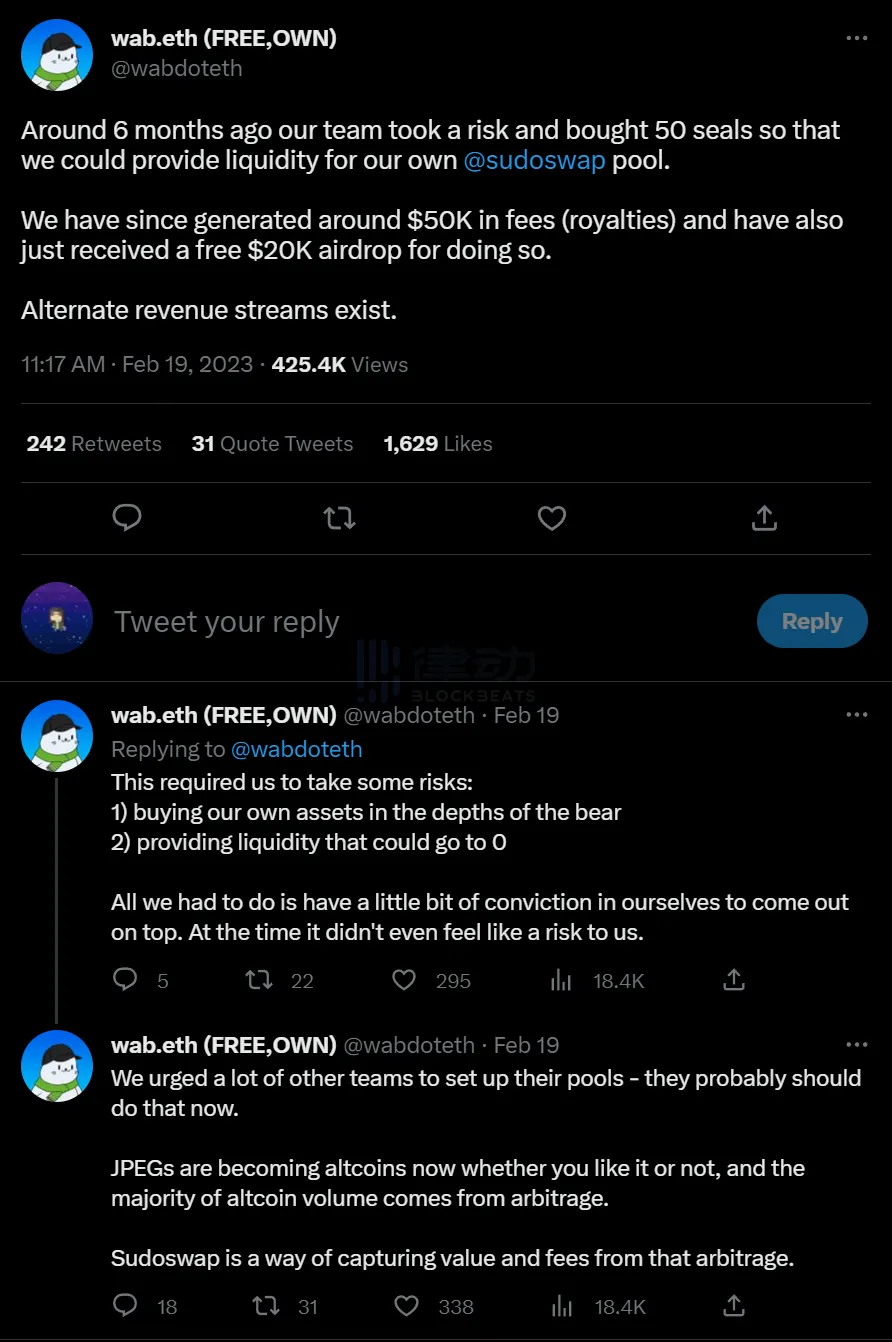
"Buying our own assets in a bear market could make liquidity zero, but we never felt that risk existed. We have the belief that we can do our best with our NFT program."
With the "liquidity attack" by Blur capture Traders, and the risk that NFT DEX could capture Creators without licenses and royalties, OpenSea is facing its biggest challenge yet. Whoever wins, let's hope the NFT market is better off as a result of this fight.
Welcome to join the official BlockBeats community:
Telegram Subscription Group: https://t.me/theblockbeats
Telegram Discussion Group: https://t.me/BlockBeats_App
Official Twitter Account: https://twitter.com/BlockBeatsAsia