Another heavy blow from the encryption giant? A detailed account of the love-hate relationship between the US SEC and encryption.
Original Title: "Another Heavy Blow to Cryptocurrency Giants? A Review of the Love-Hate Relationship between the US SEC and Cryptocurrency"
Original Author: Plain Language Blockchain
After a week of heavy regulatory crackdown on the stablecoin BUSD issued by Binance in collaboration with Paxos, CEO CZ announced yesterday that they will abandon BUSD as their primary stablecoin. Additionally, in order to appease regulatory pressure, Binance is reportedly planning to pay a fine to "settle" with authorities and reach a resolution for cooperation.
This time, US regulators have extended their reach to the world's largest cryptocurrency platform. Prior to this, the SEC has also been taking frequent actions.
On February 9th, the cryptocurrency market experienced a short-term decline, reportedly due to Kraken's agreement to pay $30 million to the US Securities and Exchange Commission (SEC) to settle allegations that its cryptocurrency-backed securities violated US securities laws.
On February 11th, Coinbase founder Brian Armstrong tweeted that the SEC reportedly wants to ban retail cryptocurrency staking in the United States. He strongly opposes the idea and hopes to avoid such a scenario.
Not only that, with the development and growth of the encryption world, SEC is also omnipresent. "SEC has a solid, almost perfect record in lawsuits against companies that provide digital currency sales without proper authorization, and there are not many legal precedents to win this battle." This regulatory stick has caused many encryption project parties to suffer.
01 "Regulation" Blockchain
When it comes to dealing with regulation, Tether is undoubtedly an experienced and "well-performed" "senior" in the industry.
As one of the "largest gray rhinos" in the cryptocurrency world, Tether received a subpoena from the US Commodity Futures Trading Commission (CFTC) in 2017, but it did not stop issuing new USDT.
Subsequently, the New York Attorney General's Office (NYAG) presented actual investigation results, stating that Bitfinex used Tether to provide loans for itself to cover up its $850 million financial loophole, but USDT is still "issuing more and more".
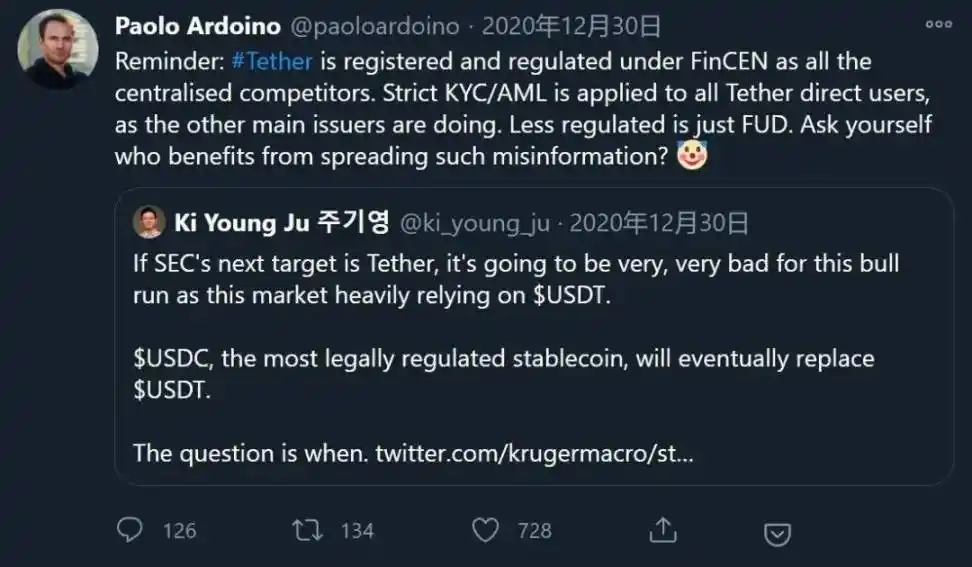
Even after the trust crisis of "being cut even when empty" on October 15, 2018, USDT still survived with its "too big to fail" attitude, and even crazily increased its issuance in 2020, further binding itself with the market depth.
Previously, the CEO of CryptoQuant, a website for encrypted data, stated that if Tether is the next target of the SEC, it will deal a serious blow to the bull market at that time.
At that time, the market heavily relied on USDT. In that context, the popular algorithmic stablecoins seemed to offer another approach:
Stablecoins with collateral anchor mode similar to USDT ultimately rely on centralized issuers (even the second-generation stablecoin DAI has to sacrifice decentralization to a certain extent by introducing centralized assets into collateral assets to ensure stability).
This has doomed its vulnerability in front of regulation. For the decentralized encrypted market, stablecoins that can be "regulated" to a certain extent have gradually become a necessity.
Compared to traditional stablecoins such as USDT, USDC, and DAI, the biggest difference of algorithmic stablecoins lies in completely abandoning the collateral anchoring model and establishing a currency system solely through market supply and demand, without a specific centralized issuer.
Therefore, algorithmic stablecoins may represent a specific market demand from a "de-regulation" perspective - gradually eating up market share in the long tail effect beyond the mainstream market dominated by USDT.
02 Telegram's Regulatory Tug-of-War
The blockchain world has always lacked real incremental users, which is a recognized pain point and difficulty. Therefore, the blockchain project TON (Telegram Open Network) of Telegram, the world's largest encrypted communication software with billions of active users, was born with a silver spoon in its mouth and was regarded as a "king project" as soon as it was launched, receiving widespread attention:
In 2018, Telegram announced the issuance of Token financing. The pre-sale of Tokens quickly reached 1.7 billion US dollars. According to the sales terms, investors will only receive their share of Tokens when the TON blockchain goes online.
Unexpectedly, TON, which was originally scheduled to launch its mainnet in October 2019, was suddenly "halted" by the SEC. On October 11, 2019, the SEC filed a complaint with the federal court, alleging that Telegram's sale of approximately 2.9 billion digital currencies violated the Securities Act of 1933, and requested a temporary restraining order against Telegram, prohibiting them from offering, selling, delivering, or distributing Tokens to anyone or entity.
Following that, the Southern District Court of New York immediately released a temporary restraining order to Telegram, which prevented its token distribution from proceeding as planned. It was from this point on that Telegram became embroiled in the legal battle with the SEC.
Subsequently, in response to the SEC's request, the court rejected Telegram's request to sell tokens to non-US investors. Telegram has consistently emphasized that the ruling clearly limits the jurisdiction of US federal law to "securities transactions listed on domestic trading platforms" and "domestic transactions of other securities", and therefore the SEC's ban is unfounded.
Even the Telegram blockchain project community foundation once hinted at "forking" the mainnet to bypass the SEC and US courts, until June 2020, this protracted regulatory tug-of-war finally came to an end with Telegram's ultimate compromise:
Telegram and its subsidiaries have agreed to pay a civil penalty of $18.5 million and return approximately $1.22 billion to investors to settle allegations of violating investor protection laws.
03 Hardcore Ripple
Of course, there are also those who dare to stand up to the SEC and even come out on top - Ripple.
On December 22, 2020, the US Securities and Exchange Commission (SEC) officially filed a lawsuit against Ripple and its founders Bradley Garlinghouse and Christian A. Larsen, alleging that Ripple and its founders have sold XRP and made a profit of $1.38 billion since 2013, without registering their offers and sales of XRP or obtaining any registration exemptions, which violates the registration requirements of federal securities laws.
Since then, SEC has been accusing Ripple of selling its XRP Token and unregistered securities, but Ripple has been insisting in court that it has not engaged in any improper behavior.
After Gary Gensler was confirmed as the SEC chairman in 2021, Ripple initially tried to make amends and resolve the legal dispute in a more open-minded way. However, it seems that the SEC did not back down, and Gary Gensler took a more firm stance, stating that many areas of cryptocurrency may involve securities laws and must be subject to SEC regulation.
Therefore, Ripple's attitude has become increasingly tough. In the first half of 2022, Ripple's CEO stated that if the company loses the lawsuit filed by the SEC, Ripple may completely move to a location outside of the United States. Furthermore, once the lawsuit with the SEC is over, Ripple will explore the possibility of an initial public offering (IPO).
And Ripple has also seized on a fatal weakness of the SEC: Bill Hinman, former director of the SEC's Division of Corporation Finance, explained in a 2018 speech that Bitcoin and Ethereum are not securities, which contradicts the SEC's statements before and after.
On August 15th, US District Judge Netburn approved Ripple's motion to serve two subpoenas to verify public statement videos made by seven officials from the US Securities and Exchange Commission (SEC), and disregarded the SEC's allegations that Ripple was attempting to reopen the discovery process.
This SEC vs. Ripple lawsuit drama is expected to continue to unfold in a fierce battle.
However, under the SEC's crackdown, mainstream trading platforms such as Coinbase, Bitstamp, and Binance US have succumbed and announced the delisting of XRP trading.
04 XRP is not the first, nor will it be the last
Actually, among many cryptocurrency projects, XRP is not the first one to be targeted by the SEC, nor will it be the last one.
The most familiar one to everyone is undoubtedly the EOS incident in 2019. However, although it was also targeted by the SEC, unlike the unfortunate situation where XRP was eventually delisted by multiple trading platforms, EOS adopted an extremely flexible approach to handling the issue, which quelled the problem before it escalated on a large scale.
On September 23, 2019, Block.one reached a settlement with the SEC, agreeing to pay a civil penalty of $24 million (0.58% of its total token financing) to resolve charges of conducting an unregistered token offering. The settlement also granted Block.one significant exemptions for future business operations.
This not only means that Block.one and EOS have successfully completed their compliance journey, but also that the looming sword of Damocles in terms of policies has been temporarily lifted. From another perspective, it provides a positive attitude and a way out for other projects facing similar accusations - be proactive and admit mistakes to pass the compliance test.
Tezos confirmed this again. On March 23, 2020, Tezos announced that after a two-year legal battle, it chose to settle the litigation issue for $20 million.
As the first and largest public token financing project before EOS, Tezos achieved a sensational first token financing issuance in the autumn of 2017, realizing a revenue of 232 million US dollars.

"SEC will be very short of money next year (2020)", and the "spending money to buy peace" of EOS and Tezos seems to have also confirmed the SEC's enforcement strategy - the historical financing and other behaviors of the project parties have regulatory handles in the law, and basically the market has consensus.
As long as you make a move, you can hit the target with one blow. At the same time, once you choose to make a move, it will also be a well-known (wealthy) project that can be heavily punished. Therefore, the logic of "founder selling tokens to become the richest" for Ripple seems to make sense.
From this perspective, there don't seem to be too many projects in the current market that satisfy both "having problems + having money". Who will be the next hunting target of the SEC?
05 EOS and Tezos' "Penalty Breakout"
However, the "Sword of Damocles" of regulation in the encryption industry is not unsolvable. Under the regulatory stick of the SEC, there are also projects that can ultimately escape the disaster through a "compromise" approach.
On September 23, 2019, SEC reached a settlement with Block.one. Block.one agreed to pay a civil penalty of $24 million (0.58% of its total token financing) to resolve SEC's allegations of unregistered token financing issuance. At the same time, Block.one was granted significant exemptions for its future business.
This not only means that the policy "Sword of Damocles" hanging over block.one and EOS has been temporarily lifted, but also provides ideas for other projects facing similar accusations from another perspective.
And on March 23rd of that year, another project team, Tezos, also chose to settle its litigation issues for $20 million after a two-year legal battle.
As the first and largest public token financing project before EOS, Tezos completed its first token financing issuance in the fall of 2017, raising $232 million and attracting the attention of the SEC, leading to a regulatory battle similar to Telegram's.
However, not all token financing projects may be able to solve problems with money like EOS and Tezos. After all, Block.one and EOS raised a staggering $24 million, even surpassing the total token financing amount of most projects.
Under the SEC's strict regulations, how many project parties will be targeted in 2023? Regardless of the number, it is inevitable that there will be many "Zhōu Yú dǎ Huáng Gài" dramas repeated.
06 Summary
As of now, regulatory bodies such as those in the United States and Europe are gradually tightening their regulatory measures on stablecoins and DeFi. The United States holds a major influence in the field of cryptocurrency regulation, and project teams are actively or passively cooperating to explore the boundaries between innovation and compliance.
At the same time, the answer to the previous debate on whether "Token is a security" seems to be gradually emerging - Debbie Stabenow, leader of the US Senate Agriculture Committee, and others planned to propose a new cryptocurrency regulatory bill last year, which would place cryptocurrencies such as Bitcoin and Ethereum under the supervision of the US Commodity Futures Trading Commission (CFTC).
This means that the commodity properties of cryptocurrencies like Bitcoin are gradually being strengthened and confirmed by regulators, and it also means that other agencies such as the CFTC will gradually play a regulatory role outside of the SEC (of course, the CFTC has also taken action against so-called cryptocurrency companies that violate derivative asset laws, such as BitMEX, Tether, and Bitfinex).
Overall, in the early stages of the birth and development of new things, it is difficult to avoid the wild growth, but the accompanying compliance issues will become increasingly prominent and become a crucial lifeline.
Regardless of whether DeFi and CeFi are prepared or not, for the crypto world, this day will eventually come as scheduled.
Welcome to join the official BlockBeats community:
Telegram Subscription Group: https://t.me/theblockbeats
Telegram Discussion Group: https://t.me/BlockBeats_App
Official Twitter Account: https://twitter.com/BlockBeatsAsia