Kraken was fined heavily and shut down the crypto pledge service in the US. What does the industry think?
Kraken Fined Heavily and shut down US crypto Pledge Service, What do the industry think?
Original article by Mary Liu
Rumors that the U.S. Securities and Exchange Commission (SEC) may ban encrypted pledges by retail customers are stirring the community. On Feb. 9, the SEC announced a settlement with Kraken, a crypto trading platform, in which Kraken agreed to "immediately" stop offering on-chain pledge services to U.S. clients and pay a $30 million fine to settle SEC charges that it offered unregistered securities.
Kraken is the second-largest cryptocurrency trading platform in the United States after Coinbase, with about $700 million in daily trading volume, according to data site CoinGecko.
U.S. regulators' focus on crypto pledge is nothing new: Coinbase disclosed last August that securities regulators were specifically investigating the company over its pledge service, and nothing came of it. Yesterday, Coinbase CEO Brian Armstrong sparked concerns again when he tweeted about rumors that the SEC wants to ban crypto pledges for U.S. customers.
In the settlement announcement, Kraken neither admitted nor denied the SEC's allegations. "Whether through pledge as a service, lending or otherwise, cryptocurrency intermediaries must provide the appropriate disclosures and safeguards required by our law," the SEC stressed. "Today's action should make clear to the market that pledge as a service providers must register and provide full, fair, and true disclosure and investor protections."
Decentralized platform or further split pledge market
质押是一种通过持有特定Token一定时间以确保网络安全并获得奖励的方式。作为质押的回报,用户将获得收益或额外奖励,以换取持有他们的 Token 以保护网络。以太坊基金会 ethereum.org 网站解释道,质押是「存入 32 ETH 以激活验证器软件的行为」。但像 Coinbase 这样的加密交易平台允许 ETH 持有者能够参与质押并获得奖励,而无需达到 32 ETH 的最低要求。
Galaxy Digital reports that at least 75% of pledged Ethereum on Ethereum is controlled by intermediaries, such as Coinbase/ Kraken trading platforms, or DeFi platforms such as Lido or Rocketpool.
Pledge has become a major business line for centralized crypto trading platforms, which hope to diversify their revenue sources through transaction fees.
Kraken's pledge service offers up to 20 percent APY and promises rewards to clients twice a week, according to its website. As of last April, U.S. investors had put more than $2.7 billion worth of crypto assets into the company's pledge program, which has netted Kraken about $147 million since its launch. And Cryptographic pledges accounted for 10.8% of Coinbase's total revenue last quarter.
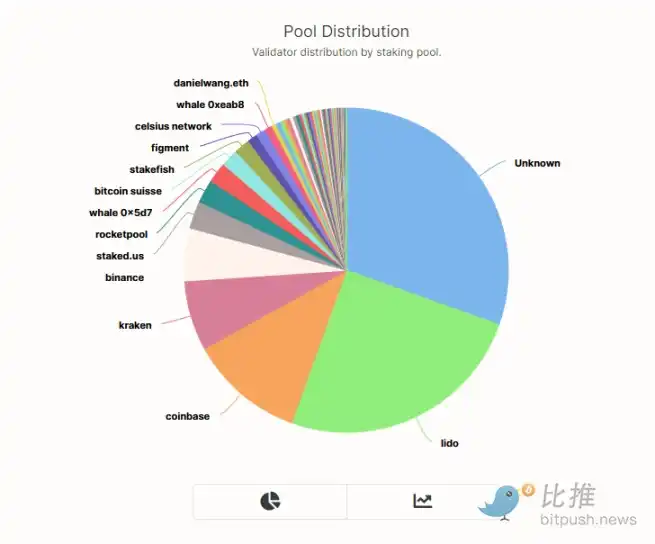
With Ethereum poised for a major post-merger upgrade, DeFiLlama's total Lido lock-up value (TVL) has surged 33% in the last month. . Currently, Lido's TVL stands at $8.56 billion. Chain data show that Lido in the pledge pool market share of 25%. Coinbase accounted for 11.5 percent. . Even as competitors like Kraken and Binance have entered the circuit, Coinbase remains the second largest stakeholder in Ethereum collateral.
As a decentralized agreement, Lido is unlikely to be subject to securities rules like Coinbase, a centralized entity incorporated in the United States. If the SEC does succeed in banning pledge schemes, it would be a boon for decentralized alternatives such as Lido, allowing them to snatch up the market held by Coinbase and other U.S.-registered trading platforms.
Henry Elder, head of decentralized finance at Wave Financial, said Kraken's case was "a huge gift to decentralized pledge providers like Lido, RocketPool and StakeWise, which are harder for regulators to control".
What does the industry think?
Whether the SEC will block all future crypto pledges remains unknown.
Hester Peirce, the SEC's commissioner and "crypto mom," denounced the agency's practices. She wrote: "When the SEC shut down Kraken's pledge program and cast it as a win for investors, I disagree...... that a paternalistic and lazy regulator has resorted to yet another familiar settlement solution: Without initiating a public process to develop a viable registration process that provides investors with valuable information, simply ordering it to close...... it is unclear whether we need a unified regulatory solution, and whether that regulatory solution is best provided in the form of enforcement action by regulators hostile to encryption ".
According to Jake Chervinsky, chief policy officer at Blockchain Association: The decision was that it was better to throw money at the problem than to rip it off, period. The SEC considers pledge as a service to be a security. Kraken neither confirms nor denies that. This could be a tough question, and one that the SEC has not answered in any way today... I strongly agree with Brian Armstrong that attacking pledge would be an extreme mistake in U.S. policy. Thankfully, we are a nation of laws, and even if the SEC wanted to ban cryptocurrencies completely (and I'm just saying it's a possibility), the laws and courts wouldn't allow it."
Daniel Kuhn, deputy managing editor at Coindesk, thinks the SEC may be right - incentiveing people to pay to protect encrypted networks - and does meet the Howey test for determining whether an asset is a security, but it shouldn't be up to the SEC alone to decide. It's also worth noting that, unlike "crypto lending," a pledge requires a trading platform, such as the Gemini "Earn" platform, to seek revenue to pay the depositor. Pledge has its risks -- protocols can be hacked, companies can cheat -- but it's part of an open-source process that's built into blockchain security, making it far less risky than remortgaged-driven gain schemes, and crypto pledge products on U.S. trading platforms aren't exactly comparable to crypto lending, And it is not clear that the SEC should unilaterally cut off retail access simply because pledges generate income.
Marcus Sotiriou, market analyst at digital asset broker GlobalBlock, commented: "Clearly, from a US perspective, this would be a huge mistake as it would lead to the rest of the world taking the lead in the important crypto and blockchain technology revolution".
Chris Burniske, a Placeholder partner at Placeholder, tweeted: "What Gary didn't expect is that cryptocurrency pledges will be global, decentralized and offshore, and his interventions will have less and less say in the matter."
Crypto analyst David Canellis argues that modern licenseless blockchain systems are built to allow ordinary people to participate in the consensus - without greedy intermediaries - and to be richly rewarded for doing so, and that the SEC crackdown on pledging as a service should not be seen as an attack on cryptocurrencies, Because directly pledging via blockchain is completely unaffected.
Original link
Welcome to join the official BlockBeats community:
Telegram Subscription Group: https://t.me/theblockbeats
Telegram Discussion Group: https://t.me/BlockBeats_App
Official Twitter Account: https://twitter.com/BlockBeatsAsia

 Related Articles