Deciphers Arbitrum's Big Move: Can Stylus, a new programming environment, surpass EVM?
Original Title: Interpreting Arbitrum's Big Move: Can Stylus, a new programming environment, surpass EVM?
Original article by Offchain Labs
原文编译: Moni,Odaily 星球日报
Feb. 7 (Arbitrum ) Development team Offchain Labs has announced that Stylus, a next-generation programming environment for Arbitrum One and Arbitrum Nova, will be available later this year. Stylus via WebAssembly Smart contract features that allow developers to deploy applications in their comfortable programming languages, including Rust, C, and C++, to run with EVM programs on Arbitrum.
More importantly, Offchain Labs says Stylus is an order of magnitude faster, cost-cutting and fully interoperable with the Ethereum virtual machine, even calling it an upgraded version of the Ethereum virtual machine "EVM+." Can Stylus really beat EVM? Let's take a look at the Odaily Planet.
Stylus: Beyond EVM Equivalence
With the launch of Mainnet in August 2021, Arbitrum One became the only EVM equivalent Rollup with a valid fraud proof, meaning that past can be found in Layer 1 All the things you do on the Internet are now available on the Internet. Layer 2 It is done safely, faster and cheaper. EVM equivalence is any generic. The technology required also makes it possible for the decentralized application and protocol ecosystem on Arbitrum One and Arbitrum Nova to be more vibrant.
However, achieving equivalence with EVM is not Arbitrum's ultimate goal, but the starting point. The Arbitrum technology remained equivalent to the EVM from the start, but it soon became clear that it could do much more. Therefore Arbitrum gives a "paradigm definition" and calls it "EVM+". The launch of Stylus is undoubtedly the first step in building this vision, and a brand new stage in Arbitrum's development - the universal programming environment and WASM virtual machine.
For users with Stylus, it's easy to deploy programs written in popular programming languages -- Rust, C, C++, etc. -- to Arbitrum One and Arbitrum Nova, as well as work with the Stylus. Arbitrum blockchain on existing Solidity dApp parallel.
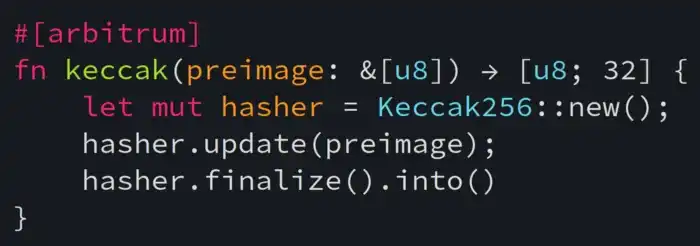
Above: A program written by Rust Voice
From game development to social media, in the transition to Web3, Stylus makes it easy to scale things up. Developers can build on Arbitrum without even knowing Solidity programming language principles, or use tools they already know and love. Regardless of the coding preferences of these tools.
For experienced Web3 developers, there is no longer a need to choose between Ethereum and other Layer 1. Whether seeking a one-to-one experience with Tai Fang traditional Solidity DeFi Arbitrum can be one of the best choices for applications, or for the next generation Zk Rollup in Rust to verify proof of zero knowledge.
This is because programs written in different languages can be combined seamlessly, the contract never has to know what language another person is using, and the user still less -- so everything speaks in the product.
Faster Dapp, lower cost
Stylus not only expands the way people write decentralized programs, it optimizes performance and makes programs faster. Arbitrum has seen a 10-fold increase in performance with last year's Nitro upgrade. With Stylus, performance will be further improved. Stylus is almost an order of magnitude faster than Arbitrum's decentralized app, written in languages such as Rust, or programs developed using Solidity and Vyper.
Stylus It can also significantly reduce the processing fee and open up a new era of high computing power application of blockchain in a wide range of fields. When combined with Arbitrum Nova's data savings, decentralized games built on Stylus will be well supported, DeFi, DAO And other encryption use cases will enjoy efficient service on Arbitrum One because Stylus is fully integrated into both Arbitrum One and Arbitrum Nova blockchains.
Low-cost computing provides developers with tremendous programming freedom, which is why the Ethereum community has been working to speed up EVM. It involves:
1. Occasionally add special smart contracts, called precompilation;
2. It can effectively perform specific tasks such as calculating hashes.
With Stylus, users will be able to create their own precompilations:
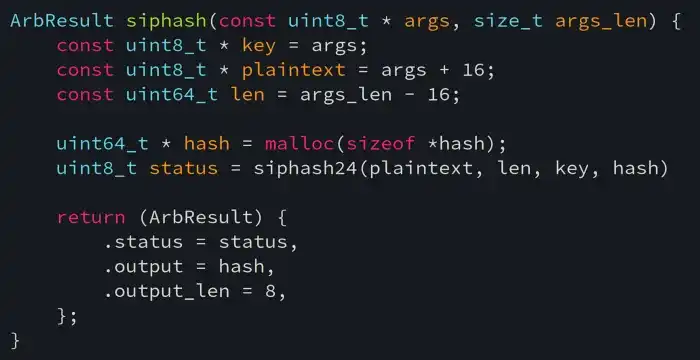
AC precompilation
If a zero-knowledge proof team needs to build an entirely new matching curve, or an alt-Layer 1 bridge requires an unusual hashing algorithm, they can simply deploy the crypto library as custom precompiled. Any cryptosystem, any reference implementation, as if it were a native SHA of EVM; 2 , Layer 3 And even machine learning applications can benefit.
The AC precompile capability of Stylus will be valuable to Ethereum researchers, as they will be able to use Stylus to design and iterate EIP precompilations without having to build their own test net, and I'm sure EVM will be happy to see Arbitrum play a key role in its evolution. Many of Arbitrum's set breakthroughs are also in line with eWASM, a Layer 1 initiative to add WASM to EVM.
How to run
In August 2022, the Nitro upgrade changed Layer 2. .
The Arbitrum verifier starts running Geth, Ethereum's most popular execution client, and verifies the fraud in WebAssembly. For the first time ever, Layer 2 was able to run at the speed of the native blockchain, with the occasional switch to slower WASM, perhaps just to prove that it was time to defeat a potential attacker (something you rarely see after a merger).
Stylus is the next step in Arbitrum's natural evolution. With Nitro, Arbitrum's fraud proof can perform trusted WASM, and the verifier must agree that Geth is an honest program and that its behavior is appropriate. While this is a sufficient basis for license-free EVM networks, which is what Ethereum and all Geth-based Layer 2 are currently doing, achieving scale requires the next step: proving fraud against untrusted WASM.
In the Stylus model, users compile their programs into WASM, then convert them down the chain to a format that is executable constrained and safely enforced. With the WASM sandbox, Arbitrum can run user programs at nearly the same speed as native blockchain, and with the same security guarantees that Web browsers rely on to render web pages, malicious programs will be terminated in a way that "can be proven on the chain without invoking EVMs."
When the EVM contract is invoked by the transaction, Geth executes and returns the result. If the EVM contract happens to make a child call to the WASM program, the Stylus steps in and evaluates that part of the result.
Evms still exist and will be exactly the same as before. The Stylus will not replace the EVM, but enhance it.
Everything Arbitrum does is fully extensible, and that is why Stylus is called "EVM+".
Original link
Welcome to join the official BlockBeats community:
Telegram Subscription Group: https://t.me/theblockbeats
Telegram Discussion Group: https://t.me/BlockBeats_App
Official Twitter Account: https://twitter.com/BlockBeatsAsia

 Related Articles