Interpreting BNBchain Greenfield: A sea of stars for Web3 data storage
Web3 Data Storage: A Sea of Stars -- A Deep Interpretation of Greenfield White Paper
原文作者: sukie.eth
Data is the "oil" of the future world, and it is a valuable asset for any country and individual. The data storage service, on the other hand, is an oil barrel floating on the sea, which must be secure enough to carry users' valuable data. Now, data leaks happen frequently, which means that our data and privacy are like oil leaking from sea water, which is constantly threatened by the black market for resale, and once this leakage occurs, it is irreversible.
Stories of decentralized storage have been told, starting with veteran Storj, Filcoin, the first IPFS incentive layer, and Arweave, a permanent storage solution for NFT creators. Ceramic dynamic storage opens new prospects for on-chain social networking and data retrieval scenarios. Pinata uses IPFS to store NFT on-chain and EthStorage serves as Layer2...... for EVM public chain storage What new story does Greenfield, proposed by BNB Chain, have to tell to fill in the puzzle of decentralized storage?
After reading Greenfield's white paper, I think the author is very clear about the web3 storage circuit and its advantages and disadvantages. First, Greenfield defines itself as a side Chain of the BNB Chain, rather than making a new public chain and issuing a new Token.
这样做一是能直接承接 BNB Chain 广大的流量和区块链数据,不需要像 Filcoin 和 Arwave 那样依靠 Token 激励完成早期网络启动。二是能作为 BNB Chain 的拓展,将原本外包出去的存储产业,纳为自家的田地,为 BNB 提供更多的赋能。下面来聊一聊 Greenfield 的用例:
Personal Cloud Storage
This function is to store some personal data, you can store some photos, videos and so on. Compared with web2 Ali Cloud AWS, it is more censor-resistant. Compared to web3Fil AR, it has a lower threshold. It should be added here why IPFS is more privacy and censorship resistant than Web2 cloud storage services.
In fact, after our data is stored in the centralized cloud service platform, our data security can only rely on the trust of this centralized platform. Our data is stored in several large centralized server rooms. The Tianjin fire almost made wechat users' data disappear overnight. The outage of Ali Cloud some time ago also proves that centralized cloud storage looks powerful but does not have anti-vulnerability.
IPFS, on the other hand, divides the user's data into fragments. A piece of user's data will be scattered and stored in different miners, and the same data will be copied to multiple miners. No machine can independently grasp the complete data, one miner's data fragment is lost, and other miners still have storage backup. Maximize the protection of user data privacy, as well as data security.
Therefore, decentralized data storage does not mean the disclosure of data, which is different from traditional blockchain technology.
Hosting and Deploying Websites
This is a developer feature that gives Web3 developers a new option for building a decentralized front end.
For example: Uniswap is a decentralized product, but its front end is still on a centralized server. The regulatory iron Fist can't stop Ethereum, but it can prevent people from accessing its front end, which is why we need a decentralized front end.
Another example is the recent fire of Nostr, which is deployed as a decentralized front end on Flux's Cloud, becoming a truly decentralized social network.
Of course for Greenfield, this decentralization is relative decentralization, and we'll see why.
New Social Media Model
I think this is because BNB Chain wants to make its own socialfi product, but relevant information has not been disclosed yet.
Roughly guess, socialfi needs three main functions for communication and socializing: one is a p2p communication tool that can protect users' privacy; the other is to confirm the rights of personal data (NFT, domain name, post, social graph, etc.); and the third is to build a decentralized trading market where the personal data mentioned in the second point can be bought and sold.
socialfi starts with storage, which reflects Binance's far-reaching thinking.
Storing Terabytes of Data from BNB Smart Chain and L2 Rollup Transactions
It is also known that the single blockchain ensures decentralization and the data is true and immutable by replay, that is, the data is repeatedly verified by all nodes, and this results in a lot of miscellaneous data.
Therefore, non-core data such as video and image front-end mentioned above need not be attached to the Decentralized Storage Network. The amount of data that a blockchain runs on, such as transaction, although not much, will also limit the scalability of the blockchain's performance.
There are two solutions. One is to improve hardware quality, such as increasing memory capacity and computing speed, so that a single node can calculate and store more tx, thus improving the capacity and computing speed of the whole node.
But once the hardware performance requirements increase and there is no way to mine with consumer grade hardware, such as Gpus, as soon as the hardware threshold is raised, the problem of centralization arises. This is when the miner begins to exulted. There is no better business than selling shovels.
Different from mining with graphics card mining and mining with personal idle storage resources, if there is not enough economic incentive, miners calculate the cost of hardware and power, the imbalance of profit and loss will stop the operation node, resulting in the shutdown of blockchain. If there is no real income to support the incentive of miners, Then for the user data on the chain, when the miners stop mining, it's a devastating blow.
And from the perspective of economic models, this event is the reverse flywheel, the market situation deteriorates, the miners sell, the more they lock up, the probability that the price of this project will rise again is very small.
If there is too much incentive, there is also too much inflation. Again, if there is no real agreed income, miners will not be able to obtain a sustained income, and the same result will be caused by endless smashing.
Obviously, the less hardware a storage public chain requires, the more nodes it has, the more dispersed it is, and the more decentralized the project becomes. The lowest threshold is to use centralized cloud servers without mining machines. I have even heard of cases where I built my own servers and used e-waste geographic arbitrage in some third countries. But in any case, lowering the bar for storage performance is a growing trend, right
Greenfile says that from extreme decentralization (personal terminal hardware mining) and decentralization (buying services like AWS), it will move toward extreme decentralization, which is currently in the middle ground.
Admittedly not decentralized enough, but at least miners, also known as storage providers (SPS), have the freedom to choose between using AWS or Aliyun.
In addition to improving the quality of the whole node, the second way to solve data redundancy is to use Rollup for off-chain storage and data processing. The key here is rollup's sequencer. Rather than increase the cost to improve the performance of the whole node, it is better to take a roundabout approach, which only increases the cost of the sequencer. Nor will it affect the decentralization of blockchain.
But the question is how do you convince people that rollup's sequencer is decentralized and trustworthy?
This is where data availability (DA) and data availability sampling (DAS) come in, and I'll do a thread on that.
In summary, Greenfield uses a set of verifiers' financial incentives and forfeiture to solve the problem of data availability through data shard random access sampling.
That is to say, Greenfield also hopes to do BNB Chain and other L2 DA.
There's a very interesting point here.
BNB Chain is EVM Compatible and works seamlessly across chains with BSC, which also means it is fully compatible with Ethereum.
Current Filcoin and Arweave don't interoperate well with smart contracts,
@EthStorage is the best Chain on EVM Compatible. After all, it is the project that claims to do Ethereum storage L2. If Greenfield is going to do BNB Chain and Ethereum storage, then at least it is not the only one in this space. But I actually think Ethereum could have done one of these things themselves and separated the DA.
Let's talk about two of the most important roles in decentralized storage: SP and validator.
The SP Storage Provider is the miner, a role that also exists in Filcoin.
Greenfield's mining mode is the same as Filcoin's. SP mines by pledging BNB, and Filcoin's upgrade function, Fil Plus, verifies the authenticity and availability of data through validators. Miners who mine valid data make money, while miners who make redundant data lose money.
Refer to the following: https://docs.filecoin.io/store/filecoin-plus/overview/
Another thing to look forward to is BNB lending.
矿工需要质押 BNB 挖矿,但是这种质押一般都是论年起步的,而退出质押则会受到非常严重的罚没,这会极大降低 BNB 的流通率。但是很多矿工是无法自己购买这么多 Token 进行挖矿的,那么可以选择将自己未来的收益进行质押挖矿,也可以选择将其他 Token 进行质押借贷,也是一种加杠杆的行为。
Just from the single economic model of storage we can see BNB
demand-side
1. SP- Pledge mining
2. Costumer-pay data storage
3. Investor-BNB acts as a store of value and can be lent to SP, earning interest
Supply side
BNB 的发行,包括投资人解锁、BNB Chain 和 Greenfield 的挖矿激励,币安发工资等等,具体要去看 Token 分配。
Eip1559burnt BNB is migrated to the BNB Chain.
At present, the Greenfield chain does not have EIP1559. If, like FVM, user access and other operations are burnBNB, this destruction mechanism will increase fomo.
These are all stars in the Filcoin blueprint, including FVM, online lending, owning Dapps, etc. Filcoin wants to do storage first and then smart contracts. BNBCHAIN, on the other hand, has smart contracts and applications first, and then storage. This experiment will also answer the chicken-and-egg question of whether our storage and applications come first.
Now, why does it take credit to store public chains? That's why I just explained supply and demand.
The storage public chain is most afraid of the death spiral, but the centralized storage can adjust the public price according to the hardware and energy prices, but the blockchain can only stop the operation of extreme market conditions miners strike. That's a huge blow to user data.
So in the relationship between the public chain and the miners, neither can we let the miners make money, nor can we let the miners make too much money.
The interest rate on borrowing is this regulatory mechanism.
Again, there's a question of whether the payment for storage is on the coin standard or the u standard.
If the storage cost is too high, users will choose another DSN or go directly to AWS.
Both user storage cost and miner mining cost are denominated in fiat currency, which is a kind of psychological valuation.
但质押和挖矿激励只能是币本位。 Token 对法币计价汇率,也影响着项目的基本盘。
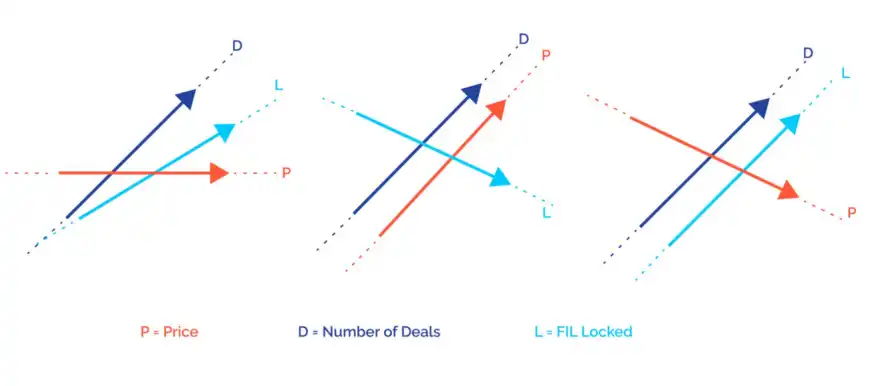
以 FIL 为例,当 FIL 价格下跌时,SP 存储一个等值美元价格的存储合约所需要的 FIL 越多,锁定的 Token 越多,供给端减少。
Miners' demand for FIL increases, the interest on FIL in the lending market increases, Investor demand also increases, so the demand side increases.
Token 价格也会上涨。
Instead, prices go up, miners demand less, interest rates go down, prices go down.
So that the price is stable and controllable.
Someone asked me how much impact Greenfield's launch would have on BNB. Greenfield hasn't published an economic model yet, but it's certainly possible to do a mathematical model assuming the effect of the amount of BNB in circulation on prices under various scenarios.
But math can't calculate the heart, just like I can never calculate the dear Chinese richest man, time management master CZ boss is planning to pull down BNB next? Had to silently order a few BNB, pray this time not to tread empty.
(Just kidding, the math is really hard.)
The views expressed are the author's own and are not investment advice.
本文作者twitter :https://twitter.com/sukie234/status/1621218548189384705?s=20
Welcome to join the official BlockBeats community:
Telegram Subscription Group: https://t.me/theblockbeats
Telegram Discussion Group: https://t.me/BlockBeats_App
Official Twitter Account: https://twitter.com/BlockBeatsAsia

 Related Articles