Bitwise Investor Letter: 10 Things to Watch in 2023

Original Source: Bitwise Chief Investment Officer Matt Hougan
Original Translation: Bitpush News Translator Mary Liu
Dear Investors, what will we witness in 2023?
This is the question on every cryptocurrency investor's mind.
As 2022 finally fades into the rearview mirror—a year of price crashes, a string of bankruptcies, and epic fraud—investors are asking: Can cryptocurrency stage a comeback? Will we see a crypto spring or a crypto winter?
Over the past few days, the Bitwise team has gathered to discuss. We present the following findings: our top 10 predictions for what will happen in 2023 (plus one big bonus prediction)!
Please note: Like all predictions, these are not guarantees; they represent our best estimates of what we expect to see. The future is complex and ever-changing, and whether these futures will unfold as written will depend on many complex factors, and this is not investment advice.
Prediction #1: Crypto Market Recovery Will Take a ‘U Shape’ Rather Than a ‘V Shape’.
Historically, cryptocurrency has moved in four-year cycles, three years up, one year down. 2022 was a perfect fit for this pattern.
Bitcoin annual returns since 2011
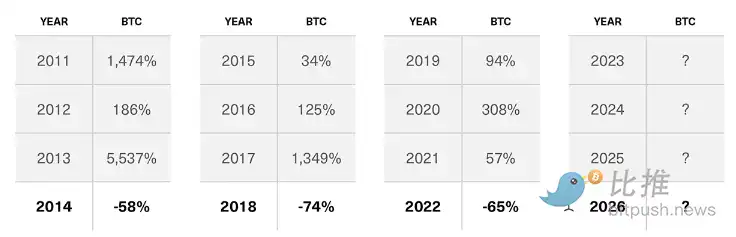
Data Source: Bitwise Asset Management. Data from January 1, 2011, to December 31, 2022, for reference only. Returns reflect Bitcoin’s own performance, not that of any fund or account, and do not include any fees. Past performance is not indicative of future results for any investment strategy. Future cryptocurrency cycles may not necessarily be four years long; the four-year increment is based on historical data for illustrative purposes and is not a prediction of future results. This material represents an assessment of the market environment at a specific time and is not a prediction of future events or a guarantee of future results.
In our view, as we enter 2023, cryptocurrency is poised for a recovery. The advancement of blockchain technologies such as Ethereum's Merge, scaling progress like Layer 2 solutions, and the emergence of new applications give us optimism. Ethereum
However, recovery won't be easy. The rampant fraud within FTX and a broader cryptocurrency credit crisis have cast a long shadow over the industry. Regulatory agencies loom, banking relationships fracture, and investors remain skeptical. Additionally, new risks—such as the planned release later this year of 127,000 bitcoins from the Mt. Gox settlement and challenges in the Bitcoin mining sector—are emerging.
We anticipate the market will consolidate for some time before entering the next bullish phase. Another cryptocurrency company closure, a token plunge, or regulatory action could trigger another wave of decline, with significant risks present.
Nevertheless, we believe cryptocurrency will ultimately recover. Historically, cryptocurrency has rebounded from every major pullback. We see no reason why this time would be different.
In fact, we believe the next bull market in the cryptocurrency space will be the largest to date—setting new all-time highs and ushering in a wave of new applications driving mainstream adoption.
Prediction #2: The initial promise of (truly) free and (extremely) fast cryptocurrency transactions will finally become a reality in 2023.
When cryptocurrency emerged suddenly in 2009, it promised an extremely fast and essentially free transaction world.
crypto stated that the traditional financial ecosystem is slow and corrupt. We have a better way.
But if we're being honest, the vision hasn't fully materialized.
Yes, you can send $1 billion anywhere in the world through the Bitcoin network 24/7/365. But it will cost you $1-2 and take 10-60 minutes. This might be better than your local bank, but $1 is not free, and 10 minutes is not fast in the digital age.
Ethereum is no better off: at the peak of the last bull market, the cost of a simple transaction on Ethereum reached as high as $200. $200!
No mainstream blockchain has fully delivered on its initial core promise. So, you can forgive the skeptics' laughter.
However, by 2023, the rise of Layer 2 solutions and planned upgrades to the Ethereum blockchain (referred to as EIP 4844) should see Ethereum's average transaction cost reduced by over 1,000%. The outcome: transaction costs will reliably fall below 1/10 of a cent and quite likely far below that.
The impact is massive. Suddenly, microtransactions may actually be viable. Suddenly, the crypto network is indeed 10 times better than Visa. Suddenly, non-financial transactions—like gaming, social networks, and other solutions—are beginning to come into effect.
(What does that last point mean? Well, for example: people have been clamoring for a decentralized version of Twitter for years. But you won't be paying $200 for every tweet. Instead, you might pay $0.0007 if it means a more secure, equitable, and just network, which could also reduce spam. We've seen this concept taking off on platforms like Farcaster and Lens and will dramatically accelerate in 2023.)
The market has not yet grasped the significance of this development. Hardly anyone is talking about it. But it will reshape cryptocurrency in 2023 and then reshape the world in the years to come.
Forecast #3: Coinbase's market cap will grow by 100% compared to the end of 2022.
In 2022, Coinbase's stock price fell by 86%, making it one of the worst-performing large-cap stocks globally. The business's market cap shrank by $47 billion, with a year-end value of around $9 billion. As a point of reference, the company raised funds in 2018 at an $8 billion valuation, meaning it essentially gained no value over the entire period.
However, from a fundamental perspective, Coinbase looks like a giant. From 2018 to 2022, revenue grew 7x, from $520 million to $3.3 billion, users grew nearly 5x, from 22 million to 101 million, and platform assets grew almost 10x, reaching $101 billion.
In short, the market just hasn't recognized Coinbase's fundamentals.
Today, Coinbase is the most well-known and trusted brand in the crypto space, with the largest installed user base in the U.S. It's run by an accomplished, focused CEO and has weathered multiple bull and bear markets. We believe it will not only navigate this space but also be well-placed for a crypto recovery.
But don't just take our word for it: As of January 8, 2023, the average target price from 26 sell-side analysts covering the company is $71.19, roughly double the recent trading price.
Forecast 4: Following the "Shanghai Upgrade" (allowing finality of staked ETH withdrawals), the amount of staked ETH will increase by 50% or more.
In September of last year, the Ethereum blockchain transitioned its consensus mechanism from proof of work to proof of stake. As of January 5, 2023, there was $21 billion worth of ETH staked on the network, approximately 14% of the total supply.
The staked ETH currently cannot be "unstaked"; the transition to proof of stake is intricate, and a way the Ethereum network controls risk is by not allowing users to withdraw their staked ETH.
However, at some point in 2023, the Ethereum blockchain will undergo what's known as the "Shanghai Upgrade," which among other things, will allow for the withdrawal of staked ETH.
Some market commentators worry this will trigger a massive sell-off as investors (some of whom staked ETH as far back as December 2020) rush to unstake and sell. However, that claim misses the mark.
In the short term, a massive sell-off is simply implausible: The Shanghai Upgrade will cap the amount of ETH that can be unstaked at any given time to mitigate any sell pressure.
More importantly, in the long run, this pessimistic view misreads market dynamics. We believe that allowing investors to unbond their ETH will lead to more, not less, ETH being staked.
The reason is as follows: Today, many investors who want to stake ETH and earn rewards are watching from the sidelines. After all, most investment strategies cannot tolerate indefinite lockups. Therefore, most investors stay away from the market. But once the indefinite lockup is removed, the percentage of investors willing to stake their ETH will skyrocket.
That's why we expect that by the end of the year, the total staked ETH will increase by at least 50%.
Forecast 5: ETH will undergo deflation in 2023, with the total circulating supply decreasing by at least 1%.
Ethereum's shift from proof of work to proof of stake in September of last year significantly reduced the daily issuance of new ETH on the blockchain. The reason is simple: proof of stake is more efficient than proof of work.
When the lower issuance is combined with the fact that ETH is burned (permanently removed from circulation) as people interact with the network, theoretically, the net supply of ETH will decrease.
We believe that 2023 will be the year for this to occur.
Before transitioning to proof of stake, ETH's circulating supply was growing at an annualized rate of about 2.5%. However, since the transition, the net issuance has remained nearly flat, with the supply growing at only a 0.011% rate annually.
We anticipate that the demand for accessing and using Ethereum applications will significantly increase in 2023 compared to 2022, which will increase the amount of ETH consumed through transactions. As a result, the total ETH supply in circulation will decrease by 1% or more, significantly impacting investors.
Forecast 6: The correlation between cryptocurrency and the stock market will sharply decrease to below 0.5 (and possibly to 0.25).
A common criticism of cryptocurrency's performance over the past two years is its high correlation with the stock market. Cryptocurrency surged during the bull market following the emergence of Covid in March 2020 and peaked as the stock market began to decline at the end of 2021.
Critics argue that cryptocurrency should be an uncorrelated asset.
They have a point. As shown in the table below, the correlation between Bitcoin and the S&P 500 Index spiked in early 2020 and has never stabilized. (The chart depicts the 90-day rolling correlation between these two assets since Bitcoin trading began.)
Bitcoin Correlation with S&P 500 Index Approaching Historic High
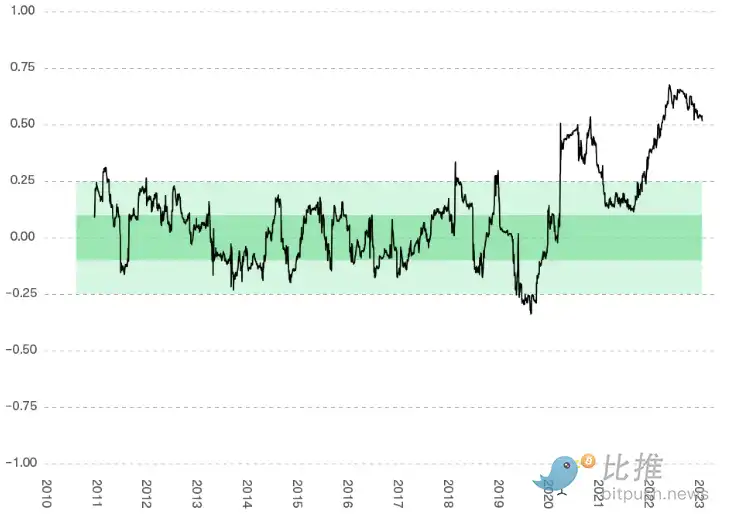
Data Source: Bitwise Asset Management, data from IEXCloud, as of December 31, 2022. Note: This chart shows a 90-day rolling correlation. The S&P 500 Index is represented by the SPDR S&P 500 ETF Trust (SPY).
We anticipate this metric to revert closer to its historical average in 2023, with the correlation dropping below 0.5 (and potentially below 0.25).
The correlation between cryptocurrency and stocks surged in 2020 as macro factors became the dominant force propelling all asset classes. Stocks, bonds, commodities, cryptocurrencies: what mattered was what Fed Chair Powell did with rates.
Macro factors remain crucial in 2023 as we grapple with an impending economic downturn and ongoing geopolitical turmoil. However, the market has now priced in the Fed's tightening cycle, and the relative strength of macro signals will diminish year by year.
This means that crypto returns will be more driven by crypto-native factors—technological, regulatory, and other developments—that are typically unrelated to the stock market.
The high correlation between cryptocurrency and stocks is a rare phenomenon. We expect this situation to start normalizing in 2023.
Prediction 7: At least one significant crypto legislation will pass through the U.S. Congress in 2023.
The aftermath of FTX has placed cryptocurrency at the forefront and center of the Washington agenda. But even before the FTX collapse, Congress was gearing up for multiple legislative measures, including driving stablecoin regulation and determining which agency should oversee cryptocurrency (CFTC vs. SEC).
With crypto-friendly Congressman Pat McHenry (R-NC) leading the House Financial Services Committee, it is expected that Washington will pass at least one significant crypto regulation in 2023.
In terms of its value, our speculation is that this legislation will be a mixed bag, with some parts being welcomed by the industry and other parts being concerning to it. However, overall, increasing regulatory transparency will benefit the space.
Prediction 8: USDC will surpass USDT (Tether) to become the world's largest stablecoin.
Stablecoins are one of the killer applications of cryptocurrency, with over $130 billion in stablecoin assets under management. However, the vast majority of this is concentrated in two names: the $66 billion Tether (USDT) and the $44 billion USD Coin (USDC).
These two assets represent two different aspects of the crypto community.
Tether is a largely unregulated stablecoin that relies on opaque proof and a longstanding record to convince investors it holds enough collateral to back the assets. It is primarily used by offshore exchanges and entities outside the US.
On the other hand, USDC is issued by a US-regulated entity created by Circle and Coinbase. It positions itself as the most regulated, transparent, and secure stablecoin.
We believe a defining theme of 2023 will be investors opting for transparency and robust regulation over alternatives. This means more funds flowing into USDC. It will be at the top by the end of the year.
Prediction 9: A cryptocurrency unicorn – a company that previously raised funds at a valuation of $1 billion+ – will go bankrupt this year.
FTX, BlockFi, Voyager, Celsius... In 2022, many former unicorn companies were forced into bankruptcy, consumed by scandals, mismanagement, and the cryptocurrency credit crisis.
We believe this is not over yet – in 2023, at least one cryptocurrency unicorn will go bankrupt (possibly more).
Prediction 10: Uniswap's trading volume will surpass Coinbase's in the fourth quarter of 2023.
As investors lose confidence in centralized exchanges and become familiar with decentralized alternatives, the market share of decentralized exchanges grew in 2022. We expect this trend to accelerate in 2023. In fact, we believe Uniswap's total trading volume will surpass Coinbase (the largest exchange in the US) in the fourth quarter of 2023.
Don't be too surprised: In November 2022, Uniswap's settlement volume actually exceeded Coinbase's as investors fled centralized exchanges post-FTX. However, as the market stabilized, this ratio dropped back in December.
We believe it will sustainably flip in Q4 2023, with Uniswap surpassing Coinbase and potentially never looking back.
The future is decentralized. Uniswap has already made it.
Additional prediction: A key new narrative for cryptocurrency in 2023 will be: "Cryptocurrency is the tech giants' solution."
Tech giants are unpopular now.
Meta/Twitter/Apple: These are among the most disliked companies in the world today; they are too big, too profitable, and have too long a reach.
Most importantly, they effectively wield monopoly power, the network effects of their businesses are exceptionally strong, and users are "captured" by them. If you have 50,000 followers on Twitter, you can't leave for another social platform; if you talk to all your friends and relatives on Facebook, you can't leave to use another app.
This absolute control encourages private monopoly abuse of users. Their decisions are for corporate profit, not for users' or public interests. Users have no choice but to accept; the switching costs are too high.
The good news? Crypto solves this problem.
Blockchain technology allows for the creation of public networks that benefit users, not companies.
For example, Ethereum can be seen as the first public computer: an operating system accessible to all but controlled by none. No individual, company, or even a country can change how this computer works. Yet everyone can build applications on it, and users and their data are not captured by any entity owned by a single company.
This is more akin to how the underlying internet operates, rather than how Facebook operates, with the openness and robust architecture of the internet enabling a million entrepreneurs to build new applications because they know the underlying foundation will not change; cryptocurrency and blockchain can also restore openness to other networks.
The crypto evangelist will champion this narrative in Washington and the media, needing a new story, a reason that will make skeptics get behind it rather than dismiss it as a scam or conspiracy.
It will strike a chord, with op-eds, congressional testimonies, and generous support from both left- and right-wing leaders.
Blockchain is the tech giant's panacea, which sounds great, and the even more wonderful part is that it happens to be true.
Original Article Link
Welcome to join the official BlockBeats community:
Telegram Subscription Group: https://t.me/theblockbeats
Telegram Discussion Group: https://t.me/BlockBeats_App
Official Twitter Account: https://twitter.com/BlockBeatsAsia